Global Polybutadiene Rubber Market Size, Share, and COVID-19 Impact Analysis, By Product (High Cis, Low Cis, High Trans, and High Vinyl), By Application (Tire Manufacturing, Polymer Modification, Industrial Rubber Manufacturing, and Others), By Distribution Channel (Online and Offline), and By Region (North America, Europe, Asia-Pacific, Latin America, Middle East, and Africa), Analysis and Forecast 2025 - 2035
Industry: Chemicals & Materials
Global Polybutadiene Rubber Market Size Insights Forecasts to 2035
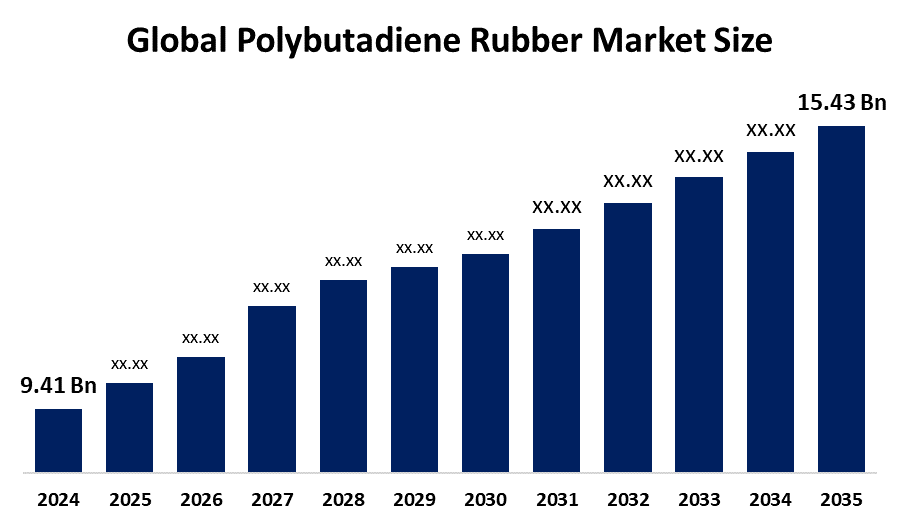
- The Global Polybutadiene Rubber Market Size Was Estimated at USD 9.41 Billion in 2024
- The Market Size is Expected to Grow at a CAGR of around 4.6% from 2025 to 2035
- The Worldwide Polybutadiene Rubber Market Size is Expected to Reach USD 15.43 Billion by 2035
- North America is expected to Grow the fastest during the forecast period.
Get more details on this report -
According to a Research Report Published by Spherical Insights and Consulting, The Global Polybutadiene Rubber Market Size was worth around USD 9.41 Billion in 2024 and is predicted to Grow to around USD 15.43 Billion by 2035 with a compound annual growth rate (CAGR) of 4.6% from 2025 to 2035. The polybutadiene rubber market is expanding because of rising demand for environmentally friendly high-performance tires which automotive manufacturers need for their electric vehicles, and because Asia-Pacific countries experience industrial growth and plastic modification with HIPS and ABS materials to achieve enhanced impact resistance and durability.
Market Overview
Polybutadiene rubber (PBR) is a synthetic elastomer produced from the polymerization of 1,3-butadiene, which is valued because it exhibits both high resilience and exceptional abrasion resistance. The material serves as the primary component in tyre manufacturing, together with its other applications in plastic modification and footwear and industrial products, accounting for 70% of worldwide consumption. The market expansion benefits from strong automotive industry demand, which drives worldwide motor vehicle production to nearly 93.9 million vehicles each year, while Asia-Pacific countries undergo rapid industrial development. The combination of increased infrastructure development and higher middle-class consumption patterns drives increased product usage.
The market presents new opportunities through the creation of bio-based PBR and new tire formulas designed specially for electric vehicles, which meet market demands for sustainable solutions and tighter environmental standards. The Tire Industry Association TIA achieved a historic achievement in July 2025 when Maryland established its first rubber-modified asphalt RMA system on Route 650 in Silver Spring. The pilot project demonstrates how recycled tires can be used to create sustainable roads that last longer, according to Delegate Kevin Hornberger and Asphalt Plus technical expert Red Clark.
Report Coverage
This research report categorizes the polybutadiene rubber market based on various segments and regions, forecasts revenue growth, and analyzes trends in each submarket. The report analyses the key growth drivers, opportunities, and challenges influencing the polybutadiene rubber market. Recent market developments and competitive strategies, such as expansion, type launch, development, partnership, merger, and acquisition, have been included to draw the competitive landscape in the market. The report strategically identifies and profiles the key market players and analyses their core competencies in each sub-segment of the polybutadiene rubber market.
Global Polybutadiene Rubber Market Report Coverage
| Report Coverage | Details |
|---|---|
| Base Year: | 2024 |
| Market Size in 2024 : | USD 9.41 Billion |
| Forecast Period: | 2025-2035 |
| Forecast Period CAGR 2025-2035 : | 4.6% |
| 2035 Value Projection: | USD 15.43 Billion |
| Historical Data for: | 2020-2023 |
| No. of Pages: | 164 |
| Tables, Charts & Figures: | 97 |
| Segments covered: | By Product, By Application and COVID-19 Impact Analysis |
| Companies covered:: | JSR Corporation, Sinopec, ARLANXEO, Versalis S.p.A., UBE Corporation, Synthos S.A., Kumho Petrochemical, Zeon Corporation, LG Chem Ltd., Evonik Industries AG, Kuraray Co. Ltd., Reliance Industries Limited, SIBUR International GmbH, ENEOS Materials Corporation, The Goodyear Tire & Rubber Company, and Others |
| Pitfalls & Challenges: | COVID-19 Empact, Challenge, Future, Growth, & Analysis |
Get more details on this report -
Driving Factors
The global polybutadiene rubber PBR market experiences strong growth because of rising automotive production, which creates demand for tires that require PBR materials. The worldwide automotive industry produced more than 92 million vehicles in 2023, which resulted in 3.8 million tons of PBR consumption for tire manufacturing because PBR provides high wear resistance and low rolling resistance. The 60% share of global PBR demand, which comes from the Asia Pacific, drives industrialization growth through increased vehicle production, manufacturing and infrastructure development. The market grows because of new sustainable and bio-based PBR alternatives and increased use of these materials for polymer modification and footwear, electronics and industrial products.
Restraining Factors
The global polybutadiene rubber market faces two main obstacles, which include fluctuating raw material costs for butadiene and stringent environmental regulations that restrict rubber production emissions. The market faces challenges because synthetic styrene-butadiene rubber and other elastomer alternatives create competition that reduces growth opportunities in important automotive and industrial markets.
Market Segmentation
The polybutadiene rubber market share is classified into product, application, and distribution channel.
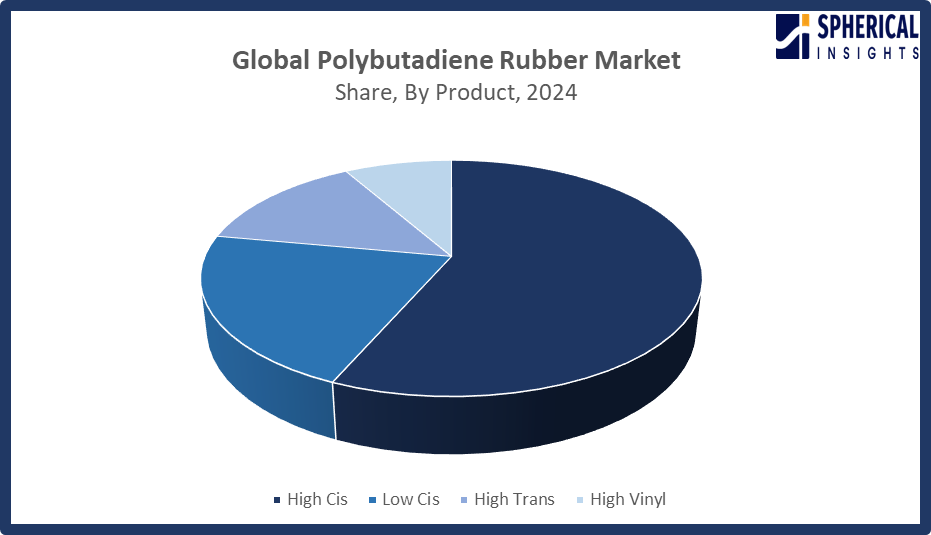
- The high cis segment dominated the market in 2024, approximately 57% and is projected to grow at a substantial CAGR during the forecast period.
Based on the product, the polybutadiene rubber market is divided into high cis, low cis, high trans, and high vinyl. Among these, the high cis segment dominated the market in 2024, approximately 57% and is projected to grow at a substantial CAGR during the forecast period. The high cis polybutadiene provides three benefits that make it suitable for tire manufacturing and automotive applications. The material replicates properties that make it suitable for use in tire production and automotive manufacturing. The material delivers advanced flexibility, which improves performance in both footwear and industrial applications because the automotive industry's growth and technological progress have created higher demand.
Get more details on this report -
- The tire manufacturing segment accounted for the largest share in 2024, approximately 72% and is anticipated to grow at a significant CAGR during the forecast period.
Based on the application, the polybutadiene rubber market is divided into tire manufacturing, polymer modification, industrial rubber manufacturing, and others. Among these, the tire manufacturing segment accounted for the largest share in 2024, approximately 72% and is anticipated to grow at a significant CAGR during the forecast period. Tire manufacturers use polybutadiene due to its high cis grades, which provide better wear resistance and lower rolling resistance, and increased product lifespan. The properties of this material enhance fuel efficiency while increasing the duration during which tires remain operational. The global demand for environmentally friendly high-performance vehicles drives increasing polybutylene usage in both passenger and commercial transportation systems throughout developing nations.
- The online segment accounted for the highest market revenue in 2024, approximately 81% and is anticipated to grow at a significant CAGR during the forecast period.
Based on the distribution channel, the polybutadiene rubber market is divided into online and offline. Among these, the online segment accounted for the highest market revenue in 2024, approximately 81% and is anticipated to grow at a significant CAGR during the forecast period. The online distribution channel is gaining importance as industrial buyers shift toward digital procurement. The system provides users with direct access to multiple suppliers while displaying product prices and detailed descriptions, which results in faster and cheaper procurement processes. The system enables users to compare products easily while reading reviews and making bulk purchases, which small manufacturers use to expand their business operations, especially in emerging market regions.
Regional Segment Analysis of the Polybutadiene Rubber Market
- North America (U.S., Canada, Mexico)
- Europe (Germany, France, U.K., Italy, Spain, Rest of Europe)
- Asia-Pacific (China, Japan, India, Rest of APAC)
- South America (Brazil and the Rest of South America)
- The Middle East and Africa (UAE, South Africa, Rest of MEA)
Asia Pacific is anticipated to hold the largest share of the polybutadiene rubber market over the predicted timeframe.

Get more details on this report -
Asia Pacific is anticipated to hold the largest share of the polybutadiene rubber market over the predicted timeframe. Asia-Pacific dominates the global polybutadiene rubber (PBR) market, capturing about 54% of total revenue in 2024, supported by strong automotive and tire manufacturing output. China produces over 30% of global tires, while India reported 8-10% vehicle production growth in 2024. Japan and South Korea strengthen demand through advanced synthetic rubber technologies and expanding EV tire production. Government support for green tires and petrochemical self-sufficiency continues to drive high-CIS PBR capacity expansion. In February 2026, China’s HCBR 9000 high-cis polybutadiene rubber price in North China declined to RMB 12,300/MT, down RMB 150 week-on-week and 14.64% year-on-year, reflecting weaker downstream tire demand and continued supply-side pressure in the regional synthetic rubber market.
North America is expected to grow at a rapid CAGR in the polybutadiene rubber market during the forecast period. North America is expected to witness strong growth in the polybutadiene rubber market, supported by rising tire replacement demand and expanding EV production. The United States, producing over 10 million vehicles in 2024, drives high-CIS PBR consumption for fuel-efficient tires. Sustainability initiatives, including rubber-modified asphalt projects and tire recycling programs, further strengthen demand. Canada contributes through infrastructure investments and increasing synthetic rubber imports. In September 2025, the U.S. Treasury and Internal Revenue Service added 39 substances, including acrylonitrile-butadiene rubber, to the Superfund excise tax list effective January 1, 2026.
Europe’s polybutadiene rubber market is expanding steadily, supported by sustainable tire innovation and rising EV adoption. Germany leads demand, producing over 4 million vehicles in 2024, driving high-CIS PBR consumption in premium tires. France and Italy further strengthen growth through circular-economy initiatives and recycled-content mandates, encouraging green rubber investments. In 2026, the EU’s Circular Economy Act will create a Single Market for secondary raw materials and harmonized End-of-Waste criteria, stimulating high-performance PBR demand and sustainable tire development.
Competitive Analysis:
The report offers the appropriate analysis of the key organizations/companies involved within the polybutadiene rubber market, along with a comparative evaluation primarily based on their type of offering, business overviews, geographic presence, enterprise strategies, segment market share, and SWOT analysis. The report also provides an elaborative analysis focusing on the current news and developments of the companies, which includes type development, innovations, joint ventures, partnerships, mergers & acquisitions, strategic alliances, and others. This allows for the evaluation of the overall competition within the market.
List of Key Companies
- JSR Corporation
- Sinopec
- ARLANXEO
- Versalis S.p.A.
- UBE Corporation
- Synthos S.A.
- Kumho Petrochemical
- Zeon Corporation
- LG Chem Ltd.
- Evonik Industries AG
- Kuraray Co. Ltd.
- Reliance Industries Limited
- SIBUR International GmbH
- ENEOS Materials Corporation
- The Goodyear Tire & Rubber Company
- Others
Key Target Audience
- Market Players
- Investors
- End-users
- Government Authorities
- Consulting and Research Firm
- Venture capitalists
- Value-Added Resellers (VARs)
Recent Development
- In January 2026, UBE Corporation certified two products under its U-BE-INFINITY brand: a biomass composite nylon under development and ISCC PLUS-certified polybutadiene manufactured by THAI SYNTHETIC RUBBERS COMPANY LIMITED. The initiative strengthens UBE’s commitment to advancing environmentally sustainable, value-added materials globally.
- In August 2025, Evonik Industries AG announced its Marl, Germany, polybutadiene site will run entirely on green electricity from July 1, 2025. The transition supports a 25% Scope 1 and 2 emissions reduction target by 2030. Two POLYVEST units now produce ISCC PLUS-certified eCO grades.
- In May 2025, Versalis inaugurated a new recycling-based plastics plant in Porto Marghera, Italy. The facility produces up to 20,000 tonnes annually of r-GPPS and r-EPS using mechanically recycled EPS waste, reinforcing the company’s circular economy strategy and supporting rising demand for sustainable plastic solutions across industries.
- In October 2021, Synthos SA partnered with Air Liquide Engineering and Construction to build a 120,000-tonne-per-year butadiene extraction unit in Plock, Poland, using BASF’s NMP technology. The project strengthens Synthos’ synthetic rubber supply for the tyre, construction, and packaging industries.
Market Segment
This study forecasts revenue at global, regional, and country levels from 2020 to 2035. Spherical Insights has segmented the polybutadiene rubber market based on the below-mentioned segments:
Global Polybutadiene Rubber Market, By Product
- High Cis
- Low Cis
- High Trans
- High Vinyl
Global Polybutadiene Rubber Market, By Application
- Tire Manufacturing
- Polymer Modification
- Industrial Rubber Manufacturing
Global Polybutadiene Rubber Market, By Distribution Channel
- Online
- Offline
Global Polybutadiene Rubber Market, By Regional Analysis
- North America
- US
- Canada
- Mexico
- Europe
- Germany
- UK
- France
- Italy
- Spain
- Russia
- Rest of Europe
- Asia Pacific
- China
- Japan
- India
- South Korea
- Australia
- Rest of Asia Pacific
- South America
- Brazil
- Argentina
- Rest of South America
- Middle East & Africa
- UAE
- Saudi Arabia
- Qatar
- South Africa
- Rest of the Middle East & Africa
Frequently Asked Questions (FAQ)
-
1. How is the growing automotive and tire industry driving global polybutadiene rubber demand?Rising automotive production, exceeding 93 million vehicles globally in 2023, boosts tire demand, which consumes nearly 70% of polybutadiene rubber output. Increasing EV sales, up over 30% annually, further accelerate high-cis PBR usage in fuel-efficient, durable tires.
-
2. What technological advancements are enhancing catalyst efficiency in high-cis polybutadiene production?Advanced neodymium and cobalt catalyst systems now achieve over 98% cis-1,4 content and improve polymerization efficiency by nearly 15%, reducing energy consumption by 10% and enhancing yield consistency in high-cis polybutadiene production.
-
3. How is high-cis PBR technology improving tire performance and fuel efficiency?High-cis PBR technology, with a cis content of at least 95%, significantly reduces rolling resistance by minimizing internal friction. This lower rolling resistance directly translates to improved fuel economy, as less energy is lost as heat during tire rotation, enhancing overall vehicle efficiency.
-
4. What emerging applications for PBR are gaining traction in the footwear and industrial goods sectors?Growing footwear output, exceeding 24 billion pairs annually worldwide, drives PBR use in soles for abrasion resistance and flexibility. Industrial goods demand rises 5-6% yearly, with PBR increasingly applied in conveyor belts, hoses, sealants, and impact-modified plastics (HIPS/ABS).
-
5. How is the shift toward electric vehicles creating new opportunities for specialty PBR grades?Global EV sales surpassed 14 million units in 2023, up 35% year-on-year, boosting demand for low-rolling-resistance, high-cis specialty PBR grades in EV tires to enhance battery efficiency, durability, and extended driving range performance.
-
6. How are trade policies and tariffs between major economies influencing global PBR supply chains?Trade policies and tariffs increase the costs of imported butadiene monomer (up to 5% of supply) and processing equipment, disrupting global PBR supply chains. These measures raise production costs in Asia-Pacific and Europe while encouraging domestic petrochemical investments and regional capacity expansion.
Need help to buy this report?