Top 25 Companies in Global Television Broadcasting Market (2026–2035): Expert View by Spherical Insights
RELEASE DATE: Apr 2026 Author: Spherical InsightsRequest Free Sample Speak to Analyst
Introduction
The global television broadcasting market refers to the industry that transmits audio-visual content through terrestrial, satellite, and cable networks to reach a large audience. The industry provides two types of broadcasting services, which include free-to-air and subscription-based services that transmit news, entertainment, sports and educational content through multiple platforms. The market shows consistent growth because people demand high-quality digital content, and high-definition (HD) and ultra-high-definition (UHD) broadcasting services expand, and worldwide media consumption increases. The migration from analog broadcasting to digital broadcasting has resulted in substantial advancements that enhance signal quality, channel capacity, and viewer experience. Internet protocol television (IPTV), hybrid broadcast broadband TV (HbbTV), and OTT platform integration are revolutionizing the standard broadcasting system. Broadcasters now implement cloud-based systems together with AI content management solutions to boost operational productivity and develop tailored experiences. The rising adoption of smart TVs and mobile devices creates greater opportunities for people to access content since it enables viewers to watch media from any location at any time. The market growth is driven by increased investments that focus on building broadcasting infrastructure and creating content. North America and Europe maintain their position as the leading regions for modern broadcasting technology, while the Asia Pacific experiences rapid development because of its growing digital infrastructure and rising need for various content types. The television broadcasting market keeps transforming through technological breakthroughs and the new ways people watch television.
Navigate Future Markets with Confidence: Insights from Spherical Insights LLP
The insights presented in this blog are derived from comprehensive market research conducted by Spherical Insights LLP, a trusted advisory partner to leading global enterprises. Backed by in-depth data analysis, expert forecasting, and industry-specific intelligence, our reports empower decision-makers to identify strategic growth opportunities in fast-evolving sectors. Clients seeking detailed market segmentation, competitive landscapes, regional outlooks, and future investment trends will find immense value in the full report. By leveraging our research, businesses can make informed decisions, gain a competitive edge, and stay ahead in the transition toward sustainable and profitable solutions.
Unlock exclusive market insights—Download the Brochure now and dive deeper into the future of the Television Broadcasting Market.
Market Segmentation
Global Television Broadcasting Market Size, Share, By Type (Television Station, Television Network), By Broadcaster Type (Public, Commercial), By Revenue Source (Subscription-Based, Advertisement-Based), and By Region (North America, Europe, Asia-Pacific, Latin America, Middle East, and Africa), Analysis and Forecast 2026 – 2035
Television Broadcasting Market Size & Statistics
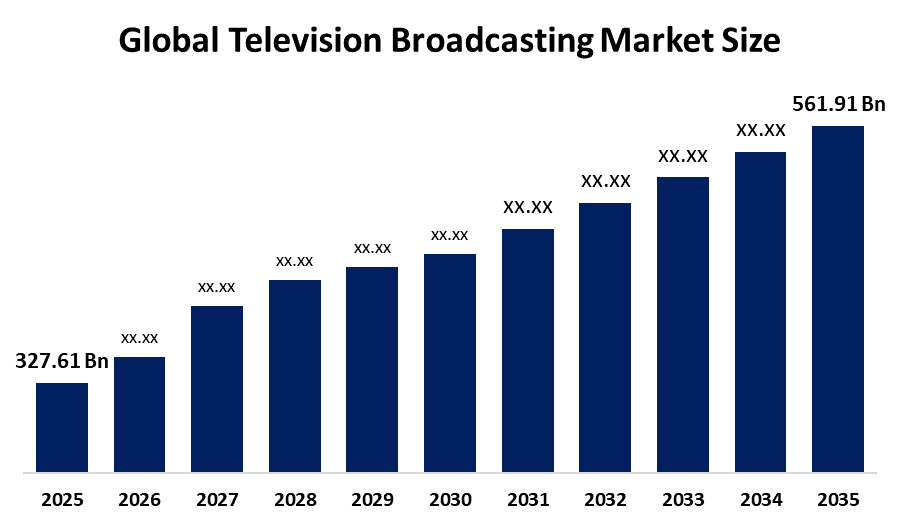
- The Market Size for Television broadcasting Was Estimated to be worth USD 327.61 Billion in 2025.
- The Market is Going to Expand at a CAGR of 5.54% between 2026 and 2035.
- The Global Television Broadcasting Market Size is anticipated to reach USD 561.91 Billion by 2035.
- North America is expected to generate the highest revenue during the forecast period in the Television Broadcasting Market.
- Middle East is expected to grow at the fastest rate during the forecast period in the Television Broadcasting Market.
Regional growth and demand
Middle East is expected to grow at the fastest rate during the forecast period in the television broadcasting market. The Middle East is expected to grow fastest due to digitalization because people increasingly use satellite and IPTV services. The region develops its media networks while people seek advanced content, and internet access continues to spread.
North America is expected to generate the highest revenue during the forecast period in the television broadcasting market. North America is expected to generate the highest demand due to advanced broadcasting systems existing because of essential media companies, which, together with digital platforms and over-the-top services, create a rising need for premium content.
Ready to lead the Global Television Broadcasting Market?
Discover the regional trends and growth factors shaping the industry. We’re here to assist with expert, personalized data.
Call +1 303 800 4326 or Send us a message for a personalized consultation.
Top 10 Trends in the Television Broadcasting Market
- Shift from Traditional TV to OTT and Streaming Platforms
- Growth of High-Definition (HD) and Ultra HD (4K/8K) Broadcasting
- Increasing Adoption of IPTV and Hybrid Broadcasting
- Integration of AI and Data Analytics in Content Delivery
- Rising Demand for Personalized and On-Demand Content
- Expansion of Smart TVs and Connected Devices
- Growth in Live Sports and Event Broadcasting
- Cloud-Based Broadcasting and Content Management
- Regional Content Production and Localization
- Advertising Shift Toward Digital and Programmatic Models
Unlock exclusive market insights—Download the Brochure now and dive deeper into the future of the Television Broadcasting Market.
- Shift from Traditional TV to OTT and Streaming Platforms
The television broadcasting industry is undergoing a major shift from traditional cable and satellite TV to OTT (over-the-top) and streaming platforms. Consumers increasingly prefer on-demand content, which they can access through the internet at any time and from any location. Platforms like Netflix, Amazon Prime Video, and Disney+ are gaining massive popularity because they offer flexible subscription models together with their extensive content libraries. The industry trend, which decreases reliance on linear television programming, requires broadcasters to implement hybrid broadcasting systems. Traditional media companies are now investing significant resources into digital platforms to maintain their market position while adapting to new consumer viewing patterns.
- Growth of High-Definition (HD) and Ultra HD (4K/8K) Broadcasting
The demand for better viewing experiences has resulted in more people using HD and Ultra HD (4K/8K) broadcasting. People now demand better image quality and sound performance together with complete immersion when they watch sports, movies and live events. Broadcasters are modernizing their networks to enable them to transmit better quality content through advanced resolution systems. The pattern exists because new high-tech television systems and display equipment have become more accessible to consumers. The growing competitive landscape has made exceptional visual quality an essential factor that broadcasters must meet to maintain their market position, which drives them to invest in upcoming broadcast systems.
- Increasing Adoption of IPTV and Hybrid Broadcasting
The Internet Protocol Television system, which delivers content through internet networks, is becoming more popular than traditional cable and satellite systems. IPTV enables viewers to watch shows and movies through its flexible interactive system, which allows viewers to customize their viewing experience. The media industry is adopting hybrid broadcasting, which combines traditional television with online streaming services. The system allows broadcasters to provide their audience with both live streaming and content that can be watched later. The global adoption of IPTV systems is increasing because more people are gaining internet access and enjoying high-speed broadband connections. Broadcasters use these technologies to improve user experience while expanding their audience and providing new services that fulfill current consumer requirements.
- Integration of AI and Data Analytics in Content Delivery
The field of television broadcasting experiences a fundamental change because artificial intelligence technologies and data analysis methods are being used in its operations. Broadcasters use artificial intelligence technology to study how viewers behave and what they like to watch so they can create customized content recommendations for their audience. Data analytics assists organizations in three key areas, which include optimizing their programming schedules, improving their audience targeting methods, and developing better advertising techniques. AI technology supports the creation of broadcasting content, which includes all aspects of content production and editing, and the automated execution of broadcasting functions. The technologies help broadcasters to achieve better operational performance while lowering their expenses and increasing the number of viewers who watch their content. The rising level of competition has made it necessary for organizations to use artificial intelligence technology together with data analytics to develop content that connects with their audience.
- Rising Demand for Personalized and On-Demand Content
Modern viewers prefer content tailored to their individual preferences, which results in increased demand for personalized and on-demand viewing experiences. Broadcasting companies use advanced recommendation systems to deliver customized content that matches user behavior patterns. Viewers can use on-demand services to watch programs whenever they want, which removes the restrictions imposed by fixed broadcasting times. This trend is particularly strong among younger audiences who prioritize flexibility and content variety. Broadcasters are moving toward user-centric models because they need digital platform investments and expanded content libraries to meet customer needs and improve customer satisfaction.
Empower your strategic planning:
Stay informed with the latest industry insights and market trends to identify new opportunities and drive growth in the television broadcasting market. To explore more in-depth trends, insights, and forecasts, please refer to our detailed report.
Top 25 Companies Leading the Television Broadcasting Market
- Comcast Corporation
- The Walt Disney Company
- Warner Bros. Discovery
- Paramount Global
- Fox Corporation
- Netflix
- NBCUniversal
- RTL Group
- Nexstar Media Group
- Sinclair Broadcast Group
- ITV plc
- ProSiebenSat.1 Media
- Fuji Media Holdings
- Nippon Television Holdings
- TF1 Group
- Tegna Inc.
- Gray Television
- E. W. Scripps Company
- Nine Entertainment Co.
- iHeartMedia
- News Corporation
- Grupo Televisa
- Entravision Communications
- Sun TV Network Limited
- Zee Entertainment Enterprises
Unlock exclusive market insights—Download the Brochure now and dive deeper into the future of the Television Broadcasting Market.
- Comcast Corporation
Headquarters: Philadelphia, Pennsylvania, USA
Comcast Corporation maintains its status as one of the largest worldwide broadcasting and media enterprises through its ownership of NBCUniversal. The company provides various television broadcasting services, which include its cable networks, news channels and entertainment channels. Comcast maintains a significant presence in both conventional broadcasting and online streaming services. The company spends large amounts of money on content creation, technological development, and distribution system improvements to better its viewer experience. Through its wide-ranging operations and multiple business activities, Comcast controls significant power to shape international television broadcasting and operates its expanding digital and on-demand platforms.
- The Walt Disney Company
Headquarters: Burbank, California, USA
The Walt Disney Company is a leading global media company with a strong presence in television broadcasting through networks such as ABC and ESPN. The company delivers high-quality entertainment, sports, and news content to a global audience. Disney has successfully combined traditional broadcasting with its digital platform Disney+, which has helped it to strengthen its market position. The company maintains its broadcasting industry leadership through its dedication to creating new content, building strong brands and expanding into international markets. The company's diverse portfolio, along with its strategic investments, enables new growth opportunities in the changing media industry.
- Warner Bros. Discovery
Headquarters: New York, USA
Warner Bros. Discovery operates as a significant television broadcasting company that delivers multiple content options through its networks, CNN, HBO and Discovery Channel. The company operates worldwide with its three core entertainment categories, which include premium content, factual shows and news broadcasting. The company uses traditional broadcasting methods together with its Max streaming service to achieve greater audience reach. The company provides its digital media content through multiple platforms while it develops new digital products and digital media transformation initiatives. The company's worldwide operations and vast content collection make it a major competitor in the television broadcasting sector.
- Paramount Global
Headquarters: New York, USA
Paramount Global operates as a top broadcasting company that owns multiple television networks, which include CBS, MTV and Nickelodeon. The company delivers various types of programming, which include news shows, entertainment shows and sports events. Paramount Global develops its online presence through its streaming service Paramount+. The company develops content while distributing it worldwide and building relationships with its audience. The company establishes itself as a major force in global television broadcasting through its well-known brand and extensive collection of content.
- Fox Corporation
Headquarters: New York, USA
Fox Corporation operates as a leading television broadcasting company which specializes in news and sports programming. The company operates major networks such as Fox News and Fox Sports, which deliver content to a large audience base. Fox focuses on live programming, which has become essential for contemporary digital broadcasting. The company maintains its competitive advantage through its ongoing investments in superior content and advanced broadcasting equipment. Fox Corporation maintains its position as a major force in international television broadcasting through its strong brand identity and dedication to delivering live programming.
Are you ready to discover more about the television broadcasting market?
The report provides an in-depth analysis of the leading companies operating in the global television broadcasting market. It includes a comparative assessment based on their product portfolios, business overviews, geographical footprint, strategic initiatives, market segment share, and SWOT analysis. Each company is profiled using a standardized format that includes:
Company Profiles
- Comcast Corporation
- Business Overview
- Company Snapshot
- Products Overview
- Company Market Share Analysis
- Company Coverage Portfolio
- Financial Analysis
- Recent Developments
- Merger and Acquisitions
- SWOT Analysis
- The Walt Disney Company
- Warner Bros. Discovery
- Paramount Global
- Fox Corporation
- Netflix
- NBCUniversal
- RTL Group
- Nexstar Media Group
- Others.
Unlock exclusive market insights—Download the Brochure now and dive deeper into the future of the Television Broadcasting Market.
Conclusion
The global television broadcasting market is experiencing continuous growth because people demand more digital content, technology improves, and media consumption expands across the world. Television broadcasting distributes news, entertainment, sports and educational content through cable, satellite and digital platforms, which people can access. The viewer experience and accessibility of content improvements are driven by high-definition (HD) and ultra-high-definition (4K/8K) IPTV and OTT service integration. People use smart TVs and mobile devices more frequently, which leads to increased content consumption. The major companies Comcast Corporation, The Walt Disney Company, and Warner Bros. Discovery are developing their international operations through digital technological advancements. The entire world depends on television broadcasting to provide essential information and entertainment.
Our Industry Reports:
Biaxial Tensile Testing Machine Market Size,Trend Report 2035
https://www.sphericalinsights.com/reports/biaxial-tensile-testing-machine-market
Global Cloud Advertising Market Size, Trend
https://www.sphericalinsights.com/reports/cloud-advertising-market
Cold Gas Spray Coating Market Size Report 2035
https://www.sphericalinsights.com/reports/cold-gas-spray-coating-market
Generative AI In Biology Market Size, Share Report 2035
https://www.sphericalinsights.com/reports/global-generative-ai-in-biology-market
Obesity GLP-1 Market Size, Share, Trends, Growth, Forecast
https://www.sphericalinsights.com/reports/obesity-glp-1-market
About the Spherical Insights & Consulting
Spherical Insights & Consulting is a market research and consulting firm which provides actionable market research study, quantitative forecasting and trends analysis provides forward-looking insight especially designed for decision makers and aids ROI. Which is catering to different industry such as financial sectors, industrial sectors, government organizations, universities, non-profits and corporations. The company's mission is to work with businesses to achieve business objectives and maintain strategic improvements.
CONTACT US:
For More Information on Your Target Market, Please Contact Us Below:
Phone: +1 303 800 4326 (the U.S.)
Phone: +91 90289 24100 (APAC)
Email: inquiry@sphericalinsights.com, sales@sphericalinsights.com
Contact Us: https://www.sphericalinsights.com/contact-us
Need help to buy this report?