Global Biaxial Tensile Testing Machine Market Size, Share, and COVID-19 Impact Analysis, By Product Type (Computer-controlled Machines and Motorized Machines), By Testing Type (Static Testing, Cyclic Testing, Dynamic Testing, and Fatigue Testing), By End-user (Aerospace, Automotive, Construction, Biomedical, Research Institutions & Universities, Textile Industry, and Others), and By Region (North America, Europe, Asia-Pacific, Latin America, Middle East, and Africa), Analysis and Forecast 2025 - 2035
Industry: Machinery & Equipment
Global Biaxial Tensile Testing Machine Market Insights Forecasts to 2035
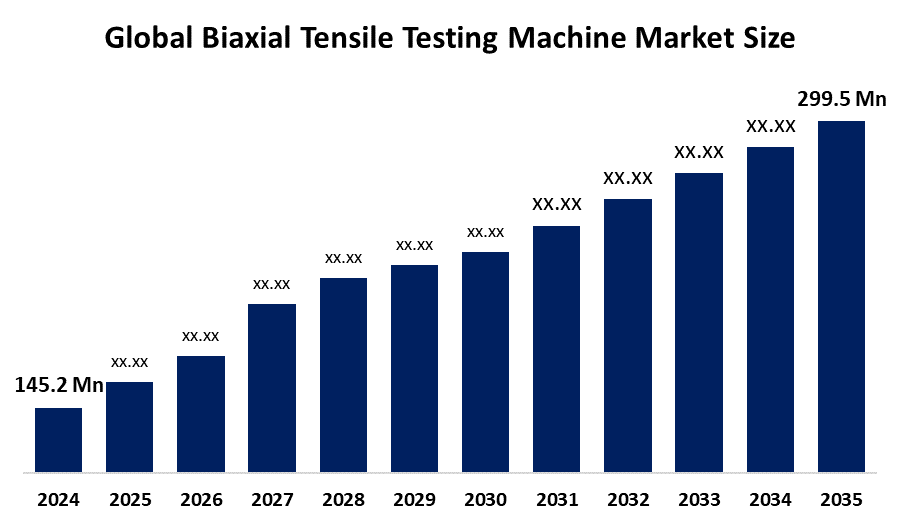
- The Global Biaxial Tensile Testing Machine Market Size Was Estimated at USD 145.2 Million in 2024
- The Market Size is Expected to Grow at a CAGR of around 6.8% from 2025 to 2035
- The Worldwide Biaxial Tensile Testing Machine Market Size is Expected to Reach USD 299.5 Million by 2035
- Asia Pacific is expected to grow the fastest during the forecast period.
Get more details on this report -
According to a research report published by Spherical Insights and Consulting, The Global Biaxial Tensile Testing Machine Market Size was Worth Around USD 145.2 million in 2024 and is Predicted to Grow to Around USD 299.5 Million by 2035 with a Compound Annual Growth Rate (CAGR) of 6.8% from 2025 to 2035. The market in the biaxial tensile testing machine is growing due to rising demand for material testing in the automotive and aerospace industries, increased adoption of automation/AI for precision, and the need to test lightweight materials and composites to meet stringent safety standards.
Market Overview
The Global Biaxial Tensile Testing Machine Market Size refers to the industry that manufactures and supplies specialized testing equipment designed to evaluate material properties under multidirectional tensile stresses. Unlike traditional uniaxial systems, biaxial testers apply forces in two perpendicular directions, making them essential for accurate mechanical characterization of advanced materials such as composites, polymers, metals, and biomedical tissues.These machines are widely used across automotive, aerospace, construction, research laboratories, and materials science sectors to ensure safety, quality, and performance.In February 2026, the China University of Petroleum (Beijing) announced a government-backed procurement of a 100 kN biaxial bidirectional tensile testing machine worth approximately USD 55,000, with delivery scheduled for December. The system will be used to simulate complex axial-radial stress conditions and analyze multidirectional material behavior under extreme downhole environments.Advanced analytics capabilities are enhancing testing precision and enabling deeper data insights, further driving market expansion.In March 2026, Aarhus University (Denmark) issued an EU tender for an electrodynamic biaxial (axial-torsion) testing system with a 12 kN force capacity and ±120 Nm torsion. The integrated single-platform system is required to meet stringent force, torque, and stroke specifications while maintaining noise levels below 78 dB(A), ensuring compatibility with sensitive nano-scale instrumentation environments. The procurement is being conducted through a negotiated procedure.
Report Coverage
This research report categorizes the Biaxial Tensile Testing Machine Market Size based on various segments and regions, forecasts revenue growth, and analyzes trends in each submarket. The report analyses the key growth drivers, opportunities, and challenges influencing the biaxial tensile testing machine market. Recent market developments and competitive strategies, such as expansion, type launch, development, partnership, merger, and acquisition, have been included to draw the competitive landscape in the market. The report strategically identifies and profiles the key market players and analyses their core competencies in each sub-segment of the biaxial tensile testing machine market.
Global Biaxial Tensile Testing Machine Market Report Coverage
| Report Coverage | Details |
|---|---|
| Base Year: | 2024 |
| Market Size in 2024: | USD 145.2 Million |
| Forecast Period: | 2024-2035 |
| Forecast Period CAGR 2024-2035 : | 6.8% |
| 2035 Value Projection: | USD 299.5 Million |
| Historical Data for: | 2020-2023 |
| No. of Pages: | 245 |
| Tables, Charts & Figures: | 100 |
| Segments covered: | By Testing Type ,By End-user |
| Companies covered:: | Instron, ADMET, Inc., MTS Systems Corporation, Shimadzu Corporation, ZwickRoell, Hegewald & Peschke, ETS Intarlaken, Presto Group, Imatek Ltd., LaVision GmbH, Torontech Group, Tinius Olsen, Cometech Testing Machines Co., Ltd., Jinan Kason Testing Equipment, and Other Key Players |
| Pitfalls & Challenges: | COVID-19 Empact, Challenges, Future, Growth, & Analysis |
Get more details on this report -
Driving Factors
The Global Biaxial Tensile Testing Machine Market Size is primarily driven by increasing demand for precise material characterization across automotive, aerospace, and biomedical industries. The global composites market will reach USD 160 billion by 2026 because research and development investments for lightweight composite materials in electric vehicles and aircraft applications continue to grow. The adoption of testing standards for material specifications that require ASTM and ISO testing procedures results in increased testing procedures. The automotive sector accounts for approximately 35% of market demand because testing for EV battery components needs to be conducted. The implementation of automation and AI-based analytics, together with Industry 4.0 technologies, enables improved testing accuracy and operational performance, which results in increased acceptance by different user groups. In December 2024, the Australian Research Council awarded USD 420,000 AUD to the University of South Australia to develop an innovative biaxial electromagnetic Hopkinson apparatus. The project aims to enhance the accuracy of dynamic material testing, benefiting aerospace structures, advanced composites, and sustainable building materials.
Restraining Factors
Key restraining factors for the Global Biaxial Tensile Testing Machine Market Size include high capital expenditure and complex integration challenges. The substantial initial investment required for advanced systems, coupled with fragmented solutions and disjointed testing platforms, increases setup complexity and total cost of ownership, deterring adoption, particularly among smaller laboratories and manufacturers.
Market Segmentation
The Biaxial Tensile Testing Machine Market share is classified into product type, testing type, and end-user.
- The computer-controlled machines segment dominated the market in 2024, approximately 60% and is projected to grow at a substantial CAGR during the forecast period.
Based on the product type, the Global Biaxial Tensile Testing Machine Market Size is divided into computer-controlled machines and motorized machines. Among these, the computer-controlled machines segment dominated the market in 2024 and is projected to grow at a substantial CAGR during the forecast period. This dominance is attributed to their superior precision, automation capabilities, and real-time data acquisition features. These systems offer programmable testing parameters, advanced software analytics, and seamless integration with Industry 4.0 technologies. Their ability to perform complex, multi-axial tests with minimal human intervention ensures higher accuracy, repeatability, and efficiency, making them indispensable for aerospace, automotive, and biomedical R&D applications requiring stringent compliance with ASTM/ISO standards.
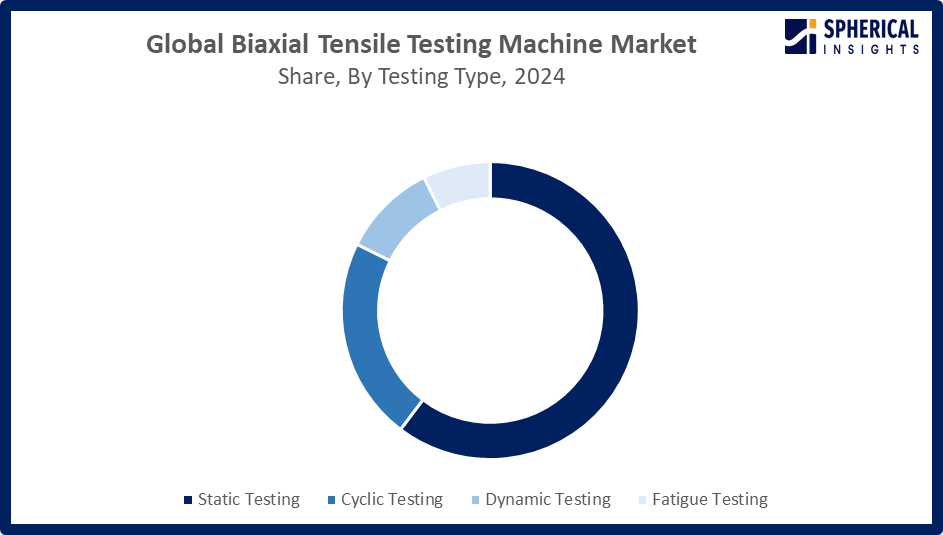
- The static testing segment accounted for the largest share in 2024, approximately 60% and is anticipated to grow at a significant CAGR during the forecast period.
Based on the testing type, the Global Biaxial Tensile Testing Machine Market Size is divided into static testing, cyclic testing, dynamic testing, and fatigue testing. Among these, the static testing segment accounted for the largest share in 2024 and is anticipated to grow at a significant CAGR during the forecast period. The segment growth is owing to its fundamental role in determining essential material properties like tensile strength, yield strength, and elastic modulus under constant, unidirectional load conditions. These baseline tests are mandatory for quality control, material certification, and regulatory compliance (ASTM/ISO) across automotive, aerospace, and construction industries. Their simplicity, repeatability, and cost-effectiveness for routine material validation drive widespread, consistent adoption globally.
Get more details on this report -
- The automotive segment accounted for the highest market revenue in 2024, approximately 35% and is anticipated to grow at a significant CAGR during the forecast period.
Based on the end-user, the Global Biaxial Tensile Testing Machine Market Size is divided into aerospace, automotive, construction, biomedical, research institutions & universities, textile industry, and others. Among these, the automotive segment accounted for the highest market revenue in 2024 and is anticipated to grow at a significant CAGR during the forecast period. The automotive segment leads due to stringent safety regulations, lightweight material adoption, and electric vehicle (EV) expansion. Manufacturers increasingly test high-strength steels, aluminium, and composites under biaxial stresses for chassis, body panels, and crashworthiness validation. Additionally, EV battery enclosure and component testing require precise multi-directional characterization, with the sector accounting for approximately 35% of market demand globally.
Regional Segment Analysis of the Biaxial Tensile Testing Machine Market
- North America (U.S., Canada, Mexico)
- Europe (Germany, France, U.K., Italy, Spain, Rest of Europe)
- Asia-Pacific (China, Japan, India, Rest of APAC)
- South America (Brazil and the Rest of South America)
- The Middle East and Africa (UAE, South Africa, Rest of MEA)
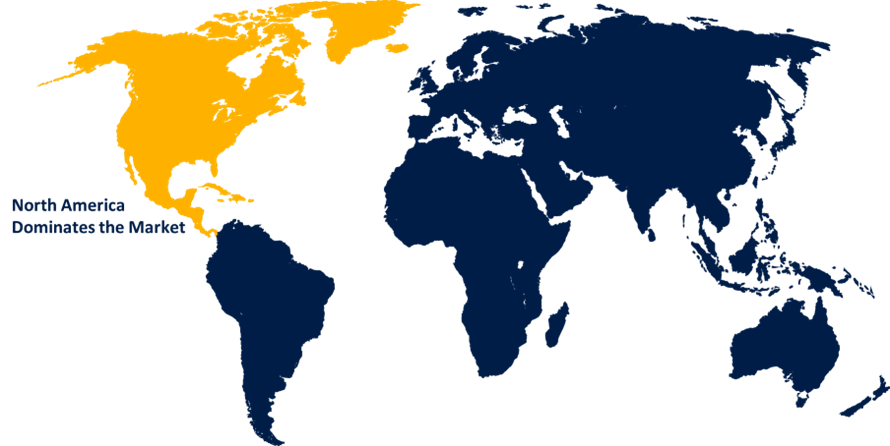
North America is anticipated to hold the largest share of the biaxial tensile testing machine market over the predicted timeframe.
North America is anticipated to hold the largest share of the Global Biaxial Tensile Testing Machine Market Size over the forecast period, accounting for approximately 36% of the global market. This dominance is primarily driven by the United States and Canada. The region benefits from advanced industrial infrastructure, high adoption of automated and computer-controlled testing systems, and stringent quality and safety regulations across automotive, aerospace, and biomedical sectors. Strong R&D investments in lightweight composites and high-performance materials, along with government-backed research programs, further stimulate demand. Additionally, the presence of leading testing equipment manufacturers and prominent academic institutions reinforces North America’s market leadership.
Get more details on this report -
Asia Pacific is expected to register the fastest CAGR during the forecast period, holding around 28% of the market share. The region’s growth is led by China, India, and Japan, driven by rapid industrialization, expanding automotive and aerospace production, and increasing investments in advanced materials research. Government initiatives supporting high-performance materials and quality testing, coupled with rising infrastructure development and the adoption of automated testing technologies, are accelerating market growth.
In November 2025, the Beijing Institute of Technology announced a procurement worth 101 million yuan (approximately USD 13.9 million) for 34 scientific instruments, including a high-speed biaxial tensile testing machine with a 10 kN load capacity and a speed range of 0.001–500 mm/min. Scheduled between October and December, this initiative strengthens government-backed advanced material research capabilities.
Europe is witnessing steady growth in the biaxial tensile testing machine market, led by Germany, France, and the United Kingdom. The region’s expansion is supported by well-established automotive and aerospace industries, stringent regulatory standards for material testing, and significant R&D investments in composites and high-performance materials. The increasing adoption of automated and computer-controlled testing systems across research institutions and manufacturing facilities further contributes to market growth.
Competitive Analysis:
The report offers the appropriate analysis of the key organizations/companies involved within the Global Biaxial Tensile Testing Machine Market Size, along with a comparative evaluation primarily based on their type of offering, business overviews, geographic presence, enterprise strategies, segment market share, and SWOT analysis. The report also provides an elaborative analysis focusing on the current news and developments of the companies, which includes type development, innovations, joint ventures, partnerships, mergers & acquisitions, strategic alliances, and others. This allows for the evaluation of the overall competition within the market.
List of Key Companies
- Instron
- ADMET, Inc.
- MTS Systems Corporation
- Shimadzu Corporation
- ZwickRoell
- Hegewald & Peschke
- ETS Intarlaken
- Presto Group
- Imatek Ltd.
- LaVision GmbH
- Torontech Group
- Tinius Olsen
- Cometech Testing Machines Co., Ltd.
- Jinan Kason Testing Equipment
- Others
Key Target Audience
- Market Players
- Investors
- End-users
- Government Authorities
- Consulting and Research Firm
- Venture capitalists
- Value-Added Resellers (VARs)
Recent Development
- In January 2025, University of South Australia will trial a USD720,000 next-generation biaxial Hopkinson bar to test building materials under extreme forces like explosions, lightning, and typhoons. Led by Professor Yan Zhuge, the project is funded by a USD420,000 ARC LIEF grant, USD300,000 from universities, and a separate ARC Discovery grant.
- In July 2025, Presto Group highlighted the growing importance of tensile testing machines in engineering and manufacturing. These systems evaluate material strength, flexibility, and durability across plastics, metals, and rubber industries, providing accurate data for quality control, product development, and informed manufacturing decisions.
-
In June 2025, Shimadzu Scientific Instruments, based in Columbia, Maryland, announced the launch of its Autograph AGS-V Series tabletop testing instruments. These systems are designed to provide precise and compact material testing solutions for both laboratory and industrial applications.
-
In November 2024, advancements in tensile strength testing systems enhanced material evaluation across multiple industries by enabling accurate measurement of how fabrics, metals, and polymers respond to stress. These systems follow standardized procedures and apply controlled loads, helping laboratories improve safety and durability assessments while increasing productivity by up to 30% through data-driven insights.
-
In July 2024, Shenzhen University issued a government tender for a biaxial dynamic disturbance testing system with a budget of RMB 2.5 million (approximately USD 350,000). Reserved for SMEs under China’s preferential policies, the system is intended to study material behavior under combined static and dynamic loading conditions for advanced engineering applications through the Shenzhen Government Procurement platform.
Market Segment
This study forecasts revenue at global, regional, and country levels from 2020 to 2035. Spherical Insights has segmented the Global Biaxial Tensile Testing Machine Market Size based on the below-mentioned segments:
Global Biaxial Tensile Testing Machine Market, By Product Type
- Computer-controlled Machines
- Motorized Machines
Global Biaxial Tensile Testing Machine Market, By Testing Type
- Static Testing
- Cyclic Testing
- Dynamic Testing
- Fatigue Testing
Global Biaxial Tensile Testing Machine Market, By End-user
- Aerospace
- Automotive
- Construction
- Biomedical
- Research Institutions & Universities
- Textile Industry
- Others
Global Biaxial Tensile Testing Machine Market, By Regional Analysis
- North America
- US
- Canada
- Mexico
- Europe
- Germany
- UK
- France
- Italy
- Spain
- Russia
- Rest of Europe
- Asia Pacific
- China
- Japan
- India
- South Korea
- Australia
- Rest of Asia Pacific
- South America
- Brazil
- Argentina
- Rest of South America
- Middle East & Africa
- UAE
- Saudi Arabia
- Qatar
- South Africa
- Rest of the Middle East & Africa
Frequently Asked Questions (FAQ)
-
1. How is the market impacting material testing standards across automotive, aerospace, and construction sectors?The market is raising standards by enforcing rigorous compliance with ASTM/ISO protocols, with 35% of demand from automotive EV battery testing and 20% from aerospace precision validation. Regulatory shifts like REACH now mandate multi-axial mechanical data, making biaxial testing essential for certification across all three sectors.
-
2. Which technological innovations are driving efficiency and accuracy in biaxial tensile testing machines?AI-driven analytics and IoT-enabled smart systems enhance precision with real-time monitoring, reducing errors. Digital twins enable virtual simulation, cutting development time, while four-channel controllers achieve force errors below 1% and displacement resolution up to 0.05 µm.
-
3. How do economic factors, including industrial investment and government initiatives, influence market expansion?Rising industrial investments and government initiatives like the U.S. CHIPS Act and EU Green Deal directly boost market expansion by incentivizing domestic production and materials innovation. Government procurement programs, such as Shenzhen University's USD 350,000 tender, further stimulate demand.
-
4. What are the emerging trends in adoption, automation, and digital integration within the market?Key trends include AI-driven analytics and IoT-enabled smart systems for real-time monitoring and predictive maintenance, enhancing testing precision and efficiency. Integration with Industry 4.0 platforms and digital twins enables virtual simulation, accelerating product development cycles by up to 30%.
-
5. How are standards and regulatory requirements affecting market adoption and innovation strategies?Standards and regulatory requirements (ASTM, ISO, REACH) are primary market drivers, compelling adoption by mandating rigorous multi-axial validation for compliance and market access. This regulatory push forces innovation in smart, AI-powered testing platforms to ensure adherence to evolving global safety and sustainability protocols.
Need help to buy this report?