Global Generative AI In Biology Market Size, Share, and COVID-19 Impact Analysis, By Technology (Generative Adversarial Networks, Variational Autoencoders, and Reinforcement Learning), By Application (Drug Discovery and Development, Medical Imaging, Genomics and Proteomics, Protein Engineering, and Synthetic Biology), By End-Use (Pharmaceutical and Biotechnology Companies, Healthcare Provider, and Research Institutions), and By Region (North America, Europe, Asia-Pacific, Latin America, Middle East, and Africa), Analysis and Forecast 2025 - 2035.
Industry: Information & Technology
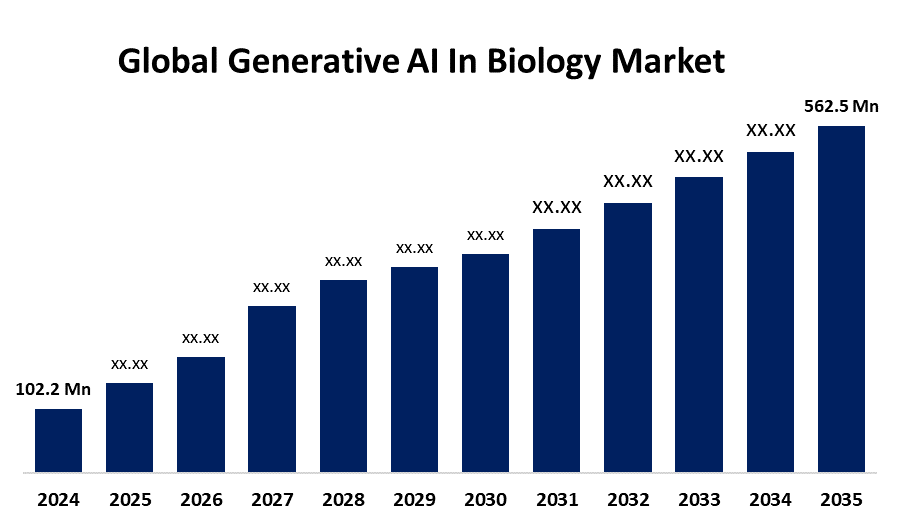
According to Spherical Insights, The Global Generative AI In Biology Market Size is Expected to Grow from USD 102.2 Million in 2024 to USD 562.5 Million by 2035, at a CAGR of 16.77% during the forecast period 2025-2035.
Key Market Trends & Opportunities
The Generative AI In Biology market has a number of opportunities to grow, due to the inclination towards protein engineering & design, personalized & precision medicine, biological reprogramming, and clinical trial optimization.
- Sustainable trend including the designing of eco-friendly materials and crops
- Startups are working on proving the protein design and biological modeling concepts
- Data mining bioinformatics and omics data integration that uses neural networks and bioinformatics algorithms for understanding complex interactions
Global Generative AI In Biology Market Insights Forecasts to 2035
- The Global Generative AI In Biology Market Size Was Estimated at USD 102.2 Million in 2024
- The Market Size is Expected to Grow at a CAGR of around 16.77% from 2025 to 2035
- The Worldwide Generative AI In Biology Market Size is Expected to Reach USD 562.5 Million by 2035
Get more details on this report -
Major Players
Absci, Arzeda Corp., Atomwise Inc., BenevolentAI, Cyclica, Deep Genomics Inc., DeepMind Technologies Ltd., Evogene Ltd., Exscientia PLC, Generate Biomedicines, Ginkgo Bioworks Holdings Inc., Insilico Medicine, Owkin Inc., Recursion Pharmaceuticals Inc., Schrodinger Inc., Shiru Inc., and Verge Analytics Inc.
Market Overview
The global industry of generative AI in biology encompasses the use of artificial intelligence models for creating, designing, and simulating new biological data, molecules, and systems rather than just analyzing existing ones. Generative biology enables researchers to create novel protein structures, DNA sequences, and small molecules for drug discovery. Generative AI in biology is an emerging field that uses machine learning models, trained on vast biological datasets (DNA, proteins, RNA), to create, design, and optimize new, functional biological molecules and structures, rather than just analyzing existing ones.
Innovation and market expansion are anticipated as a result of major players' growing R&D expenditures and expanding partnerships. For instance, in October 2025, Profluent Bio, a pioneer in generative AI for protein design, announced a strategic collaboration with Corteva, a global leader in agricultural sciences and solutions. Under the collaboration, the companies will use artificial intelligence (AI) and gene editing to deliver a new generation of more sustainable, resilient crops.
Report Coverage
This research report categorizes the generative AI in biology market based on various segments and regions, forecasts revenue growth, and analyzes trends in each submarket. The report analyses the key growth drivers, opportunities, and challenges influencing the generative AI in biology market. Recent market developments and competitive strategies such as expansion, type launch, development, partnership, merger, and acquisition have been included to draw the competitive landscape in the market. The report strategically identifies and profiles the key market players and analyses their core competencies in each sub-segment of the generative AI in biology market.
Global Generative AI In Biology Market Report Coverage
| Report Coverage | Details |
|---|---|
| Base Year: | 2024 |
| Market Size in 2024: | USD 562.5 Million |
| Forecast Period: | 2024-2035 |
| Forecast Period CAGR 2024-2035 : | CAGR of 16.77% |
| 2035 Value Projection: | USD 562.5 Million |
| Historical Data for: | 2020-2023 |
| No. of Pages: | 210 |
| Tables, Charts & Figures: | 111 |
| Segments covered: | By Technology, By Application |
| Companies covered:: | Absci, Arzeda Corp., Atomwise Inc., BenevolentAI, Cyclica, Deep Genomics Inc., DeepMind Technologies Ltd., Evogene Ltd., Exscientia PLC, Generate Biomedicines, Ginkgo Bioworks Holdings Inc., Insilico Medicine, Owkin Inc., Recursion Pharmaceuticals Inc., Schrodinger Inc., Shiru Inc., Verge Analytics Inc., Others, and |
| Pitfalls & Challenges: | COVID-19 Empact, Challenge, Future, Growth, & Analysis |
Get more details on this report -
Driving Factors
Advanced technology adoption in drug discovery
An increasing adoption of generative AI models and solutions for drug discovery is promoting the generative AI in biology market. Discovery or designing small drug molecules involves two approaches that aim to get a drug molecule with the best pharmacokinetic and pharmacodynamic profiles. Molecular property prediction, molecule production, virtual screening, synthesis planning, and repurposing are a few of the applications for artificial intelligence models. The potential of generative AI to produce completely new data, such as images, phrases, sounds, films, new chemical molecules, etc., has made it popular recently in a variety of fields.
Restraining Factors
Inaccurate data results
Generative AI (GenAI) in biology frequently produces inaccurate or unreliable data due to its probabilistic nature, which prioritizes plausible-sounding outputs over factual accuracy. While transformative, these tools can "hallucinate" molecular structures, misinterpret genomic variants, or generate non-existent citations, creating risks of "fake science"
Market Segment Insights
By Technology: Generative Adversarial Networks (Dominant) versus Variational Autoencoders (Emerging)
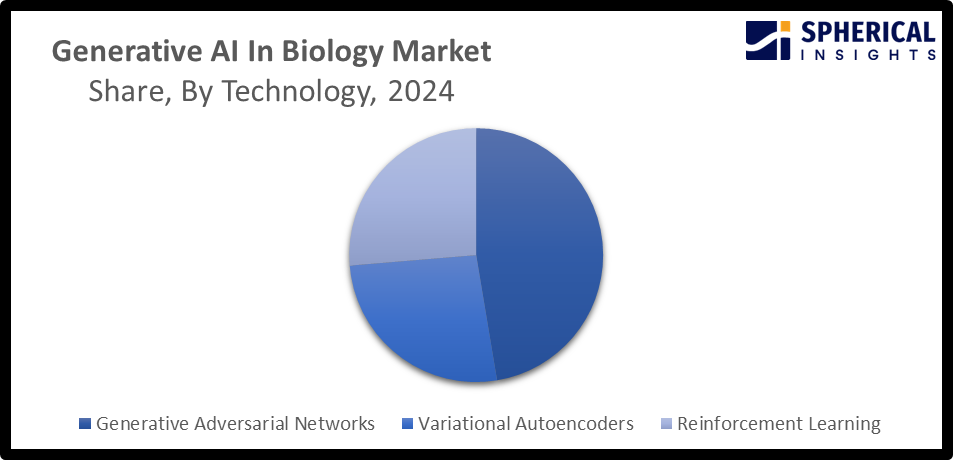
The generative adversarial networks segment held a significant market share of over 35.0% in 2024, owing to the increasing application of generative adversarial network technology for creating realistic images, protein structure presentation, synthetic biology, and drug discovery. Generative Adversarial Networks (GAN) are trained in an adversarial setting, a deep neural network, specifically learning the generative model of data distribution through adversarial methods. While the variational autoencoders segment is growing rapidly owing to its increasing usage for drug design, generating molecular structures, and analyzing genomics data. Variational autoencoders are generative models used in machine learning to generate new data in the form of variations of the input data they are trained on.
Get more details on this report -
By Application: Drug Discovery and Development (Dominant) versus Medical Imaging (Emerging)
The drug discovery and development segment held the dominant share of around 40.0% in the generative AI in biology market, owing to the increasing use of generative AI models and algorithms in drug discovery. The drug discovery process is an expensive, time-consuming, and risk-associated process that requires USD 2.5 billion and around 12-15 years for obtaining a novel drug into the market. While medical imaging segment is anticipated to grow significantly, as several technologies like variational autoencoders and generative adversarial networks aid in promoting medical imaging. Generative artificial intelligence (AI) is rapidly transforming medical imaging by enabling capabilities such as data synthesis, image enhancement, modality translation, and spatiotemporal modeling.
By End-Use: Pharmaceutical and Biotechnology Companies (Dominant) versus Healthcare Provider (Emerging)
The pharmaceutical and biotechnology companies segment is dominating the market with approximately 45.0% share, due to genAI’s potential applications in the biotech industry. Researchers are already using AI for predicting protein structures, model disease progression, and testing theoretical biological experiments in silico, for example, before running costly web lab trials. The healthcare provider segment is anticipated to grow at a substantial CAGR during the forecast period. This is due to the increasing use of genAI in healthcare infrastructure. Generative AI has transformative potential in healthcare to enhance patient care, personalize treatment options, train healthcare professionals, and advance medical research.
Regional Segment Analysis of the Generative AI In Biology Market
- North America (U.S., Canada, Mexico)
- Europe (Germany, France, U.K., Italy, Spain, Rest of Europe)
- Asia-Pacific (China, Japan, India, Rest of APAC)
- South America (Brazil and the Rest of South America)
- The Middle East and Africa (UAE, South Africa, Rest of MEA)
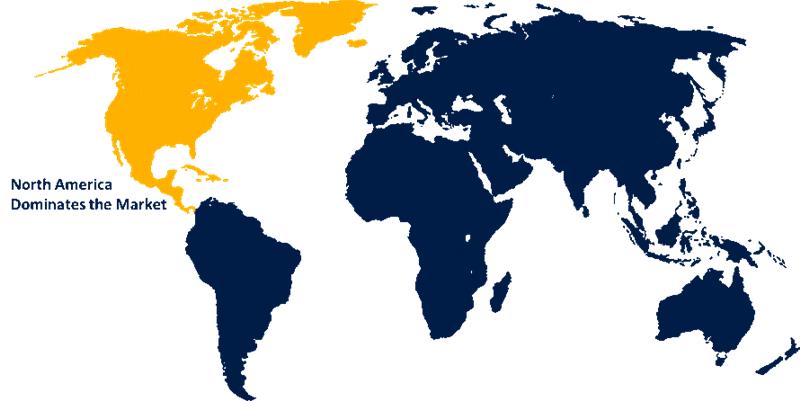
North America is anticipated to hold the largest share of the generative AI in biology market over the predicted timeframe.
North America is anticipated to hold the largest share of over 40.0% in the generative AI in biology market over the predicted timeframe. The market ecosystem in North America is strong, due to increasing R&D activity for launching novel services and the availability of advanced services. The United States is the dominant country in the North America generative AI in biology market, owing to the ongoing advancements in artificial intelligence in healthcare and machine learning. Furthermore, increasing genomic and proteomic research, drug discovery and development activities, and adoption of personalized and precision medicine are other contributing factors in the market growth.
Asia Pacific is expected to grow at the fastest CAGR in the generative AI in biology market during the forecast period. The Asia Pacific area has a thriving market for generative AI in biology due to its increasing healthcare expenditure for better health services. Further, an increasing need for bioinformatics is contributing to propel the regional market. China is the leading country in the Asia Pacific market, owing to the increased clinical trial activities with computational designs, drug development costs & timeline pressures, and an increasing volume of omics data & bioinformatics research.
Get more details on this report -
Competitive Analysis:
The report offers the appropriate analysis of the key organizations/companies involved within the generative AI in biology market, along with a comparative evaluation primarily based on their type of offering, business overviews, geographic presence, enterprise strategies, segment market share, and SWOT analysis. The report also provides an elaborative analysis focusing on the current news and developments of the companies, which includes type development, innovations, joint ventures, partnerships, mergers & acquisitions, strategic alliances, and others. This allows for the evaluation of the overall competition within the market.
List of Key Companies
- Absci
- Arzeda Corp.
- Atomwise Inc.
- BenevolentAI
- Cyclica
- Deep Genomics Inc.
- DeepMind Technologies Ltd.
- Evogene Ltd.
- Exscientia PLC
- Generate Biomedicines
- Ginkgo Bioworks Holdings Inc.
- Insilico Medicine
- Owkin Inc.
- Recursion Pharmaceuticals Inc.
- Schrodinger Inc.
- Shiru Inc.
- Verge Analytics Inc.
- Others
- Key Target Audience
- Market Players
- Investors
- End-users
- Government Authorities
- Consulting And Research Firm
- Venture capitalists
- Value-Added Resellers (VARs)
Industry Development
- In February 2026, Tamarind Bio Secures USD 13.6M Series A to Make AI More Accessible for Biology. Tamarind’s platform for model coordination and inference enables user-friendly AI tools for life science researchers.
- In January 2026, Illumina, Inc. introduced the world’s largest genome-wide genetic perturbation dataset, being built to accelerate drug discovery through AI across the pharmaceutical ecosystem.
- In January 2026, the tech giant and pharmaceutical manufacturer are building foundation models for biology and chemistry, using physical AI to accelerate drug development. AI is poised to reshape pharmaceutical manufacturing as Nvidia and Eli Lilly announce a USD1 billion investment in a co-innovation laboratory.
- In January 2026, GenScript Biotech Corporation, a global leader in life science research and biotech solutions, announced its supporting role in the experimental validation of Latent-X2 further proving that GenScript is Scripting Possibilities in AI-driven drug discovery.
- In October 2025, Tokyo-headquartered Elix and the Graduate School of Life Sciences at Tohoku University signed a joint research agreement aimed at advancing drug discovery using AI technologies.
- In April 2025, Signios Biosciences, a science-first biotechnology company at the forefront of multiomics and AI-powered bioinformatics, announced its rebranding from its previous identity as the US-based research division of MedGenome Inc.
Market Segment
This study forecasts revenue at global, regional, and country levels from 2020 to 2035. Spherical Insights has segmented the generative AI in biology market based on the below-mentioned segments:
Global Generative AI In Biology Market, By Technology
- Generative Adversarial Networks
- Variational Autoencoders
- Reinforcement Learning
Global Generative AI In Biology Market, By Application
- Drug Discovery and Development
- Medical Imaging
- Genomics and Proteomics
- Protein Engineering
- Synthetic Biology
Global Generative AI In Biology Market, By End-Use
- Pharmaceutical and Biotechnology Companies
- Healthcare Provider
- Research Institutions
Global Generative AI In Biology Market, By Regional Analysis
- North America
- US
- Canada
- Mexico
- Europe
- Germany
- UK
- France
- Italy
- Spain
- Russia
- Rest of Europe
- Asia Pacific
- China
- Japan
- India
- South Korea
- Australia
- Rest of Asia Pacific
- South America
- Brazil
- Argentina
- Rest of South America
- Middle East & Africa
- UAE
- Saudi Arabia
- Qatar
- South Africa
- Rest of the Middle East & Africa
Frequently Asked Questions (FAQ)
-
1.What is the market size of the generative AI in biology market?The global generative AI in biology market size is expected to grow from USD 102.2 Million in 2024 to USD 562.5 Million by 2035, at a CAGR of 16.77% during the forecast period 2025-2035.
-
2.Which region holds the largest share of the generative AI in biology market?North America is anticipated to hold the largest share of the generative AI in biology market over the predicted timeframe.
-
3.What is the forecasted CAGR of the Global Generative AI In Biology Market from 2024 to 2035?The market is expected to grow at a CAGR of around 16.77% during the period 2024–2035.
-
4.Who are the top companies that are involved in the Global Generative AI In Biology Market?Key players include Absci, Arzeda Corp., Atomwise Inc., BenevolentAI, Cyclica, Deep Genomics Inc., DeepMind Technologies Ltd., Evogene Ltd., Exscientia PLC, Generate Biomedicines, Ginkgo Bioworks Holdings Inc., Insilico Medicine, Owkin Inc., Recursion Pharmaceuticals Inc., Schrodinger Inc., Shiru Inc., and Verge Analytics Inc.
-
5.What are the main drivers in the generative AI in biology market?An increasing technology adoption for drug development is a major market growth drivers of the generative AI in biology market.
-
6.What challenges are limiting the adoption of Generative AI In Biology?Factors like unreliable and inaccurate data results remain key restraints in the Generative AI In Biology market.
-
7.What are the key trends in the generative AI in biology market?The increasing sustainable trend, like designing eco-friendly materials, protein design and biological modeling concepts, and data mining bioinformatics, are major key trends in the generative AI in biology market.
Need help to buy this report?