Top 15 Companies in Global TNF Inhibitors Market: Global Share, Market Size, Revenue Report (2024–2035)
RELEASE DATE: Apr 2026 Author: Spherical InsightsRequest Free Sample Speak to Analyst
Description
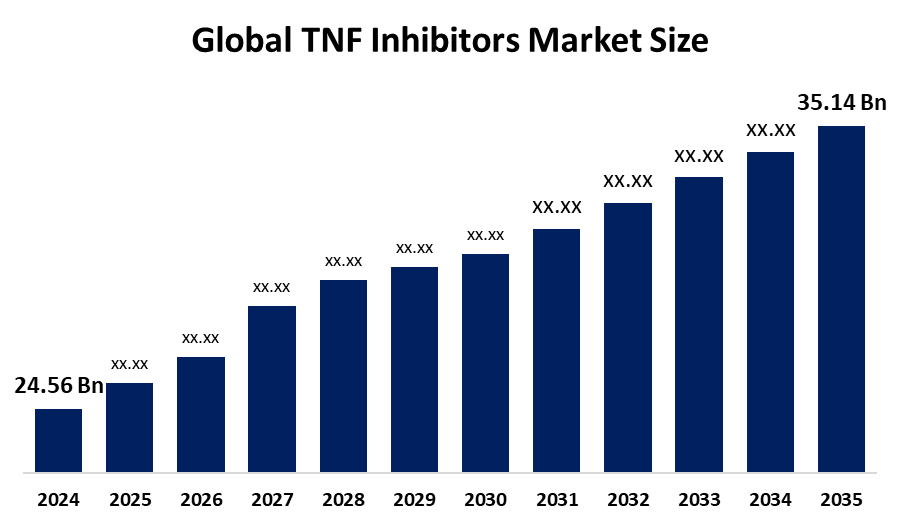
According to a research report published by Spherical Insights & Consulting, the Global TNF inhibitors Market Size is projected to grow from USD 24.56 billion in 2024 to USD 35.14 billion by 2035, at a CAGR of 3.31% during the forecast period 2024–2035. The TNF inhibitors market is driven by rising demand in packaging, hygiene products, and automotive adhesives, along with superior bonding, flexibility, low odor, and increasing preference for lightweight, sustainable materials.
Introduction
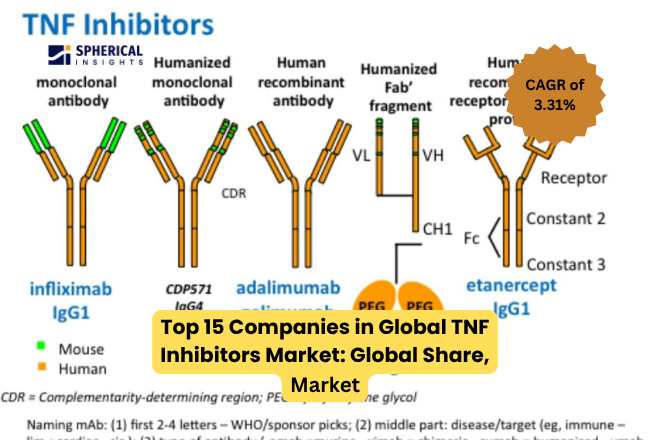
The Tumor Necrosis Factor (TNF) inhibitors market comprises biologic drugs that block TNF, a key inflammatory cytokine responsible for autoimmune diseases, thereby reducing inflammation and immune system overactivity. Tumor Necrosis Factor inhibitors are primarily derived from monoclonal antibodies and recombinant proteins produced using advanced biopharmaceutical raw materials such as cell cultures, recombinant DNA technology, and protein purification systems. The market is driven by the rising prevalence of rheumatoid arthritis, psoriasis, and inflammatory bowel diseases, along with an aging population and increasing demand for targeted therapies. Applications include rheumatology, dermatology, and gastroenterology, with rheumatoid arthritis dominating usage due to its high global incidence. Government initiatives such as drug approvals, reimbursement policies, and biosimilar promotion programs are enhancing accessibility. Recent developments include the expansion of biosimilars and new biologics that improve affordability and treatment outcomes. In 2024, advancements in targeted biologics, self-injection devices, and personalized medicine, along with increased R&D investments, are accelerating innovation and expanding therapeutic potential across chronic inflammatory diseases.
Navigate Future Markets with Confidence: Insights from Spherical Insights LLP
The insights presented in this blog are derived from comprehensive market research conducted by Spherical Insights LLP, a trusted advisory partner to leading global enterprises. Backed by in-depth data analysis, expert forecasting, and industry-specific intelligence, our reports empower decision-makers to identify strategic growth opportunities in fast-evolving sectors. Clients seeking detailed market segmentation, competitive landscapes, regional outlooks, and future investment trends will find immense value in the full report. By leveraging our research, businesses can make informed decisions, gain a competitive edge, and stay ahead in the transition toward sustainable and profitable solutions.
In March 2025, significant developments in the TNF inhibitors market were driven by increasing biosimilar adoption, with adalimumab and infliximab biosimilars gaining strong market penetration and reducing treatment costs globally. Biosimilars captured a notable share of the market, with some regions reporting nearly 30% contribution, improving patient accessibility and intensifying price competition. Additionally, pharmaceutical companies introduced advanced delivery formats such as subcutaneous injections and auto-injectors to enhance patient convenience and adherence.
Unlock exclusive market insights—Download the Brochure now and dive deeper into the future of the TNF Inhibitors Market.
Market Segmentation
Global TNF Inhibitors Market Size, Share, and COVID-19 Impact Analysis, By Drug Type (Adalimumab, Infliximab, Etanercept, Certolizumab Pegol, Golimumab), By Indication (Rheumatoid Arthritis, Psoriasis, Ankylosing Spondylitis, Inflammatory Bowel Disease, Others), By Route of Administration (Subcutaneous, Intravenous), By Distribution Channel (Hospital Pharmacies, Retail Pharmacies, Online Pharmacies), By End-User (Hospitals, Specialty Clinics, Homecare Settings), and By Region (North America, Europe, Asia Pacific, Latin America, Middle East & Africa), Analysis and Forecast, 2024–2035.
TNF Inhibitors Market Size & Statistics
- The Market Size for TNF inhibitors Was Estimated to be worth USD 24.56 billion in 2024.
- The Market is Going to Expand at a CAGR of 3.31% between 2024 and 2035.
- The Global TNF inhibitors Market Size is anticipated to reach USD 35.14 billion by 2035.
- North America is expected to generate the highest demand during the forecast period in the TNF inhibitors Market
- Asia Pacific is expected to grow the fastest during the forecast period in the TNF inhibitors Market.
Regional growth and demand
Europe is expected to grow the fastest during the forecast period in the TNF inhibitors market. The region’s growth is driven by the increasing prevalence of autoimmune diseases such as rheumatoid arthritis, psoriasis, and inflammatory bowel disease, along with the rising adoption of biosimilars across countries like Germany, France, and the UK. Strong government support through favorable reimbursement policies and initiatives promoting cost-effective biologics is enhancing patient access. Additionally, expanding healthcare infrastructure, growing awareness regarding early diagnosis, and increasing investments in biologic research and development are accelerating market growth across the region.
In February 2026, Europe witnessed a significant rise in biosimilar uptake, with reports indicating nearly a 25% increase in adoption across major countries, driven by cost-reduction strategies and government-supported substitution policies. Additionally, regulatory bodies across the EU continued promoting interchangeability guidelines for biologics, improving patient access, and encouraging competition among manufacturers.
North America is expected to generate the highest demand during the forecast period in the TNF inhibitors market. The region’s dominance is attributed to the high burden of chronic inflammatory diseases, strong presence of leading biopharmaceutical companies, and the rapid adoption of advanced biologic therapies. Favorable reimbursement frameworks, continuous innovation in monoclonal antibody treatments, and increasing availability of biosimilars are supporting market expansion. Furthermore, well-established healthcare systems and high healthcare spending contribute to sustained demand for TNF inhibitors across the region.
In December 2025, major developments included investment in biologics manufacturing expansion to strengthen TNF inhibitor supply chains and meet growing demand, particularly in the United States. Furthermore, multiple biosimilars received wider approvals and reimbursement coverage across the U.S. and Canada, intensifying competition and enhancing treatment accessibility. These advancements highlight sustained innovation, strong demand, and continuous market growth in the region.
Ready to lead the TNF Inhibitors Market?
Discover the regional trends and growth factors shaping the industry. We’re here to assist with expert, personalized data.
Call +1 303 800 4326 or Send us a message for a personalized consultation.
Top 10 Trends in the TNF Inhibitors Market
• Rising Adoption of Biosimilars
• Increasing Prevalence of Autoimmune Diseases
• Expansion of Self-Administration and Homecare Therapies
• Growing Focus on Personalized Medicine
• Technological Advancements in Biologic Drug Development
• Increasing Approvals of New Indications
• Strong Pipeline of Monoclonal Antibodies
• Favorable Government Reimbursement Policies
• Strategic Collaborations and Licensing Agreements
• Growth in Emerging Markets
Unlock exclusive market insights—Download the Brochure now and dive deeper into the future of the TNF Inhibitors Market.
Top 5 Trends
- Rising Adoption of Biosimilars
The TNF inhibitors market is witnessing strong growth due to increasing adoption of biosimilars such as adalimumab and infliximab alternatives. These cost-effective versions are significantly reducing treatment expenses and improving patient access, especially in price-sensitive markets. Governments and healthcare providers are actively promoting biosimilars through substitution policies and reimbursement support, intensifying competition and expanding market penetration globally.
- Increasing Prevalence of Autoimmune Diseases
The rising incidence of autoimmune conditions such as rheumatoid arthritis, psoriasis, and Crohn’s disease is a major driver for TNF inhibitors. Sedentary lifestyles, genetic predisposition, and environmental factors are contributing to disease prevalence. This increasing patient pool is driving demand for effective biologic therapies, positioning TNF inhibitors as a cornerstone treatment across multiple therapeutic areas.
- Expansion of Self-Administration and Homecare Therapies
There is a growing shift toward subcutaneous TNF inhibitors that allow self-administration at home. The development of user-friendly auto-injectors and prefilled syringes enhances patient convenience, adherence, and reduces hospital visits. This trend is particularly beneficial for chronic disease management and is gaining traction globally.
- Growing Focus on Personalized Medicine
Advancements in precision medicine are enabling tailored TNF inhibitor therapies based on patient-specific biomarkers and disease profiles. This approach improves treatment efficacy, reduces adverse effects, and supports optimized therapeutic outcomes. Pharmaceutical companies are increasingly investing in biomarker research to enhance targeted treatment strategies.
- Technological Advancements in Biologic Drug Development
Continuous innovation in biologics manufacturing, including recombinant DNA technology and advanced cell culture systems, is improving the safety, efficacy, and scalability of TNF inhibitors. These advancements are enabling the development of next-generation biologics with improved pharmacokinetics and reduced immunogenicity, supporting long-term market growth.
Empower your strategic planning:
Stay informed with the latest industry insights and market trends to identify new opportunities and drive growth in the TNF inhibitors market. To explore more in-depth trends, insights, and forecasts, please refer to our detailed report.
Top 15 Companies Leading the TNF Inhibitors Market
- AbbVie Inc.
- Amgen Inc.
- Johnson&Johnson (Janssen Biotech)
- Pfizer Inc.
- UCB Pharma
- Novartis AG
- Samsung Bio epis
- Biogen Inc.
- Eli Lilly and Company
- Merck & Co., Inc.
- Celltrion Healthcare
- Sandoz (Novartis division)
- Fresenius Kabi
- Lupin Limited
- Reddy’s Laboratories
- ExxonMobil Corporation
Unlock exclusive market insights—Download the Brochure now and dive deeper into the future of the TNF Inhibitors Market.
Headquarters: Irving, Texas, USA
ExxonMobil Corporation is a leading global producer of synthetic polymers, including TNF inhibitors used in adhesive formulations. The company offers high-performance APAO products under its specialty polymers portfolio, widely used in packaging, hygiene, and automotive applications. Its materials provide excellent thermal stability, adhesion, and processability. ExxonMobil focuses on innovation in polymer science and sustainable product development, including recyclable and energy-efficient materials. With strong global manufacturing capabilities and extensive R&D investments, the company plays a crucial role in advancing adhesive technologies and supporting the growth of the APAO market.
- Eastman Chemical Company
Headquarters: Kingsport, Tennessee, USA
Eastman Chemical Company manufactures specialty materials, including APAO-based products for adhesives and coatings. Its solutions are widely used in packaging, bookbinding, and nonwoven hygiene applications due to their strong bonding, flexibility, and low odor. Eastman emphasizes sustainable innovation, including circular economy initiatives and advanced recycling technologies. The company continues to expand its specialty polymer portfolio through research and strategic collaborations, strengthening its position in the global APAO market.
- Arkema S.A.
Headquarters: Colombes, France
Arkema S.A. is a global leader in specialty materials, offering advanced adhesive solutions that incorporate TNF inhibitors. The company provides high-performance materials for packaging, construction, and automotive industries. Arkema focuses on sustainability, developing bio-based and recyclable materials aligned with global environmental regulations. Its strong innovation capabilities and global presence enable it to deliver customized polymer solutions for diverse industrial applications.
- Evonik Industries AG
Headquarters: Essen, Germany
Evonik Industries AG produces specialty chemicals and performance polymers, including materials used in APAO-based adhesive systems. Its products are known for high durability, flexibility, and chemical resistance. The company invests heavily in R&D to enhance polymer performance and sustainability. Evonik supports industries such as automotive, electronics, and consumer goods with innovative material solutions, contributing significantly to market growth.
- LyondellBasell Industries N.V.
Headquarters: Rotterdam, Netherlands
LyondellBasell Industries N.V. is one of the largest plastics and chemicals companies globally, producing polyolefins used in TNF inhibitors formulations. Its materials are widely applied in packaging, automotive, and industrial sectors. The company focuses on advancing polymer processing technologies and developing sustainable solutions, including recyclable plastics and low-emission materials, strengthening its role in the APAO value chain.
Are you ready to discover more about the TNF inhibitors market?
The report provides an in-depth analysis of the leading companies operating in the global TNF inhibitors market. It includes a comparative assessment based on their product portfolios, business overviews, geographical footprint, strategic initiatives, market segment share, and SWOT analysis. Each company is profiled using a standardized format that includes:
Company Profiles
- AbbVie Inc.
- Business Overview
- Company Snapshot
- Products Overview
- Company Market Share Analysis
- Company Coverage Portfolio
- Financial Analysis
- Recent Developments
- Merger and Acquisitions
- SWOT Analysis
- Amgen Inc.
- Johnson&Johnson (Janssen Biotech)
- Pfizer Inc.
- UCB Pharma
- Novartis AG
- Samsung Bio epis
- Biogen Inc.
- Eli Lilly and Company
- Others.
Conclusion
The TNF inhibitors market is experiencing steady growth, driven by the increasing prevalence of autoimmune diseases such as rheumatoid arthritis, psoriasis, and inflammatory bowel disease, along with rising demand for effective biologic therapies. The market is strongly supported by advancements in monoclonal antibody development, expanding biosimilar availability, and growing adoption of self-administered treatments. Favorable government initiatives, including reimbursement policies and biosimilar promotion programs, are improving treatment accessibility and affordability. Leading companies continue to focus on innovation, strategic collaborations, and pipeline expansion to strengthen their market position. Additionally, increasing healthcare expenditure and improving diagnostic capabilities, especially in emerging regions, are further accelerating market growth. Overall, the TNF inhibitors market is expected to witness sustained expansion, supported by technological advancements, rising patient awareness, and continuous development of cost-effective and targeted therapeutic solutions.
Our Reports:
China Defense Electronics Market Size, Share, Forecast to 2035
India Molded Fibre Packaging Market Size, Growth, Forecast to 2035
India Acrylic Adhesives Market Size, Growth, Forecast to 2035
India Handheld Ultrasound Devices Market Size, Forecast to 2035
Unlock exclusive market insights—Download the Brochure now and dive deeper into the future of the TNF Inhibitors Market.
About the Spherical Insights & Consulting
Spherical Insights & Consulting is a market research and consulting firm which provides actionable market research study, quantitative forecasting and trends analysis provides forward-looking insight especially designed for decision makers and aids ROI. Which is catering to different industry such as financial sectors, industrial sectors, government organizations, universities, non-profits and corporations. The company's mission is to work with businesses to achieve business objectives and maintain strategic improvements.
CONTACT US:
For More Information on Your Target Market, Please Contact Us Below:
Phone: +1 303 800 4326 (the U.S.)
Phone: +91 90289 24100 (APAC)
Email: inquiry@sphericalinsights.com, sales@sphericalinsights.com
Contact Us: https://www.sphericalinsights.com/contact-us
Need help to buy this report?