Global UV-Curable Urethane Acrylate Oligomers Market Size, Share, and COVID-19 Impact Analysis, By Oligomer Type (Aliphatic Urethane Acrylates, Aromatic Urethane Acrylates, Polyether Urethane Acrylates, Polyester & Other Urethane Acrylates), By Curing Technology (UV Mercury Lamp Cure, LED-UV Cure, and EB/Other Radiation Cure), By Application (Industrial Coatings, Wood & Furniture Coatings, Graphic Arts & Inks, and Electronics & Other Uses), and By Region (North America, Europe, Asia-Pacific, Latin America, Middle East, and Africa), Analysis and Forecast 2025 - 2035
Industry: Chemicals & Materials
Global UV-Curable Urethane Acrylate Oligomers Market Size Insights Forecasts to 2035
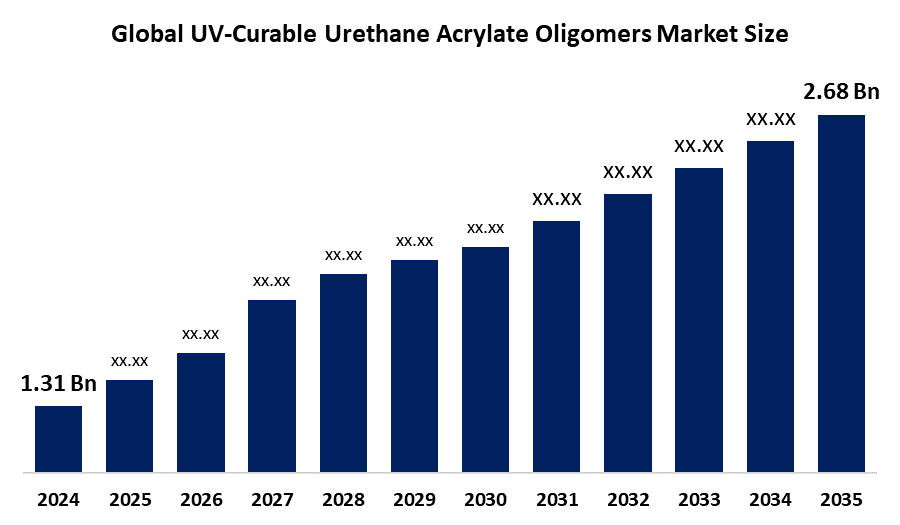
- The Global UV-Curable Urethane Acrylate Oligomers Market Size Was Estimated at USD 1.31 Billion in 2024
- The Market Size is Expected to Grow at a CAGR of around 6.72% from 2025 to 2035
- The Worldwide UV-Curable Urethane Acrylate Oligomers Market Size is Expected to Reach USD 2.68 Billion by 2035
- North America is expected to Grow the fastest during the forecast period.
Get more details on this report -
According to a Research Report Published by Spherical Insights and Consulting, The Global UV-Curable Urethane Acrylate Oligomers Market Size was worth around USD 1.31 Billion in 2024 and is predicted to Grow to around USD 2.68 Billion by 2035 with a compound annual growth rate (CAGR) of 6.72% from 2025 to 2035. The UV-curable urethane acrylate oligomers market is experiencing fast growth because industries need to use eco-friendly products that cure rapidly and provide high performance and low-VOC emissions in their automotive, electronics and packaging operations.
Market Overview
The UV-curable urethane acrylate oligomers serve as the fundamental materials that enable the creation of advanced radiation-curable systems because these materials combine polyurethane flexibility and toughness with acrylate fast curing speed. The oligomers function as vital elements which make up coatings and adhesives, printing inks, and 3D printing resins because they deliver exceptional abrasion protection, flexible performance and chemical resistance across multiple surface types. The market growth results from rising consumer preference for technologies that produce low-VOC emissions and environmental benefits because UV systems achieve 90% solvent emissions reduction when compared to traditional coatings. The increasing use of LED-UV curing technology, which reduces energy usage by 20% to 30%, drives industry growth.
The Asia Pacific region drives increased demand because its packaging and digital printing sectors maintain rapid expansion, which produces more than 40% of worldwide market requirements. The company can explore business potential through the development of bio-based urethane acrylates and advanced hybrid oligomers and their expansion into developing markets. The European Union and Environmental Protection Agency published new volatile organic compound emission regulations for coatings and adhesives in February 2026. The industry needs to adopt UV-curable low-emission systems because the new regulations prohibit high-VOC solvent systems, which create a need for the industry to change its coating and printing ink methods worldwide.
Report Coverage
This research report categorizes the UV-curable urethane acrylate oligomers market based on various segments and regions, forecasts revenue growth, and analyzes trends in each submarket. The report analyses the key growth drivers, opportunities, and challenges influencing the UV-curable urethane acrylate oligomers market. Recent market developments and competitive strategies such as expansion, type launch, development, partnership, merger, and acquisition, have been included to draw the competitive landscape in the market. The report strategically identifies and profiles the key market players and analyses their core competencies in each sub-segment of the UV-curable urethane acrylate oligomers market.
Global UV-Curable Urethane Acrylate Oligomers Market Report Coverage
| Report Coverage | Details |
|---|---|
| Base Year: | 2024 |
| Market Size in 2024 : | USD 1.31 Billion |
| Forecast Period: | 2025-2035 |
| Forecast Period CAGR 2025-2035 : | 6.72% |
| 2035 Value Projection: | USD 2.68 Billion |
| Historical Data for: | 2020-2023 |
| No. of Pages: | 179 |
| Tables, Charts & Figures: | 111 |
| Segments covered: | By Oligomer Type, By Curing Technology and COVID-19 Impact Analysis |
| Companies covered:: | Allnex Netherlands B.V., Covestro AG, BASF SE, Arkema (Sartomer), Evonik Industries AG, Alberdingk Boley GmbH, Mitsubishi Chemical Group, IGM Resins, DIC Corporation, Wanhua Chemical Group Co., Ltd., Nippon Gohsei, Resonac Holdings Corporation, Showa Denko Materials, Miwon Specialty Chemical Co., Ltd., and Others |
| Pitfalls & Challenges: | Covid 19 Impact Challenges, Future, Growth and Analysis |
Get more details on this report -
Driving Factors
The global UV-curable urethane acrylate oligomers market has primary drivers, which include industrial organizations that are adopting environmentally friendly technologies that contain no VOC emissions and provide rapid curing capabilities. Demand is increasing in the automotive, electronics, and wood-coating industries because customers require products with superior durability, flexibility, and abrasion resistance, as well as high performance. The demand for efficient and high-quality materials is rising because of improvements in UV-LED curing systems and the widespread use of 3D printing and additive manufacturing technology. European and North American environmental regulations, which restrict solvent-based emissions, are driving manufacturers to implement sustainable solutions that enable high production rates.
Restraining Factors
The global UV-curable urethane acrylate oligomers market faces restraints from high raw material costs and technical complexity. Petrochemical feedstock volatility affects margins, while regulations such as REACH increase compliance costs by 30-40%. The concentrated monomer supply creates dangers. The technical problems that researchers face include oxygen inhibition during curing and thermal degradation, which occurs at temperatures above 120°C, because these issues restrict product usability.
Market Segmentation
The UV-curable urethane acrylate oligomers market share is classified into oligomer type, curing technology, and application.
- The aliphatic urethane acrylates segment dominated the market in 2024, approximately 45% and is projected to grow at a substantial CAGR during the forecast period.
Based on the oligomer type, the UV-curable urethane acrylate oligomers market is divided into aliphatic urethane acrylates, aromatic urethane acrylates, polyether urethane acrylates, polyester & other urethane acrylates. Among these, the aliphatic urethane acrylates segment dominated the market in 2024 and is projected to grow at a substantial CAGR during the forecast period. The market for UV-curable urethane acrylate oligomers develops through aliphatic urethane acrylate compounds, which provide outstanding color stability and non-yellowing capabilities and exceptional outdoor durability. The balance between hardness and flexibility creates protective and decorative coating solutions. The system provides extensive formulation options through its ability to work with both reactive diluents and photo initiators while maintaining product appearance and curing performance throughout its industrial use period.
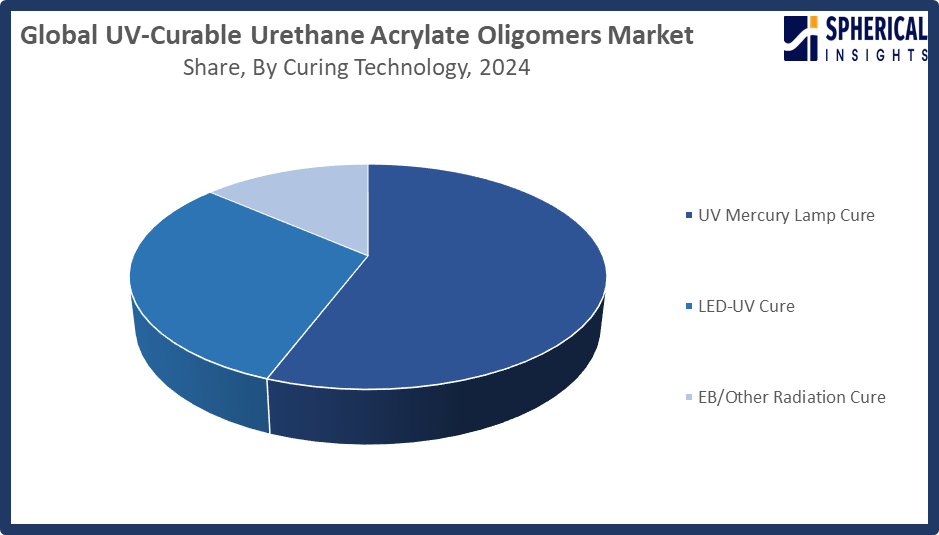
- The UV mercury lamp cure segment accounted for the largest share in 2024, approximately 56% and is anticipated to grow at a significant CAGR during the forecast period.
Based on the curing technology, the UV-curable urethane acrylate oligomers market is divided into UV mercury lamp cure, LED-UV cure, and EB/other radiation cure. Among these, the UV mercury lamp cure segment accounted for the largest share in 2024 and is anticipated to grow at a significant CAGR during the forecast period. The segment experienced market growth because it offers deep curing abilities through its intense light output, which works with existing industrial coating systems. The system provides dependable performance through its entire production process while generating consistent results and delivering affordable expenses, which makes it popular for industrial applications in coatings, inks and adhesives.
Get more details on this report -
- The industrial coatings segment accounted for the highest market revenue in 2024, approximately 40% and is anticipated to grow at a significant CAGR during the forecast period.
Based on the application, the UV-curable urethane acrylate oligomers market is divided into industrial coatings, wood & furniture coatings, graphic arts & inks, and electronics & other uses. Among these, the industrial coatings segment accounted for the highest market revenue in 2024 and is anticipated to grow at a significant CAGR during the forecast period. The UV-curable urethane acrylate oligomers market remains controlled by industrial coatings because manufacturers require surfaces that can dry quickly while maintaining strength and protection against abrasion. These oligomers enable production of high-quality products through their capacity to maintain specific linembler speeds and control thickness during the manufacturing process. Industrial applications require chemical resistance and mechanical strength, which creates a continuous demand at high volumes throughout the market.
Regional Segment Analysis of the UV-Curable Urethane Acrylate Oligomers Market
- North America (U.S., Canada, Mexico)
- Europe (Germany, France, U.K., Italy, Spain, Rest of Europe)
- Asia-Pacific (China, Japan, India, Rest of APAC)
- South America (Brazil and the Rest of South America)
- The Middle East and Africa (UAE, South Africa, Rest of MEA)
Asia Pacific is anticipated to hold the largest share of the UV-curable urethane acrylate oligomers market over the predicted timeframe.

Get more details on this report -
Asia Pacific is anticipated to hold the largest share of the UV-curable urethane acrylate oligomers market over the predicted timeframe. The market for UV-curable urethane acrylate oligomers will see its largest growth in the Asia Pacific, with approximate 45% of worldwide demand during 2024. The manufacturing sector in China, India, Japan and South Korea drives the market because these countries show strong manufacturing expansion. China at present shows the highest regional market consumption because its coatings, electronics, and packaging sectors are so large, while India sees more than 6% annual growth in its infrastructure and automotive industries. The market for the region expands because companies increasingly implement UV-LED curing technology, which decreases energy usage by 20-30%, and because environmental laws support the use of low-VOC coatings.
North America is expected to grow at a rapid CAGR in the UV-curable urethane acrylate oligomers market during the forecast period. The UV-curable urethane acrylate oligomers market in North America will experience a 25% share of rapid growth because customers demand sustainable, low-VOC coatings together with modern manufacturing methods. The United States leads regional growth because its automotive and packaging, electronics, and 3D printing sectors continue to grow. Canada creates market demand through its industrial wood coatings and green building programs. The market across the region expands because companies now implement UV-LED curing systems, which enable faster processing while consuming less energy.
The market for UV-curable urethane acrylate oligomers in Europe experiences steady growth because of strict environmental regulations and strong market demand for sustainable coatings that comply with the European Union Green Deal. Germany, France and Italy lead as the top countries for automotive and industrial coating consumption. UV systems enable users to achieve VOC emission reductions of up to 90%, which helps them meet compliance requirements. The rising adoption of UV-LED technology leads to energy efficiency gains of 20-30%, which drives regional development.
Competitive Analysis:
The report offers the appropriate analysis of the key organizations/companies involved within the UV-curable urethane acrylate oligomers market, along with a comparative evaluation primarily based on their type of offering, business overviews, geographic presence, enterprise strategies, segment market share, and SWOT analysis. The report also provides an elaborative analysis focusing on the current news and developments of the companies, which includes type development, innovations, joint ventures, partnerships, mergers & acquisitions, strategic alliances, and others. This allows for the evaluation of the overall competition within the market.
List of Key Companies
- Allnex Netherlands B.V.
- Covestro AG
- BASF SE
- Arkema (Sartomer)
- Evonik Industries AG
- Alberdingk Boley GmbH
- Mitsubishi Chemical Group
- IGM Resins
- DIC Corporation
- Wanhua Chemical Group Co., Ltd.
- Nippon Gohsei
- Resonac Holdings Corporation
- Showa Denko Materials
- Miwon Specialty Chemical Co., Ltd.
- Others
Key Target Audience
- Market Players
- Investors
- End-users
- Government Authorities
- Consulting and Research Firm
- Venture capitalists
- Value-Added Resellers (VARs)
Recent Development
- In December 2025, Covestro expanded global support for its Direct Coating in-mold technology, integrating injection molding with polyurethane coating in a two-shot process. The innovation reduces energy use and costs, eliminates traditional painting lines, shortens cycle times, and enables high-quality, design-flexible automotive plastic components with enhanced visual and haptic effects.
- In February 2025, Arkema inaugurated a new Center of Excellence for Graphic Arts in Wetherby, UK, advancing UV/LED/EB curable technologies. The facility focuses on innovative, sustainable solutions for printing, digital printing, and packaging, reinforcing Arkema’s commitment to environmentally friendly, high-performance specialty materials.
- In September 2024, allnex launched energy-curable resins for the textile and leather industry, replacing thermal curing with UV/EB technology. The innovation delivers 70-80% energy savings and significant CO2 reduction while eliminating hazardous solvents. The launch includes EBECRYL 8466, UCECOAT 2807 primer, and UCECOAT 7630 topcoat for enhanced durability, flexibility, and adhesion.
- In May 2024, DIC Corporation opened the DIC South Asia Application Lab in India, focusing on automotive and infrastructure coating resins. With India’s market growing around 9% annually, the company expands its presence via a second production site at IDEAL CHEMI PLAST, operational since February 2024.
- In September 2023, Evonik launched TEGO RC 2000 LCF, a UV LED-curable release coating made from recycled silicone feedstocks. Debuted at Label Expo Europe, it reduces energy use and carbon footprint, meets rising demand for sustainable labels, and offers excellent curing, anchorage, and ageing stability with pressure- and temperature-sensitive adhesives.
Market Segment
This study forecasts revenue at global, regional, and country levels from 2020 to 2035. Spherical Insights has segmented the UV-curable urethane acrylate oligomers market based on the below-mentioned segments:
Global UV-Curable Urethane Acrylate Oligomers Market, By Oligomer Type
- Aliphatic Urethane Acrylates
- Aromatic Urethane Acrylates
- Polyether Urethane Acrylates
- Polyester & Other Urethane Acrylates
Global UV-Curable Urethane Acrylate Oligomers Market, By Curing Technology
- UV Mercury Lamp Cure
- LED-UV Cure
- EB/Other Radiation Cure
Global UV-Curable Urethane Acrylate Oligomers Market, By Application
- Industrial Coatings
- Wood & Furniture Coatings
- Graphic Arts & Inks
- Electronics & Other Uses
Global UV-Curable Urethane Acrylate Oligomers Market, By Regional Analysis
- North America
- US
- Canada
- Mexico
- Europe
- Germany
- UK
- France
- Italy
- Spain
- Russia
- Rest of Europe
- Asia Pacific
- China
- Japan
- India
- South Korea
- Australia
- Rest of Asia Pacific
- South America
- Brazil
- Argentina
- Rest of South America
- Middle East & Africa
- UAE
- Saudi Arabia
- Qatar
- South Africa
- Rest of the Middle East & Africa
Frequently Asked Questions (FAQ)
-
1. What role does UV-LED curing technology play in shaping industry trends and innovation?Bio-based raw materials are creating growth opportunities by enabling manufacturers to meet sustainability goals and regulatory demands. Approximately 25% of new oligomer innovations now emphasize eco-friendly formulations. The demand for UV-curable resins with 30% to over 80% bio-content is growing at 12% annually in the wood coating and packaging sectors.
-
2. How are bio-based raw materials creating new growth opportunities for manufacturers?Bio-based raw materials drive growth by reducing carbon footprint and meeting sustainability demand; adoption in UV-curable urethane acrylates grew about 18% in 2025, expanding eco-friendly product portfolios and market share.
-
3. What impact do stringent environmental regulations have on product development and adoption?Stringent environmental regulations drive green innovation by up to 20-30% pollution reduction and 11% lower abatement costs, while creating market opportunities where early adopters gain a competitive advantage.
-
4. How is the growing demand for 3D printing resins influencing the development of new urethane acrylate oligomer grades?Growing 3D printing demand is prompting the development of specialized urethane acrylate oligomer grades with improved resolution and toughness. The 3D printing segment grew about 28 % in 2025, expanding product portfolios.
-
5. What opportunities exist for developing water-borne UV-curable urethane acrylate oligomers to penetrate new market segments?Water-borne UV-curable urethane acrylate oligomers offer opportunities in low-VOC, eco-friendly coatings; their adoption could grow 25-30% by 2030, opening new segments in architecture, furniture, and consumer goods while meeting strict emissions regulations.
-
6. How are advancements in catalyst and resin technology improving product performance and efficiency?Advancements in catalyst technology enable the complete hydrogenation of polymers, achieving 99.6% purity while reducing energy consumption through lower processing temperatures.
Need help to buy this report?