Brazil Green Cement Market Size, Share, and COVID-19 Impact Analysis, By Product type (Fly Ash-Based, Slag-Based, Limestone-Based, Silica Fume-Based, and Others), By Application (Residential, Commercial, Industrial, and Others), and Brazil Green Cement Market Insights, Industry Trend, Forecasts to 2035
Industry: Construction & Manufacturing
Brazil Green Cement Market Insights Forecasts to 2035
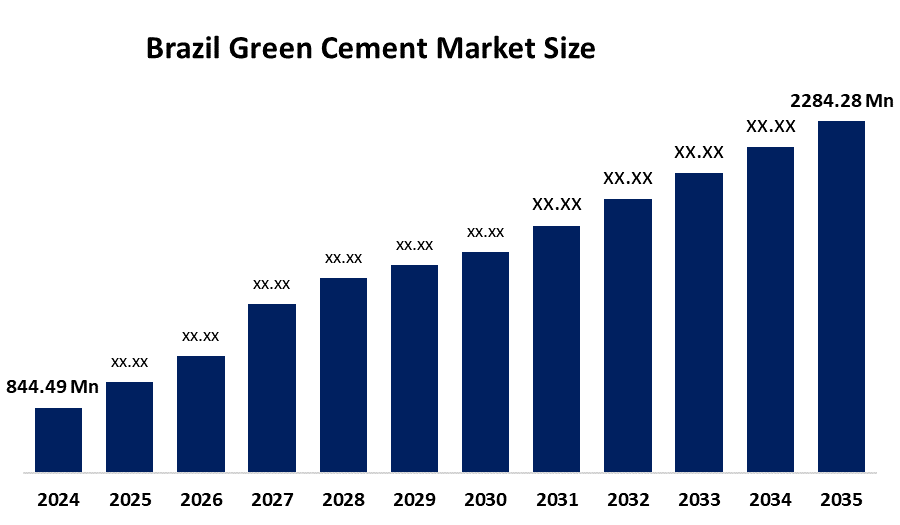
- The Brazil Green Cement Market Size Was Estimated at USD 844.49 Million in 2024
- The Market Size is Expected to Grow at a CAGR of Around 9.47% from 2025 to 2035
- The Brazil Green Cement Market Size is Expected to Reach USD 2284.28 Million by 2035
Get more details on this report -
According to a research report published by Spherical Insights & Consulting, The Brazil Green Cement Market Size is anticipated to reach USD 2284.28 Million by 2035, Growing at a CAGR of 9.47% from 2025 to 2035. The growth of the Brazil green cement market is driven by rising environmental regulations to reduce carbon emissions, increasing adoption of sustainable construction practices, and government initiatives promoting low-carbon infrastructure. Growing investments in green buildings, urbanization, and infrastructure development, along with advancements in eco-friendly cement technologies and higher awareness among builders about sustainable materials, further support market expansion.
Market Overview
The Brazil Green cement market refers to low-carbon, eco-friendly cement produced using alternative raw materials such as fly ash, slag, limestone, and recycled inputs that significantly reduce CO2 emissions compared with traditional Portland cement. The system enables sustainable construction through its application in residential, commercial, and public sector low-carbon infrastructure projects. The production process uses supplementary cementitious materials and industrial by-products which decrease clinker usage and energy requirements while improving product durability. The construction value chain advances through increased collaboration between manufacturers and research institutions and environmental agencies which drive progress in blended cements and carbon capture technologies and circular economy practices.
The Brazilian regulatory framework establishes strict environmental and safety compliance standards which achieve this transition through their enforcement. The Brazilian Institute of Environment and Renewable Natural Resources (IBAMA) enforces emission limits, environmental licensing, and pollution monitoring, which compel producers to adopt cleaner technologies and alternative fuels such as biomass. The National Environment Policy (PNMA) and Brazil's Paris Agreement commitments direct greenhouse gas reduction targets while driving industrial efficiency improvements. The technical standards for construction materials together with mandatory environmental impact assessments for new plants ensure product quality and operational safety and sustainable resource management, which supports the green cement market's long-term development.
Report Coverage
This research report categorizes the market for the Brazil green cement market based on various segments and regions, and forecasts revenue growth and analyses trends in each submarket. The report analyses the key growth drivers, opportunities, and challenges the Brazil green cement market. Recent market developments and competitive strategies, such as expansion, product launch, development, partnership, merger, and acquisition, have been included to draw the competitive landscape in the market. The report strategically identifies and profiles the key market players and analyses their core competencies in each sub-segment of the Brazil green cement market.
Brazil Green Cement Market Report Coverage
| Report Coverage | Details |
|---|---|
| Base Year: | 2024 |
| Market Size in 2024: | USD 844.49 Million |
| Forecast Period: | 2024-2035 |
| Forecast Period CAGR 2024-2035 : | CAGR of 9.47% |
| 2035 Value Projection: | USD 2284.28 Million |
| Historical Data for: | 2020-2023 |
| No. of Pages: | 210 |
| Tables, Charts & Figures: | 105 |
| Segments covered: | By Product type, By Application |
| Companies covered:: | Votorantim Cimentos, InterCement Brasil, Holcim Ltd, Cementos Argos S.A., CEMEX S.A.B. de C.V., Heidelberg Materials, Buzzi S.p.A., Companhia Siderúrgica Nacional (CSN), Secil Group, UltraTech Cement Ltd, Others, and |
| Pitfalls & Challenges: | COVID-19 Empact, Challenge, Future, Growth, & Analysis |
Get more details on this report -
Driving Factors
The Brazil green cement market is being fueled by the growing demand for green construction materials, which results from the rapid development of urban areas and new infrastructure projects. The market is experiencing growth because of three factors, which include the increasing demand for green building codes, the stricter environmental regulations that aim to decrease carbon emissions, and the governmental initiatives that target decarbonization efforts. The market benefits from the increasing development of renewable energy projects and the financial support for low-carbon infrastructure and the research and development activities that focus on blended cement and clinker-reduced cement production.
Restraining Factors
The Brazil green cement market is restricted by the fact that the cost of producing low-carbon cement is higher than that of traditional Portland cement. Contractors have two issues that make it difficult for them to comprehend the benefits of sustainable materials. The growth of the market is delayed due to three factors, which include the changes in the availability of raw materials for fly ash and slag, the need for significant budget outlays for new technology, and the process of acquiring environmental permits.
Market Segmentation
The Brazil green cement market share is classified into product type and application.
- The fly ash-based segment accounted for the largest share in 2024 and is expected to grow at a significant CAGR during the forecast period.
The Brazil green cement market is segmented by product type into fly ash-based, slag-based, limestone-based, silica fume-based, and others. Among these, the fly ash-based segment accounted for the largest share in 2024 and is expected to grow at a significant CAGR during the forecast period. The fly ash-based market is currently leading due to its cost-effectiveness, easy availability from industrial by-products, and substantial reduction in clinker content and carbon emissions. It improves the durability of concrete, workability, and long-term strength of structures, thus being in high demand for sustainable construction projects.
- The residential industrial segment dominated the share in 2024 and is anticipated to grow at a remarkable CAGR during the forecast period.
The Brazil green cement market is segmented by application into residential, commercial, industrial, others. Among these, the residential segment dominated the share in 2024 and is anticipated to grow at a remarkable CAGR during the forecast period. The growth of the residential segment is driven by expanding urban housing projects, rising population, increasing demand for eco-friendly homes, and supportive government housing initiatives. Greater awareness of sustainable construction materials and green building certifications further accelerates adoption of green cement in residential developments.
Competitive Analysis:
The report offers the appropriate analysis of the key organizations/companies involved within the Brazil green cement market, along with a comparative evaluation primarily based on their product offering, business overviews, geographic presence, enterprise strategies, segment market share, and SWOT analysis. The report also provides an elaborate analysis focusing on the current news and developments of the companies, which includes product development, innovations, joint ventures, partnerships, mergers & acquisitions, strategic alliances, and others. This allows for the evaluation of the overall competition within the market.
List of Key Companies
- Votorantim Cimentos
- InterCement Brasil
- Holcim Ltd
- Cementos Argos S.A.
- CEMEX S.A.B. de C.V.
- Heidelberg Materials
- Buzzi S.p.A.
- Companhia Siderúrgica Nacional (CSN)
- Secil Group
- UltraTech Cement Ltd
- Others
Key Target Audience
- Market Players
- Investors
- End-users
- Government Authorities
- Consulting and Research Firm
- Venture capitalists
- Value-Added Resellers (VARs)
Recent Developments:
- In February 2026, CEMEX S.A.B. de C.V. invested in a startup that converts non-recyclable waste into low-carbon fuel, strengthening alternative energy adoption and accelerating decarbonization efforts across cement manufacturing operations.
- In January 2026, Votorantim Cimentos reported strong cement demand and increased profits, supported by rising infrastructure investments, improved operational efficiency, and growing focus on sustainable and low-carbon cement production initiatives.
- In March 2025, On January 16, 2024, Atlas Renewable Energy and Votorantim Cimentos signed a 15-year, 100 MW solar PPA in Brazil, advancing decarbonization and supporting one-third of the company’s national energy consumption.
Market Segment
This study forecasts revenue at the Brazil, regional, and country levels from 2020 to 2035. Spherical Insights has segmented the Brazil green cement market based on the below-mentioned segments:
Brazil Green Cement Market, By Product type
- Fly Ash-Based
- Slag-Based
- Limestone-Based
- Silica Fume-Based
- Others
Brazil Green Cement Market, By Application
- Residential
- Commercial
- Industrial
- Others
Frequently Asked Questions (FAQ)
-
Q: What is the Brazil green cement market size?A: The Brazil green cement market is expected to grow from USD 844.49 million in 2024 to USD 2284.28million by 2035, registering a CAGR of 9.47% during the forecast period 2025–2035.
-
Q: What are the key growth drivers of the market?A: Market growth is driven by rising sustainable construction demand, urbanization, stricter carbon regulations, green building adoption, infrastructure expansion, renewable energy projects, and increasing investment in low-carbon cement technologies.
-
Q: What factors restrain the Brazil green cement market?A: High production costs, price sensitivity, limited awareness, fluctuating availability of fly ash and slag, regulatory compliance expenses, and slow adoption among small contractors restrain market growth.
-
Q: How is the market segmented by application?A: The market is segmented into residential construction, commercial buildings, industrial infrastructure, and public infrastructure projects including roads, bridges, and urban development.
-
Q: Who are the key players in the Brazil green cement market?A: Key players include Votorantim Cimentos, InterCement Brasil, Holcim, Heidelberg Materials, Cementos Argos, CEMEX, CSN Cimentos, and other regional cement manufacturers and other
-
Q: Who are the target audiences for this market report?A: The report is intended for manufacturers, investors, utilities, EPC companies, policymakers, research and consulting firms, distributors, and other stakeholders across the electrical and power sectors.
Need help to buy this report?