Global Triethylene Glycol Market Size, Share, and COVID-19 Impact Analysis, By Grade (Technical Grade, Pharmaceutical Grade, and Food Grade), By Application (Natural Gas Dehydration, Solvents, Plasticizers, Humectants, Polyester Resins, and Others), By End-use (Oil and Gas, Automotive, Textile, Construction, and Others), and By Region (North America, Europe, Asia-Pacific, Latin America, Middle East, and Africa), Analysis and Forecast 2025 - 2035
Industry: Chemicals & Materials
Global Triethylene Glycol Market Size Insights Forecasts to 2035
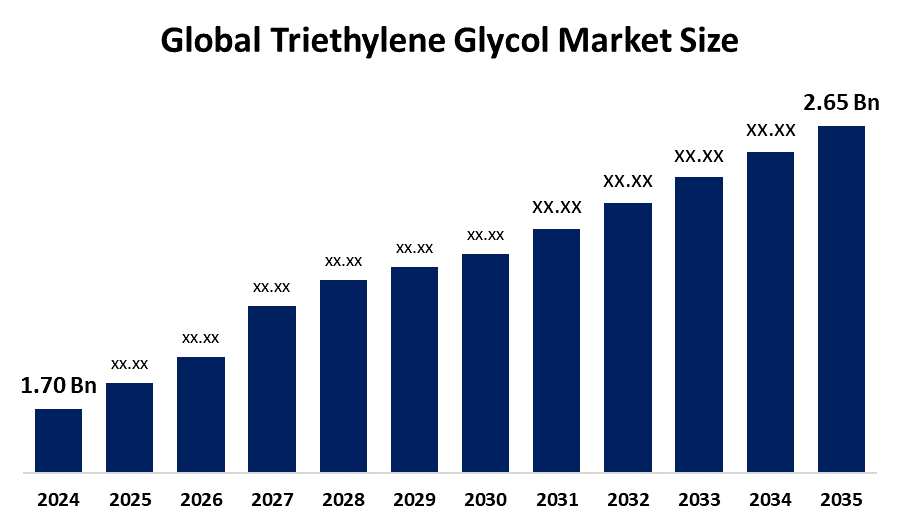
- The Global Triethylene Glycol Market Size Was Estimated at USD 1.70 Billion in 2024
- The Market Size is Expected to Grow at a CAGR of around 4.12% from 2025 to 2035
- The Worldwide Triethylene Glycol Market Size is Expected to Reach USD 2.65 Billion by 2035
- North America is expected to Grow the fastest during the forecast period.
Get more details on this report -
According to a Research Report Published by Spherical Insights and Consulting, The Global Triethylene Glycol Market Size was worth around USD 1.70 Billion in 2024 and is predicted to Grow to around USD 2.65 Billion by 2035 with a compound annual growth rate (CAGR) of 4.12% from 2025 to 2035. The triethylene glycol (TEG) market is growing because natural gas dehydration needs plasticizer production requirements, and the textile and automotive industry needs are increasing amounts. The market grows because TEG prevents corrosion, and companies choose environmentally friendly solvent alternatives.
Market Overview
Triethylene glycol (TEG) is the fundamental substance defining the worldwide triethylene glycol market because it is a colourless, odourless liquid that absorbs water through its hygroscopic nature while maintaining low evaporation rates. TEG serves its primary role in natural gas dehydration because it extracts water to stop pipeline corrosion and hydrate formation while also functioning as a solvent and plasticizer and humectant, polyester resin, and coating intermediate. The market experiences expansion through two main factors, which include increasing natural gas production, developing LNG infrastructure and increasing demand from petrochemical and polymer production facilities. Natural gas dehydration processes use TEG consumption at a rate of 47%, which establishes this application as the primary method for TEG usage in the global market.
The Asia-Pacific region presents emerging business possibilities because its industrial growth and petrochemical production capabilities increase, while investments in premium sustainable TEG products rise. The world experiences steady market growth and increasing demand throughout all regions due to these combined factors. In December 2025, India establishes self-reliance through Make in India and Aatma Nirbhar Bharat programs, which will increase chemicals and petrochemicals investments to reach INR 8 lakh crore by 2025. The initiative will enhance triethylene glycol production in India to meet domestic needs for natural gas dehydration operations and plasticizer usage.
Report Coverage
This research report categorizes the triethylene glycol market based on various segments and regions, forecasts revenue growth, and analyzes trends in each submarket. The report analyses the key growth drivers, opportunities, and challenges influencing the triethylene glycol market. Recent market developments and competitive strategies, such as expansion, type launch, development, partnership, merger, and acquisition, have been included to draw the competitive landscape in the market. The report strategically identifies and profiles the key market players and analyses their core competencies in each sub-segment of the triethylene glycol market.
Global Triethylene Glycol Market Report Coverage
| Report Coverage | Details |
|---|---|
| Base Year: | 2024 |
| Market Size in 2024 : | USD 1.70 Billion |
| Forecast Period: | 2025-2035 |
| 2035 Value Projection: | USD 2.65 Billion |
| Historical Data for: | 2020-2023 |
| No. of Pages: | 187 |
| Tables, Charts & Figures: | 104 |
| Segments covered: | By Grade, By Application and COVID-19 Impact Analysis |
| Companies covered:: | Dow, BASF SE, SABIC, Huntsman Corporation, Shell Chemicals, LyondellBasell Industries, PTT Global Chemical, Eastman Chemicals, Mitsubishi Chemical Corporation, Nanya Plastic, India Glycols Limited, Arham Petrochem, Exxon Mobil Corporation, Sinopec Yangzi Petrochemical, and Others |
| Pitfalls & Challenges: | Covid 19 Impact Challenges, Future, Growth and Analysis |
Get more details on this report -
Driving Factors
The global triethylene glycol (TEG) market exists because TEG functions as a vital element in natural gas dehydration processes, demand for plasticizers continues to increase, and TEG usage as a humectant in personal care products expands. The growing demand for natural gas as a cleaner energy source makes TEG essential for removing water vapor from natural gas streams, which protects pipelines from corrosion while supporting efficient energy production. The application stands as the main market segment that shows growth because global demand for natural gas increases. The International Energy Agency (IEA) reports that worldwide natural gas usage grew by 2.8% during 2024, which created higher TEG requirements for dehydration systems operating in important gas-producing areas.
Restraining Factors
The global triethylene glycol (TEG) market faces major obstacles because raw material prices (ethylene oxide) experience fluctuations, environmental regulations become increasingly stringent and alternative desiccants gain market share. TEG production requires ethylene oxide, which manufacturers obtain from naphtha and natural gas sources, resulting in production cost fluctuations. The naphtha price increase of 15% during 2024 created production cost uncertainty for manufacturers, which resulted in pricing difficulties that decreased their profit margins.
Market Segmentation
The triethylene glycol market share is classified into grade, application, and end-use.
- The technical grade segment dominated the market in 2024, approximately 64% and is projected to grow at a substantial CAGR during the forecast period.
Based on the grade, the triethylene glycol market is divided into technical grade, pharmaceutical grade, and food grade. Among these, the technical grade segment dominated the market in 2024, approximately 64% and is projected to grow at a substantial CAGR during the forecast period. Industrial facilities use the product extensively, which enables the company to maintain its market position. Technical Grade TEG operates as the primary solution for customers because the product provides efficient performance and dependable results, and affordable pricing. The product functions as the ideal solution for various industrial needs because it combines effective performance and dependable results, and affordable cost.
- The natural gas dehydration segment accounted for the largest share in 2024, approximately 47% and is anticipated to grow at a significant CAGR during the forecast period.
Based on the application, the triethylene glycol market is divided into natural gas dehydration, solvents, plasticizers, humectants, polyester resins, and others. Among these, the natural gas dehydration segment accounted for the largest share in 2024, approximately 47% and is anticipated to grow at a significant CAGR during the forecast period. Natural gas processing requirements create the highest demand for this business segment. TEG serves as the primary drying agent, which stops hydrate formation to safeguard pipelines from harm. The industry maintains its leading position because of the worldwide increase in gas consumption and the growth of infrastructure development. The energy sector will create strong TEG requirements in 2025 through its energy projects and advanced gas processing technologies.
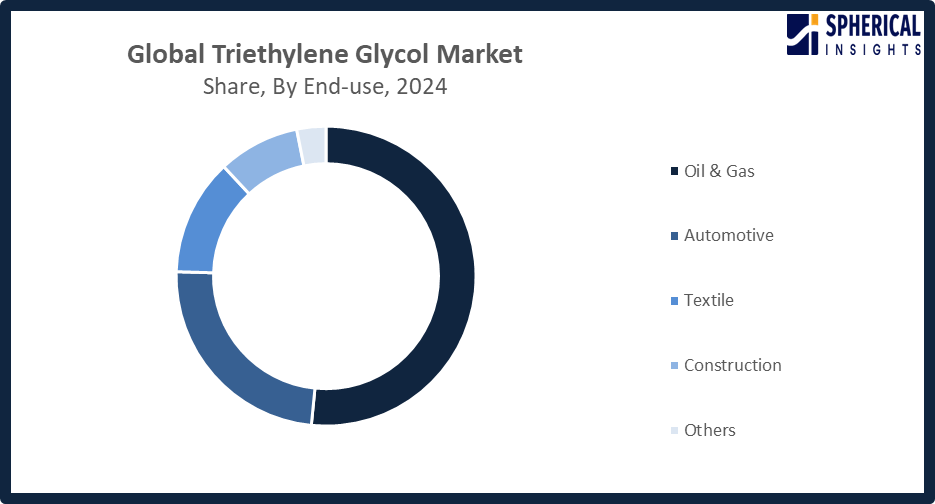
- The oil and gas segment accounted for the highest market revenue in 2024, approximately 51% and is anticipated to grow at a significant CAGR during the forecast period.
Based on the end-use, the triethylene glycol market is divided into oil and gas, automotive, textile, construction, and others. Among these, the oil and gas segment accounted for the highest market revenue in 2024, approximately 51% and is anticipated to grow at a significant CAGR during the forecast period. The strong market position of TEG derives from its essential function in natural gas dehydration processes, which prevents hydrate formation and protects pipeline systems. The market requires more products because of increased oil and gas exploration activities, offshore drilling operations, and pipeline construction. The Oil and Gas sector will continue to lead the market because of upcoming global energy infrastructure developments.
Get more details on this report -
Regional Segment Analysis of the Triethylene Glycol Market
- North America (U.S., Canada, Mexico)
- Europe (Germany, France, U.K., Italy, Spain, Rest of Europe)
- Asia-Pacific (China, Japan, India, Rest of APAC)
- South America (Brazil and the Rest of South America)
- The Middle East and Africa (UAE, South Africa, Rest of MEA)
Asia Pacific is anticipated to hold the largest share of the triethylene glycol market over the predicted timeframe.

Get more details on this report -
Asia Pacific is anticipated to hold the largest share of the triethylene glycol market over the predicted timeframe. The triethylene glycol market will reach its 60% share in the Asia Pacific region because industrial growth, petrochemical development and natural gas processing capacity will increase in this area. The major contributors are China, India, Japan and South Korea. China leads with its extensive chemical production capabilities and its developing LNG infrastructure system. The demand in India increases because of its growing natural gas needs and industrial programs supported by the government. The advanced polymer, automotive and electronics industries in Japan and South Korea create demand for TEG, which they use in dehydration, solvent and resin functions.
North America is expected to grow at a rapid CAGR in the triethylene glycol market during the forecast period. The triethylene glycol market in North America will experience a 30% share in rapid growth because natural gas production increases, shale gas exploration expands, and LNG export capacity rises. The United States drives regional expansion through its extensive spending on pipeline systems and gas processing plants, which use TEG for dehydration processes. Canada contributes to the market through its oil sands operations and natural gas initiatives. The region experiences steady demand because of the combination of strict environmental rules and advancements in energy processing technology.
The European triethylene glycol market expands because of strict environmental regulations, cutting-edge chemical production methods, and the growth of natural gas transportation systems. The German petrochemical and automotive sectors create demand for TEG in resin and plastic manufacturing. The United Kingdom and Norway contribute through offshore gas production and pipeline projects, where TEG is essential for dehydration. The regional demand increase receives support from sustainability programs and energy security initiatives.
Competitive Analysis:
The report offers the appropriate analysis of the key organizations/companies involved within the triethylene glycol market, along with a comparative evaluation primarily based on their type of offering, business overviews, geographic presence, enterprise strategies, segment market share, and SWOT analysis. The report also provides an elaborative analysis focusing on the current news and developments of the companies, which includes type development, innovations, joint ventures, partnerships, mergers & acquisitions, strategic alliances, and others. This allows for the evaluation of the overall competition within the market.
List of Key Companies
- Dow
- BASF SE
- SABIC
- Huntsman Corporation
- Shell Chemicals
- LyondellBasell Industries
- PTT Global Chemical
- Eastman Chemicals
- Mitsubishi Chemical Corporation
- Nanya Plastic
- India Glycols Limited
- Arham Petrochem
- Exxon Mobil Corporation
- Sinopec Yangzi Petrochemical
- Others
Key Target Audience
- Market Players
- Investors
- End-users
- Government Authorities
- Consulting and Research Firm
- Venture capitalists
- Value-Added Resellers (VARs)
Recent Development
- In January 2026, BASF has commissioned a steam cracker at its new Verbund site in Zhanjiang, powered entirely by renewable energy for its main compressors. With one million metric tons of annual ethylene capacity, the cracker anchors integrated chemical production at the complex.
- In October 2025, Dow Inc. has finalized an agreement with MEGlobal to supply an additional 100 KTA of ethylene from its Gulf Coast operations. The feedstock will support MEGlobal’s ethylene glycol facility at the co-located Oyster Creek manufacturing site.
- In December 2023, INEOS agreed to acquire LyondellBasell's Ethylene Oxide and Derivatives business in Texas for $700 million. The deal includes plants producing ethylene oxide, glycols, and glycol ethers. This strategic acquisition strengthens INEOS's position in supplying essential raw materials for pharmaceuticals, semiconductors, and consumer goods.
Market Segment
This study forecasts revenue at global, regional, and country levels from 2020 to 2035. Spherical Insights has segmented the triethylene glycol market based on the below-mentioned segments:
Global Triethylene Glycol Market, By Grade
- Technical Grade
- Pharmaceutical Grade
- Food Grade
Global Triethylene Glycol Market, By Application
- Natural Gas Dehydration
- Solvents
- Plasticizers
- Humectants
- Polyester Resins
- Others
Global Triethylene Glycol Market, By End-use
- Oil & Gas
- Automotive
- Textile
- Construction
- Others
Global Triethylene Glycol Market, By Regional Analysis
- North America
- US
- Canada
- Mexico
- Europe
- Germany
- UK
- France
- Italy
- Spain
- Russia
- Rest of Europe
- Asia Pacific
- China
- Japan
- India
- South Korea
- Australia
- Rest of Asia Pacific
- South America
- Brazil
- Argentina
- Rest of South America
- Middle East & Africa
- UAE
- Saudi Arabia
- Qatar
- South Africa
- Rest of the Middle East & Africa
Frequently Asked Questions (FAQ)
-
1. How is the surging demand for natural gas dehydration influencing the consumption of triethylene glycol?Surging natural gas production, exceeding 4,100 billion cubic meters, directly increases TEG consumption, as it is the primary desiccant for dehydrating raw gas to prevent pipeline corrosion and ensure safe transport.
-
2. What role do government initiatives like India's Make in India and Aatma Nirbhar Bharat play in shaping regional TEG demand?These initiatives boost regional TEG demand by targeting INR 8 lakh crore in chemical sector investments, strengthening domestic production of glycol derivatives for natural gas dehydration and plasticizer applications nationwide.
-
3. How have recent U.S. trade policies and tariffs in 2025 impacted the global supply chain for triethylene glycol?Recent 2025 U.S. tariffs triggered global trade disruptions, with US TEG prices spiking 9.55% as Chinese exports diverted to Asia, pressuring regional markets and threatening a 15% drop in global petrochemical trade.
-
4. How does feedstock innovation, such as using refinery ethane for crackers, help optimize costs in ethylene glycol production?Feedstock innovation using refinery ethane reduces production costs by utilizing inexpensive by-products, diversifying sources to avoid price volatility, and enhancing energy efficiency for greater profitability in ethylene glycol manufacturing.
-
5. What is the significance of INEOS's 2023 acquisition of LyondellBasell's ethylene oxide and derivatives business for the TEG value chain?The acquisition strengthens the TEG value chain by giving INEOS access to cost-advantaged U.S. feedstocks, expanding its production capacity for ethylene glycols (375 kt), and mitigating high European production costs for derivatives like TEG.
-
6. What are the key challenges posed by raw material price volatility, such as ethylene price spikes, on TEG manufacturing?Ethylene price spikes directly squeeze TEG manufacturers' profit margins. In October 2025, a 5.53% increase in ethylene oxide prices contributed to a 9.55% surge in US TEG prices, demonstrating how raw material volatility drives production costs and market instability.
Need help to buy this report?