Global Terbinafine Hydrochloride Drug Market Size, Share, and COVID-19 Impact Analysis, By Formulation (Tablets, Creams, Sprays, Gels, and Others), By Application (Dermatophytosis, Onychomycosis, and Others), and By Region (North America, Europe, Asia-Pacific, Latin America, Middle East, and Africa), Analysis and Forecast 2025 - 2035
Industry: Healthcare
Global Terbinafine Hydrochloride Drug Market Size Insights Forecasts to 2035
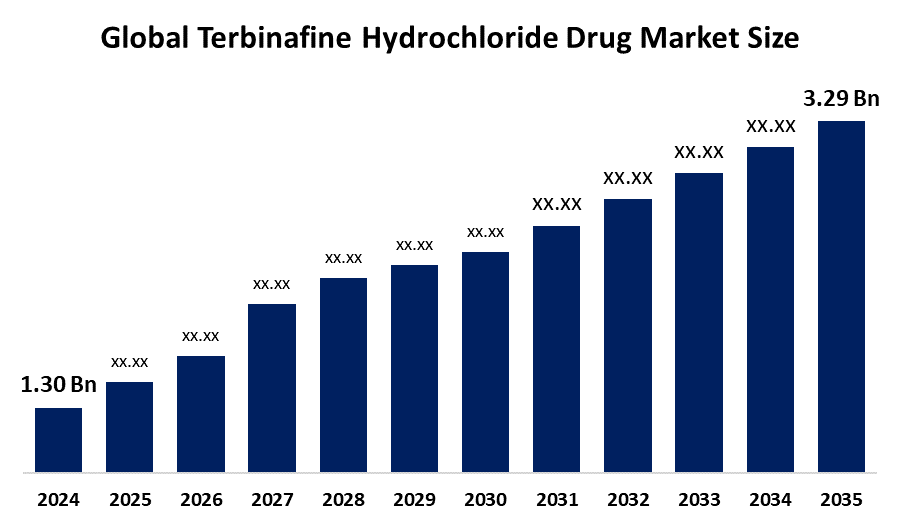
- The Global Terbinafine Hydrochloride Drug Market Size Was Estimated at USD 1.30 Billion in 2024
- The Market Size is Expected to Grow at a CAGR of around 8.81% from 2025 to 2035
- The Worldwide Terbinafine Hydrochloride Drug Market Size is Expected to Reach USD 3.29 Billion by 2035
- Europe is expected to Grow the fastest during the forecast period.
Get more details on this report -
According to a Research Report Published by Spherical Insights and Consulting, The Global Terbinafine Hydrochloride Drug Market Size was valued at around USD 1.30 Billion in 2024 and is predicted to Grow to around USD 3.29 Billion by 2035 with a compound annual growth rate (CAGR) of 8.81 % from 2025 to 2035. The market for terbinafine hydrochloride drugs offers opportunities for growing antifungal treatments, rising fungal infection rates, an aging population, more awareness, and the possibility of novel formulations and worldwide market penetration.
Market Overview
The production and distribution, and selling and using of terbinafine hydrochloride, which is a synthetic antifungal drug from the allylamine class, make up the worldwide pharmaceutical market known as the terbinafine hydrochloride drug market. The medication serves as a treatment for dermatophyte infections, which include onychomycosis, tinea pedis, tinea corporis, and various other superficial fungal skin disorders. The product mainly exists in the market asoral tablets and topical creams, sprays, and various other product forms. The terbinafine hydrochloride drug market includes multiple stakeholders, who include pharmaceutical producers, healthcare providers, distributors, and end users, while market demand and clinical effectiveness, regulatory approvals, and patent rights distribution affect market operations. The rising incidence of fungal infections, improvements in medication formulations, and more knowledge of antifungal therapies are all factors contributing to the market's expansion. The increasing prevalence of fungal infections globally is one of the primary drivers of the terbinafine hydrochloride drug market growth.
Report Coverage
This research report categorizes the terbinafine hydrochloride drug market based on various segments and regions, forecasts revenue growth, and analyzes trends in each submarket. The report analyses the key growth drivers, opportunities, and challenges influencing the terbinafine hydrochloride drug market. Recent market developments and competitive strategies, such as expansion, product launch, development, partnership, merger, and acquisition, have been included to draw the competitive landscape in the market. The report strategically identifies and profiles the key market players and analyzes their core competencies in each sub-segment of the terbinafine hydrochloride drug market.
Global Terbinafine Hydrochloride Drug Market Report Coverage
| Report Coverage | Details |
|---|---|
| Base Year: | 2024 |
| Market Size in 2024: | USD 1.30 Billion |
| Forecast Period: | 2025-2035 |
| Forecast Period CAGR 2025-2035 : | 8.81% |
| 2035 Value Projection: | USD 3.29 Billion |
| Historical Data for: | 2020-2023 |
| No. of Pages: | 288 |
| Tables, Charts & Figures: | 112 |
| Segments covered: | By Formulation, By Application and COVID-19 Impact Analysis |
| Companies covered:: | Alkem Laboratories Ltd., Apotex Inc., Aurobindo Pharma Ltd., Cipla Inc., Dr. Reddy’s Laboratories Ltd., Glenmark Pharmaceuticals Ltd., Hikma Pharmaceuticals PLC, Lupin Limited, Novartis AG, Sandoz International GmbH, Sun Pharmaceutical Industries Ltd., Teva Pharmaceutical Industries Ltd., Torrent Pharmaceuticals Ltd., Zydus Cadila, and Others |
| Pitfalls & Challenges: | COVID-19 Empact, Challenge, Future, Growth, & Analysis |
Get more details on this report -
Driving Factors
Pharmaceutical formulation innovations have also been crucial to the expansion of the market. The global prevalence of fungal infections, growing awareness of the need for prompt antifungal treatment, improvements in drug delivery systems, and the expansion of healthcare infrastructure are all factors driving the terbinafine hydrochloride drug market's growth. Additionally, the terbinafine hydrochloride drug market will probably continue to be driven by continuing research and development initiatives targeted at finding new indications and improving dose schedules. Another important element driving market expansion is rising patient and healthcare professional knowledge of antifungal medicines.
Restraining Factors
High treatment costs, possible adverse effects, stringent regulatory approvals, low awareness in some areas, and the availability of alternative antifungal therapies are some of the factors that restrict the terbinafine hydrochloride drug market.
Market Segmentation
The terbinafine hydrochloride drug market share is classified into formulation and application.
- The tablets segment accounted for the largest share in 2024 and is anticipated to grow at a significant CAGR during the forecast period.
Based on the formulation, the terbinafine hydrochloride drug market is divided into tablets, creams, sprays, gels, and others. Among these, the tablets segment accounted for the largest share in 2024 and is anticipated to grow at a significant CAGR during the forecast period. Onychomycosis and dermatophytosis are frequently treated with oral terbinafine tablets, which provide systemic therapy that guarantees complete fungus elimination. Tablets are a popular option for both consumers and healthcare professionals due to their high bioavailability and shown effectiveness.
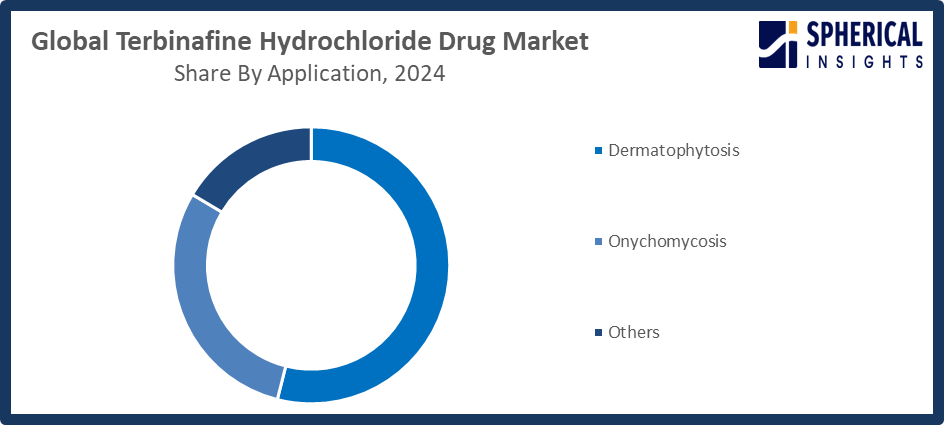
- The dermatophytosis segment accounted for the highest market revenue in 2024 and is anticipated to grow at a significant CAGR during the forecast period.
Based on the application, the terbinafine hydrochloride drug market is divided into dermatophytosis, onychomycosis, and others. Among these, the dermatophytosis segment accounted for the highest market revenue in 2024 and is anticipated to grow at a significant CAGR during the forecast period. Ringworm, or dermatophytosis, is a common fungal infection that affects the skin, hair, and nails. Terbinafine hydrochloride and other efficient antifungal therapies are in high demand due to the high occurrence of dermatophytosis, especially in tropical and subtropical countries.
Get more details on this report -
Regional Segment Analysis of the Terbinafine Hydrochloride Drug Market
- North America (U.S., Canada, Mexico)
- Europe (Germany, France, U.K., Italy, Spain, Rest of Europe)
- Asia-Pacific (China, Japan, India, Rest of APAC)
- South America (Brazil and the Rest of South America)
- The Middle East and Africa (UAE, South Africa, Rest of MEA)
Asia Pacific is anticipated to hold the largest share of the terbinafine hydrochloride drug market over the predicted timeframe.

Get more details on this report -
Asia Pacific is anticipated to hold the largest share of the terbinafine hydrochloride drug market over the predicted timeframe. The Asian Pacific region has tropical or subtropical temperatures with a higher prevalence of fungal infections; the region is a significant market for terbinafine hydrochloride medications. People easily obtain and purchase Terbinafine Hydrochloride items due to rising disposable income levels and China's and India's expanding pharmaceutical manufacturing capabilities. The region's vast population base, growing healthcare costs, and easier access to medical facilities all play a major role in the market's expansion. Because China and India produce more than 70 billion units annually for both local and international markets, they, along with Japan, hold the top spot in the market.
Europe is expected to grow at a rapid CAGR in the terbinafine hydrochloride drug market during the forecast period. The aging population and rising prevalence of fungal infections in the area are driving up demand for terbinafine hydrochloride medications. The primary causes of this rise include high healthcare expenditures, growing awareness of fungal diseases, and the presence of established healthcare infrastructure in countries like Germany, the UK, and France. Moderate-to-rapid growth is attributed to a well-established pharmaceutical presence, a focus on public health, and growing demand for both oral and topical formulations; some projections predict a CAGR of 4.8–6%+ through 2032–2033.
Competitive Analysis:
The report offers the appropriate analysis of the key organizations/companies involved within the terbinafine hydrochloride drug market, along with a comparative evaluation primarily based on their product offering, business overviews, geographic presence, enterprise strategies, segment market share, and SWOT analysis. The report also provides an elaborative analysis focusing on the current news and developments of the companies, which includes product development, innovations, joint ventures, partnerships, mergers & acquisitions, strategic alliances, and others. This allows for the evaluation of the overall competition within the market.
List of Key Companies
- Alkem Laboratories Ltd.
- Apotex Inc.
- Aurobindo Pharma Ltd.
- Cipla Inc.
- Dr. Reddy's Laboratories Ltd.
- Glenmark Pharmaceuticals Ltd.
- Hikma Pharmaceuticals PLC
- Lupin Limited
- Novartis AG
- Sandoz International GmbH
- Sun Pharmaceutical Industries Ltd.
- Teva Pharmaceutical Industries Ltd.
- Torrent Pharmaceuticals Ltd.
- Zydus Cadila
- Others
Key Target Audience
- Market Players
- Investors
- End-users
- Government Authorities
- Consulting and Research Firm
- Venture capitalists
- Value-Added Resellers (VARs)
Recent Development
- In January 2024, Medexus Pharmaceuticals announced that Health Canada has accepted its new drug submission for terbinafine hydrochloride nail lacquer, advancing the company toward a planned commercial launch in Canada during the first half of 2025.
Market Segment
This study forecasts revenue at global, regional, and country levels from 2020 to 2035. Spherical Insights has segmented the terbinafine hydrochloride drug market based on the below-mentioned segments:
Global Terbinafine Hydrochloride Drug Market, By Formulation
- Tablets
- Creams
- Sprays
- Gels
- Others
Global Terbinafine Hydrochloride Drug Market, By Application
- Dermatophytosis
- Onychomycosis
- Others
Global Terbinafine Hydrochloride Drug Market, By Regional Analysis
- North America
- US
- Canada
- Mexico
- Europe
- Germany
- UK
- France
- Italy
- Spain
- Russia
- Rest of Europe
- Asia Pacific
- China
- Japan
- India
- South Korea
- Australia
- Rest of Asia Pacific
- South America
- Brazil
- Argentina
- Rest of South America
- Middle East & Africa
- UAE
- Saudi Arabia
- Qatar
- South Africa
- Rest of the Middle East & Africa
Frequently Asked Questions (FAQ)
-
1. What is the CAGR of the terbinafine hydrochloride drug market over the forecast period?The global Terbinafine Hydrochloride Drug market is projected to expand at a CAGR of 8.81 % during the forecast period.
-
2. What is the market size of the terbinafine hydrochloride drug market?The global terbinafine hydrochloride drug market size is expected to grow from USD 1.30 billion in 2024 to USD 3.29 billion by 2035, at a CAGR of 8.81 % during the forecast period 2025-2035.
-
3. Which region holds the largest share of the terbinafine hydrochloride drug market?Asia Pacific is anticipated to hold the largest share of the terbinafine hydrochloride drug market over the predicted timeframe.
-
4. Who are the top companies operating in the global terbinafine hydrochloride drug market?Alkem Laboratories Ltd., Apotex Inc., Aurobindo Pharma Ltd., Cipla Inc., Dr. Reddy's Laboratories Ltd., Glenmark Pharmaceuticals Ltd., Hikma Pharmaceuticals PLC, Lupin Limited, Novartis AG, Sandoz International GmbH, Sun Pharmaceutical Industries Ltd., Teva Pharmaceutical Industries Ltd., Torrent Pharmaceuticals Ltd., Zydus Cadila, and Others.
-
5. What factors are driving the growth of the terbinafine hydrochloride drug market?Rising prevalence of fungal infections, increasing geriatric population, growing healthcare awareness, advancements in drug formulations, expanding healthcare infrastructure, and higher accessibility of antifungal treatments are driving the terbinafine hydrochloride drug market growth.
-
6. What are the market trends in the terbinafine hydrochloride drug market?Trends include the development of innovative topical and oral formulations, increasing adoption of combination therapies, growing focus on patient compliance, rising investment in R&D, and expanding presence in emerging markets.
-
7. What are the main challenges restricting the wider adoption of the terbinafine hydrochloride drug market?High treatment costs, potential side effects, stringent regulatory approvals, limited awareness in certain regions, and the availability of alternative antifungal therapies restrict the wider adoption of Terbinafine Hydrochloride drugs.
Need help to buy this report?