Global Natural Mineral Oil Coolant Market Size, Share, and COVID-19 Impact Analysis, By Coolant Type (Paraffin-based Mineral Oil Coolant, Naphthenic Mineral Oil Coolant, and Others), By Application (Industrial Equipment, Data Center, Automobile, and Others), and By Region (North America, Europe, Asia-Pacific, Latin America, Middle East, and Africa), Analysis and Forecast 2025 - 2035
Industry: Chemicals & Materials
Global Natural Mineral Oil Coolant Market Size Insights Forecasts to 2035
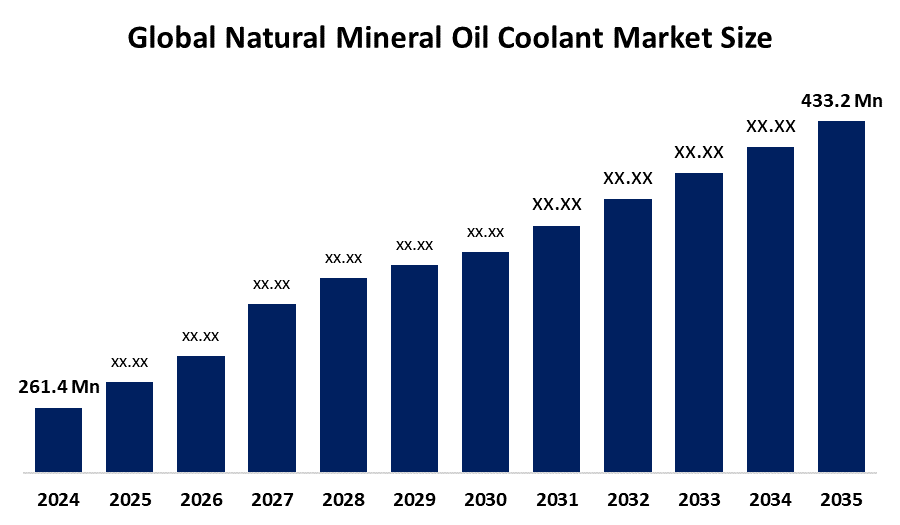
- The Global Natural Mineral Oil Coolant Market Size Was Estimated at USD 261.4 Million in 2024
- The Market Size is Expected to Grow at a CAGR of around 4.7% from 2025 to 2035
- The Worldwide Natural Mineral Oil Coolant Market Size is Expected to Reach USD 433.2 Million by 2035
- North America is expected to Grow the fastest during the forecast period.
Get more details on this report -
According to a Research Report Published by Spherical Insights and Consulting, The Global Natural Mineral Oil Coolant Market Size was worth around USD 261.4 Million in 2024 and is predicted to Grow to around USD 433.2 Million by 2035 with a compound annual growth rate (CAGR) of 4.7% from 2025 to 2035. The natural mineral oil coolant market is growing because industrial lubricants are becoming more affordable, data center immersion cooling systems require better thermal conductivity, and electric vehicle battery technology expands. The dual drivers of increased industrial activity in Asia-Pacific and the demand for high-purity environmental-friendly refinements drive market growth.
Market Overview
The worldwide market for natural mineral oil coolants consists of mineral-based oils that serve thermal management needs in transformers and heavy machinery, automotive components and data centers. The oils function as crucial industrial and electrical components because they deliver outstanding dielectric insulation, heat dissipation, and corrosion protection. The market experiences upward growth because industrial activities increase and electrical systems progress throughout the world. The production of electric vehicles and the expansion of data centers increase market demand while environmental regulations support the use of biodegradable oils that have low toxicity.
The development of renewable energy projects and smart grid systems creates business opportunities that require dependable thermal management solutions. The rising investments from both governments and industries in sustainable cooling methods create an ideal environment for developing new natural mineral oil coolant technologies. In January 2026, China’s Ministry of Commerce and General Administration of Customs updated its Export License Management Catalog which implemented a new licensing system that required all lubricating oils, greases and base oils to obtain licenses through a one-batch one-license procedure. The new regulation will bring major changes to both worldwide supply chains and the international trade of mineral oil-based products.
Report Coverage
This research report categorizes the natural mineral oil coolant market based on various segments and regions, forecasts revenue growth, and analyzes trends in each submarket. The report analyses the key growth drivers, opportunities, and challenges influencing the natural mineral oil coolant market. Recent market developments and competitive strategies, such as expansion, type launch, development, partnership, merger, and acquisition, have been included to draw the competitive landscape in the market. The report strategically identifies and profiles the key market players and analyses their core competencies in each sub-segment of the natural mineral oil coolant market.
Global Natural Mineral Oil Coolant Market Report Coverage
| Report Coverage | Details |
|---|---|
| Base Year: | 2024 |
| Market Size in 2024 : | USD 261.4 Million |
| Forecast Period: | 2025-2035 |
| Forecast Period CAGR 2025-2035 : | 4.7% |
| 2035 Value Projection: | USD 433.2 Million |
| Historical Data for: | 2020-2023 |
| No. of Pages: | 148 |
| Tables, Charts & Figures: | 95 |
| Segments covered: | By Coolant Type, By Application and COVID-19 Impact Analysis |
| Companies covered:: | Royal Dutch Shell, LUKOIL, Ergon, Inc., NYNAS AB, PetroChina Company Limited, Gars Lubricants, Exxon Mobil Corporation, TotalEnergies, BP plc, Chevron Corporation, Renkert Oil, Idemitsu Kosan Co., Ltd., Gulf Oil International, Valvoline Inc., Sonneborn LLC, and Others |
| Pitfalls & Challenges: | COVID-19 Empact, Challenge, Future, Growth, & Analysis |
Get more details on this report -
Driving Factors
The global natural mineral oil coolant market receives its main force from industrial development and the growth of electricity networks throughout the world. Power transformers, automotive components, and heavy machinery commonly use mineral oil coolants because of their superior dielectric and thermal performance. Coolant requirements increase because electricity use rises in the Asia Pacific, where more than 1.5 million transformers were installed in 2024. Data center expansion and electric vehicle manufacturing both create demand for effective thermal control solutions. The market shows increasing preference for biodegradable mineral oils with low toxicity because environmental problems and tougher regulations create this trend. Natural mineral oil coolant demand experiences long-term growth because renewable energy infrastructure and grid modernization initiatives receive funding.
Restraining Factors
The global natural mineral oil coolant market encounters multiple growth barriers, which result in decreased market expansion. Environmental and regulatory concerns over petroleum based oils limit adoption as buyers shift to bio based alternatives and incur higher compliance costs. The production costs become unpredictable because crude oil prices experience volatility, and raw material supply interruptions occur.
Market Segmentation
The natural mineral oil coolant market share is classified into coolant type and application.
- The paraffin-based mineral oil coolant segment dominated the market in 2024, approximately 59% and is projected to grow at a substantial CAGR during the forecast period.
Based on the coolant type, the natural mineral oil coolant market is divided into paraffin-based mineral oil coolant, naphthenic mineral oil coolant, and others. Among these, the paraffin-based mineral oil coolant segment dominated the market in 2024 and is projected to grow at a substantial CAGR during the forecast period. The market was led by the paraffin-based mineral oil coolant segment because it provided superior thermal stability, low volatility, and cost-effective solutions. The material maintains its performance standards through its oxidation resistance, which performs well in high-demand situations such as data center immersion cooling and industrial equipment operations. The properties of paraffin-based oils, together with their availability and established manufacturing processes, have made these oils the top option for various cooling needs.
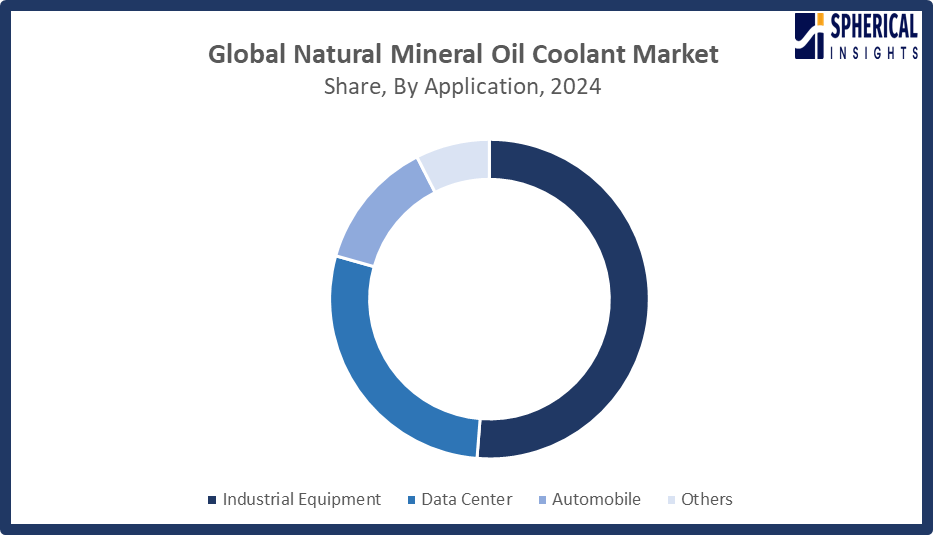
- The industrial equipment segment accounted for the highest market revenue in 2024, approximately 51% and is anticipated to grow at a significant CAGR during the forecast period.
Based on the application, the natural mineral oil coolant market is divided into industrial equipment, data center, automobile, and others. Among these, the industrial equipment segment accounted for the highest market revenue in 2024 and is anticipated to grow at a significant CAGR during the forecast period. The industrial equipment segment market is expanding because of increasing global industrialization and rising demand for heavy machinery, and the development of manufacturing facilities which needed effective thermal management systems. Mineral oil coolants deliver dependable heat dissipation and dielectric insulation, which results in reduced equipment downtime. The Asian Pacific and North American regions experienced rapid infrastructure development, which drove adoption of this segment, making it the top revenue-generating segment.
Get more details on this report -
Regional Segment Analysis of the Natural Mineral Oil Coolant Market
- North America (U.S., Canada, Mexico)
- Europe (Germany, France, U.K., Italy, Spain, Rest of Europe)
- Asia-Pacific (China, Japan, India, Rest of APAC)
- South America (Brazil and the Rest of South America)
- The Middle East and Africa (UAE, South Africa, Rest of MEA)
Asia Pacific is anticipated to hold the largest share of the natural mineral oil coolant market over the predicted timeframe.

Get more details on this report -
Asia Pacific is anticipated to hold the largest share of the natural mineral oil coolant market over the predicted timeframe. The Asia Pacific region dominated the natural mineral oil coolant market because of its industrial growth and factory expansion, and its need for effective thermal management systems. The power generation sector, transformer market and automotive industry of China, India and Japan drive their economic progress. The region held 42% of worldwide demand in 2024, while China accounted for roughly 18%, as industrial production, infrastructure development, and sustainable high-performance mineral oil coolants became more common. In January 2026, China will ban HFC refrigerants (R134a, R404A) in household appliances, promoting natural alternatives like R600a, highlighting regulatory pressure and global trends toward eco-friendly, sustainable cooling solutions.
North America is expected to grow at a rapid CAGR in the natural mineral oil coolant market during the forecast period. The natural mineral oil coolant market in North America will experience rapid growth due to rising industrial automation, data centre expansion and the need for dependable thermal management systems. The United States and Canada lead this growth, with the U.S. accounting for over 25% of regional demand in 2024, driven by investments in power infrastructure, manufacturing, and environmentally compliant mineral oil coolants that meet strict safety and efficiency standards.
The natural mineral oil coolant market in Europe shows growth because power infrastructure investments, renewable energy projects, and industrial automation raise demand. The market needs regional contributors who will become the main drivers of 2024 demand, with Germany representing 20% of all regional needs. Rising adoption of efficient, eco-friendly mineral oil coolants in transformers and manufacturing equipment supports sustained market expansion across the region.
Competitive Analysis:
The report offers the appropriate analysis of the key organizations/companies involved within the natural mineral oil coolant market, along with a comparative evaluation primarily based on their type of offering, business overviews, geographic presence, enterprise strategies, segment market share, and SWOT analysis. The report also provides an elaborative analysis focusing on the current news and developments of the companies, which includes type development, innovations, joint ventures, partnerships, mergers & acquisitions, strategic alliances, and others. This allows for the evaluation of the overall competition within the market.
List of Key Companies
- Royal Dutch Shell
- LUKOIL
- Ergon, Inc.
- NYNAS AB
- PetroChina Company Limited
- Gars Lubricants
- Exxon Mobil Corporation
- TotalEnergies
- BP plc
- Chevron Corporation
- Renkert Oil
- Idemitsu Kosan Co., Ltd.
- Gulf Oil International
- Valvoline Inc.
- Sonneborn LLC
- Others
Key Target Audience
- Market Players
- Investors
- End-users
- Government Authorities
- Consulting and Research Firm
- Venture capitalists
- Value-Added Resellers (VARs)
Recent Development
- In July 2025, TotalEnergies Lubrifiants and XING Mobility signed an MOU to advance immersion cooling battery systems, initially for electrified marine applications, then expanding to energy storage, mobility, and AI data center solutions, combining advanced fluids with innovative cooling technology.
- In January 2025, TotalEnergies Lubrifiants acquired fire-resistant hydraulic fluid product lines from German manufacturer Fluid Competence. The expansion adds mineral oil-free, low VOC fluids for steel, mining, and tunneling, supporting TotalEnergies’s sustainability and high-performance safety goals.
- In February 2025, Bharat Petroleum Corporation Limited partnered with Refroid Technologies to launch India’s first Make in India liquid coolant for AI-driven and sovereign data centers, advancing energy efficiency, sustainability, and digital infrastructure development nationwide.
Market Segment
This study forecasts revenue at global, regional, and country levels from 2020 to 2035. Spherical Insights has segmented the natural mineral oil coolant market based on the below-mentioned segments:
Global Natural Mineral Oil Coolant Market, By Coolant Type
- Paraffin-based Mineral Oil Coolant
- Naphthenic Mineral Oil Coolant
- Others
Global Natural Mineral Oil Coolant Market, By Application
- Industrial Equipment
- Data Center
- Automobile
- Others
Global Natural Mineral Oil Coolant Market, By Regional Analysis
- North America
- US
- Canada
- Mexico
- Europe
- Germany
- UK
- France
- Italy
- Spain
- Russia
- Rest of Europe
- Asia Pacific
- China
- Japan
- India
- South Korea
- Australia
- Rest of Asia Pacific
- South America
- Brazil
- Argentina
- Rest of South America
- Middle East & Africa
- UAE
- Saudi Arabia
- Qatar
- South Africa
- Rest of the Middle East & Africa
Frequently Asked Questions (FAQ)
-
1. What role does the global data center explosion play in driving demand for immersion cooling applications?The global data center boom fuels immersion cooling demand, with over 1,200 hyperscale data centers worldwide in 2024. Mineral oil-based immersion cooling reduces energy consumption by up to 40%, improving efficiency and supporting sustainable, high-performance computing operations.
-
2. How is the electric vehicle revolution and battery thermal management requirements impacting market growth?The electric vehicle revolution drives mineral oil coolant demand, with global EV sales reaching 14 million units in 2024. Advanced battery thermal management using mineral oil enhances safety, efficiency, and lifespan, significantly supporting growth in automotive and energy storage cooling applications.
-
3. What is the pipeline status for next-generation coolants with enhanced heat transfer properties?Next‑generation coolants with enhanced heat transfer are advancing through development, with pilot programs in 2024 reporting 10–25% higher thermal efficiency than traditional mineral oil. Several formulations are entering late‑stage testing for industrial, transformer, and data center applications, signaling strong future adoption.
-
4. How do regulatory frameworks across different regions create barriers or opportunities for market entry?Regulatory frameworks influence mineral oil coolant market entry, with over 60% of countries in 2024 enforcing environmental and safety standards. While strict regulations create compliance barriers, they also drive opportunities for eco-friendly, high-performance mineral oil formulations and innovation adoption.
-
5. What role do nanofuels and nanoparticle-enhanced coolants play in next-generation thermal management?Nanofuels and nanoparticle-enhanced coolants improve next-generation thermal management, offering 10-20% higher heat transfer efficiency in trials, supporting advanced industrial, transformer, and data center applications, driving innovation adoption by 2025.
-
6. How are renewable energy system integrations creating new applications for mineral oil coolants?Renewable energy integrations are driving mineral oil coolant demand, particularly in transformers and thermal storage for solar and wind power. In 2024, global renewable capacity reached 3,200 GW, with over 70% of high-voltage transformers using mineral oil for efficient heat management.
-
7. What impact do PFAS restriction proposals in the EU have on natural mineral oil adoption?EU PFAS restriction proposals are boosting natural mineral oil adoption, as over 12,000 PFAS applications face limitations by 2025, prompting industries to switch to PFAS-free, eco-friendly mineral oil coolants in transformers, industrial machinery, and data centers.
-
8. How is technological innovation improving the performance and adoption of mineral oil coolants?Technological innovation boosts mineral oil coolant performance, with new formulations achieving up to 15-25% better thermal conductivity in 2024, enhancing heat transfer efficiency and expanding adoption across industrial cooling and transformer applications.
Need help to buy this report?