Global Generative AI in Packaging Market Size, Share, and COVID-19 Impact Analysis, By Component (Software and Services), By Technology (Machine Learning (ML), Natural Language Processing (NLP), Generative Adversarial Networks (GANs), 3D Generative Design Tools, and Others), By Application (Structural Design, Label & Artwork Generation, Eco-efficiency Optimization, Consumer Personalization, Marketing Visualization, Simulation & Testing, and Others), By End Use (Food & Beverages, Consumer Goods, Pharmaceuticals, Retail & E-commerce, Cosmetics & Personal Care, Industrial Goods, and Others), and By Region (North America, Europe, Asia-Pacific, Latin America, Middle East, and Africa), Analysis and Forecast 2025 - 2035
Industry: Information & Technology
Global Generative AI in Packaging Market Size Insights Forecasts to 2035
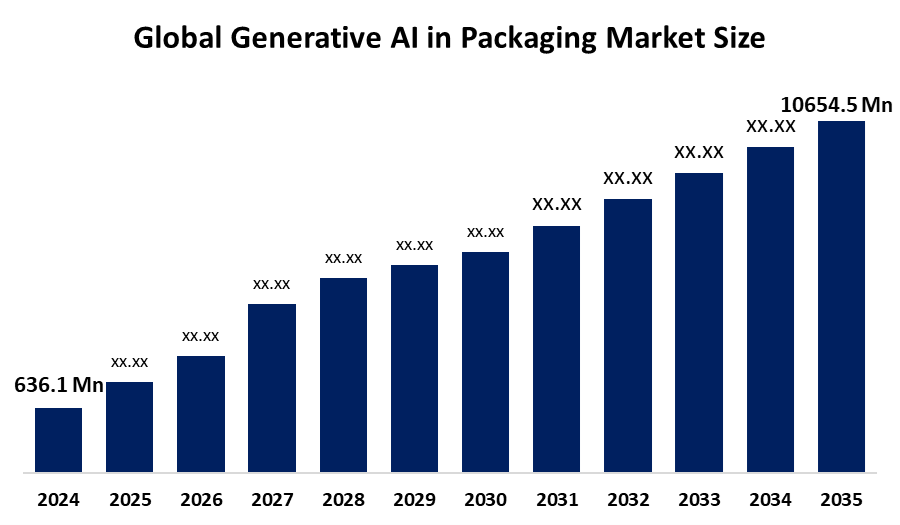
- The Global Generative AI in Packaging Market Size Was Estimated at USD 636.1 Million in 2024
- The Market Size is Expected to Grow at a CAGR of around 29.2% from 2025 to 2035
- The Worldwide Generative AI in Packaging Market Size is Expected to Reach USD 10654.5 Million by 2035
- Asia Pacific is expected to grow the fastest during the forecast period.
Get more details on this report -
According to a Research Report Published by Spherical Insights and Consulting, The Global Generative AI In Packaging Market Size was worth around USD 636.1 Million in 2024 and is Predicted to Grow to around USD 10654.5 Million by 2035 with a compound annual growth rate (CAGR) of 29.2% from 2025 to 2035. The generative AI in packaging market is growing due to the increased requirements for eco-friendly materials, quick design testing, and ultra-customized shopping experiences.
Market Overview
The global generative AI in packaging market refers to the deployment of generative artificial intelligence models that autonomously create, optimize, and personalize packaging designs, structures, graphics, and material configurations by analyzing parameters for functionality, sustainability, and consumer appeal. The solutions enable automatic structural design and quick prototype development, and creation of personalized artwork and product labels and lightweight product design, recycling process optimization and supply chain management efficiency for food and beverage and online retail, beauty and pharmaceutical and consumer packaged goods industries. Market growth is propelled by major drivers such as the massive $2 trillion global investment in AI infrastructure anticipated in 2026 and increasing automation in manufacturing and the technology's ability to accelerate product launches while enabling efficiency gains like a 15-percentage point increase in tool-in-hand time and a 17-23% reduction in maintenance costs.
The packaging industry presents major opportunities for development because 30% of companies use AI across the packaging lifecycle, while 70% of companies consider design to be the most important area, and 40% of companies believe that AI can identify material waste. In October 2024, Germany’s AI Application Hub for Plastic Packaging, funded by the Federal Ministry of Research and Education, showcased milestones across Aachen, Darmstadt, Dresden, and Nuremberg. The 51 partners displayed AI-based packaging design solutions, virtual data room technology and life cycle assessment tools, which enabled them to meet EU standards for 35% recycled content by 2030 while developing environmentally friendly packaging solutions.
Report Coverage
This research report categorizes the generative AI in packaging market based on various segments and regions, forecasts revenue growth, and analyzes trends in each submarket. The report analyses the key growth drivers, opportunities, and challenges influencing the generative AI in packaging market. Recent market developments and competitive strategies such as expansion, type launch, development, partnership, merger, and acquisition, have been included to draw the competitive landscape in the market. The report strategically identifies and profiles the key market players and analyses their core competencies in each sub-segment of the generative AI in packaging market.
Generative AI in Packaging Market Report Coverage
| Report Coverage | Details |
|---|---|
| Base Year: | 2024 |
| Market Size in 2024: | USD 636.1 Million |
| Forecast Period: | 2025-2035 |
| Forecast Period CAGR 2025-2035 : | CAGR of 29.2% |
| 2035 Value Projection: | USD 10654.5 Million |
| Historical Data for: | 2020-2023 |
| No. of Pages: | 235 |
| Tables, Charts & Figures: | 110 |
| Segments covered: | By Component, By Technology |
| Companies covered:: | Adobe Inc., Microsoft, Amazon.com, Inc., PackageX Inc., NVIDIA Corporation, OpenAI & Midjourney Inc., Clarifai, Smurfit Westrock, Amcor plc, Dassault Systemes, Accenture, IBM Corporation, Kebotix, Inc., and other key players |
| Pitfalls & Challenges: | COVID-19 Empact, Challenge, Future, Growth, & Analysis |
Get more details on this report -
Driving Factors
The global generative AI in packaging market operates because companies need systems that create design solutions through automatic design processes and forecasting tools, and customized packaging systems. Generative AI decreases design time by 30-40% while material waste decreases by 15-25%, which results in better environmental results and higher cost efficiency. The fast-growing e-commerce industry and retail sector create a higher need for packaging that can be both customized and changed in real time. The system improves quality control through its capability to combine computer vision and machine learning, which leads to a 20-30% decrease in defects. Brands are adopting AI technologies for supply chain forecasting and waste management, which drives market growth because companies are looking for more intelligent data-based packaging solutions.
Restraining Factors
The global generative AI in packaging market faces restraints from high implementation costs, with upfront technology investments increasing by 20-30% for SMEs. The process of adopting new technologies faces two main obstacles, which include data security problems and a shortage of qualified workers. The process of deploying the system throughout the organization faces two major challenges, which include difficulties in linking new systems with current systems and problems with maintaining high-quality data.
Market Segmentation
The generative AI in packaging market share is classified into component, technology, application, and end use.
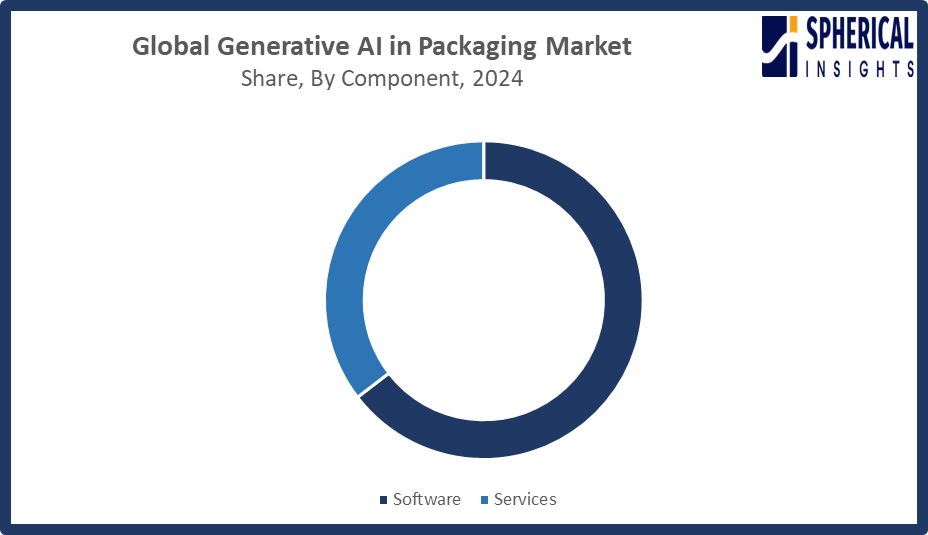
- The software segment dominated the market in 2024, approximately 65% and is projected to grow at a substantial CAGR during the forecast period.
Based on the component, the generative AI in packaging market is divided into software and services. Among these, the software segment dominated the market in 2024 and is projected to grow at a substantial CAGR during the forecast period. The leading market share of AI software platforms exists because these platforms enable automated design work, pattern development and packaging optimization through their technological capabilities. The process of machine learning development and creative automation advancement, and scalable AI deployment across multiple industries receives multiple benefits from ongoing algorithm development, cloud-based solutions and system connection with current operational processes.
Get more details on this report -
- The natural language processing (NLP) segment accounted for the largest share in 2024, approximately 30% and is anticipated to grow at a significant CAGR during the forecast period.
Based on the technology, the generative AI in packaging market is divided into machine learning (ML), natural language processing (NLP), generative adversarial networks (GANs), 3D generative design tools, and others. Among these, the natural language processing (NLP) segment accounted for the largest share in 2024 and is anticipated to grow at a significant CAGR during the forecast period. Natural language processing (NLP) drives AI in packaging by analyzing customer feedback, reviews, and regulatory documents to optimize design, ensure compliance, and enhance consumer interaction. The system uses intelligent labeling to deliver real-time product data, which includes operational details and environmental impact information through QR codes and smart tags.
- The structural design segment dominated the market in 2024, approximately 34% and is projected to grow at a substantial CAGR during the forecast period.
Based on the application, the generative AI in packaging market is divided into structural design, label & artwork generation, eco-efficiency optimization, consumer personalization, marketing visualization, simulation & testing, and others. Among these, the structural design segment dominated the market in 2024 and is projected to grow at a substantial CAGR during the forecast period. The segment market growth demonstrates how AI technology improves packaging designs to achieve better material usage and protection capabilities, and manufacturing efficiency. The rising demand for sustainable packaging requires multiple industries to implement AI technology, which automates design work and optimizes material distribution and performance assessment.
- The food & beverages segment accounted for the highest market revenue in 2024, approximately 26% and is anticipated to grow at a significant CAGR during the forecast period.
Based on the end use, the generative AI in packaging market is divided into food & beverages, consumer goods, pharmaceuticals, retail & e-commerce, cosmetics & personal care, industrial goods, and others. Among these, the food & beverages segment accounted for the highest market revenue in 2024 and is anticipated to grow at a significant CAGR during the forecast period. The food and beverages segment experienced maximum market growth because consumers increasingly demand sustainable packaging, while they prefer personalized packaging designs. The need for differentiation on crowded retail shelves and compliance with food safety regulations further accelerates the adoption of generative AI.
Regional Segment Analysis of the Generative AI in Packaging Market
- North America (U.S., Canada, Mexico)
- Europe (Germany, France, U.K., Italy, Spain, Rest of Europe)
- Asia-Pacific (China, Japan, India, Rest of APAC)
- South America (Brazil and the Rest of South America)
- The Middle East and Africa (UAE, South Africa, Rest of MEA)
North America is anticipated to hold the largest share of the generative AI in packaging market over the predicted timeframe.

Get more details on this report -
North America is anticipated to hold the largest share of the generative AI in packaging market over the predicted timeframe. North America is projected to hold the 38% share of the generative AI in packaging market due to advanced technology adoption, robust industrial infrastructure, and high investment in AI-driven automation. The United States leads with extensive R&D in AI platforms for packaging design, optimization, and smart labeling. Rising demand for sustainable, personalized packaging and regulatory compliance drives adoption across food & beverage, consumer goods, and e-commerce sectors. In November 2024, AI adoption sparked debate as U.S. machinery production lagged global standards, yet initiatives such as the Executive Order on Safe AI are expected to enhance packaging machine design, productivity, functionality, and OEM efficiency, supporting significant market growth.
Asia Pacific is expected to grow at a rapid CAGR in the generative AI in packaging market during the forecast period. Asia Pacific is expected to have a 25% share and grow rapidly in the generative AI in packaging market, driven by industrial automation, e-commerce growth, and rising demand for smart, sustainable packaging. China, India, and Japan lead due to strong manufacturing bases, consumer awareness, and supportive government initiatives. Companies use generative AI to optimize packaging design, improve efficiency, reduce material waste, and meet regulatory and eco-friendly standards. In March 2025, Chinas Cyberspace Administration (CAC) released final Labeling Rules and national standard GB 45438-2025, requiring AI-generated content labeling, effective September 1, enforcing obligations under existing AI regulations.
Europe’s generative AI in packaging market is growing steadily, driven by demand for sustainable, personalized, and compliant packaging. Germany, France, and the UK lead adoption, supported by advanced manufacturing, R&D, and regulatory incentives for low-VOC and recyclable materials. AI optimizes design, reduces waste, and improves efficiency across food, beverage, and consumer goods sectors. In August 2024, the EU AI Act came into force, classifying AI by risk, mandating transparency and human oversight, banning unacceptable AI, and setting rules for general-purpose AI models to ensure trust and protect citizens.
Competitive Analysis:
The report offers the appropriate analysis of the key organizations/companies involved within the generative AI in packaging market, along with a comparative evaluation primarily based on their type of offering, business overviews, geographic presence, enterprise strategies, segment market share, and SWOT analysis. The report also provides an elaborative analysis focusing on the current news and developments of the companies, which includes type development, innovations, joint ventures, partnerships, mergers & acquisitions, strategic alliances, and others. This allows for the evaluation of the overall competition within the market.
List of Key Companies
- Adobe Inc.
- Microsoft
- Amazon.com, Inc.
- PackageX Inc.
- NVIDIA Corporation
- OpenAI & Midjourney Inc.
- Clarifai
- Smurfit Westrock
- Amcor plc
- Dassault Systemes
- Accenture
- IBM Corporation
- Kebotix, Inc.
- Others
Key Target Audience
- Market Players
- Investors
- End-users
- Government Authorities
- Consulting and Research Firm
- Venture capitalists
- Value-Added Resellers (VARs)
Recent Developments
• In November 2025, Amcor launched the Lift-Off Winter 2025/26 Challenge, inviting global start-ups to develop sustainable packaging solutions. The focus areas include compostable adhesives, oxygen barriers, and nature-based additives, with opportunities for joint development and potential investment of up to $500,000, building on previous AI and bio-based initiatives.
• In November 2025, the European Commission unveiled its Digital Omnibus Package, updating EU digital regulations. The package proposes amendments to the AI Act, replacing mandatory AI literacy obligations for providers with guidance encouraging Member States and companies to promote AI literacy as a strategic priority, thereby easing compliance burdens.
• In August 2025, Nestlé partnered with IBM to develop a generative AI tool for discovering high-barrier, sustainable packaging materials. Using public and proprietary data, the AI analyzes molecular structures to optimize cost, recyclability, and performance, improving food protection against moisture, temperature, and oxygen while accelerating material innovation.
• In July 2025, Amazon advanced sustainability initiatives using AI to reduce packaging waste. Its Package Decision Engine optimizes packaging through computer vision and natural language processing (NLP), reducing shipment weight by 43% in North America and Europe, avoiding over 500,000 tons of material annually, and eliminating more than 2 million tons globally since 2015.
• In February 2025, PackageX launched its Enterprise Logistics Platform, an AI-powered solution designed to automate warehouse and store operations. Featuring AI scanning, enterprise applications, and integration tools, the platform streamlines receiving, inventory management, asset tracking, and fulfillment, improving workforce productivity, operational efficiency, and real-time logistics visibility.
• In November 2024, Amcor launched two new editions of its Lift-Off program—Sprints and Connect—to accelerate research and development in emerging packaging technologies. These initiatives build on previous successes with start-ups developing solutions such as AI-based waste recognition, reusable packaging, sustainable coatings, and bio-based PET materials.
Market Segment
This study forecasts revenue at global, regional, and country levels from 2020 to 2035. Spherical Insights has segmented the generative AI in packaging market based on the below-mentioned segments:
Global Generative AI in Packaging Market, By Component
- Software
- Services
Global Generative AI in Packaging Market, By Technology
- Machine Learning (ML)
- Natural Language Processing (NLP)
- Generative Adversarial Networks (GANs)
- 3D Generative Design Tools
- Others
Global Generative AI in Packaging Market, By Application
- Structural Design
- Label & Artwork Generation
- Eco-efficiency Optimization
- Consumer Personalization
- Marketing Visualization
- Simulation & Testing
- Others
Global Generative AI in Packaging Market, By End Use
- Food & Beverages
- Consumer Goods
- Pharmaceuticals
- Retail & E-commerce
- Cosmetics & Personal Care
- Industrial Goods
- Others
Global Generative AI in Packaging Market, By Regional Analysis
- North America
- US
- Canada
- Mexico
- Europe
- Germany
- UK
- France
- Italy
- Spain
- Russia
- Rest of Europe
- Asia Pacific
- China
- Japan
- India
- South Korea
- Australia
- Rest of Asia Pacific
- South America
- Brazil
- Argentina
- Rest of South America
- Middle East & Africa
- UAE
- Saudi Arabia
- Qatar
- South Africa
- Rest of the Middle East & Africa
Frequently Asked Questions (FAQ)
-
1. What are the key technological trends shaping generative AI adoption in packaging?Key trends include AI‑driven design automation, NLP-based smart labelling, and predictive analytics. Adoption grew about 35 % in 2025, with cloud deployment and real‑time simulation boosting packaging efficiency and sustainability.
-
2. How is generative AI impacting time-to-market and design iteration cycles in the packaging industry?Generative AI reduces time‑to‑market by automating design iterations and simulations, cutting development cycles by up to 40 % in 2025 and enabling faster, optimized packaging solutions.
-
3. What are the major trends driving the adoption of generative AI for sustainable and lightweight packaging solutions?Major trends include sustainability goals, lightweight design, and material optimization. Generative AI adoption for eco‑friendly packaging grew about 38 % in 2025, reducing material use and waste while improving recyclability and performance.
-
4. How does generative AI influence environmental sustainability and recyclability metrics in modern packaging?Generative AI improves sustainability by optimizing material use and design, reducing waste and weight; adoption in sustainable packaging grew about 38 % in 2025, enhancing recyclability and lowering environmental impact.
-
5. What generative AI tools are accelerating emerging trends in bio-based material innovation?Emerging bio‑based material trends accelerated by generative AI include the development of plant‑derived polymers, compostable barriers, and recyclable composites; adoption of AI‑guided bio‑material design increased roughly 32 % in 2025, boosting sustainable packaging innovation.
-
6. How is generative AI reshaping cost structures and customization capabilities across food, e-commerce, and pharmaceutical packaging?Generative AI lowers costs by automating design and material optimization while boosting customization for food, e‑commerce, and pharmaceutical packaging. Adoption rose about 33 % in 2025, enabling tailored, efficient, and scalable packaging solutions.
-
7. How are government EPR and circular economy regulations creating new opportunities for generative AI-driven packaging compliance?Government EPR and circular economy regulations boost generative AI use by automating compliance, tracking recyclability, and optimizing material use. Adoption in regulated markets grew about 29 % in 2025, enabling smarter, standards‑aligned packaging designs.
Need help to buy this report?