Asia Pacific Blowing Agent Market Size, Share, and COVID-19 Impact Analysis, By Type (Hydrochlorofluorocarbons (HCFC), Hydrofluorocarbons (HFC), Hydrofluoroolefin (HFO), Hydrocarbons (HC), and Others), By Foam (Polystyrene Foam, Polyolefin Foam, Polyurethane Foam, Phenolic Foam), By Application (Bedding & Furniture, Building & Construction, Appliances, Packaging, and Others), and Asia Pacific Blowing Agent Market Size Insights, Industry Trends, Forecast to 2035
Industry: Chemicals & Materials
Asia Pacific Blowing Agent Market Size Insights Forecasts to 2035
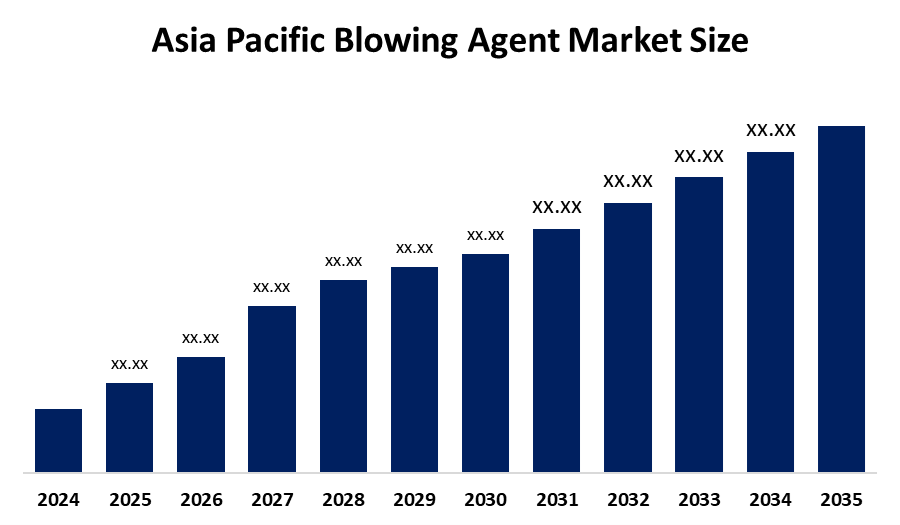
- The Asia Pacific Blowing Agents Market Size Expected to Grow at a CAGR of Around 5.4% from 2025 to 2035
- The Asia Pacific Blowing Agents Market Size is Expected to Reach a Significant Share by 2035
Get more details on this report -
According to a Research Report Published By Spherical Insights & Consulting, The Asia Pacific Blowing Agents Market Size Is Growing at a CAGR of 5.4% from 2025 to 2035. The market is driven by massive demand in building, construction, and automotive sectors for polyurethane and polyolefin foams, Increasing demand in various end-use industries and high growth in the global polymeric foams market.
Market Overview
The blowing agents market is experiencing significant growth due to multiple factors, which include increasing demand for blowing agents across different industrial sectors, including automotive, construction, and aerospace. Blowing Agents are chemical substances that produce expandable materials that develop into a cellular structure through a process that allows the material to change into different types of substances. Blowing agents are becoming more popular because they are being used in new fields like healthcare, which includes the FDA approval process for a foaming agent that treats abdominal trauma.
China has the world's largest construction industry. The industry's growth rate has become more limited because the Chinese government wants to switch to a services-based economic model. Polyurethane variants dominate commercial segments tied to refrigeration units and HVAC systems.
The new building codes and energy efficiency standards required by governments lead to higher incentives for using advanced, eco-friendly insulation materials. The building orders reported by Japan's Ministry of Land, Infrastructure, Transport and Tourism in June 2022 increased by 15.5% when compared to the same month in 2021. Asian construction expansion, with industrial development, created increased demand for environmentally clean blowing agents that comply with performance requirements and act as controlled substances.
Report Coverage
This research report categorises the Asia Pacific Blowing Agent Market Size based on various segments and regions, and forecasts revenue growth and analyses trends in each submarket. The report analyses the key growth drivers, opportunities, and challenges influencing the Asia Pacific Blowing Agent Market Size. Recent market developments and competitive strategies, such as expansion, product launch, development, partnership, merger, and acquisition have been included to draw the competitive landscape in the market. The report strategically identifies and profiles the key market players and analyses their core competencies in each sub-segment of the Asia Pacific Blowing Agent Market Size.
Asia Pacific Blowing Agent Market Report Coverage
| Report Coverage | Details |
|---|---|
| Base Year: | 2024 |
| Forecast Period: | 2025-2035 |
| Forecast Period CAGR 2025-2035 : | CAGR of 5.4% |
| Historical Data for: | 2020-2023 |
| No. of Pages: | 240 |
| Tables, Charts & Figures: | 110 |
| Segments covered: | By Type, By Foam |
| Pitfalls & Challenges: | COVID-19 Empact, Challenge, Future, Growth, & Analysis |
Get more details on this report -
Driving Factors
The Blowing Agent Market Size in Asia Pacific is driven by the demand for polymeric insulation foams, which is growing because urban areas and industrial sectors in India, China, and Vietnam are expanding. The automotive industry needs lightweight, fuel-efficient vehicles, so manufacturers use polymer foams to create their acoustic components. Chinese laws, such as the Kigali Amendment (2021), require industries to stop using traditional Hydrochlorofluorocarbons and switch to environmentally safe blowing agents, which have low Global Warming Potential.
Restraining Factors
The Blowing Agent Market Size in the Asia Pacific is restrained by the limited supply and production capacity for low-GWP agents, which can hinder demand fulfilment. The process of switching to new formulations creates technical challenges, which lead to problems with foam production stability.
Market Segmentation
The Asia Pacific Blowing Agent Market Size share is categorised into type, foam and application.
- The hydrocarbons segment accounted for the largest share in 2024 and is expected to grow at a significant CAGR during the forecast period.
The Asia Pacific Blowing Agent Market Size is segmented by type into hydrochlorofluorocarbons (HCFC), hydrofluorocarbons (HFC), hydrofluoroolefin (HFO), hydrocarbons (HC), and others. Among these, the hydrocarbons segment accounted for the largest share in 2024 and is expected to grow at a significant CAGR during the forecast period. The segmental growth is driven by the rising need for oxygenated hydrocarbons, which has resulted in their expanding application range, which includes integral skin and polystyrene foam production methods. The blowing agents industry has been expanding its portfolio of hydrocarbon blowing agents to meet the increasing demand for integral skin and polystyrene foams.
- The polyurethane foam segment dominated the market in 2024 and is projected to grow at a substantial CAGR during the forecast period.
Based on foam, the Asia Pacific Blowing Agent Market Size is segmented into polystyrene foam, polyolefin foam, polyurethane foam, phenolic foam. Among these, the polyurethane foam segment dominated the market in 2024 and is projected to grow at a substantial CAGR during the forecast period. The segmental growth is driven by the foam material, which finds extensive use as a thermal insulation solution that protects buildings, transportation systems, and various household appliances. The materials find use in bedding products, seating furniture, carpet backing, electronics devices, and computer systems, with numerous other applications. The ongoing need for polyurethane foams in these industrial sectors will create market demand for these products.
- The building & construction segment accounted for the largest share in 2024 and is expected to grow at a significant CAGR during the forecast period.
The Asia Pacific Blowing Agent Market Size is segmented by application into bedding & furniture, building & construction, appliances, packaging, and others. Among these, the building & construction segment accounted for the largest share in 2024 and is expected to grow at a significant CAGR during the forecast period. The segmental growth is driven by the current population numbers currently continue to grow at an increasing rate. The worldwide construction industry expansion, which is driven by both rapid urban development and rising population numbers, serves as the primary force propelling this situation forward. The construction industry requires blowing agents because these substances serve as basic materials needed to produce various construction products, which include doors, roof insulations and multiple other items.
Competitive Analysis:
The report offers the appropriate analysis of the key organizations/companies involved within the Asia Pacific Blowing Agent Market Size, along with a comparative evaluation primarily based on their product offering, business overviews, geographic presence, enterprise strategies, segment market share, and SWOT analysis. The report also provides an elaborate analysis focusing on the current news and developments of the companies, which includes product development, innovations, joint ventures, partnerships, mergers & acquisitions, strategic alliances, and others. This allows for the evaluation of the overall competition within the market.
List of Key Companies
- Sinochem Holdings Co., Ltd
- Yuji Advanced Materials
- Shandong Dongyue Group
- Wanhua Chemical Group
- Zeon Co.
- Otsuka Chemical Co., Ltd
- Adeka Co.
- DPL Group
- HPL Additive Ltd
- Reliance Industries
- Others
Key Target Audience
- Market Players
- Investors
- End-users
- Government Authorities
- Consulting and Research Firm
- Venture capitalists
- Value-Added Resellers (VARs)
Market Segment
This study forecasts revenue at the Asia Pacific, regional, and country levels from 2020 to 2035. Spherical Insights has segmented the Asia Pacific Blowing Agent Market Size based on the below-mentioned segments:
Asia Pacific Blowing Agent Market Size, By Type
- Hydrochlorofluorocarbons (HCFC)
- Hydrofluorocarbons (HFC)
- Hydrofluoroolefin (HFO)
- Hydrocarbons (HC)
- Others
Asia Pacific Blowing Agent Market Size, By Foam
- Polystyrene Foam
- Polyolefin Foam
- Polyurethane Foam
- Phenolic Foam
Asia Pacific Blowing Agent Market Size, By Application
- Bedding & Furniture
- Building & Construction
- Appliances
- Packaging
- Others
Frequently Asked Questions (FAQ)
-
What is the Asia Pacific Blowing Agent Market Size?The Asia Pacific blowing agents market size is expected to grow at a CAGR of 5.4% during the forecast period 2025-2035.
-
What is blowing agent, and its primary use?The blowing agents market is experiencing significant growth because of multiple factors which include increasing demand for blowing agents across different industrial sectors including automotive construction and aerospace.
-
What are the key growth drivers of the market?Market growth is driven by the demand for polymeric insulation foams, which is growing because urban areas and industrial sectors in India, China, and Vietnam are expanding
-
What factors restrain the Asia Pacific Blowing Agent Market Size?The market is restrained by the limited supply and production capacity for low-GWP agents, which can hinder demand fulfilment.
-
Who are the key players in the Asia Pacific Blowing Agent Market Size?Key companies include Sinochem Holdings Co., Ltd, Yuji Advanced Materials, Shandong Dongyue Group, Wanhua Chemical Group, Zeon Co., Otsuka Chemical Co., Ltd, Adeka Co., DPL Group, HPL Additive Ltd, and Reliance Industries.
Need help to buy this report?