Who Dominates the Worldwide Arms Trade in 2026? Key Exporters and Importers
RELEASE DATE: Mar 2026 Author: Spherical InsightsRequest Free Sample Speak to Analyst
How does the arms trade change the defence sector?
The global defence sector is expanding significantly due to military modernisation and increasing geopolitical tensions. Countries are raising defence budgets in response to regional conflicts, territorial disputes, and changing power dynamics. These investments are directed toward advanced technologies, including missile defence systems, cyber warfare and artificial intelligence. The increase in military spending reflects both the need to strengthen national security and the ambition to influence global power dynamics. In addition, the global arms trade plays a vital role in shaping military strength and strategic alliances. Countries that export weapons strengthen political relationships and economic influence by supplying advanced military equipment and defence systems. This exchange of technology and weapons contributes to shaping the global balance of power.
Navigate Future Markets with Confidence: Insights from Spherical Insights LLP
The insights presented in this blog are derived from comprehensive market research conducted by Spherical Insights LLP, a trusted advisory partner to leading global enterprises. Backed by in-depth data analysis, expert forecasting, and industry-specific intelligence, our reports empower decision-makers to identify strategic growth opportunities in fast-evolving sectors. Clients seeking detailed market segmentation, competitive landscapes, regional outlooks, and future investment trends will find immense value in the full report. By leveraging our research, businesses can make informed decisions, gain a competitive edge, and stay ahead in the transition toward sustainable and profitable solutions.
Unlock exclusive market insights-Download the Brochure now and dive deeper into the future of The Worldwide Arms Trade
How has technology changed in the arms trade sector?
The defence industry is rapidly evolving as unmanned systems and drones are increasingly used for logistics, combat, and surveillance. AI-powered technologies improve these platforms by enabling advanced targeting, predictive maintenance, and autonomous decision-making. As space becomes strategically important, space-based military assets such as satellites for communication, navigation and missile detection are becoming essential in modern warfare. Alongside these developments, cybersecurity and electronic warfare systems play a critical role in protecting networks, disrupting enemy communications and ensuring dominance in the digital domain. Together, these innovations are transforming military strategies and providing countries with both offensive and defensive advantages in a period of technological competition.
Worldwide Market Size Snapshot for Arms Exports
- In 2022, the most recent year with comprehensive statistics, the financial value of global arms exports reached at least 138 billion.
- Between 2020 and 2025, global arms transfers increased due to rising European defence demand and the Russia-Ukraine conflict, along with ongoing tensions in the Middle East.
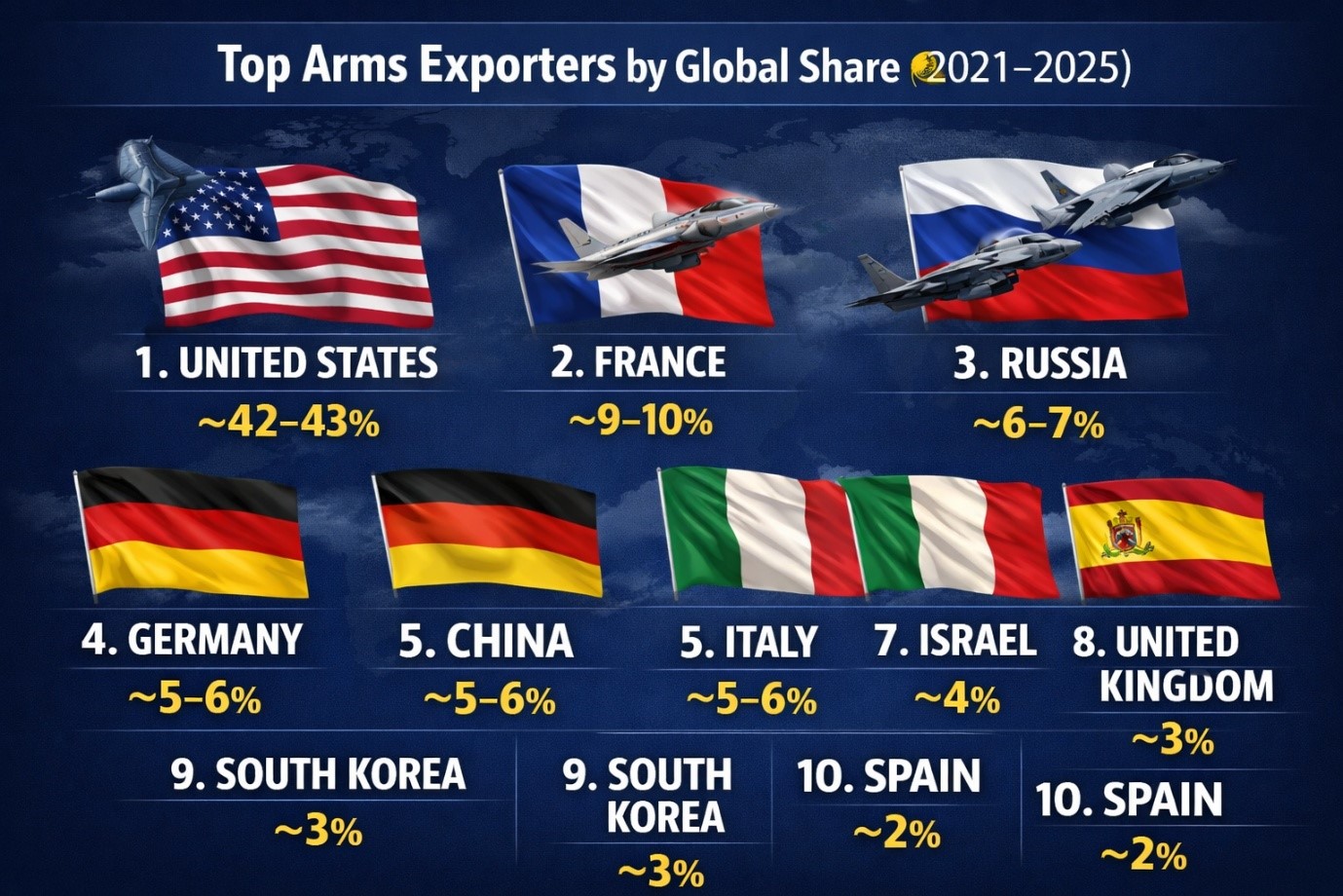
- From 2021 to 2025, the United States accounted for about 42 per cent of global arms transfers.
- Germany recently moved ahead of China in the global export rankings, while France and Russia followed with approximately 10 per cent and 7 per cent shares, respectively.
- South Korea is emerging as a rapidly growing defence exporter, expanding the global shipment of advanced weapon systems.
Worldwide Market Size Snapshot for Arms Imports
- Global arms imports in 2024 were estimated at approximately 28.8 billion.
- In 2024, the total value of global arms imports and exports reached around 111.6 billion, representing the highest level of international weapons trade since the end of the Cold War.
- The global volume of major arms transfers increased by about 9.2% between the periods 2020 and 2025.
- Europe has become the largest regional importer, accounting for about 33% of global arms imports over the past five years.
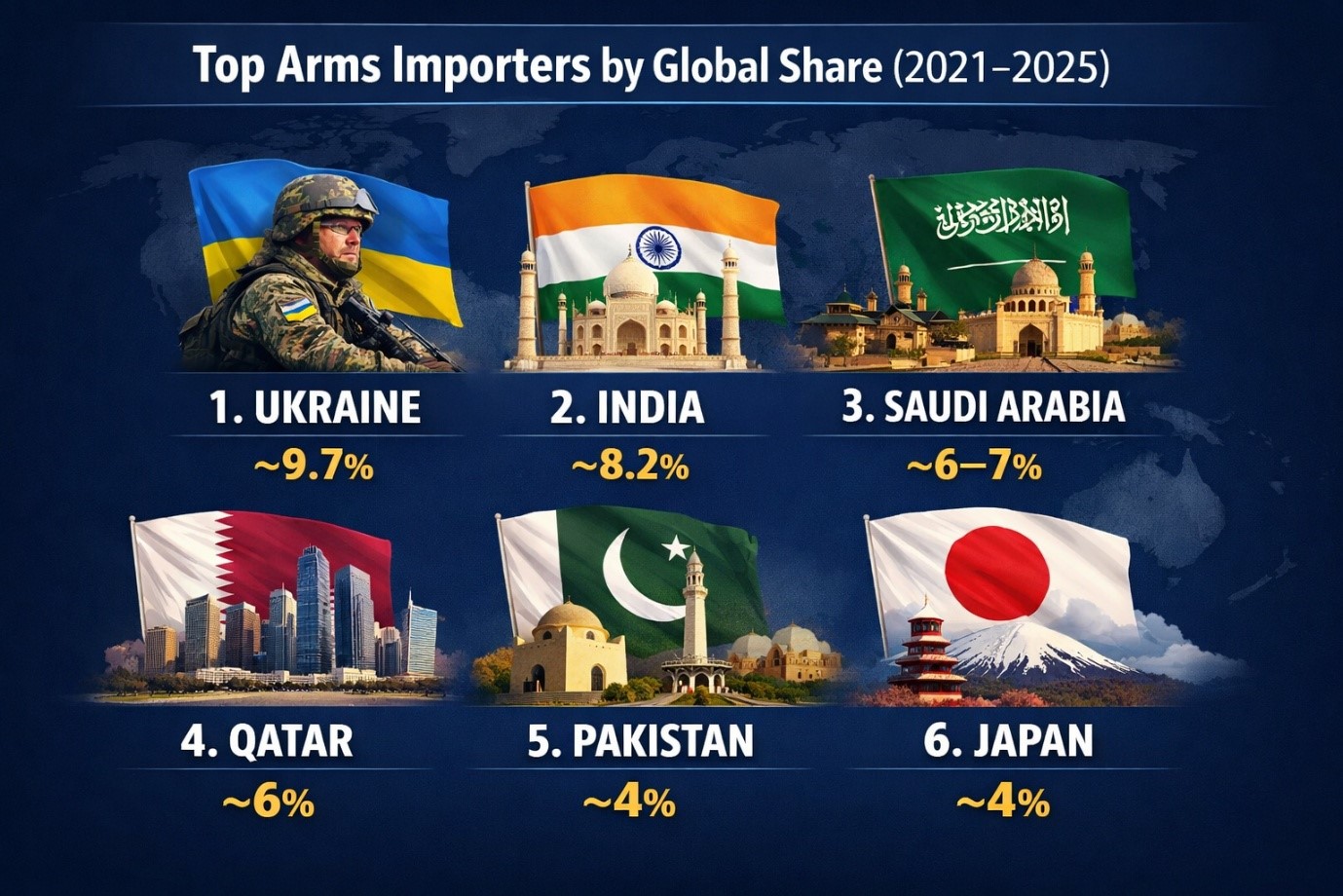
- India remains the second largest arms importer globally, with approximately 8.2% of total imports between 2021 and 2025, while Ukraine moved to the top position due to wartime demand.
Ready to lead the Worldwide Arms Trade?
Discover the regional trends and growth factors shaping the industry. We’re here to assist with expert, personalized data.
Call +1 303 800 4326 or Send us a message for a personalized consultation.
Top Countries for Arms Export in the World Defence Sector
- United States
The United States is the largest arms exporter in the world and a dominant force in the global defence industry. It accounts for approximately 42 to 43 per cent of global arms exports with an estimated annual export value of 45 to 50 billion. The country supplies advanced fighter jets, missile defence systems, drones and naval equipment to allies across Europe, the Middle East and Asia. The United States defence budget for 2025 to 2026 is about 886 billion dollars, the highest military budget in the world. A major recent development is the launch of the B21 Raider stealth bomber developed by Northrop Grumman, which is designed for long-range strategic missions and nuclear deterrence. Strong technological innovation and a large defence manufacturing sector continue to support the leadership of the United States in the global arms market.
- France
France is the second largest arms exporter globally, with an estimated annual export value of 10 to 12 billion, accounting for around 9 to 10 per cent of global arms exports. French defence companies such as Dassault Aviation, Naval Group, and Thales Group provide advanced fighter aircraft, submarines, radar systems and missile technologies to countries in Europe, the Middle East and Asia. France's defence budget for 2025 to 2026 is approximately 47 to 50 billion euros, reflecting increased investment in national security and NATO commitments. The export success of the Rafale multirole fighter jet has significantly increased France's presence in the international defence market and helped secure several large defence contracts.
- Russia
Russia remains one of the leading arms exporters worldwide, with an estimated annual export value of 6 to 8 billion, representing about 6 to 7 per cent of global arms exports. Russian defence equipment, including fighter aircraft, air defence systems, tanks and helicopters, is widely supplied to countries across Asia, Africa and the Middle East. Major defence producers include Almaz Antey and Rostec. Russia's defence budget for 2025 to 2026 is estimated to be between 110 and 120 billion, reflecting increased military spending during ongoing geopolitical tensions. One notable development is the deployment and export promotion of the Sukhoi Su-57 fifth-generation stealth fighter jet.
- Germany
Germany is among the top global defence exporters with an estimated annual export value of 6 to 7 billion dollars, representing approximately 5 to 6% of global arms exports. German defence companies such as Rheinmetall ThyssenKrupp Marine Systems and Airbus Defence and Space manufacture advanced submarines, armoured vehicles, air defence systems, and military electronics. Germany significantly increased its military budget due to rising security concerns across Europe. Defence spending for 2025 to 2026 is expected to reach approximately 70 to 75 billion euros, supported by a special modernisation fund. A recent development is the upgrade of the Leopard 2A8 main battle tank, which improves protection, mobility and digital battlefield capabilities.
- South Korea
South Korea has rapidly become one of the fastest-growing arms exporters in the world, with an estimated annual export value of 3 to 4 billion, representing about 2 to 3 per cent of global arms exports. Major defence companies, including Hyundai Rotem and Hanwha Aerospace, produce advanced tanks, artillery systems, naval vessels and missile technologies. South Korea's defence budget for 2025 to 2026 is about 48 to 50 billion, supporting military modernisation and deterrence. A recent development is the introduction of the KF21 Boramae fighter jet, a domestically developed next-generation aircraft designed to enhance airpower and reduce reliance on foreign systems.
Unlock exclusive market insights-Download the Brochure now and dive deeper into the future of The Worldwide Arms Trade
Key Countries for Arms Imports in the Global Defence Sector
- Ukraine
Due to the prolonged conflict with Russia, Ukraine's defence spending increased significantly, with the 2025 defence budget reaching approximately 2.96 trillion hryvnias, equivalent to about 70.9 billion. Ukraine has become the largest arms importer globally, receiving large shipments of air defence systems, missiles, artillery, armoured vehicles, drones and ammunition from NATO partners. In 2025, Ukraine received more than 45 billion in military aid, including weapons, air defence systems and joint procurement support.
- India
India remains one of the world's largest arms importers, accounting for about 8.3% of global arms imports between 2021 and 2025. India's defence budget for the financial year 2025 to 2026 is about 6.81 lakh crore rupees, equivalent to approximately 78 to 79 billion. About 1.80 lakh crore rupees, or roughly 20 billion, is allocated for capital acquisition of weapons and equipment. Recent imports include Javelin anti-tank missiles and Excalibur guided artillery rounds from the United States, worth approximately 93 million.
- Qatar
Qatar is among the leading arms importers, with military purchases estimated at 764.8 million in 2024. The country continues to invest heavily in defence modernisation, including combat aircraft, naval vessels and advanced air defence systems. One major recent procurement includes the acquisition of MQ9B drones from the United States, valued at nearly 2 billion, to enhance surveillance and strike capabilities.
- Saudi Arabia
Saudi Arabia has historically ranked among the largest arms importers globally. Its defence budget is projected to reach about 78 billion in 2025, representing nearly 7% of its national GDP. The country imports the majority of its defence equipment primarily from the United States, including F15SA fighter jets, Eurofighter Typhoon aircraft, Patriot and THAAD air defence systems and advanced precision rockets.
- Japan
Japan's defence policy has shifted significantly due to regional security concerns. The country's fiscal year 2026 defence budget exceeds 9 trillion yen, equivalent to approximately 58 billion dollars, which moves Japan closer to spending 2% of its GDP on defence. Japan is purchasing up to 400 Tomahawk long-range cruise missiles from the United States under a deal valued at about 2.35 billion dollars. The country is also accelerating the deployment of upgraded Type 12 surface-to-ship missiles with a range of about 1000 kilometres to strengthen coastal defence and deterrence capabilities.
Unlock exclusive market insights-Download the Brochure now and dive deeper into the future of The Worldwide Arms Trade
Top Companies for Arms Exports in the Defence Sector
- Lockheed Martin
Lockheed Martin is the largest defence exporter in the United States, responsible for major international sales of fighter aircraft, missile systems and radar technologies. Strong United States defence spending close to 886 billion dollars for 2025 to 2026 supports extensive research, development and procurement. Recent export activities include the approval of M142 HIMARS rocket system sales to Sweden, which strengthens NATO defence capabilities. Lockheed Martin also leads in missile defence exports, including Patriot PAC3 MSE missile systems under a contract valued at 9.8 billion dollars and major agreements with Saudi Arabia worth approximately 9 billion dollars.
- Thales Group
Thales Group is a major European defence exporter supplying radar systems, air defence missiles and advanced battlefield electronics to numerous countries. The company recently secured a contract worth 1.6 billion pounds to deliver 5000 air defence missiles to Ukraine. Thales has also partnered with Bharat Dynamics Limited to provide STARStreak very short-range air defence systems to the Indian armed forces. Other major projects include a 600 million euro French air defence modernisation program and the development of the SkyDefender integrated missile defence system.
- Rheinmetall Group
Rheinmetall Group is one of Europe's largest defence exporters with record sales of approximately 9.75 billion euros in 2024. Around 70% of its sales come from international markets, including vehicles, ammunition and air defence systems. A major export contract involves the supply of artillery ammunition worth 444 million euros to a customer in Eastern Europe, with deliveries continuing until 2027. Rheinmetall is also expanding production capacity through a 180 million euro ammunition factory in Lithuania and joint ventures in Romania
- Elbit Systems
Elbit Systems is a leading Israeli defence exporter responsible for around 40% of Israel's total defence export value. The company sells advanced land, air, and naval systems to international customers. A recent contract worth 277 million involves the supply of 30 millimetre turret systems and ammunition to foreign clients. Elbit is also involved in the Iron Beam laser-based air defence project and naval warfare solutions valued at approximately 330 million for NATO partners.
- Hanwha Aerospace
Hanwha Aerospace is a key contributor to South Korea's expanding defence export industry. The company recently secured a contract worth 922 million to supply long-range artillery systems and rockets to Norway as part of a broader 2 billion defence agreement. South Korea's defence budget of about 48 to 50 billion supports major projects, including the KF21 Boramae fighter jet engine supply program, valued at more than 1.18 trillion won for the delivery of 80 F414 engines by 2028.
Unlock exclusive market insights-Download the Brochure now and dive deeper into the future of The Worldwide Arms Trade
Final Sum up
In 2026, the United States will account for 42 to 43% of global armament exports, or roughly 45 to 50 billion annually. France will follow with 9 to 10%, Russia with 6 to 7%, Germany with 5 to 6%, and South Korea with 2 to 3%. Due to wartime demand, Ukraine leads the world in overall weaponry imports, but India continues to rank second with about 8.3% of worldwide imports. Overall, Europe accounts for over 33% of the world's imports, a sign of growing regional security worries. Major defence contracts and technology improvements are fueling exports from companies like Lockheed Martin, Thales, Rheinmetall, Elbit Systems and Hanwha Aerospace, while advances in artificial intelligence, drones, and space-based military assets.
About the Spherical Insights & Consulting
Spherical Insights & Consulting is a market research and consulting firm which provides actionable market research study, quantitative forecasting and trends analysis provides forward-looking insight especially designed for decision makers and aids ROI.
Which is catering to different industry such as financial sectors, industrial sectors, government organizations, universities, non-profits and corporations. The company's mission is to work with businesses to achieve business objectives and maintain strategic improvements.
CONTACT US:
For More Information on Your Target Market, Please Contact Us Below:
Phone: +1 303 800 4326 (the U.S.)
Phone: +91 90289 24100 (APAC)
Email: inquiry@sphericalinsights.com, sales@sphericalinsights.com
Contact Us: https://www.sphericalinsights.com/contact-us
Need help to buy this report?