Top 25 Companies in Global Prenatal, Fetal and Neonatal Equipment Market (2026–2035): Expert View by Spherical Insights
RELEASE DATE: Apr 2026 Author: Spherical InsightsRequest Free Sample Speak to Analyst
Description
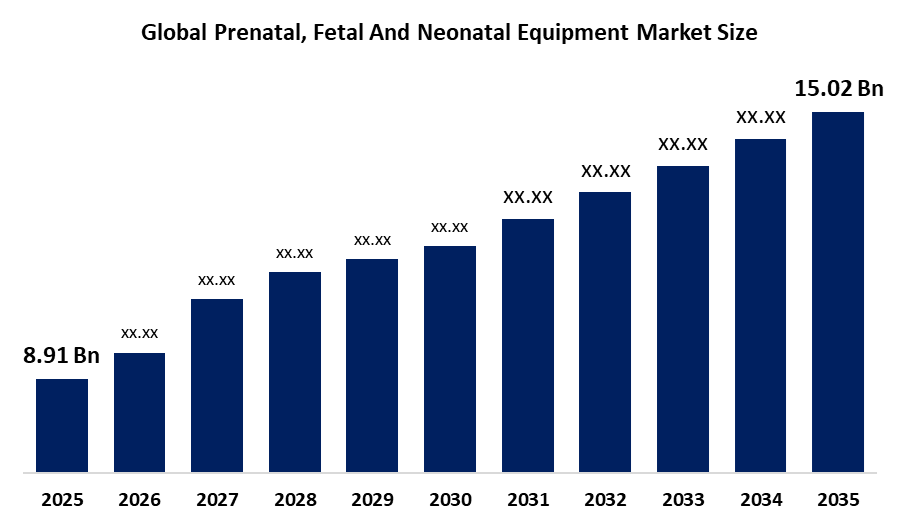
According to a research report published by Spherical Insights & Consulting, the Global Prenatal, Fetal And Neonatal Equipment Market size is projected to grow from USD 8.91 Billion in 2025 to USD 15.02 Billion by 2035, at a CAGR of 5.36% during the forecast period 2026–2035. The prenatal, fetal and neonatal equipment market exists because preterm births increase, maternal age rises, advanced diagnostic devices become available, neonatal care demand grows, healthcare investments increase, government initiatives start, and global healthcare infrastructure development progresses.
Introduction
The worldwide prenatal, fetal and neonatal equipment market represents the medical industry, which develops instruments that track and assess fetal growth throughout gestation while delivering essential medical care to newborns, especially those born prematurely or with low body weight. The market comprises medical instruments, which include ultrasound equipment, fetal monitoring devices, neonatal incubators, phototherapy systems, and ventilators that doctors use to protect the health of mothers and their infants. The market experiences continuous growth because of three factors, which are the increasing number of preterm births, the higher maternal age and the enhanced understanding of prenatal and neonatal healthcare. The medical sector implements cutting-edge technology to enhance its ability to identify illnesses at an early stage and to enhance patient results. The healthcare field benefits from new developments, which include high-resolution imaging technology, portable monitoring equipment and artificial intelligence diagnostic systems that enable precise and efficient treatment methods. The government programs that aim to decrease infant death rates work together with the increasing healthcare spending and better healthcare system development to create a market growth trend. The market experiences growth because developing areas establish more neonatal intensive care units while their residents gain better access to medical facilities. The market serves a critical function that enables newborns around the world to survive while achieving better health results throughout their lives.
Navigate Future Markets with Confidence: Insights from Spherical Insights LLP
The insights presented in this blog are derived from comprehensive market research conducted by Spherical Insights LLP, a trusted advisory partner to leading global enterprises. Backed by in-depth data analysis, expert forecasting, and industry-specific intelligence, our reports empower decision-makers to identify strategic growth opportunities in fast-evolving sectors. Clients seeking detailed market segmentation, competitive landscapes, regional outlooks, and future investment trends will find immense value in the full report. By leveraging our research, businesses can make informed decisions, gain a competitive edge, and stay ahead in the transition toward sustainable and profitable solutions.
Unlock exclusive market insights—Download the Brochure now and dive deeper into the future of the Prenatal, Fetal and Neonatal Equipment Market.
Market Segmentation
Global Prenatal, fetal and neonatal equipment Market Size, Share, By Product Type (Fetal Monitoring Equipment, Ultrasound Equipment, Fetal Therapy Equipment, Neonatal Intensive Care Equipment), By Technology (Ultrasound Imaging, Fetal Doppler, CTG Monitoring, Neonatal Ventilation), By Application (Prenatal Monitoring, Labor and Delivery, Postnatal Care), By End User (Hospitals, Clinics, Homecare Settings), and By Region (North America, Europe, Asia-Pacific, Latin America, Middle East, and Africa), Analysis and Forecast 2026 – 2035
Prenatal, Fetal And Neonatal Equipment Market Size & Statistics
- The Market Size for Prenatal, Fetal and Neonatal Equipment Was Estimated to be worth USD 8.91 Billion in 2025.
- The Market is Going to Expand at a CAGR of 5.36% between 2026 and 2035.
- The Global Prenatal, Fetal, and Neonatal Equipment Market Size is anticipated to reach USD 15.02 Billion by 2035.
- North America is expected to generate the highest revenue during the forecast period in the Prenatal, Fetal, and Neonatal Equipment Market
- Asia Pacific is expected to grow at the fastest rate during the forecast period in the Prenatal, Fetal and Neonatal Equipment Market.
Regional growth and demand
Asia Pacific is expected to grow at the fastest rate during the forecast period in the prenatal, fetal and neonatal equipment market. This growth is driven by increasing birth rates in developing countries, rising awareness of maternal and infant healthcare, improving healthcare infrastructure, and growing government initiatives to reduce infant mortality. The market is expanding in the area because hospitals and neonatal intensive care units (NICUs) have better accessibility and healthcare investments are increasing.
North America is expected to generate the highest revenue during the forecast period in the prenatal, fetal and neonatal equipment market. The advanced healthcare infrastructure together with the widespread use of modern medical technology and the presence of top healthcare companies and the rising healthcare spending creates the current market leadership. The regional market demand receives support from government policies and the dedicated efforts to enhance neonatal healthcare results.
Ready to lead the Prenatal, Fetal and Neonatal Equipment Market?
Discover the regional trends and growth factors shaping the industry. We’re here to assist with expert, personalized data.
Call +1 303 800 4326 or Send us a message for a personalized consultation.
Top 10 Trends in the Prenatal, Fetal and Neonatal Equipment Market
- Increasing Adoption of Advanced Imaging Technologies (3D/4D Ultrasound)
- Rising Integration of Artificial Intelligence (AI) in Diagnostics
- Growing Demand for Portable and Point-of-Care Devices
- Expansion of Neonatal Intensive Care Units (NICUs)
- Shift Toward Non-Invasive Monitoring Technologies
- Increasing Focus on Reducing Infant Mortality Rates
- Growth in Telemedicine and Remote Monitoring Solutions
- Rising Demand Due to Preterm Births and High-Risk Pregnancies
- Technological Advancements in Neonatal Ventilators and Incubators
- Increasing Government Investments in Maternal and Child Healthcare
- Increasing Adoption of Advanced Imaging Technologies (3D/4D Ultrasound)
Advanced imaging technologies such as 3D and 4D ultrasound are transforming prenatal and fetal care by providing clearer and more detailed images of the fetus. These technologies help healthcare professionals detect abnormalities early and monitor fetal development more accurately. The 3D/4D ultrasound technology enables real-time visualization which helps doctors make better diagnoses and helps patients to understand their conditions more effectively. The requirement for early, accurate diagnosis, together with increased knowledge among expectant parents, leads to more people using this service. The healthcare industry experiences a major trend as hospitals and diagnostic centers acquire advanced imaging systems to improve their care standards.
- Rising Integration of Artificial Intelligence (AI) in Diagnostics
Artificial intelligence increasingly assists prenatal and neonatal diagnostic work by bringing better diagnostic precision and improved operational efficiency to the field. AI systems perform medical image analysis to identify defects while providing doctors with decision support tools. The tools help medical professionals to make accurate diagnoses because they minimize human mistakes while providing quick results in difficult medical situations. AI systems use predictive analytics to discover pregnancies with high danger levels and forecast delivery problems. AI implementation in healthcare systems boosts operational productivity while helping organizations achieve improved patient results. Medical facilities require AI-based systems as their fundamental technology for current prenatal and neonatal medical examination systems which maintain pace with ongoing technological advancements.
- Growing Demand for Portable and Point-of-Care Devices
Portable and point-of-care devices are becoming more popular in prenatal and neonatal care because they provide convenient and accessible medical solutions. The devices enable healthcare providers to conduct diagnostic tests and patient monitoring outside of standard hospital environments which encompass both rural areas and remote locations. Medical professionals can use portable ultrasound machines and handheld fetal monitors to conduct rapid medical evaluations which enable them to provide immediate medical treatment. The need for this particular trend exists in areas that possess insufficient medical facilities. The demand exists because people require affordable flexible solutions which they can easily operate. The portable equipment plays an essential function in increasing healthcare access as healthcare systems work to improve patient access.
- Expansion of Neonatal Intensive Care Units (NICUs)
The expansion of neonatal intensive care units (NICUs) is a key trend which medical facilities pursue because more preterm babies and high-risk pregnancies require their services. NICUs use special medical devices which include incubators and ventilators and monitoring systems to deliver critical care for newborn patients. Governments and healthcare providers are investing in expanding NICU facilities to reduce infant mortality rates and improve survival outcomes. The development of new medical technologies for neonatal care helps medical facilities achieve better patient outcomes. The demand for neonatal equipment rises because medical professionals now prioritize both newborn health and expert medical treatment.
- Shift Toward Non-Invasive Monitoring Technologies
The importance of non-invasive monitoring technologies for prenatal and neonatal care has grown because they lower risks while enhancing patient comfort. Healthcare providers can monitor fetal heart rate, oxygen levels, and other vital parameters through these technologies without requiring invasive procedures. Non-invasive methods lower the chances of complications and infections, which makes them safer for both mother and baby. The growing preference for patient-friendly and risk-free diagnostic solutions is driving adoption. The market future will be shaped by non-invasive monitoring because technological advancements are making these systems more accurate and reliable.
Empower your strategic planning:
Stay informed with the latest industry insights and market trends to identify new opportunities and drive growth in the prenatal, fetal and neonatal equipment market. To explore more in-depth trends, insights, and forecasts, please refer to our detailed report.
Unlock exclusive market insights—Download the Brochure now and dive deeper into the future of the Prenatal, Fetal and Neonatal Equipment Market.
Top 25 Companies Leading the Prenatal, Fetal, and Neonatal Equipment Market
- GE HealthCare
- Koninklijke Philips N.V.
- Medtronic plc
- Siemens Healthineers
- Dragerwerk AG & Co. KGaA
- Natus Medical Incorporated
- Fisher & Paykel Healthcare
- Masimo Corporation
- Atom Medical Corporation
- Becton, Dickinson and Company
- Mindray Medical International Limited
- Getinge AB
- Smiths Medical
- Vyaire Medical
- Phoenix Medical Systems Pvt. Ltd.
- Canon Medical Systems
- FUJIFILM SonoSite
- CareFusion Corporation
- CooperSurgical
- Merck & Co., Inc.
- VoluSense
- Mediprema
- DRE Medical
- Monica Healthcare
- Hisense Medical
- GE HealthCare
Headquarters: Chicago, Illinois, USA
GE HealthCare is a worldwide leader in prenatal, fetal, and neonatal medical devices, which include its state-of-the-art imaging and monitoring systems. The company provides a wide range of products, including ultrasound systems, fetal monitors, and neonatal care equipment used in hospitals and diagnostic centers worldwide. GE HealthCare develops new imaging technologies that use 3D and 4D ultrasound systems to provide accurate assessments of fetal development and detect diseases at early stages. The company integrates artificial intelligence with digital technologies to create solutions that boost clinical productivity and improve patient treatment results. Through its extensive distribution network and global presence, GE HealthCare helps healthcare organizations deliver maternal and neonatal care while its solutions improve infant survival rates and raise overall healthcare standards.
- Koninklijke Philips N.V.
Headquarters: Amsterdam, Netherlands
Koninklijke Philips N.V. leads the prenatal and neonatal equipment market with its advanced solutions, which support maternal and infant healthcare. The company develops medical products that include advanced fetal monitoring systems, neonatal ventilators and patient monitoring devices to enhance clinical results. Philips develops digital health technologies with connected care systems, which enable healthcare providers to monitor patients in real time while sharing information between their different systems. The company provides solutions that hospitals use in both neonatal intensive care units and maternity wards. The company dedicates substantial resources to research and development activities, which help it expand its product offerings while enhancing patient safety measures. Philips maintains its global leadership in prenatal and neonatal healthcare through its commitment to sustainability and innovative research practices.
- Medtronic plc
Headquarters: Dublin, Ireland
Medtronic plc is a major player in medical technology because the company provides various healthcare solutions, which include systems for monitoring neonates and patients. The company creates sophisticated equipment that enables medical teams to provide essential treatment for newborns through its respiratory equipment and monitoring tools. Medtronic maintains its dedication to innovation, quality and patient safety as the company develops medical technologies that function reliably in complex healthcare systems. Hospitals and NICUs use their technologies to achieve better results for their neonatal patients. The company uses its international operations and dedication to scientific research to drive ongoing progress in medical technology development. Medtronic establishes itself as a critical contributor that improves healthcare systems and helps mothers and newborns achieve better health results throughout the world.
- Siemens Healthineers
Headquarters: Erlangen, Germany
Siemens Healthineers holds a major position in the prenatal and fetal equipment market through its development of advanced diagnostic imaging solutions. The company provides ultrasound systems and imaging technologies that deliver high-quality performance for precise fetal monitoring and medical assessment. Siemens Healthineers uses three main areas of research, which include precision medicine and digitalization and AI-driven diagnostics to boost operational performance and patient health results. Its products find extensive application across hospitals, diagnostic facilities and research centers. The company makes continuous investments in research and development to improve both imaging precision and operational throughput. Siemens Healthineers operates worldwide while maintaining its dedication to healthcare excellence, which enables the company to make major advancements in both prenatal care and early fetal condition detection.
- Dragerwerk AG & Co. KGaA
Headquarters: Lubeck, Germany
Dragerwerk AG & Co. KGaA leads the market for neonatal medical equipment because its incubators, ventilators, and monitoring systems have established its reputation. The company develops life-support systems that medical staff use to treat patients in neonatal intensive care units. Drager develops its products to deliver safe, dependable solutions that medical teams can use to treat premature infants and critically ill newborns. The company's products provide complete temperature management solutions together with breathing assistance and ongoing patient observation. The company dedicates resources to product development while working with medical staff to enhance neonatal healthcare practices. Dräger maintains its international reach while making significant contributions to the progress of neonatal healthcare throughout the globe.
Unlock exclusive market insights—Download the Brochure now and dive deeper into the future of the Prenatal, Fetal and Neonatal Equipment Market.
Are you ready to discover more about the prenatal, fetal and neonatal equipment market?
The report provides an in-depth analysis of the leading companies operating in the global prenatal, fetal and neonatal equipment market. It includes a comparative assessment based on their product portfolios, business overviews, geographical footprint, strategic initiatives, market segment share, and SWOT analysis. Each company is profiled using a standardized format that includes:
Company Profiles
- GE HealthCare
- Business Overview
- Company Snapshot
- Products Overview
- Company Market Share Analysis
- Company Coverage Portfolio
- Financial Analysis
- Recent Developments
- Merger and Acquisitions
- SWOT Analysis
- Koninklijke Philips N.V.
- Medtronic plc
- Siemens Healthineers
- Dragerwerk AG & Co. KGaA
- Natus Medical Incorporated
- Fisher & Paykel Healthcare
- Masimo Corporation
- Atom Medical Corporation
- Others.
Conclusion
The global prenatal, fetal and neonatal equipment market is witnessing steady growth because preterm birth rates keep rising, maternal age keeps increasing, and people develop more knowledge about maternal and infant healthcare. The devices, which include ultrasound systems, fetal monitors, incubators and neonatal ventilators, serve an essential function for monitoring and maintaining fetal development and providing care for newborns. The development of AI-based diagnostic systems, portable devices, and advanced imaging technologies has created better capabilities for detecting medical conditions and achieving successful treatment results. The market growth accelerates because healthcare spending increases, neonatal intensive care units expand, and government programs exist to support efforts that decrease infant mortality. The leading medical device companies operate their businesses worldwide, which results in better healthcare systems and medical advancements for different regions.
Our Reports:
Australia Event Management Software Market Size Scope, Forecast to 2035
Australia Circulating Tumor Cells Market Size Growth, Forecast to 2035
China Cell Therapy Raw Materials Market Size, Growth, Forecast to 2035
Brazil Structural Wood Screws Market Size, Growth, Forecast to 2035
Unlock exclusive market insights—Download the Brochure now and dive deeper into the future of the Prenatal, Fetal and Neonatal Equipment Market.
About the Spherical Insights & Consulting
Spherical Insights & Consulting is a market research and consulting firm which provides actionable market research study, quantitative forecasting and trends analysis provides forward-looking insight especially designed for decision makers and aids ROI. Which is catering to different industry such as financial sectors, industrial sectors, government organizations, universities, non-profits and corporations. The company's mission is to work with businesses to achieve business objectives and maintain strategic improvements.
CONTACT US:
For More Information on Your Target Market, Please Contact Us Below:
Phone: +1 303 800 4326 (the U.S.)
Phone: +91 90289 24100 (APAC)
Email: inquiry@sphericalinsights.com, sales@sphericalinsights.com
Contact Us: https://www.sphericalinsights.com/contact-us
Need help to buy this report?