Top 25 Companies in Global Connected Medical Device Market: Statistics Report Till 2035
RELEASE DATE: Mar 2026 Author: Spherical InsightsRequest Free Sample Speak to Analyst
Description
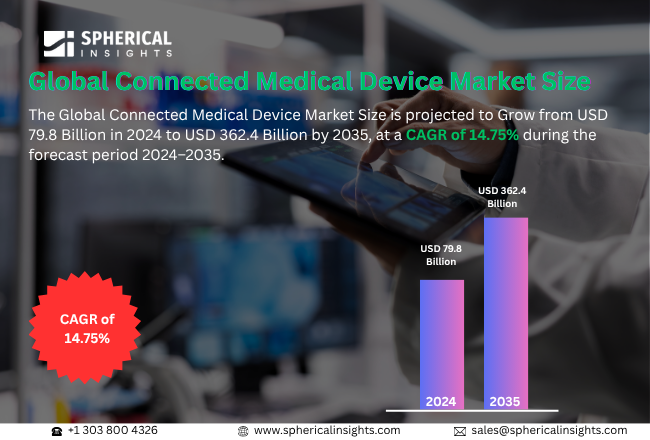
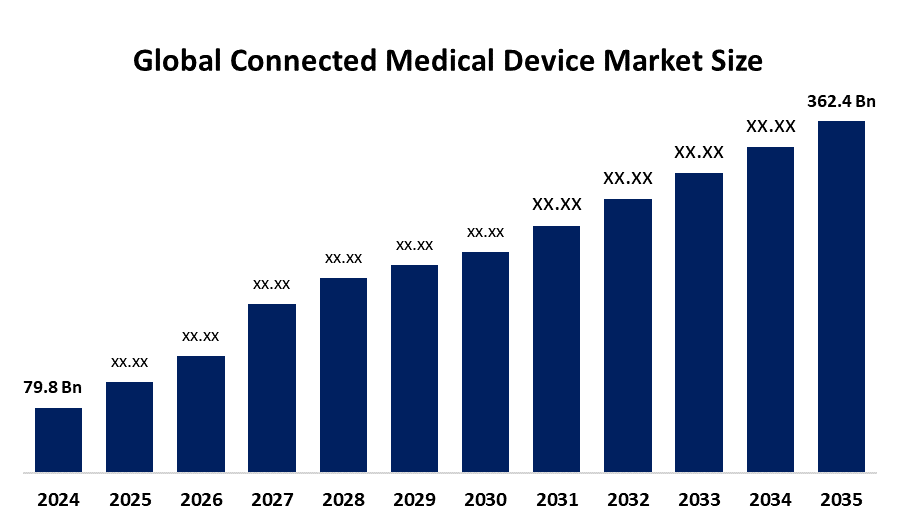
According to a research report published by Spherical Insights & Consulting, The Global Connected Medical Device Market Size is projected to Grow from USD 79.8 Billion in 2024 to USD 362.4 Billion by 2035, at a CAGR of 14.75% during the forecast period 2024–2035. The connected medical device market is expanding because people need real-time patient monitoring and healthcare IoT technologies and government programs that support digital health infrastructure. Medical connected devices offer hospitals and clinics and home health care facilities a data-based solution which helps them achieve better patient results and enhanced operational performance.
Introduction
The global connected medical device market refers to the segment of the healthcare industry that focuses on digitally integrated medical devices capable of collecting, transmitting, and analyzing patient data in real time. The devices deliver a dependable and efficient patient care solution which uses data to support treatment across hospitals and clinics and home healthcare and remote monitoring environments. Connected medical devices provide a modern technological solution which enables healthcare providers to achieve better clinical results while decreasing medical expenses and boosting patient participation. The market is expanding rapidly because remote patient monitoring becomes more popular and chronic disease rates increase and governments introduce supportive digital health initiatives and the development of IoT AI cloud computing technologies creates better device performance and interoperability. The market growth accelerates because telehealth solutions and home-based care options become more popular among the aging population who need medical services. Connected medical devices function as digital health technology partners which create healthcare systems that enable constant patient monitoring and emergency medical response. The development of smart healthcare infrastructure and connected technologies in advanced markets demonstrates that developed countries now value efficient and personalized healthcare systems which use modern technology.
Navigate Future Markets with Confidence: Insights from Spherical Insights LLP
The insights presented in this blog are derived from comprehensive market research conducted by Spherical Insights LLP, a trusted advisory partner to leading global enterprises. Backed by in-depth data analysis, expert forecasting, and industry-specific intelligence, our reports empower decision-makers to identify strategic growth opportunities in fast-evolving sectors. Clients seeking detailed market segmentation, competitive landscapes, regional outlooks, and future investment trends will find immense value in the full report. By leveraging our research, businesses can make informed decisions, gain a competitive edge, and stay ahead in the transition toward sustainable and profitable solutions.
Unlock exclusive market insights—Download the Brochure now and dive deeper into the future of the Connected Medical Device Market.
Market Segmentation
Global Connected Medical Device Market Size, Share, By Connectivity Technology (Wi-Fi, BLE, NFC, Zigbee, Cellular, LPWAN, Satellite IoT), By Device Type (Wearable, Implantable, Stationary, Disposable Sensors, Portable Tools), By Application (Clinical Operations, Imaging, Medication Management, and More), By End User (Hospitals, Home-Care, Patients, and More), By Region (North America, Europe, Asia-Pacific, Latin America, Middle East, and Africa), Analysis and Forecast 2024 – 2035
Connected Medical Device Market Size & Statistics
- The Market Size for Connected Medical Device Was Estimated to be worth USD 79.8 Billion in 2024.
- The Market is Going to Expand at a CAGR of 14.75% between 2024 and 2035.
- The Global Connected Medical Device Market Size is anticipated to reach USD 362.4 Billion by 2035.
- North America is expected to generate the highest demand during the forecast period in the Connected Medical Device Market
- Asia Pacific is expected to grow the fastest during the forecast period in the Connected Medical Device Market.
Regional growth and demand
Asia Pacific is expected to grow the fastest during the forecast period in the connected medical device market. The market experiences rapid growth because healthcare organizations are increasing their digital operations while patients use remote monitoring systems and wearable devices more frequently and chronic diseases become more common in India and China. The region experiences market growth because healthcare facilities are being built and government programs are backing the industry while the region's large population supports business development.
North America is expected to generate the highest demand during the forecast period in the connected medical device market. The region's superior healthcare facilities together with its high digital health technology adoption and its strong market presence of major companies result in their market dominance. The market expands because of three factors which include rising chronic disease cases and increasing need for remote patient monitoring and government policies that support healthcare digital transformation.
Unlock exclusive market insights—Download the Brochure now and dive deeper into the future of the Connected Medical Device Market.
Ready to lead the Connected Medical Device Market?
Discover the regional trends and growth factors shaping the industry. We’re here to assist with expert, personalized data.
Call +1 303 800 4326 or Send us a message for a personalized consultation.
Top 10 Trends in the Connected Medical Device Market
- Integration of AI and Machine Learning
- Expansion of the Internet of Medical Things (IoMT)
- Remote Patient Monitoring and Telehealth Growth
- Rising demand for wearable medical devices
- Growth of personalized and precision medicine
- Adoption of 5G technology for faster and more reliable data transmission
- Use of cloud computing and big data analytics for better decision-making
- Strong focus on cybersecurity to protect patient data and devices
- Development of miniaturized and advanced sensors improving device efficiency
- Increasing shift toward home healthcare and decentralized care models
1. Integration of AI and Machine Learning
AI and ML are transforming connected medical devices through their ability to analyze data instantaneously while enabling early disease detection and forecasting future healthcare needs. The technologies enable doctors to deliver faster and more precise medical decisions which results in better outcomes for their patients. AI-powered devices can analyze large volumes of patient data to identify patterns that may not be visible to human clinicians. The system provides diagnostic automation which helps to decrease the possibility of human mistakes. The result is that healthcare systems now operate with greater efficiency through their ability to anticipate medical needs instead of just responding to emergencies.
2. Expansion of the Internet of Medical Things (IoMT)
IoMT enables medical devices and healthcare systems to connect with patients through internet technology which enables data transfer and patient monitoring. The system enhances healthcare operations by decreasing the need for manual tasks while enabling uninterrupted treatment for patients. The system allows devices which include monitors and wearables to interact with hospital systems through instant message transmission. IoMT improves clinical procedures by delivering precise and current data about patients. Healthcare providers need this connectivity because it helps them work together better which results in improved treatment results.
3. Remote Patient Monitoring and Telehealth Growth
Patients can use connected devices from their homes which enables doctors to monitor them and this approach results in fewer hospital admissions and lower medical expenses. This trend became especially important after COVID-19 and continues to grow with digital healthcare adoption. The situation delivers special advantages for patients who need to control diabetes and heart-related medical conditions. Doctors can access real-time health data which patients share with them to enable immediate medical response. The method enhances patient access to healthcare services while simultaneously decreasing the operational demands placed on medical institutions.
4. Rise of Wearable Medical Devices
Users can track their vital signs through wearables which include smartwatches and fitness trackers to monitor their heart rate and sleep patterns and daily physical activities. The devices enable users to maintain their health through preventive measures while they identify medical conditions in their early stages. Advanced wearables now provide users with the ability to monitor their ECG results and oxygen saturation levels and stress indicators. Users gain the ability to manage their health through their own choices regarding their daily activities. The rising costs and improved availability of these devices result in their increasing popularity among users.
5. Growth of Personalized and Precision Medicine
Medical devices which connect to the internet create personalized treatment strategies through the use of patient-specific medical information. The treatment method delivers customized health solutions which improve treatment results while minimizing potential hazards. The devices operate continuously to obtain health information which helps create an accurate health profile for each patient. The medical professionals use this data to develop treatments which achieve higher precision and better results. The healthcare system is moving away from standard treatments which apply to all patients to deliver customized treatment solutions which enhance both patient satisfaction and treatment results.
Empower your strategic planning:
Stay informed with the latest industry insights and market trends to identify new opportunities and drive growth in the connected medical device market. To explore more in-depth trends, insights, and forecasts, please refer to our detailed report.
Unlock exclusive market insights—Download the Brochure now and dive deeper into the future of the Connected Medical Device Market.
Top 25 Companies Leading the Connected Medical Device Market
- Medtronic
- Johnson & Johnson (MedTech)
- Abbott Laboratories
- Siemens Healthineers
- Stryker Corporation
- Becton, Dickinson and Company (BD)
- GE HealthCare
- Philips Healthcare
- Boston Scientific Corporation
- Baxter International Inc.
- Roche Diagnostics
- Cardinal Health
- Medline Industries
- Danaher Corporation
- Fresenius Medical Care
- 3M Healthcare
- Zimmer Biomet Holdings
- Smith & Nephew
- ResMed
- Edwards Lifesciences
- Intuitive Surgical
- Masimo Corporation
- Dexcom Inc.
- Omron Healthcare
- Nihon Kohden Corporation
1. Medtronic
Headquarters: Dublin, Ireland
Medtronic operates its Connected Medical Device business as a worldwide leader across 150 different countries. The company develops advanced medical technologies which include connected devices that support cardiac care and diabetes management and remote patient monitoring. Medtronic develops digital health solutions which it combines with its medical devices to track patient data in real time and enhance clinical results. The company achieves efficient disease management through its commitment to innovation and AI technology and its dedication to delivering patient-focused medical services. Medtronic drives the progress of healthcare systems which use modern technology through its development of various connected medical solutions.
2. Johnson & Johnson (MedTech)
Headquarters: New Brunswick, New Jersey, USA
Johnson & Johnson MedTech operates as a leading company in the connected medical device market through its development of advanced medical solutions which support surgical procedures and orthopedic treatments and eye care services. The company uses intelligent technology solutions to build its medical devices which lead to better precision and improved system connections and enhanced patient tracking capabilities. The digital platforms allow healthcare professionals to obtain real-time data which helps enhance treatment results. Johnson & Johnson promotes the use of connected healthcare systems and minimally invasive medical treatments through its extensive global operations and continuous research and development expenditures.
3. Abbott Laboratories
Headquarters: Abbott Park, Illinois, USA
Abbot Laboratories is known for its superior connected medical devices which include diabetes and cardiovascular monitoring systems. The company’s wearable devices, such as continuous glucose monitoring systems, provide real-time health data to patients and healthcare providers. Abbott creates portable devices which users can operate easily while those devices deliver precise measurements for disease management and patient comfort. The company established itself as an industry leader through its digital connection and innovation research development work on customized healthcare solutions which include remote patient monitoring systems.
4. Siemens Healthineers
Headquarters: Erlangen, Germany
Siemens Healthineers is a leading provider of connected healthcare technologies, offering advanced imaging systems, diagnostics, and digital health solutions. The company integrates connectivity and data analytics into its medical devices, enabling seamless communication across healthcare systems. The solutions deliver fast clinical operations together with precise diagnostic results which lead to superior medical treatment. Siemens Healthineers uses its expertise in artificial intelligence and cloud technologies to develop intelligent healthcare systems that connect with other medical devices and services.
5. GE HealthCare
Headquarters: Chicago, Illinois, USA
GE HealthCare operates as a major player in connected medical devices through its development of cutting-edge imaging systems along with monitoring technologies and diagnostic tools. The company uses digital technologies such as artificial intelligence and cloud computing to enhance its device performance and connectivity capabilities. Healthcare providers can use the connected systems to monitor patients in real time which helps them make better medical decisions. Through its dedication to digital transformation and innovation GE HealthCare is transforming the healthcare industry by developing medical services which are both accurate and efficient and accessible to all patients
Are you ready to discover more about the connected medical device market?
The report provides an in-depth analysis of the leading companies operating in the global connected medical device market. It includes a comparative assessment based on their product portfolios, business overviews, geographical footprint, strategic initiatives, market segment share, and SWOT analysis. Each company is profiled using a standardized format that includes:
Unlock exclusive market insights—Download the Brochure now and dive deeper into the future of the Connected Medical Device Market.
Company Profiles
- Medtronic
- Business Overview
- Company Snapshot
- Products Overview
- Company Market Share Analysis
- Company Coverage Portfolio
- Financial Analysis
- Recent Developments
- Merger and Acquisitions
- SWOT Analysis
- Johnson & Johnson (MedTech)
- Abbott Laboratories
- Siemens Healthineers
- Stryker Corporation
- Becton, Dickinson and Company (BD)
- GE HealthCare
- Philips Healthcare
- Boston Scientific Corporation
- Others.
Our Reports
https://www.sphericalinsights.com/reports/europe-anti-aging-supplements-market
https://www.sphericalinsights.com/reports/europe-ophthalmic-drugs-market
https://www.sphericalinsights.com/reports/europe-methanol-market
https://www.sphericalinsights.com/reports/germany-asphalt-pavers-market
https://www.sphericalinsights.com/reports/france-fertility-services-market
Conclusion
The global connected medical device market is experiencing continuous expansion because remote patient monitoring needs have grown combined with fast technological development and government programs that support digital healthcare solutions. Connected medical devices provide efficient real-time health monitoring solutions which hospitals, clinics, and homecare facilities use to enhance patient outcomes while decreasing healthcare expenses. The latest developments in wearable technologies and wireless connectivity and cloud-based health platforms have improved device performance and accuracy and reliability. Medtronic Abbott Laboratories GE HealthCare Philips Healthcare and Siemens Healthineers are expanding their international operations which helps to drive market growth. Connected medical devices are essential for developing contemporary healthcare systems that rely on data throughout the globe.
About the Spherical Insights & Consulting
Spherical Insights & Consulting is a market research and consulting firm which provides actionable market research study, quantitative forecasting and trends analysis provides forward-looking insight especially designed for decision makers and aids ROI.
Which is catering to different industry such as financial sectors, industrial sectors, government organizations, universities, non-profits and corporations. The company's mission is to work with businesses to achieve business objectives and maintain strategic improvements.
CONTACT US:
For More Information on Your Target Market, Please Contact Us Below:
Phone: +1 303 800 4326 (the U.S.)
Phone: +91 90289 24100 (APAC)
Email: inquiry@sphericalinsights.com, sales@sphericalinsights.com
Contact Us: https://www.sphericalinsights.com/contact-us
Need help to buy this report?