Europe Ophthalmic Drugs Market Size, Share, and COVID-19 Impact Analysis, By Drug Class (Anti-allergy, Anti-inflammatory, NSAIDs, Anti-VEGF Agents, Antiglaucoma, and Others), By Disease Type (Dry Eye, Allergies, Infection, Glaucoma, and Others), By Route of Administration (Topical and Systemic), By Dosage Form (Gel, Eye Solution & Suspension, Capsule & Tablet, Eye Drop, and Ointment), and Europe Ophthalmic Drugs Market Insights, Industry Trend, Forecasts to 2035
Industry: Healthcare
Europe Ophthalmic Drugs Market Insights Forecasts to 2035
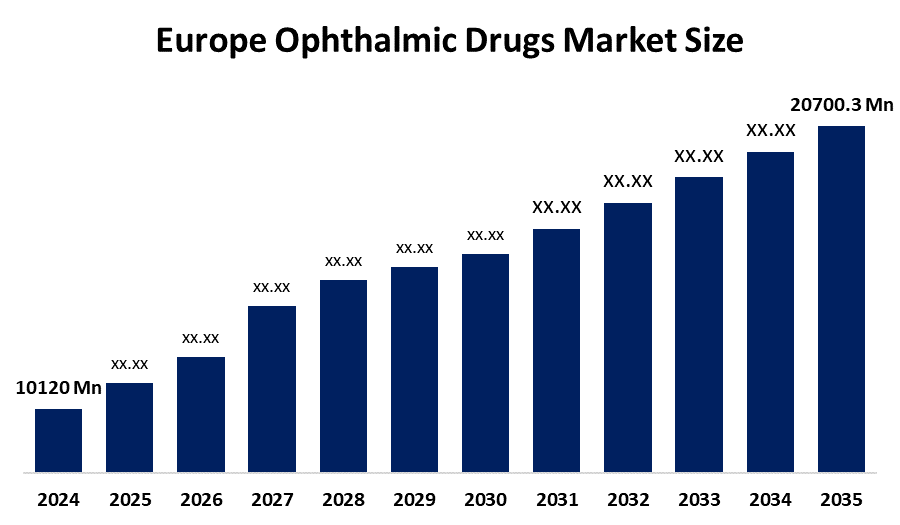
- The Europe Ophthalmic Drugs Market Size Was Estimated at USD 10120 Million in 2024
- The Market Size is Expected to Grow at a CAGR of Around 6.72% from 2025 to 2035
- The Europe Ophthalmic Drugs Market Size is Expected to Reach USD 20700.3 Million by 2035
Get more details on this report -
According to a research report published by Spherical Insights & Consulting, the Europe Ophthalmic Drugs market size is anticipated to reach USD 20700.3 million by 2035, growing at a CAGR of 6.72% from 2025 to 2035.
Market Overview
The Europe ophthalmic drugs market is defined as the development and distribution of therapeutic agents aimed at managing ocular pathologies, including glaucoma, cataracts, and age-related macular degeneration (AMD). According to Eurostat projections, the segment of the EU population aged 65 and over will rise to 28.5% by 2050, a demographic shift that fundamentally drives demand for chronic vision care. Research from the European Eye Epidemiology Consortium indicates that 12.3 million Europeans currently live with glaucoma, with this burden expected to increase by over a million by mid-century.
Innovation is largely steered toward gene therapies and sustained-release delivery systems to improve patient compliance, supported by the European Medicines Agency (EMA), which in 2024 recommended 114 new medicines, including 28 biosimilars targeting conditions like macular degeneration.
Government support remains robust; the Horizon Europe framework provides significant funding, including a USD 9.6 billion allocation for 2025 aimed at health and competitiveness. Furthermore, the EMA’s PRIME scheme offers accelerated regulatory pathways for innovative drugs that address unmet medical needs. These systemic drivers, alongside increasing rates of diabetic retinopathy and digital eye strain, position the European market as a global leader in high-value, specialised pharmaceutical interventions.
Report Coverage
This research report categorizes the Europe ophthalmic drugs market based on various segments and regions, and forecasts revenue growth and analyses trends in each submarket. The report analyses the key growth drivers, opportunities, and challenges influencing the Europe ophthalmic drugs market. Recent market developments and competitive strategies, such as expansion, product launch, development, partnership, merger, and acquisition, have been included to draw the competitive landscape in the market. The report strategically identifies and profiles the key market players and analyses their core competencies in each sub-segment of the Europe ophthalmic drugs market.
Europe Ophthalmic Drugs Market Report Coverage
| Report Coverage | Details |
|---|---|
| Base Year: | 2024 |
| Market Size in 2024: | USD 10120 Million |
| Forecast Period: | 2025-2035 |
| Forecast Period CAGR 2025-2035 : | CAGR Of 6.72% |
| 2035 Value Projection: | USD 20700.3 Million |
| Historical Data for: | 2020-2023 |
| No. of Pages: | 211 |
| Tables, Charts & Figures: | 116 |
| Segments covered: | By Drug Class,By Disease Type,By Dosage Form |
| Companies covered:: | Novartis, Bayer, Roche, Alcon, AbbVie, Santen Pharmaceuticals, Laboratoires Théa, Bausch + Lomb, Sandoz, Nicox, Horus Pharma, URSAPHARM Arzneimittel, Sifi, Faes Farma, Others |
| Pitfalls & Challenges: | COVID-19 Empact, Challenge, Future, Growth, & Analysis |
Get more details on this report -
Driving Factors
The ophthalmic drugs market in Europe is driven by a rapidly ageing demographic and the escalating prevalence of chronic ocular conditions. Technological breakthroughs in sustained-release delivery systems and gene therapies also act as critical catalysts, reducing the burden of frequent dosing and improving patient compliance. Furthermore, government initiatives like the Horizon Europe program and the European Medicines Agency (EMA) are streamlining the approval of biosimilars, which enhances treatment affordability and market penetration. Collectively, these elements, demographic shifts, technological breakthroughs in drug delivery, and substantial public funding form a strong foundation for sustained market expansion.
Restraining Factors
The ophthalmic drugs market in Europe is mostly constrained by the high cost of advanced biologic and gene therapies, which strains national healthcare budgets. stringent regulatory hurdles for novel drug approvals and the looming patent expiry for blockbuster treatments such as ranibizumab, and patient non-compliance due to invasive delivery methods further limit the effectiveness of long-term ocular care strategies.
Market Segmentation
The Europe ophthalmic drugs market share is classified into drug class, disease type, route of administration, and dosage form.
- The anti-VEGF agents segment accounted for the largest revenue market share in 2024 and is expected to grow at a significant CAGR during the forecast period.
The Europe ophthalmic drugs market is segmented by drug class into anti-allergy, anti-inflammatory, NSAIDs, anti-VEGF agents, antiglaucoma, and others. Among these, the anti-VEGF agents segment accounted for the largest revenue market share in 2024 and is expected to grow at a significant CAGR during the forecast period. Because it provides critical, high-value biologic treatments for age-related Macular Degeneration (AMD) and diabetic retinopathy. The market is currently being reshaped by the introduction of biosimilars and next-generation, long-acting injections that reduce the frequency of clinical visits for the region's expanding elderly population.
- The glaucoma segment dominated the share in 2024 and is anticipated to grow at a remarkable CAGR during the forecast period.
Based on disease type, the Europe ophthalmic drugs market is segmented into dry eye, allergies, infection, glaucoma, and others. Among these, the metal processing segment dominated the share in 2024 and is anticipated to grow at a remarkable CAGR during the forecast period. Indonesia's sizable and growing mining and smelting industry, especially for nickel, copper, and other base metals, is the main driver of this supremacy. Due to the widespread use of sulfuric acid in leaching, refining, and hydrometallurgical processes, particularly in HPAL projects that feed the supply chain for electric car batteries, demand has grown significantly and steadily.
- The topical segment accounted for the largest revenue market share in 2024 and is expected to grow at a significant CAGR during the forecast period.
The Europe ophthalmic drugs market is segmented by route of administration into topical and systemic. Among these, the topical segment accounted for the largest revenue market share in 2024 and is expected to grow at a significant CAGR during the forecast period. This is because it offers a non-invasive, localized delivery method that is preferred by patients and clinicians for treating common conditions like dry eye and glaucoma. This segment accounts for the majority of market volume because it minimizes systemic side effects and supports high levels of patient self-administration at home.
- The eye drops segment dominated the share in 2024 and is anticipated to grow at a remarkable CAGR during the forecast period.
Based on dosage form, the Europe ophthalmic drugs market is segmented into gel, eye solution & suspension, capsule & tablet, eye drop, and ointment. Among these, the eye drop segment dominated the share in 2024 and is anticipated to grow at a remarkable CAGR during the forecast period. Because eye drops are the standard delivery vehicle for most ophthalmic medications, ranging from antibiotics to antiglaucoma agents. Their dominance is sustained by their ease of use, cost-effective manufacturing, and the wide availability of both over-the-counter and prescription formulations across European pharmacies.
Competitive Analysis:
The report offers the appropriate analysis of the key organisations/companies involved within the Europe ophthalmic drugs market, along with a comparative evaluation primarily based on their product offering, business overviews, geographic presence, enterprise strategies, segment market share, and SWOT analysis. The report also provides an elaborate analysis focusing on the current news and developments of the companies, which includes product development, innovations, joint ventures, partnerships, mergers & acquisitions, strategic alliances, and others. This allows for the evaluation of the overall competition within the market.
List of Key Companies
- Novartis
- Bayer
- Roche
- Alcon
- AbbVie
- Santen Pharmaceuticals
- Laboratoires Théa
- Bausch + Lomb
- Sandoz
- Nicox
- Horus Pharma
- URSAPHARM Arzneimittel
- Sifi
- Faes Farma
- Others
Key Target Audience
- Market Players
- Investors
- End-users
- Government Authorities
- Consulting and Research Firm
- Venture capitalists
- Value-Added Resellers (VARs)
Recent Developments:
- In October 2025, Essilor Luxottica acquired the Optegra chain of eye clinics in Europe from MidEuropa for USD 2.4 billion, a vertical integration move intended to control both the surgical delivery and pharmaceutical prescription channels.
- In September 2025, Alcon acquired LumiThera, including its photo-biomodulation device for dry Age-related Macular Degeneration, to expand its portfolio beyond traditional pharmaceuticals into light-based ocular therapies.
- In July 2024, Alcon completed the acquisition of Belkin Vision for a total of USD 330 million. The acquisition, brings in Direct Selective Laser Trabeculoplasty (DSLT) technology for glaucoma, integrating the glaucoma laser into its pharmaceutical and device ecosystem to offer hybrid treatment options.
Market Segment
This study forecasts revenue at the Europe, regional, and country levels from 2020 to 2035. Spherical Insights has segmented the Europe ophthalmic drugs market based on the below-mentioned segments:
Europe Ophthalmic Drugs Market, By Drug Class
- Anti-allergy
- Anti-inflammatory
- NSAIDs
- Anti-VEGF Agents
- Antiglaucoma
- Others
Europe Ophthalmic Drugs Market, By Disease Type
- Dry Eye
- Allergies
- Infection
- Glaucoma
- Others
Europe Ophthalmic Drugs Market, By Route of Administration
- Topical
- Systemic
Europe Ophthalmic Drugs Market, By Dosage Form
- Gel
- Eye Solution & Suspension
- Capsule & Tablet
- Eye Drop
- Ointment
Need help to buy this report?