Top 15 Companies in Global eHealth Market (2026–2035): Statistics Report Till 2035
RELEASE DATE: Apr 2026 Author: Spherical InsightsRequest Free Sample Speak to Analyst
Description
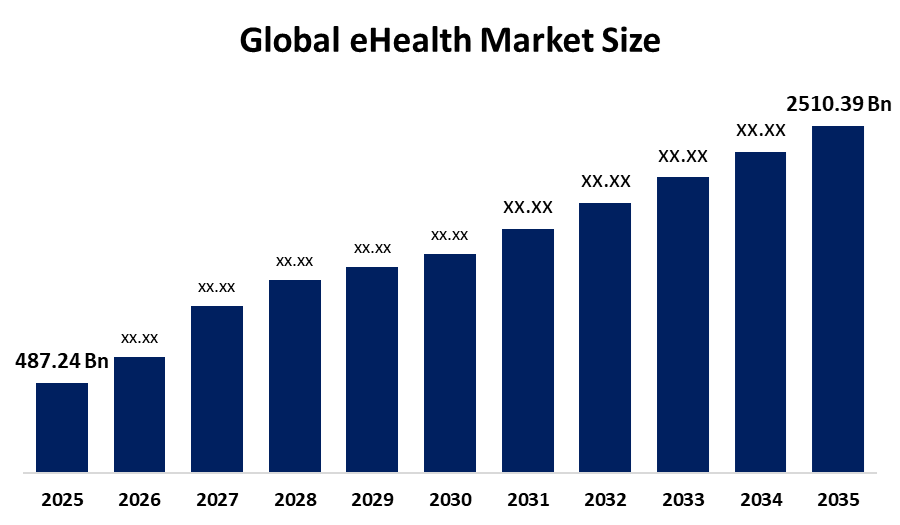
According to a research report published by Spherical Insights & Consulting, the global eHealth market size is projected to grow from USD 487.24 Billion in 2025 to USD 2510.39 Billion by 2035, at a CAGR of 17.81% during the forecast period 2026–2035. The global eHealth market is driven by the rising adoption of digital health technologies, increasing chronic disease burden, expanding telemedicine usage, government initiatives supporting healthcare digitization, growing internet penetration, and demand for cost-efficient care delivery, which are key drivers of the global eHealth market, alongside advancements in AI, wearables, and mobile health applications, enhancing patient outcomes and accessibility globally.
Introduction
The global eHealth market refers to the integration of digital technologies such as telemedicine, electronic health records, and mobile health applications to enhance healthcare delivery and patient outcomes. It encompasses a broad range of digital solutions, including health information systems and data analytics tools, designed to improve efficiency, strengthen patient engagement, and elevate the overall quality and accessibility of care. Market growth is supported by the rising burden of chronic diseases, increasing demand for remote healthcare, and strong government-backed digital health initiatives. According to the OECD, about 60% of individuals across member countries used the internet to search for health information in 2022, reflecting growing digital health engagement. Additionally, teleconsultations stabilized at around 1.0 per patient annually in 2023, remaining significantly above pre-pandemic levels. Opportunities lie in AI integration, cloud-based platforms, and wearable technologies, enabling predictive and personalized care. Innovations include real-time remote monitoring and interoperable health systems, while the World Health Organization emphasizes digital health as a key pillar for strengthening global healthcare systems and achieving universal health coverage.
News:
- In January 2024, the World Health Organization announced expanded global guidance on digital health transformation, emphasizing telemedicine and interoperable health systems to strengthen universal healthcare delivery.
- In June 2024, the European Commission advanced the European Health Data Space initiative to improve cross-border digital health data sharing and patient access across member states.
Navigate Future Markets with Confidence: Insights from Spherical Insights LLP
The insights presented in this blog are derived from comprehensive market research conducted by Spherical Insights LLP, a trusted advisory partner to leading global enterprises. Backed by in-depth data analysis, expert forecasting, and industry-specific intelligence, our reports empower decision-makers to identify strategic growth opportunities in fast-evolving sectors. Clients seeking detailed market segmentation, competitive landscapes, regional outlooks, and future investment trends will find immense value in the full report. By leveraging our research, businesses can make informed decisions, gain a competitive edge, and stay ahead in the transition toward sustainable and profitable solutions.
Unlock exclusive market insights—Download the Brochure now and dive deeper into the future of the Global eHealth Market.
Market Segmentation
Global eHealth Market Size, Share, and, By Product Type (Telemedicine, Health Information Systems, mHealth, ePrescribing, and ePharmacy), By Services (Monitoring, Diagnostic, Administrative, and Financial), By Deployment Mode (Cloud-Based and On-Premise), By End User (Healthcare Providers, Payers, and Patients), By Region (North America, Europe, Asia-Pacific, Latin America, and Middle East & Africa), Analysis and Forecast 2026 – 2035.
Global eHealth Market Size & Statistics
- The market size for Global eHealth was estimated to be worth USD 487.24 Billion in 2025.
- The market is going to expand at a CAGR of 17.81% between 2026 and 2035.
- The Global eHealth market size is anticipated to reach USD 2510.39 Billion by 2035.
- North America is expected to generate the largest revenue during the forecast period in the Global eHealth market
- Asia Pacific is expected to grow at the fastest rate during the forecast period in the Global eHealth market.
Regional growth and demand
Asia Pacific is expected to grow at the fastest rate during the forecast period in the global eHealth market. Asia Pacific is expected to grow at the fastest rate due to rapid digital infrastructure expansion and increasing internet penetration across emerging economies. Governments in countries such as China and India are actively promoting digital health initiatives to improve healthcare accessibility. The growing burden of chronic diseases and rising smartphone usage further accelerate adoption. Additionally, investments in telemedicine platforms and mobile health applications are strengthening regional market expansion.
North America is expected to generate the largest revenue during the forecast period in the global eHealth market. North America is expected to generate the highest revenue due to its advanced healthcare infrastructure and high adoption of digital health technologies. The presence of established technology providers and strong regulatory support enhances market maturity. Widespread use of electronic health records and telehealth services contributes significantly to regional leadership. Furthermore, continuous innovation and higher healthcare spending sustain its leading share in the global market
Ready to lead the eHealth Market?
Discover the regional trends and growth factors shaping the industry. We’re here to assist with expert, personalized data.
Call +1 303 800 4326 or Send us a message for a personalized consultation.
Top 10 Trends in the Global eHealth Market
- Expansion of Telemedicine and Virtual Care Services
- Integration of Artificial Intelligence in Healthcare
- Growth of Mobile Health (Mhealth) Applications
- Increasing Adoption of Wearable Health Devices
- Development of Interoperable Health Data Systems
- Rising Use of Cloud-Based Healthcare Solutions
- Emergence of Personalized and Precision Medicine
- Strengthening Cybersecurity in Digital Health
- Adoption of Remote Patient Monitoring Solutions
- Government Initiatives Supporting Digital Health Transformation
- Expansion of telemedicine and virtual care services
Telemedicine and virtual care services are transforming healthcare delivery by enabling remote consultations, diagnosis, and treatment. The increasing need for accessible and cost-effective healthcare solutions has accelerated adoption across both urban and rural populations. Healthcare providers are integrating video consultations, digital prescriptions, and remote triage systems to enhance patient engagement. Advancements in communication technologies and supportive regulatory frameworks are further strengthening telemedicine infrastructure. Additionally, the integration of telehealth platforms with electronic health records improves continuity of care. This trend is expected to reduce hospital burden while expanding healthcare reach globally.
- Integration of artificial intelligence in healthcare
Artificial intelligence is playing a critical role in enhancing clinical decision-making and operational efficiency in healthcare systems. AI-powered tools are being used for medical imaging analysis, predictive diagnostics, and treatment planning. These technologies enable early disease detection and personalized treatment approaches, improving patient outcomes. Healthcare organizations are increasingly adopting AI-driven chatbots and virtual assistants to streamline patient interactions. Furthermore, AI supports large-scale data analysis, enabling better population health management. Continuous advancements in machine learning algorithms and data availability are expected to expand AI applications across various segments of the eHealth market globally.
- Growth of mobile health (mHealth) applications
Mobile health applications are rapidly gaining traction as they provide convenient access to healthcare services through smartphones and tablets. These applications support health monitoring, medication adherence, fitness tracking, and chronic disease management. Increasing smartphone penetration and internet accessibility are key factors driving their adoption. mHealth platforms empower patients by enabling self-management and real-time communication with healthcare providers. Integration with wearable devices enhances data accuracy and personalized care delivery. Moreover, developers are focusing on user-friendly interfaces and data security features, ensuring broader acceptance of mHealth solutions across diverse demographic groups globally.
- Increasing adoption of wearable health devices
Wearable health devices are becoming integral to modern healthcare by enabling continuous monitoring of vital parameters such as heart rate, activity levels, and sleep patterns. These devices support preventive healthcare by providing real-time insights into an individual’s health status. Growing consumer awareness regarding fitness and wellness is driving demand for such technologies. Integration with mobile applications and cloud platforms enhances data accessibility for both patients and healthcare providers. Additionally, advancements in sensor technology and device accuracy are improving reliability. This trend is fostering proactive healthcare management and reducing dependence on traditional clinical visits.
- Development of interoperable health data systems
The development of interoperable health data systems is essential for ensuring seamless data exchange across healthcare platforms and providers. Interoperability enhances coordination of care by enabling access to comprehensive patient records across different healthcare settings. Governments and regulatory bodies are promoting standardized data formats and integration frameworks to improve system compatibility. This facilitates efficient clinical decision-making and reduces duplication of medical procedures. Furthermore, interoperable systems support large-scale data analytics, contributing to improved public health management. As healthcare ecosystems become more connected, interoperability is expected to play a pivotal role in advancing digital healthcare transformation globally.
Unlock exclusive market insights—Download the Brochure now and dive deeper into the future of the Global eHealth Market.
Empower your strategic planning:
Stay informed with the latest industry insights and market trends to identify new opportunities and drive growth in the global eHealth market. To explore more in-depth trends, insights, and forecasts, please refer to our detailed report.
Top 15 Companies Leading the Global eHealth Market
- Oracle Health
- Epic Systems Corporation
- Veradigm
- eClinicalWorks
- InterSystems Corporation
- MEDITECH
- Teladoc Health
- Amwell
- MDLIVE
- Doctor On Demand
- me
- IQVIA
- Optum
- Microsoft
- Koninklijke Philips N.V
- Oracle Health
Headquarters: Austin, Texas, USA
Oracle Health, active in over 25 countries, is a leading provider of cloud-based electronic health record systems and integrated healthcare data platforms. The company supports hospitals, health systems, and governments with solutions that streamline clinical workflows and enable real-time data access. Its global presence is strengthened by large-scale public health projects and national digital health infrastructures. Oracle Health focuses on improving interoperability and care coordination across healthcare ecosystems. By leveraging cloud capabilities and advanced analytics, it enhances decision-making, operational efficiency, and patient outcomes, playing a central role in advancing digital healthcare transformation worldwide.
- Epic Systems Corporation
Headquarters: Verona, Wisconsin, USA
Epic Systems Corporation, active in over 10 countries, is a dominant provider of electronic health record systems, particularly for large hospitals and academic medical centers. The company offers a comprehensive platform that integrates clinical, administrative, and financial functions. Its interoperability framework enables seamless data exchange across healthcare organizations globally. Epic is widely recognized for supporting large-scale healthcare networks with unified patient records and coordinated care delivery. Its solutions contribute to improved clinical efficiency and patient engagement. By continuously enhancing its platform capabilities, Epic Systems plays a vital role in shaping modern healthcare information management worldwide.
- Veradigm
Headquarters: Chicago, Illinois, USA
Veradigm (formerly Allscripts), active in over 15 countries, provides healthcare technology solutions focused on ambulatory care, data analytics, and real-world evidence generation. The company connects providers, payers, and life sciences organizations through integrated digital platforms. Its offerings support clinical decision-making, population health management, and value-based care initiatives. Veradigm is particularly known for leveraging extensive healthcare data to improve research and treatment outcomes. By facilitating interoperability and data-driven insights, it enhances coordination across healthcare systems. Its global activities position it as a key contributor to advancing connected and evidence-based healthcare delivery.
- eClinicalWorks
Headquarters: Westborough, Massachusetts, USA
eClinicalWorks, active in over 20 countries, delivers cloud-based electronic health records and practice management solutions, primarily for ambulatory care providers. The company enables healthcare organizations to streamline operations, manage patient records, and improve care coordination through integrated digital platforms. Its solutions support population health management and patient engagement through mobile and web-based applications. eClinicalWorks emphasizes usability, scalability, and interoperability, allowing providers to adapt to evolving healthcare demands. By offering cost-effective and comprehensive digital health tools, the company contributes to improving efficiency and accessibility in healthcare systems across global markets.
- InterSystems Corporation
Headquarters: Cambridge, Massachusetts, USA
InterSystems Corporation, active in over 80 countries, provides advanced healthcare data platforms, including unified electronic health records and health information exchange solutions. The company is known for its HealthShare and TrakCare platforms, which enable seamless data integration and interoperability across diverse healthcare environments. Its technologies support governments and healthcare providers in building connected, patient-centric systems. InterSystems focuses on real-time data accessibility and analytics to enhance clinical decision-making and operational efficiency. By enabling secure and scalable health information exchange, the company plays a critical role in strengthening digital healthcare infrastructure globally.
Unlock exclusive market insights—Download the Brochure now and dive deeper into the future of the Global eHealth Market.
Are you ready to discover more about the global eHealth market?
The report provides an in-depth analysis of the leading companies operating in the global eHealth market. It includes a comparative assessment based on their product portfolios, business overviews, geographical footprint, strategic initiatives, market segment share, and SWOT analysis. Each company is profiled using a standardized format that includes:
Company Profiles
- Oracle Health
- Business Overview
- Company Snapshot
- Products Overview
- Company Market Share Analysis
- Company Coverage Portfolio
- Financial Analysis
- Recent Developments
- Merger and Acquisitions
- SWOT Analysis
- Epic Systems Corporation
- Veradigm
- eClinicalWorks
- InterSystems Corporation
- MEDITECH
- Teladoc Health
- Amwell
- MDLIVE
- Others.
Conclusion
The global eHealth market is undergoing a transformative phase, driven by the convergence of digital technologies, increasing healthcare demands, and supportive policy frameworks. The integration of telemedicine, electronic health records, and advanced analytics is reshaping healthcare delivery by enhancing efficiency, accessibility, and patient-centric care. As highlighted, the market is expected to witness strong long-term expansion, supported by rising chronic disease prevalence and continuous technological advancements. Regional dynamics indicate that while North America maintains leadership due to its mature infrastructure, Asia-Pacific is emerging as a high-growth region fueled by rapid digital adoption and government initiatives. The competitive landscape, led by key players such as Oracle Health, Epic Systems, and Teladoc Health, reflects a strong focus on interoperability, cloud-based platforms, and data-driven healthcare solutions. The market will be defined by innovations in artificial intelligence, remote patient monitoring, and interoperable systems, which will further enhance clinical outcomes and operational efficiency. Organizations that prioritize scalable digital ecosystems, data security, and patient engagement will be best positioned to capitalize on emerging opportunities. Overall, the global eHealth market is set to play a pivotal role in shaping the future of healthcare delivery and achieving more connected, efficient, and inclusive health systems worldwide.
Our Reports:
Russia Home Healthcare Devices Market Size, Growth, Scope to 2035
Australia Endoscopic Submucosal Dissection Market Size, Forecast ot 2035
China Phenol Market Size, Scope, Forecast to 2035
Europe Acrylonitrile Market Size, Growth, Forecast to 2035
Unlock exclusive market insights—Download the Brochure now and dive deeper into the future of the Global eHealth Market.
About the Spherical Insights & Consulting
Spherical Insights & Consulting is a market research and consulting firm which provides actionable market research study, quantitative forecasting and trends analysis provides forward-looking insight especially designed for decision makers and aids ROI. Which is catering to different industry such as financial sectors, industrial sectors, government organizations, universities, non-profits and corporations. The company's mission is to work with businesses to achieve business objectives and maintain strategic improvements.
CONTACT US:
For More Information on Your Target Market, Please Contact Us Below:
Phone: +1 303 800 4326 (the U.S.)
Phone: +91 90289 24100 (APAC)
Email: inquiry@sphericalinsights.com, sales@sphericalinsights.com
Contact Us: https://www.sphericalinsights.com/contact-us
Need help to buy this report?