Global Zero Waste Packaging Market Size, Share, and COVID-19 Impact Analysis, By Type (Recyclable Packaging, Compostable Packaging, and Edible Packaging), By Material (Biopolymer, Paper & Cardboard, Glass Packaging, and Metal Packaging), By Application (Food & Beverages, Healthcare, Cosmetics & Personal Care, E-Commerce, And Others), and By Region (North America, Europe, Asia-Pacific, Latin America, Middle East, and Africa), Analysis and Forecast 2025 - 2035
Industry: Specialty & Fine Chemicals
Global Zero Waste Packaging Market Size Insights Forecasts to 2035
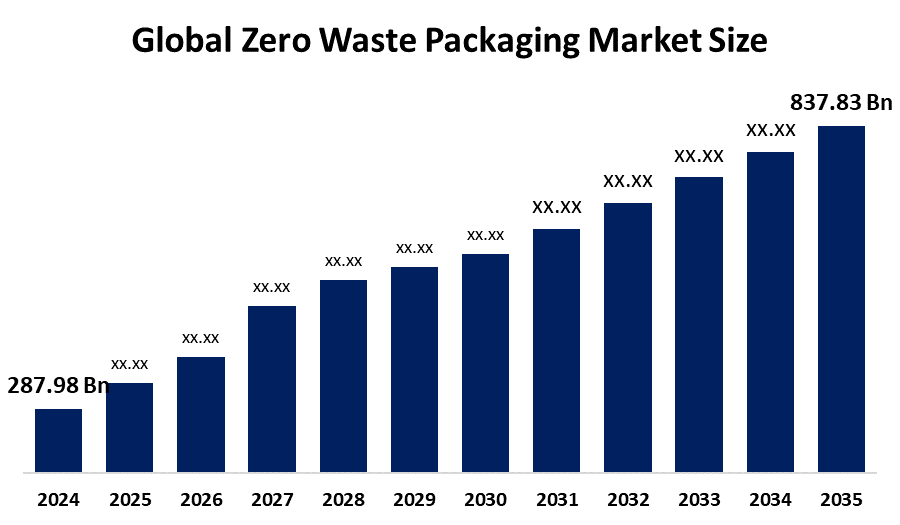
- The Global Zero Waste Packaging Market Size Was Estimated at USD 287.98 Billion in 2024
- The Market Size is Expected to Grow at a CAGR of around 10.2% from 2025 to 2035
- The Worldwide Zero Waste Packaging Market Size is Expected to Reach USD 837.83 Billion by 2035
- North America is expected to Grow the fastest during the forecast period.
Get more details on this report -
According to a Research Report Published by Spherical Insights and Consulting, The Global Zero Waste Packaging Market Size was worth around USD 287.98 Billion in 2024 and is predicted to Grow to around USD 837.83 Billion by 2035 with a compound annual growth rate (CAGR) of 10.2% from 2025 to 2035. Global shift towards circular economy, strict environmental regulations, technological innovations in materials and design, circular economy adoption, and growth in e-commerce platforms are all driving opportunities in the zero-waste packaging market.
Market Overview
The global industry segment focused on designing, producing, and distributing packaging solutions that eliminate or drastically reduce waste by prioritizing reuse, refill, and recycling, composting, and material reduction across the entire product lifecycle is known as the zero waste packaging market. These include advanced bio-based materials, smart recyclable polymers, edible packaging, AI-enabled packaging optimization, and closed-loop recycling systems. The government backed through sustainability regulations and incentives for circular economy initiatives. For example, in February 2022, India’s around 2.26 million tonnes of plastic packaging were covered under the EPR framework for 2022–2 under the Plastic Waste Management Rules, making producers, importers, and brand owners responsible for collecting, recycling, and reusing plastic packaging waste throughout its lifecycle.
In December 2024, the EU’s PPWR regulation covering the entire packaging lifecycle, focusing on reducing packaging waste, increasing reuse, and improving recyclability, targeting upto 65% recycled content in plastic bottles by 2040. Growth is due to several factors, such as the growing adoption of circular economy models and improvements in recycling infrastructure, which are significantly accelerating the demand for zero-waste packaging worldwide. The quick speed of technological advancement is one of the main drivers of the zero-waste packaging market's expansion.
Report Coverage
This research report categorizes the zero waste packaging market based on various segments and regions, forecasts revenue growth, and analyzes trends in each submarket. The report analyses the key growth drivers, opportunities, and challenges influencing the zero waste packaging market. Recent market developments and competitive strategies, such as expansion, product launch, development, partnership, merger, and acquisition, have been included to draw the competitive landscape in the market. The report strategically identifies and profiles the key market players and analyses their core competencies in each sub-segment of the zero waste packaging market.
Global Zero Waste Packaging Market Report Coverage
| Report Coverage | Details |
|---|---|
| Base Year: | 2024 |
| Market Size in 2024 : | USD 287.98 Billion |
| Forecast Period: | 2025-2035 |
| Forecast Period CAGR 2025-2035 : | 10.2% |
| 2035 Value Projection: | USD 837.83 Billion |
| Historical Data for: | 2020-2023 |
| No. of Pages: | 183 |
| Tables, Charts & Figures: | 76 |
| Segments covered: | By Type, By Material and COVID-19 Impact Analysis |
| Companies covered:: | Tetra Pak, Dow Company, Unilever, PepsiCo, Mondi plc, Nestle, Amcor plc, DS Smith plc, Berry Global, WestRock Company, Ball Corporation, Sealed Air Corporation, Smurfit Kappa, and Others |
| Pitfalls & Challenges: | COVID-19 Empact, Challenge, Future, Growth, & Analysis |
Get more details on this report -
Driving Factors
Rapid technological innovation is one of the main drivers of the zero waste packaging market's growth. Increasing environmental concerns over plastic pollution and landfill waste are encouraging industries to adopt sustainable packaging solutions, which is the main factor driving the market for zero waste packaging. In this field, innovation and investment are driven by the advancements in biodegradable materials, innovative packaging solutions, and the growing adoption of circular economy models for applications such as food & beverages, personal care, and e-commerce to implement minimal-waste packaging systems.
In 2024, Nestle introduced recyclable paper packaging for products such as Nescafé, KitKat, Maggi bouillon cubes, Nesquik, and Smarties, replacing multi-material packaging that is difficult to recycle, highlighting a strong shift towards zero waste packaging market.
Restraining Factors
High development and deployment costs, limited recycling and composting infrastructure, Performance limitations, lack of standardized regulations, supply chain constraints for bio-based raw materials, and difficulty of redesigning existing packaging systems and production lines are the main factors restricting the zero waste packaging market.
Market Segmentation
The zero waste packaging market share is classified into type, material, and application.
- The recyclable packaging segment dominated the market in 2024, approximately 94%, and is projected to grow at a substantial CAGR during the forecast period.
Based on the type, the zero waste packaging market is divided into recyclable packaging, compostable packaging, and edible packaging. Among these, the recyclable packaging segment dominated the market in 2024, approximately 94%, and is projected to grow at a substantial CAGR during the forecast period. High consumer awareness, existing infrastructure, rising environmental awareness, growth in e-commerce platforms, and offers a balance of eco-friendly properties, is driving the recyclable packaging industry.
- The paper & cardboard segment accounted for the largest share in 2024, approximately 76%, and is anticipated to grow at a significant CAGR during the forecast period.
Based on the material, the zero waste packaging market is divided into biopolymer, paper & cardboard, glass packaging, and metal packaging. Among these, the paper & cardboard segment accounted for the largest share in 2024, approximately 76%, and is anticipated to grow at a significant CAGR during the forecast period. High recycling rates, well-established curbside recycling systems, reduction in landfill waste, rapid use in diverse sectors, and innovation in barrier technology is driving the paper & cardboard industry.
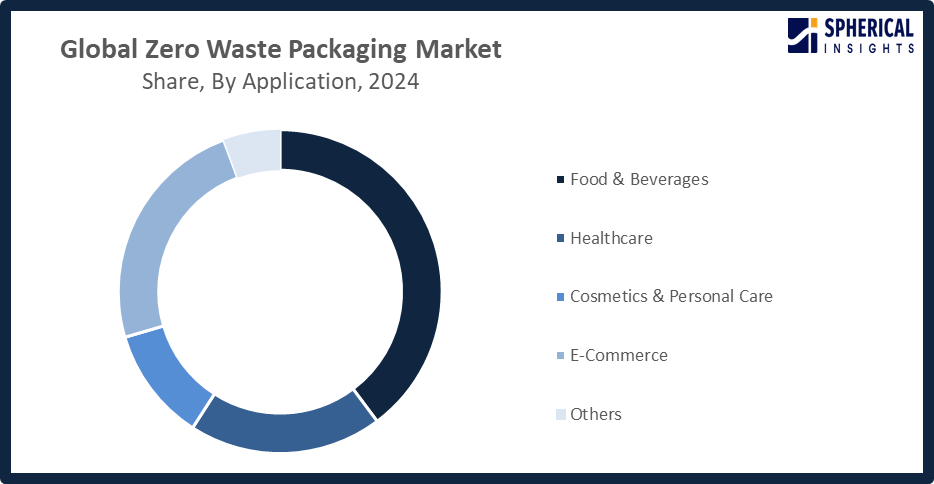
- The food & beverages segment accounted for the highest market revenue in 2024, approximately 35%, and is anticipated to grow at a significant CAGR during the forecast period.
Based on the application, the zero waste packaging market is divided into food & beverages, healthcare, cosmetics & personal care, e-commerce, and others. Among these, the food & beverages segment accounted for the highest market revenue in 2024, approximately 35%, and is anticipated to grow at a significant CAGR during the forecast period. Intense pressure to reduce single-use plastic pollution, strict regulatory mandates, and rising consumer demand for sustainable, non-toxic, and biodegradable packaging is bolstering food & beverages market.
Get more details on this report -
Regional Segment Analysis of the Zero Waste Packaging Market
- North America (U.S., Canada, Mexico)
- Europe (Germany, France, U.K., Italy, Spain, Rest of Europe)
- Asia-Pacific (China, Japan, India, Rest of APAC)
- South America (Brazil and the Rest of South America)
- The Middle East and Africa (UAE, South Africa, Rest of MEA)
Asia Pacific is anticipated to hold the largest share of the zero waste packaging market over the predicted timeframe.

Get more details on this report -
Asia Pacific is anticipated to hold the largest share of the zero waste packaging market over the predicted timeframe. China, Japan, India, and South Korea are among the nations making significant investments with strong government backing that provide financial incentives, subsidies, and infrastructure support for recycling facilities and circular economy initiatives, which lower the barriers to implementing zero-waste packaging and propel the Asia Pacific. The region's position is further reinforced by government programs' strict regulations on single-use plastics and recycling mandates, which compel manufacturers and brand owners to adopt recyclable, biodegradable, and reusable packaging solutions.
Government initiatives include UNDP November 2024 funding of USD 18,389,000 from donors upto October 2027 to strengthen policy regulatory frameworks and recycling infrastructure across South & Southeast Asia, the Vietnam's January 2022 Decree No. 08/2022/ND-CP under the Law on Environmental Protection enforces extended producer responsibility (EPR) for packaging products, and Japan's PRCA June 2022, to promote the 3Rs and improve recycling of plastic resources including. packaging.
North America is expected to grow at a rapid CAGR in the zero waste packaging market during the forecast period. The United States and Canada are among the nations making significant investments in R&D, recyclable materials, reusable packaging, and closed-loop recycling systems as part of their corporate sustainability and ESG goals, which accelerates market growth. Rapid adoption of sustainable packaging driven by stringent federal and state regulations mandates for recyclable and compostable packaging.
Government launches include Canada's Federal Plastics Registry, launched in 2025 to collect data on plastic production, reuse, recycling, and disposal, the U.S. EPR's Packaging Waste and Cost Reduction Act in early 2024, California Zero Waste Plan, January 2026 to reduce and reuse all materials, close waste system gaps, and support circular economy objectives, including packaging waste reduction.
Competitive Analysis:
The report offers the appropriate analysis of the key organizations/companies involved within the zero waste packaging market, along with a comparative evaluation primarily based on their product of offering, business overviews, geographic presence, enterprise strategies, segment market share, and SWOT analysis. The report also provides an elaborative analysis focusing on the current news and developments of the companies, which includes product development, innovations, joint ventures, partnerships, mergers & acquisitions, strategic alliances, and others. This allows for the evaluation of the overall competition within the market.
List of Key Companies
- Tetra Pak
- Dow Company
- Unilever
- PepsiCo
- Mondi plc
- Nestle
- Amcor plc
- DS Smith plc
- Berry Global
- WestRock Company
- Ball Corporation
- Sealed Air Corporation
- Smurfit Kappa
- Others
Key Target Audience
- Market Players
- Investors
- End-users
- Government Authorities
- Consulting and Research Firm
- Venture capitalists
- Value-Added Resellers (VARs)
Recent Development
- In January 2026, Tetra Pak announced an investment of €60 million in a pilot plant in Lund, Sweden to accelerate the development of paper-based barrier materials for recyclable food packaging.
- In December 2025, Tetra Pak introduced the world’s first paper-based barrier aseptic carton in collaboration with Garcia Carrion. The package contains up to 80% paper and about 92% renewable materials, reducing carbon footprint by around 43% compared with traditional cartons. This innovation replaces aluminium foil with a renewable paper-based barrier to reduce fossil-based materials.
- In July 2025, Dow launched INNATE TF 220 Precision Packaging Resin, designed to improve recyclability of flexible packaging films used in food, cleaning, and personal-care products, supporting circular economy packaging systems and enabling recyclable detergent packaging formats.
- In June 2024, Mondi Group partnered with retail chain Biedronka to launch a closed-loop corrugated packaging system where packaging is collected, recycled, and reused to produce new packaging materials.
Market Segment
This study forecasts revenue at global, regional, and country levels from 2020 to 2035. Spherical Insights has segmented the zero waste packaging market based on the below-mentioned segments:
Global Zero Waste Packaging Market, By Type
- Recyclable Packaging
- Compostable Packaging
- Edible Packaging
Global Zero Waste Packaging Market, By Material
- Biopolymer
- Paper & Cardboard
- Glass Packaging
- Metal Packaging
Global Zero Waste Packaging Market, By Application
- Food & Beverages
- Healthcare
- Cosmetics & Personal care
- E-Commerce
- Others
Global Zero Waste Packaging Market, By Regional Analysis
- North America
- US
- Canada
- Mexico
- Europe
- Germany
- UK
- France
- Italy
- Spain
- Russia
- Rest of Europe
- Asia Pacific
- China
- Japan
- India
- South Korea
- Australia
- Rest of Asia Pacific
- South America
- Brazil
- Argentina
- Rest of South America
- Middle East & Africa
- UAE
- Saudi Arabia
- Qatar
- South Africa
- Rest of the Middle East & Africa
Frequently Asked Questions (FAQ)
-
1. What technological innovations support the market?Innovations include bio-based polymers, edible packaging, compostable films, advanced recycling systems, and reusable containers. These reduce carbon footprint and improve circularity.
-
2. How is consumer behaviour influencing zero-waste packaging?Eco-conscious consumers prefer sustainable packaging, creating demand for recyclable or reusable containers. Brands respond with green marketing and responsible product design.
-
3. How does zero-waste packaging benefit the environment?Reduces landfill and marine pollution, lowers carbon emissions, and supports resource efficiency encourages reuse and recycling throughout product life cycles.
-
4. How is the healthcare sector adopting zero-waste packaging?The market is projected to grow steadily, driven by regulatory mandates, sustainable packaging adoption, and consumer preference for eco-friendly products.
-
5. How do companies measure packaging sustainability?Through metrics like recyclability, recycled content, carbon footprint, and life-cycle analysis. Certifications (e.g., FSC, OK compost, Mobius Loop) also validate sustainability claims.
-
6. What future trends are shaping the market?Growth of reusable packaging models, plant-based materials, smart packaging for tracking recyclability, and stricter global EPR regulations. Consumer awareness and government incentives will continue driving adoption.
Need help to buy this report?