Global Wood Dining Table Market Size, Share, and COVID-19 Impact Analysis, By Table Shape (Oval, Rectangle, Round, and Square), By Distribution Channel (Specialty Stores, Supermarkets & Hypermarkets, Online Stores, and Others), and by Region (North America, Europe, Asia-Pacific, Latin America, Middle East, and Africa), Analysis and Forecast 2025 - 2035.
Industry: Consumer Goods
Global Wood Dining Table Market Insights Forecasts to 2035
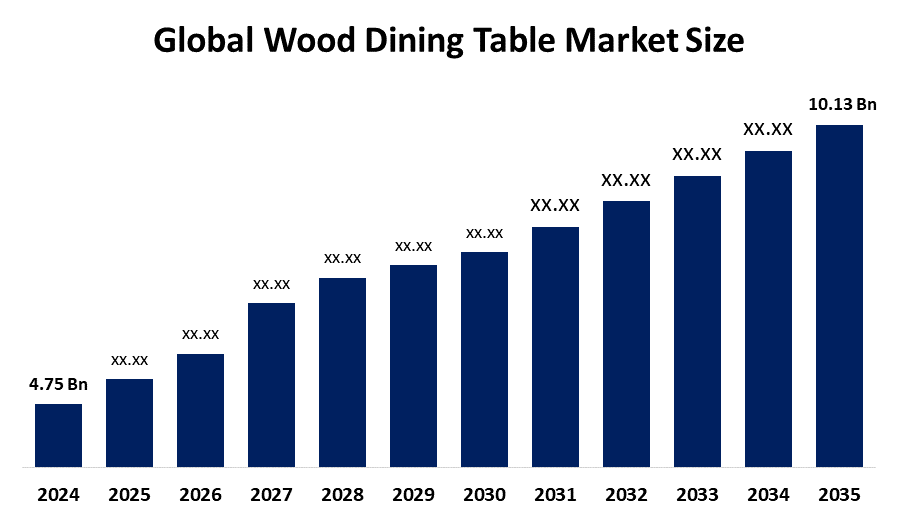
- The Global Wood Dining Table Market Size Was Estimated at USD 4.75 Billion in 2024
- The Market Size is Expected to Grow at a CAGR of around 7.13 % from 2025 to 2035
- The Worldwide Wood Dining Table Market Size is Expected to Reach USD 10.13 Billion by 2035
- North America is expected to grow the fastest during the forecast period.
Get more details on this report -
According to a research report published by Spherical Insights and Consulting, The Global Wood Dining Table Market Size was worth around USD 4.75 Billion in 2024 and is predicted to Grow to around USD 10.13 Billion by 2035 with a compound annual growth rate (CAGR) of 7.13% from 2025 to 2035. Future opportunities in the wood dining table market include rising demand for sustainable furniture, customized designs, urban housing growth, e-commerce expansion, and increasing preference for premium solid wood interiors.
Market Overview
The wood dining table market refers to the production and sale of dining tables manufactured from solid wood or engineered wood materials for residential and commercial use. The market is driven by growing urban housing development, rising preference for sustainable and natural furniture, and increasing disposable incomes. Globally, over 55% of consumers prefer wooden furniture due to durability and aesthetic appeal. Government initiatives supporting housing development, smart city projects, and affordable housing schemes in countries such as India and China continue to stimulate furniture demand. Additionally, policies encouraging sustainable forestry and certified wood usage promote eco-friendly production. Growth in e-commerce furniture sales, which accounts for nearly 30% of furniture purchases, and rising demand for customized and space-saving furniture further support market expansion, despite challenges from fluctuating raw material prices.
Report Coverage
This research report categorizes the wood dining table market based on various segments and regions, forecasts revenue growth, and analyzes trends in each submarket. The report analyses the key growth drivers, opportunities, and challenges influencing the wood dining table market. Recent market developments and competitive strategies, such as expansion, product launch, development, partnership, merger, and acquisition, have been included to draw the competitive landscape in the market. The report strategically identifies and profiles the key market players and analyzes their core competencies in each sub-segment of the wood dining table market.
Global Wood Dining Table Market Report Coverage
| Report Coverage | Details |
|---|---|
| Base Year: | 2024 |
| Market Size in 2024: | USD 4.75 Billion |
| Forecast Period: | 2025-2035 |
| Forecast Period CAGR 2025-2035 : | 7.13% |
| 2035 Value Projection: | USD 10.13 Billion |
| Historical Data for: | 2020-2023 |
| No. of Pages: | 240 |
| Tables, Charts & Figures: | 95 |
| Segments covered: | By Type, By Application |
| Companies covered:: | IKEA, Ashley Furniture Industries, Herman Miller, Inc., Williams-Sonoma, Inc., Ethan Allen Interiors Inc., Steelcase Inc., HNI Corporation, La-Z-Boy Incorporated, Sauder Woodworking Co., Dorel Industries Inc., Poliform S.p.A., Hooker Furniture Corporation, Bassett Furniture Industries, Inc., Godrej & Boyce Manufacturing Co. Ltd., Yihua Lifestyle Technology Co. Ltd., and Key Players |
| Pitfalls & Challenges: | COVID-19 Empact, Challenge, Future, Growth, & Analysis |
Get more details on this report -
Driving Factors
The wood dining table market is driven by increasing urbanization and residential construction, with global housing completions rising steadily each year. Growing consumer preference for sustainable and natural furniture materials supports demand, as over 55% of buyers favor wooden furniture for durability and aesthetics. Rising disposable incomes and changing lifestyle trends, including home décor personalization, further boost sales. Additionally, rapid growth of e-commerce furniture platforms, accounting for nearly 30% of purchases, and expanding hospitality and commercial spaces significantly contribute to market growth.
Restraining Factors
High raw material and transportation costs, deforestation regulations, availability of low-cost alternatives, long manufacturing lead times, and sensitivity to economic slowdowns restrain wood dining table market growth.
Market Segmentation
The wood dining table market share is classified into table shape and distribution channel.
- The rectangle segment accounted for the largest share in 2024 and is anticipated to grow at a significant CAGR during the forecast period.
Based on the table shape, the wood dining table market is divided into oval, rectangle, round, and square. Among hese, the rectangle segment accounted for the largest share in 2024 and is anticipated to grow at a significant CAGR during the forecast period. The rectangular segment led the wood dining table market in 2024 with about 45% revenue share, mainly because its elongated shape fits most dining room layouts and maximizes seating capacity, accommodating families and guests more effectively than other shapes. Rectangular tables also offer versatile size options and are widely available in various finishes and designs, making them the most preferred choice globally and supporting continued strong CAGR growth.
- The specialty stores segment accounted for the highest market revenue in 2024 and is anticipated to grow at a significant CAGR during the forecast period.
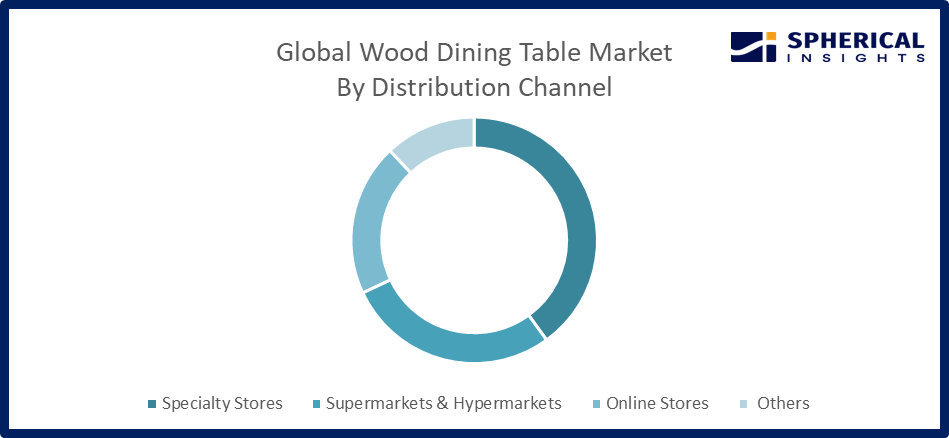
Based on the distribution channel, the wood dining table market is divided into specialty stores, supermarkets & hypermarkets, online stores, and others. Among these, the specialty stores segment accounted for the highest market revenue in 2024 and is anticipated to grow at a significant CAGR during the forecast period. Specialty stores held the highest revenue share (35%) in 2024 because customers value physical inspection, tactile experience, and expert guidance when buying high-value furniture. Meanwhile, online stores are growing rapidly at a 7.6% CAGR due to convenience, broader product variety, and home delivery options, attracting younger and digital-savvy buyers.
Get more details on this report -
Regional Segment Analysis of the Wood Dining Table Market
- North America (U.S., Canada, Mexico)
- Europe (Germany, France, U.K., Italy, Spain, Rest of Europe)
- Asia-Pacific (China, Japan, India, Rest of APAC)
- South America (Brazil and the Rest of South America)
- The Middle East and Africa (UAE, South Africa, Rest of MEA)
Asia Pacific is anticipated to hold the largest share of the wood dining table market over the predicted timeframe.
Asia Pacific is anticipated to hold the largest share of the wood dining table market over the predicted timeframe. Asia Pacific is anticipated to hold the largest share of the wood dining table market due to abundant raw materials, low manufacturing costs, and strong furniture exports. Rapid urbanization, rising disposable incomes, and growing residential and hospitality construction in China and India are boosting demand for wooden dining furniture across the region.

Get more details on this report -
North America is expected to grow at a rapid CAGR in the wood dining table market during the forecast period. North America is expected to grow at a rapid CAGR in the wood dining table market due to rising demand for premium, customized furniture, increasing home renovation activities, and strong e-commerce penetration. Growing consumer preference for sustainable and solid wood furniture, along with expanding residential construction and hospitality upgrades in the U.S. and Canada, is further accelerating market growth.
Competitive Analysis:
The report offers the appropriate analysis of the key organizations/companies involved within the wood dining table market, along with a comparative evaluation primarily based on their product offering, business overviews, geographic presence, enterprise strategies, segment market share, and SWOT analysis. The report also provides an elaborative analysis focusing on the current news and developments of the companies, which includes product development, innovations, joint ventures, partnerships, mergers & acquisitions, strategic alliances, and others. This allows for the evaluation of the overall competition within the market.
List of Key Companies
- IKEA
- Ashley Furniture Industries
- Herman Miller, Inc.
- Williams-Sonoma, Inc.
- Ethan Allen Interiors Inc.
- Steelcase Inc.
- HNI Corporation
- La-Z-Boy Incorporated
- Sauder Woodworking Co.
- Dorel Industries Inc.
- Poliform S.p.A.
- Hooker Furniture Corporation
- Bassett Furniture Industries, Inc.
- Godrej & Boyce Manufacturing Co. Ltd.
- Yihua Lifestyle Technology Co. Ltd.
Key Target Audience
- Market Players
- Investors
- End-users
- Government Authorities
- Consulting and Research Firm
- Venture capitalists
- Value-Added Resellers (VARs)
Market Segment
This study forecasts revenue at global, regional, and country levels from 2020 to 2035. Spherical Insights has segmented the wood dining table market based on the below-mentioned segments:
Global Wood Dining Table Market, By Table Shape
- Oval
- Rectangle
- Round
- Square
Global Wood Dining Table Market, By Distribution Channel
- Specialty Stores
- Supermarkets & Hypermarkets
- Online Stores
- Others
Global Wood Dining Table Market, By Regional Analysis
- North America
- US
- Canada
- Mexico
- Europe
- Germany
- UK
- France
- Italy
- Spain
- Russia
- Rest of Europe
- Asia Pacific
- China
- Japan
- India
- South Korea
- Australia
- Rest of Asia Pacific
- South America
- Brazil
- Argentina
- Rest of South America
- Middle East & Africa
- UAE
- Saudi Arabia
- Qatar
- South Africa
- Rest of the Middle East & Africa
Frequently Asked Questions (FAQ)
-
1.What is the CAGR of the wood dining table market over the forecast period?The global wood dining table market is projected to expand at a CAGR of 7.13% during the forecast period.
-
2.What is the market size of the wood dining table market?The global wood dining table market size is expected to grow from USD 4.75 billion in 2024 to USD 10.13 billion by 2035, at a CAGR of 7.13 % during the forecast period 2025-2035.
-
3.Which region holds the largest share of the wood dining table market?Asia Pacific is anticipated to hold the largest share of the wood dining table market over the predicted timeframe.
-
4.Who are the top 10 companies operating in the global wood dining table market?IKEA, Ashley Furniture Industries, Herman Miller, Williams-Sonoma, Ethan Allen Interiors, Steelcase, HNI Corporation, La-Z-Boy, Sauder Woodworking, Dorel Industries, Poliform, Hooker Furniture, Bassett Furniture Industries, Godrej & Boyce Manufacturing, and Yihua Lifestyle Technology.
-
5.What factors are driving the growth of the wood dining table market?Rising residential construction, urbanization, increasing disposable incomes, home renovation trends, growing hospitality sector, and strong demand for durable, sustainable wooden furniture.
-
6.What are the market trends in the wood dining table market?Increasing demand for sustainable materials, customizable designs, online sales growth, multifunctional tables, premium finishes, and focus on eco-friendly, space-saving furniture trends.
-
7.What are the main challenges restricting the wider adoption of the wood dining table market?High raw material costs, supply chain disruptions, competition from alternative materials, fluctuating wood prices, and limited skilled labor availability restrict market growth.
Need help to buy this report?