Global Wireless EEG Monitoring System Market Size, Share, and COVID-19 Impact Analysis, By System Type (Head-mounted Systems, Implantable Systems, Portable Systems, Multichannel Professional Systems, and Others), By Application (Epilepsy Monitoring, Sleep Research, Cognitive & Emotional Research, Neurorehabilitation, and Others), and By Region (North America, Europe, Asia-Pacific, Latin America, Middle East, and Africa), Analysis and Forecast 2025 - 2035.
Industry: Healthcare
Global Wireless EEG Monitoring System Market Insights Forecasts to 2035
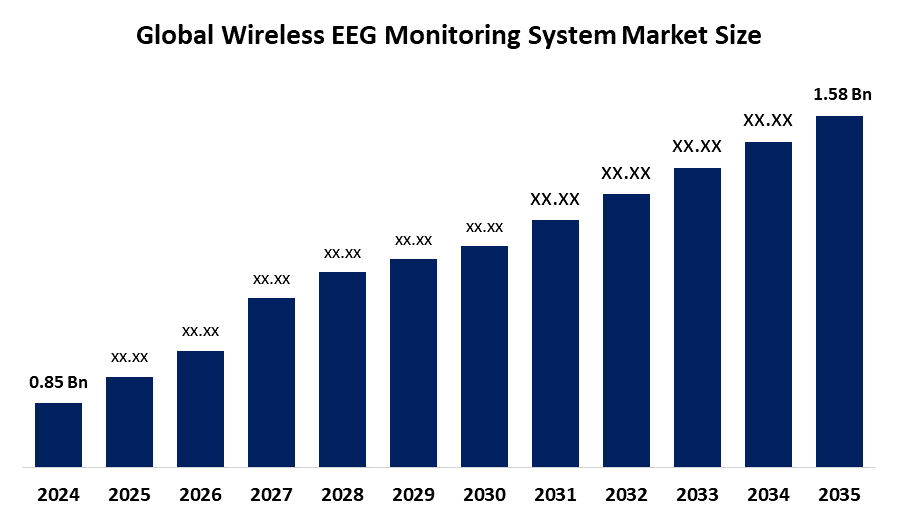
- The Global Wireless EEG Monitoring System Market Size Was Estimated at USD 0.85 Billion in 2024
- The Market Size is Expected to Grow at a CAGR of around 5.8% from 2025 to 2035
- The Worldwide Wireless EEG Monitoring System Market Size is Expected to Reach USD 1.58 Billion by 2035
- Asia Pacific is expected to grow the fastest during the forecast period.
Get more details on this report -
According to a research report published by Spherical Insights and Consulting, The global wireless EEG monitoring system market size was worth around USD 0.85 Billion in 2024 and is predicted to Grow to around USD 1.58 Billion by 2035 with a compound annual Growth rate (CAGR) of 5.8% from 2025 to 2035. The wireless EEG monitoring system market is growing due to an increase in cases of neurological problems, a rise in demand for remote patient monitoring, improvements in wearable technology, and the advancement of AI technology for analyzing the readings provided by this portable device.
Market Overview
The global wireless EEG monitoring system market involves the processing and utilisation of sophisticated electroencephalography devices that can record brain activity without requiring a physical connection to an electromagnetic spectrum, thereby enabling live observation. These systems are generally utilised for diagnosing as well as managing different neurological disorders such as epilepsy, sleep disorders, brain trauma, and neurodegenerative disorders. The global market for wireless EEG monitoring systems is mainly bolstered by different factors, such as the rise in neurological disorders, advancements in the concept of telemedicine for carrying out patient observations from a distance, and the rise in wearable healthcare solutions. Advancements in AI technology have enabled the collection of more accurate brain signals from electroencephalography devices.
Various opportunities have also emerged in different markets because many countries have witnessed an increase in healthcare infrastructure. Leading vendors in the global wireless EEG monitoring systems industry, such as Nihon Kohden, NeuroSky, Medtronic, Ceribell, Cadwell Industries, and Philips Healthcare, are putting continuous efforts into innovation, partnerships, and product diversification to acquire different market shares. In March 2025, the U.S. NIH BRAIN Initiative Funding for FY2024. In FY2024, the NIH budgeted an amount of $402 million for neural science to develop innovative tools for researching the brain, including wireless EEG sensors for managing epilepsy. However, the budget amount dropped from FY2023's budgeted $680 million.
Report Coverage
This research report categorizes the wireless EEG monitoring system market based on various segments and regions, forecasts revenue growth, and analyzes trends in each submarket. The report analyses the key growth drivers, opportunities, and challenges influencing the wireless EEG monitoring system market. Recent market developments and competitive strategies, such as expansion, type launch, development, partnership, merger, and acquisition, have been included to draw the competitive landscape in the market. The report strategically identifies and profiles the key market players and analyses their core competencies in each sub-segment of the wireless EEG monitoring system market.
Global Wireless EEG Monitoring System Market Report Coverage
| Report Coverage | Details |
|---|---|
| Base Year: | 2024 |
| Market Size in 2024: | USD 0.85 Billion |
| Forecast Period: | 2024-2035 |
| Forecast Period CAGR 2024-2035 : | 5.8% |
| 2035 Value Projection: | USD 1.58 Billion |
| Historical Data for: | 2020-2023 |
| No. of Pages: | 240 |
| Tables, Charts & Figures: | 105 |
| Segments covered: | By Type, By Application |
| Companies covered:: | Natus Medical Incorporated, Nihon Kohden, Cadwell Industries,Medtronic, Ceribell, Philips Healthcare, Neuroelectrics, ANT Neuro, EMOTIV Inc.,Biosemi B.V., Masimo Corporation, and Key Players. |
| Pitfalls & Challenges: | COVID-19 Empact, Challenge, Future, Growth, & Analysis |
Get more details on this report -
Driving Factors
The wireless EEG monitoring system market is propelled by the rising number of neurological disorders like epilepsy, sleep disorders, and brain injuries, which boost the demand for effective monitoring systems. The technological advancement of wireless and wearable technologies allows for real-time monitoring of brain activity at a convenient remote location, and the adoption of telemedicine and home-based healthcare adds to the market growth. Furthermore, awareness and investments made by research institutions and hospitals for advanced neurological diagnosis accelerate market adoption. Additionally, the integration of AI and analytics capabilities in EEG monitoring systems increases the accuracy of analysis and treatment, promoting market growth.
Restraining Factors
The market for wireless EEG monitors around the world is constrained by high equipment cost, unfavorable reimbursement policies, and technological issues such as signal noise and data integrity. Furthermore, the shortage of qualified personnel to man sophisticated devices in healthcare settings is a major deterrent for its adoption in developing countries.
Market Segmentation
The wireless EEG monitoring system market share is classified into system type and application.
- The head-mounted systems segment dominated the market in 2024, approximately 52% and is projected to grow at a substantial CAGR during the forecast period.
Based on the system type, the wireless EEG monitoring system market is divided into head-mounted systems, implantable systems, portable systems, multichannel professional systems, and others. Among these, the head-mounted systems segment dominated the market in 2024 and is projected to grow at a substantial CAGR during the forecast period. This segment develops owing to advanced portability, weight efficiency, and differentiated recording capabilities that allow for enhanced accuracy of diagnosis even during mobile diagnosis and medical settings. Healthcare professionals like mobile technology that ensures consistent signals, comfort for the patient, and home monitoring capabilities. Head-worn wireless EEG technology is notable for its trusted signal transfer, cloud connectivity, and high compliance for various neurological applications.
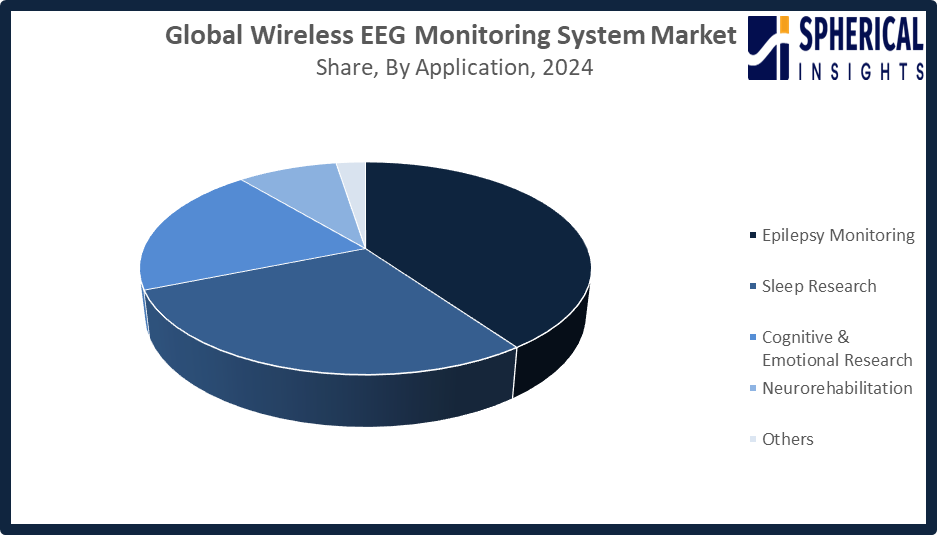
- The epilepsy monitoring segment accounted for the highest market revenue in 2024, approximately 40% and is anticipated to grow at a significant CAGR during the forecast period.
Based on the application, the wireless EEG monitoring system market is divided into epilepsy monitoring, sleep research, cognitive & emotional research, neurorehabilitation, and others. Among these, the epilepsy monitoring segment accounted for the highest market revenue in 2024 and is anticipated to grow at a significant CAGR during the forecast period. This segment growth is fueled by the increasing use of ambulatory seizure monitoring and a focus on medication management, evaluation for surgery, and management of the condition. Neurologists are interested in having functional recordings, sensitive seizure detection, and system integration capabilities. Spending on epilepsy programs and an increase in drug-resistant patients are key factors fuelling the wireless EEG systems market.
Get more details on this report -
Regional Segment Analysis of the Wireless EEG Monitoring System Market
- North America (U.S., Canada, Mexico)
- Europe (Germany, France, U.K., Italy, Spain, Rest of Europe)
- Asia-Pacific (China, Japan, India, Rest of APAC)
- South America (Brazil and the Rest of South America)
- The Middle East and Africa (UAE, South Africa, Rest of MEA)
North America is anticipated to hold the largest share of the wireless EEG monitoring system market over the predicted timeframe.
North America is anticipated to hold the largest share of the wireless EEG monitoring system market over the predicted timeframe. North America is anticipated to 38% market share for wireless EEG monitoring systems, fueled by its developed healthcare system, early adoption of digital health, and a large number of neurological conditions. The United States has the leading position, thanks to its significant investments in research and development of neurotechnology, its high usage of telemedicine, and its favorable reimbursements. Rising demand for ambulatory and home-based EEG monitoring systems and active research work at institutions contribute to this growth. The presence of large medical device players also enhances this market position. The United States NIH BRAIN Initiative continued funding research work in advanced neurotechnology in September 2025 to quickly develop better wireless EEG systems with high accuracy and real-time tracking capabilities.
Asia Pacific is expected to grow at a rapid CAGR in the wireless EEG monitoring system market during the forecast period. Asia Pacific is expected to have a 25% market share of the wireless EEG monitoring system market due to increasing healthcare expenditure, growing knowledge of neurological disorders, and increased adoption of digital healthcare platforms. China, Japan, and the Republic of India are significant to this region due to increasing initiatives by their governments, growing hospital infrastructure, and increasing adoption of telemedicine platforms. The massive population, fast-growing urbanization, and increasing investment by medical device manufacturers are other significant growth contributors. In August 2025, China launched a national policy framework for BCI with a focus on non-invasive, wearable neural technologies such as wireless EEG, by 2030.
The European market is expected to have steady growth in the wireless EEG monitoring system market owing to rising interest in early neurological diagnoses, an aging population, and home-monitoring solutions. The countries that lead this region are Germany, the UK, and France, mainly because they have robust healthcare infrastructures, medical research, and support advanced medical device regulations. The increasing adoption of digital health technologies and tele-neurology services further helps to boost this market.
Competitive Analysis:
The report offers the appropriate analysis of the key organizations/companies involved within the wireless EEG monitoring system market, along with a comparative evaluation primarily based on their type of offering, business overviews, geographic presence, enterprise strategies, segment market share, and SWOT analysis. The report also provides an elaborative analysis focusing on the current news and developments of the companies, which includes type development, innovations, joint ventures, partnerships, mergers & acquisitions, strategic alliances, and others. This allows for the evaluation of the overall competition within the market.
List of Key Companies
- Natus Medical Incorporated
- Nihon Kohden
- Cadwell Industries
- Medtronic
- Ceribell
- Philips Healthcare
- Neuroelectrics
- ANT Neuro
- EMOTIV Inc.
- Biosemi B.V.
- Masimo Corporation
- NeuroSky Inc.
- Compumedics Limited
- Bitbrain Technologies
- Others
Key Target Audience
- Market Players
- Investors
- End-users
- Government Authorities
- Consulting and Research Firm
- Venture capitalists
- Value-Added Resellers (VARs)
Recent Development
- In September 2025, Natus Medical acquired the remaining minority shares of Holberg EEG, gaining full ownership. Holberg, known for its AI model that interprets clinical EEGs with expert-level accuracy, now become entirely part of Natus, strengthening its neurodiagnostics portfolio.
- In January 2025, Emotiv launched next-generation EEG Active Noise-Cancelling Earphones, combining advanced EEG technology with high-quality audio to provide insights into cognitive performance and personal wellness, offering users a unique tool for monitoring brain activity while enjoying superior sound.
- In May 2025, Natus Medical launched BrainWatch, an AI-driven point-of-care EEG solution. Based in Middleton, Wisconsin, Natus aims to bring trusted neurodiagnostic reliability to critical care. BrainWatch integrates with NeuroWorks, meeting the demand for accessible, efficient EEG monitoring in hospitals worldwide.
- In April 2023, Cadwell Industries launched Arc Voyager in the U.S., a remote monitoring solution for wireless in-home EEG. Combined with Arc Apollo+ and Arc 3.1 software, physicians can access real-time EEG data and video, featuring automatic data backfill for comprehensive daily reporting and efficient patient monitoring.
- In June 2019, Nihon Kohden launched VitalEEG, a wireless EEG headset for rapid brain-wave assessment in unconscious patients. Designed for quick electrode placement and setup within five minutes, VitalEEG enables clinicians to efficiently evaluate brain health and guide timely treatment decisions.
Market Segment
This study forecasts revenue at global, regional, and country levels from 2020 to 2035. Spherical Insights has segmented the wireless EEG monitoring system market based on the below-mentioned segments:
Global Wireless EEG Monitoring System Market, By System Type
- Head-mounted Systems
- Implantable Systems
- Portable Systems
- Multichannel Professional Systems
- Others
Global Wireless EEG Monitoring System Market, By Application
- Epilepsy Monitoring
- Sleep Research
- Cognitive & Emotional Research
- Neurorehabilitation
- Others
Global Wireless EEG Monitoring System Market, By Regional Analysis
- North America
- US
- Canada
- Mexico
- Europe
- Germany
- UK
- France
- Italy
- Spain
- Russia
- Rest of Europe
- Asia Pacific
- China
- Japan
- India
- South Korea
- Australia
- Rest of Asia Pacific
- South America
- Brazil
- Argentina
- Rest of South America
- Middle East & Africa
- UAE
- Saudi Arabia
- Qatar
- South Africa
- Rest of the Middle East & Africa
Frequently Asked Questions (FAQ)
-
1.What is the CAGR of the wireless EEG monitoring system market over the forecast period?The global wireless EEG monitoring system market is projected to expand at a CAGR of 5.8% during the forecast period.
-
2.What is the wireless EEG monitoring system market?The wireless EEG monitoring system market involves devices that record brain activity without wires for neurological diagnosis, monitoring, and research.
-
3.What is the market size of the wireless EEG monitoring system market?The global wireless EEG monitoring system market size is expected to grow from USD 0.85 billion in 2024 to USD 1.58 billion by 2035, at a CAGR of 5.8% during the forecast period 2025-2035.
-
4.Which region holds the largest share of the wireless EEG monitoring system market?North America is anticipated to hold the largest share of the wireless EEG monitoring system market over the predicted timeframe.
-
5.Who are the top 10 companies operating in the global wireless EEG monitoring system market?Natus Medical Incorporated, Nihon Kohden, Cadwell Industries, Medtronic, Ceribell, Philips Healthcare, Neuroelectrics, ANT Neuro, EMOTIV Inc., Biosemi B.V., and Others.
-
6.What factors are driving the growth of the wireless EEG monitoring system market?The growth of the wireless EEG monitoring system market is driven primarily by the rising prevalence of neurological disorders, significant technological advancements (portability, AI integration), and the increasing demand for remote patient monitoring and home-based healthcare solutions.
-
7.What are the market trends in the wireless EEG monitoring system market?Increasing adoption of wearable EEG devices, integration with telemedicine, AI‑enhanced analysis, home monitoring, and demand for real‑time neurological diagnostics.
-
8.What are the main challenges restricting wider adoption of the wireless EEG monitoring system market?The main challenges restricting the wider adoption of the wireless EEG monitoring system market include technical limitations related to signal quality and data analysis, the high cost of advanced systems, significant regulatory hurdles, and concerns over data privacy and security.
Need help to buy this report?