Global Wastewater Treatment Chemicals Market Size, Share, By Product (Coagulants and Flocculants, Biocide and Disinfectant, Defoamer and Defoaming Agent, pH & Adjuster and Softener, and Others), By Application (Raw Water Treatment, Water Desalination, Cooling, Boiler, Effluent Water Treatment, and Others), By End Use (Power, Oil and Gas, Chemical Manufacturing, Mining and Mineral Processing, Municipal, Food and Beverage, and Others), and By Region (North America, Europe, Asia-Pacific, Latin America, Middle East, and Africa), Analysis and Forecast 2025 - 2035.
Industry: Chemicals & Materials
Global Wastewater Treatment Chemicals Market Insights Forecasts to 2035
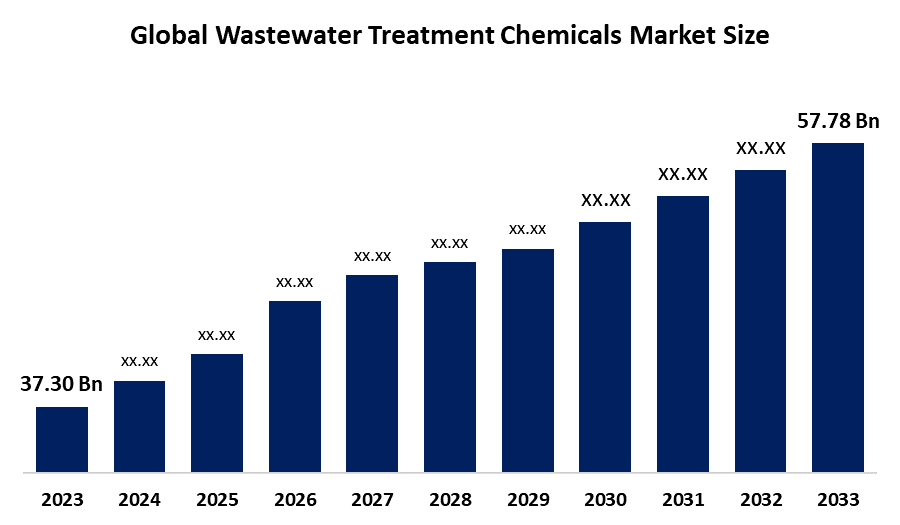
- The Global Wastewater Treatment Chemicals Market Size Was Estimated at USD 37.30 billion in 2024
- The Market Size is Expected to Grow at a CAGR of around 4.06 % from 2025 to 2035
- The Worldwide Wastewater Treatment Chemicals Market Size is Expected to Reach USD 57.78 billion by 2035
- Middle East & Africa region is expected to grow the fastest during the forecast period.
Get more details on this report -
According to a research report published by Spherical Insights, The Global Wastewater Treatment Chemicals Market Size Was Worth Around USD 37.30 Billion In 2024 And Is Predicted To Grow To Around USD 57.78 Billion By 2035 With A Compound Annual Growth Rate (CAGR) Of 4.06% From 2025 To 2035. The global wastewater treatment chemicals market is driven by stricter regulations, industrial growth, water scarcity, population rise, technological advances in chemical treatments, and increasing environmental awareness, boosting demand for efficient wastewater solutions.
Market Overview
The Global Market For Wastewater Treatment Chemicals is comprised of various producers selling their associated products to remove contaminants from various types of wastewater before it can then be reused either as is or after further treatment. The continuing growth of this sector is mainly due to the increased volumes of industrial effluent generated by industry, increasingly stringent effluent discharge standards being enforced, an overall increased governmental focus on providing clean water through various outreach programs, a growing trend toward sustainable management of water resources, and a move toward using increasingly advanced, efficient, and environmentally friendly chemicals for treating industrial effluents.
The market offers opportunities from rapid urbanization, increasingly stringent governmental discharge regulations, having many large infrastructure projects planned or underway, the increasing volume of industrial water being discharged each year, emerging contaminants such as PFAS, and the development of innovative and environmentally sustainable technologies to improve treatment efficiency. The Government of India has committed to spending in excess of 20,000 crores, approximately 2.7 billion, on sewage treatment infrastructure under the Navami Gange Programme of the National Mission for Clean Ganga. These expenditures will be used to construct and renovate hundreds of sewage treatment plants to help reduce the pollution of the Ganga River basin. In addition, this governmental programme is slated for continued funding to upgrade sewage treatment plants and continue projects that focus on wastewater treatment and ecosystems to revitalize rivers. This amount of additional governmental funding for sewage treatment will directly or indirectly impact the demand for coagulants, flocculants, and other water and wastewater treatment chemicals.
Report Coverage
This research report categorizes the global wastewater treatment chemicals market based on various segments and regions, forecasts revenue growth, and analyzes trends in each submarket. The report analyses the key growth drivers, opportunities, and challenges influencing the global wastewater treatment chemicals market. Recent market developments and competitive strategies, such as expansion, product launch, development, partnership, merger, and acquisition, have been included to draw the competitive landscape in the market. The report strategically identifies and profiles the key market players and analyzes their core competencies in each sub-segment of the global wastewater treatment chemicals market.
Global Wastewater Treatment Chemicals Market Report Coverage
| Report Coverage | Details |
|---|---|
| Base Year: | 2024 |
| Market Size in 2024: | USD 37.30 Billion |
| Forecast Period: | 2025-2035 |
| Forecast Period CAGR 2025-2035 : | CAGR Of 4.06% |
| 2035 Value Projection: | USD 57.78 Billion |
| Historical Data for: | 2020-2023 |
| No. of Pages: | 240 |
| Tables, Charts & Figures: | 90 |
| Segments covered: | By Product Type, By Application |
| Companies covered:: | BASF SE Ecolab Inc Kemira Oyj SUEZ Water Technologies & Solutions Solenis LLC SNF Floerger DuPont / DuPont Water Solutions Buckman Laboratories International Shandong Taihe Water Treatment Technologies Kurita Water Industries Ltd Solvay S A The Dow Chemical Company BWA Water Additives Chembond Chemicals Ltd Ion Exchange India Ltd Other Key Players |
| Pitfalls & Challenges: | COVID-19 Empact, Challenge, Future, Growth, & Analysis |
Get more details on this report -
Driving Factors
The primary driving factor for the global wastewater treatment chemicals market is the increasing focus on sustainable water management which includes water recycling and water reuse. Industries and municipalities use advanced chemical treatments to ensure safe, efficient wastewater management and maintain high water quality standards in their closed-loop systems. For instance, in May 2024, Kurita Water Industries established Kurita Aqua Chemise India Private Limited in Chennai, India, to expand its water treatment chemicals business in the region, aligning with growth in the global water and wastewater treatment chemicals market.
Restraining Factors
A key restraining factor for the global wastewater treatment chemicals market is the volatility of raw material prices, such as chlorine derivatives and polymers, combined with high operational and compliance costs, which can limit adoption, particularly for smaller municipalities and industrial facilities.
Market Segmentation
The global wastewater treatment chemicals market share is classified into loader type, technology, and vehicle type.
- The coagulants and flocculants segment accounted for the largest share in 2024, approximately 36%, and is anticipated to grow at a significant CAGR during the forecast period.
Based on the product, the global wastewater treatment chemicals market is divided into coagulants and flocculants, biocide and disinfectant, defoamer & defoaming agent, ph & adjuster and softener, and others. Among these, the coagulants and flocculants segment accounted for the largest share in 2024, approximately 36%, and is anticipated to grow at a significant CAGR during the forecast period. This is because coagulants and flocculants are essential in municipal and industrial wastewater treatment, effectively removing suspended solids, impurities, and turbidity, improving water clarity, supporting downstream treatment processes, and ensuring compliance with environmental and discharge regulations.
- The effluent water treatment segment accounted for the highest market revenue in 2024, approximately 40%, and is anticipated to grow at a significant CAGR during the forecast period.
Based on the application, the global wastewater treatment chemicals market is divided into raw water treatment, water desalination, cooling, boiler, effluent water treatment, and others. Among these, the effluent water treatment segment accounted for the highest market revenue in 2024, approximately 40%, and is anticipated to grow at a significant CAGR during the forecast period. This is because it addresses large volumes of industrial and municipal wastewater, helping industries comply with stringent environmental regulations while ensuring safe discharge and efficient treatment processes.
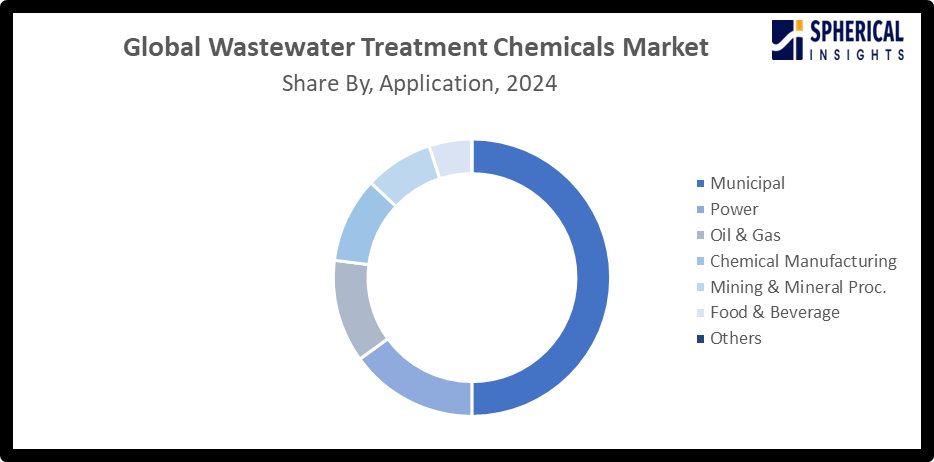
- The municipal dominated the market in 2024, approximately 50%, and is projected to grow at a substantial CAGR during the forecast period.
Based on the end use, the global wastewater treatment chemicals market is divided into power, oil and gas, chemical manufacturing, mining and mineral processing, municipal, food and beverage, and others. Among these, the municipal dominated the market in 2024, approximately 50%, and is projected to grow at a substantial CAGR during the forecast period. The market dominates due to municipal authorities generating large volumes of wastewater that require extensive treatment, and increasing urbanization, population growth, and stringent discharge regulations drive continuous demand for effective wastewater treatment chemicals.
Get more details on this report -
Regional Segment Analysis of the Global Wastewater Treatment Chemicals Market
- North America (U.S., Canada, Mexico)
- Europe (Germany, France, U.K., Italy, Spain, Rest of Europe)
- Asia-Pacific (China, Japan, India, Rest of APAC)
- South America (Brazil and the Rest of South America)
- The Middle East and Africa (UAE, South Africa, Rest of MEA)
Asia-Pacific is anticipated to hold the largest share of the global wastewater treatment chemicals market over the predicted timeframe.

Get more details on this report -
Asia Pacific is anticipated to hold the largest share of global wastewater treatment chemicals market over the predicted timeframe. This is largely due to rapid urbanization, industrial expansion, and increasing government investments in municipal and industrial wastewater treatment infrastructure across countries like China, India, and Southeast Asian nations. Rising environmental regulations and initiatives to improve water quality also drive market growth in this region.
The Middle East & Africa region is expected to grow at the fastest rate during the forecast period. This rapid growth is driven by increasing industrialization, water scarcity issues, and significant investments in wastewater treatment infrastructure to meet environmental regulations and support sustainable development projects. High-performance anticipants and corrosion inhibitors, which are necessary for the upkeep of thermal and membrane desalination facilities, are the focus of market activity.
Competitive Analysis:
The report offers the appropriate analysis of the key organizations/companies involved within the global wastewater treatment chemicals market, along with a comparative evaluation primarily based on their product offering, business overviews, geographic presence, enterprise strategies, segment market share, and SWOT analysis. The report also provides an elaborative analysis focusing on the current news and developments of the companies, which includes product development, innovations, joint ventures, partnerships, mergers & acquisitions, strategic alliances, and others. This allows for the evaluation of the overall competition within the market.
List of Key Companies
- BASF SE
- Ecolab Inc
- Kemira Oyj
- SUEZ Water Technologies & Solutions
- Solenis LLC
- SNF Floerger
- DuPont / DuPont Water Solutions
- Buckman Laboratories International
- Shandong Taihe Water Treatment Technologies
- Kurita Water Industries Ltd
- Solvay S A
- The Dow Chemical Company
- BWA Water Additives
- Chembond Chemicals Ltd
- Ion Exchange India Ltd
- Other
Key Target Audience
- Market Players
- Investors
- End-users
- Government Authorities
- Consulting and Research Firm
- Venture capitalists
- Value-Added Resellers (VARs)
Recent Development
• In September 2025, Veolia launched its next-generation Hubgrade Centre in Scottsdale, offering advanced AI- and data-enabled monitoring for wastewater treatment optimization, and continues to offer its Hyrax 6000 Series plant-based coagulants for wastewater treatment applications.
• In April 2024, Gradiant launched CURE Chemicals, a portfolio of over 300 proprietary formulations, including corrosion and scale inhibitors, coagulants and flocculants, biocides, and antiscalants, engineered to enhance water and wastewater treatment efficiency and sustainability in industrial applications.
Market Segment
This study forecasts revenue at global, regional, and country levels from 2020 to 2035. Spherical Insights has segmented the global wastewater treatment chemicals market based on the below-mentioned segments:
Global Wastewater Treatment Chemicals Market, By Product
- Coagulants and Flocculants
- Biocide and Disinfectant
- Defoamer and Defoaming Agent
- pH & Adjuster and Softener
- Others
Global Wastewater Treatment Chemicals Market, By Application
- Raw Water Treatment
- Water Desalination
- Cooling
- Boiler
- Effluent Water Treatment
- Others
Global Wastewater Treatment Chemicals Market, By End Use
- Power
- Oil and Gas
- Chemical Manufacturing
- Mining and Mineral Processing
- Municipal
- Food and Beverage
- Others
Global Wastewater Treatment Chemicals Market, By Regional Analysis
- North America
- US
- Canada
- Mexico
- Europe
- Germany
- UK
- France
- Italy
- Spain
- Russia
- Rest of Europe
- Asia Pacific
- China
- Japan
- India
- South Korea
- Australia
- Rest of Asia Pacific
- South America
- Brazil
- Argentina
- Rest of South America
- Middle East & Africa
- UAE
- Saudi Arabia
- Qatar
- South Africa
- Rest of the Middle East & Africa
Frequently Asked Questions (FAQ)
-
What are the emerging trends in wastewater treatment chemicals?Emerging trends include biodegradable and eco-friendly chemicals, hybrid coagulant-flocculant formulations, AI-assisted dosing systems, and chemicals tailored for PFAS and micropollutant removal
-
Which industries are driving demand for wastewater treatment chemicals?Key industries include power generation, oil and gas, chemical manufacturing, food and beverage processing, and mining, all requiring effective effluent treatment to meet regulatory standards.
-
How do regulatory changes impact the wastewater treatment chemicals market?Stricter environmental and discharge regulations globally force industries and municipalities to adopt advanced chemical solutions for BOD, COD, nutrient, and micropollutant removal.
-
What role does innovation play in the wastewater treatment chemicals sector?Innovations improve chemical efficiency, reduce sludge generation, lower operational costs, and enhance sustainability, driving adoption in both municipal and industrial applications
-
Which regions are seeing the fastest adoption of advanced wastewater treatment chemicals?Middle East & Africa and parts of Southeast Asia are witnessing rapid growth due to industrialization, water scarcity, and infrastructure development
-
How does population growth influence the market?Increasing urban populations generate higher volumes of municipal wastewater, creating sustained demand for treatment chemicals to ensure safe water recycling and environmental compliance.
-
What are the key challenges faced by chemical manufacturers in this market?Challenges include fluctuating raw material costs, stringent compliance requirements, competition from alternative treatment technologies, and the need for sustainable product development.
Need help to buy this report?