Global Waste Wood Recycling Market Size, Share, and COVID-19 Impact Analysis, By Type (Direct Recycling, Physical Processing Recycling, Chemical Treatment Recycling, and Others), By Application (Building Materials, Furniture, Wooden Consumer Goods, and Others), and By Region (North America, Europe, Asia-Pacific, Latin America, Middle East, and Africa), Analysis and Forecast 2025 - 2035
Industry: Chemicals & Materials
Global Waste Wood Recycling Market Insights Forecasts to 2035
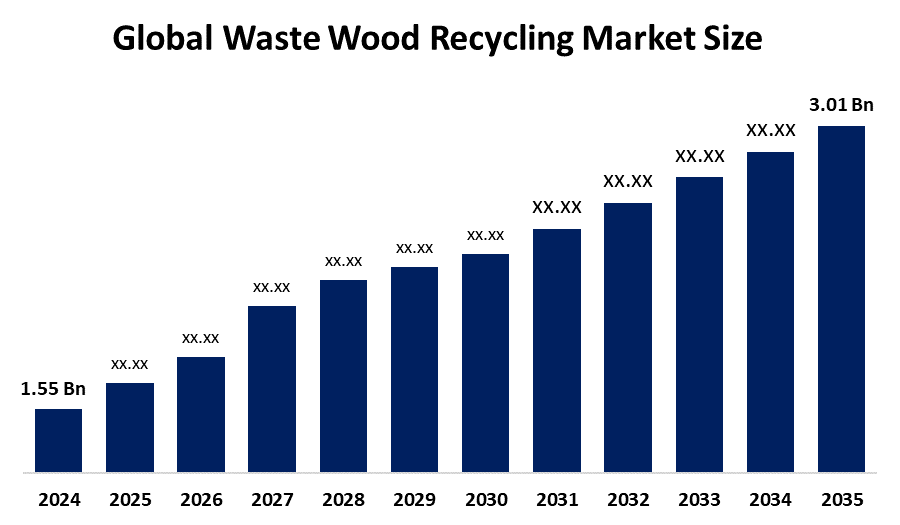
- The Global Waste Wood Recycling Market Size Was Estimated at USD 1.55 Billion in 2024
- The Market Size is Expected to Grow at a CAGR of around 6.22 % from 2025 to 2035
- The Worldwide Waste Wood Recycling Market Size is Expected to Reach USD 3.01 Billion by 2035
- Asia Pacific is expected to grow the fastest during the forecast period.
Get more details on this report -
According to a research report published by Spherical Insights and Consulting, the global waste wood recycling market size was worth around USD 1.55 billion in 2024 and is predicted to grow to around USD 3.01 billion by 2035 with a compound annual growth rate (CAGR) of 6.22 % from 2025 to 2035. Opportunities for sustainable resource use, the production of renewable energy, the development of the circular economy, cost savings, regulatory compliance, job creation, and innovation in recycled wood products are all provided by the waste wood recycling market.
Market Overview
The organized economic sector that collects, separates, processes, treats, and reuses wasted wood materials from manufacturing, packaging, building, demolition, and municipal waste streams is known as the waste wood recycling market. This circular economy sector not only reduces the pressure on landfills but also protects virgin forests by promoting sustainable uses in the production of panel boards, biomass energy, and furniture. It involves a range of participants, including waste management companies, recycling facilities, equipment manufacturers, end-use industries, and government organizations. The influence of policy is evidenced by the latest government actions, such as the U.S. EPA’s campaign for 75% building waste diversion targets and Quebec’s USD 25.5 million investment in secondary wood processing in June 2025. The market is being driven by rising investments in building material applications and furniture manufacturing worldwide, as well as rising demand for direct recycling procedures and processed wood products. In order to create wood chips, mulch, and biomass fuel products, processing methods include direct recycling procedures that use mechanical shredding, chipping, and sizing activities.
Report Coverage
This research report categorizes the waste wood recycling market based on various segments and regions, forecasts revenue growth, and analyzes trends in each submarket. The report analyses the key growth drivers, opportunities, and challenges influencing the waste wood recycling market. Recent market developments and competitive strategies, such as expansion, product launch, development, partnership, merger, and acquisition, have been included to draw the competitive landscape in the market. The report strategically identifies and profiles the key market players and analyzes their core competencies in each sub-segment of the waste wood recycling market.
Global Waste Wood Recycling Market Report Coverage
| Report Coverage | Details |
|---|---|
| Base Year: | 2024 |
| Market Size in 2024: | USD 1.55 Billion |
| Forecast Period: | 2024-2035 |
| Forecast Period CAGR 2024-2035 : | CAGR of 6.22% |
| 2035 Value Projection: | USD 3.01 Billion |
| Historical Data for: | 2020-2023 |
| No. of Pages: | 244 |
| Tables, Charts & Figures: | 100 |
| Segments covered: | By Type, By Application |
| Companies covered:: | Austin Wood Recycling, Bodens Group, Brüning Group, Dunham Inc, EGGER, Japan Waste Group, Rainier Wood Recyclers, Sylvagen, Tokyo Board Industries, TOMRA, Unilin, Waste Mission, And Other Players |
| Pitfalls & Challenges: | COVID-19 Empact, Challenge, Future, Growth, & Analysis |
Get more details on this report -
Driving Factors
Environmental, regulatory, economic, and industrial concerns all contribute to the growth of sustainable waste management techniques, which in turn drives the waste wood recycling market. Three tangible demand variables related to construction and industrial outputs drive the waste wood recycling market. The increasing concentration on resource preservation and eco-friendliness is among the key reasons, as recycling wood waste results in less greenhouse gas emissions, less cutting of trees, and less use of waste dumps. The economic benefits of recycling waste wood support market expansion. Wood recycling frequently lowers disposal costs, gives access to reasonably priced secondary raw materials, and generates income through the sale of recycled products or biomass energy.
Restraining Factors
Contamination problems, high processing and transportation costs, inadequate recycling infrastructure, uneven waste supply quality, a lack of standardized regulations, and, in some areas, lower economic viability when compared to landfill disposal or incineration are the factors restricting the waste wood recycling market.
Market Segmentation
The waste wood recycling market share is classified into type and application.
- The direct recycling segment accounted for the largest share in 2024 and is anticipated to grow at a significant CAGR during the forecast period.
Based on the type, the waste wood recycling market is divided into direct recycling, physical processing recycling, chemical treatment recycling, and others. Among these, the direct recycling segment accounted for the largest share in 2024 and is anticipated to grow at a significant CAGR during the forecast period. The market for the direct recycling segment is a result of its demonstrated processing capabilities, with solutions that can handle a variety of material recovery needs while upholding constant quality standards and processing efficacy in various manufacturing settings.
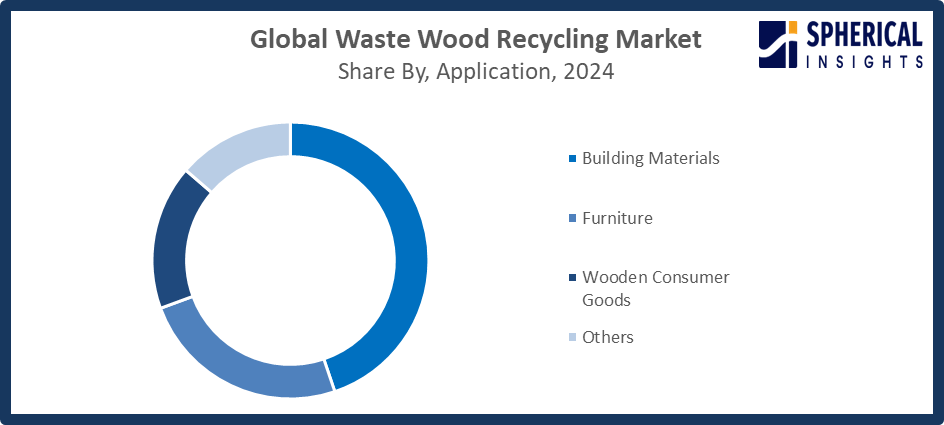
- The building materials segment accounted for the highest market revenue in 2024 and is anticipated to grow at a significant CAGR during the forecast period.
Based on the application, the waste wood recycling market is divided into building materials, furniture, wooden consumer goods, and others. Among these, the building materials segment accounted for the highest market revenue in 2024 and is anticipated to grow at a significant CAGR during the forecast period. The building materials market is driven by of recycled wood's widespread use in construction, the strong need for economical and sustainable resources, and its capacity to effectively satisfy structural and aesthetic requirements.
Get more details on this report -
Regional Segment Analysis of the Waste Wood Recycling Market
- North America (U.S., Canada, Mexico)
- Europe (Germany, France, U.K., Italy, Spain, Rest of Europe)
- Asia-Pacific (China, Japan, India, Rest of APAC)
- South America (Brazil and the Rest of South America)
- The Middle East and Africa (UAE, South Africa, Rest of MEA)
North America is anticipated to hold the largest share of the waste wood recycling market over the predicted timeframe.
North America is anticipated to hold the largest share of the waste wood recycling market over the predicted timeframe. The main focus is on North America's robust regulatory framework and well-established waste handling infrastructure. Strict environmental laws that encourage recycling, landfill diversion, and sustainable resource use are advantageous to the area. The large amount of wood waste produced in North America guarantees a steady supply of recyclable materials. The sector is being driven by strict waste diversion requirements in the United States and Canada, where building and demolition operations generate over 140 million tons of waste annually, according to U.S. EPA data. Action has been prompted by the U.S. EPA's 2025 Recycling Report, which highlights a "say-do gap" in which 75% of Americans claim to recycle, yet national rates fall short at 32%. The October 2024 partnership between Waste Management and Renewlogy for the chemical recycling of mixed wood into fuels, which will be expanded in 2025, is one of the new advancements.
Asia Pacific is expected to grow at a rapid CAGR in the waste wood recycling market during the forecast period. Building materials activities are growing significantly in the Asia Pacific region as a result of rising investments in cloud-based services, startup ecosystems, and information technology. Automation solutions that improve developer productivity and shorten development timeframes are becoming more and more popular in nations like China, India, Japan, and South Korea. The nation's Ministry of Housing and Urban-Rural Development offers comprehensive material recovery capability development as well as policy support for the modernization of building waste. The rise is supported by cloud-native tactics and error-reducing AI integrations that increase productivity by up to 28 days per developer yearly, as well as rising software demands in China and India, where there are more than 10 million developers.
Competitive Analysis:
The report offers the appropriate analysis of the key organizations/companies involved within the waste wood recycling market, along with a comparative evaluation primarily based on their product offering, business overviews, geographic presence, enterprise strategies, segment market share, and SWOT analysis. The report also provides an elaborative analysis focusing on the current news and developments of the companies, which includes product development, innovations, joint ventures, partnerships, mergers & acquisitions, strategic alliances, and others. This allows for the evaluation of the overall competition within the market.
List of Key Companies
- Austin Wood Recycling
- Bodens Group
- Brüning Group
- Dunham Inc
- EGGER
- Japan Waste Group
- Rainier Wood Recyclers
- Sylvagen
- Tokyo Board Industries
- TOMRA
- Unilin
- Waste Mission
- Others
Key Target Audience
- Market Players
- Investors
- End-users
- Government Authorities
- Consulting and Research Firm
- Venture capitalists
- Value-Added Resellers (VARs)
Recent Development
- In February 2025, the UNDP and Turkey’s Ministry of Environment launched a model waste wood recycling facility in Hatay, funded by Japan, demonstrating safe management of earthquake debris, alongside additional facilities and mobile crushers in critical locations.
Market Segment
This study forecasts revenue at global, regional, and country levels from 2020 to 2035. Spherical Insights has segmented the waste wood recycling market based on the below-mentioned segments:
Global Waste Wood Recycling Market, By Type
- Direct Recycling
- Physical Processing Recycling
- Chemical Treatment Recycling
- Others
Global Waste Wood Recycling Market, By Application
- Building Materials
- Furniture
- Wooden Consumer Goods
- Others
Global Waste Wood Recycling Market, By Regional Analysis
- North America
- US
- Canada
- Mexico
- Europe
- Germany
- UK
- France
- Italy
- Spain
- Russia
- Rest of Europe
- Asia Pacific
- China
- Japan
- India
- South Korea
- Australia
- Rest of Asia Pacific
- South America
- Brazil
- Argentina
- Rest of South America
- Middle East & Africa
- UAE
- Saudi Arabia
- Qatar
- South Africa
- Rest of the Middle East & Africa
Frequently Asked Questions (FAQ)
-
1. What is the CAGR of the waste wood recycling market over the forecast period?The global waste wood recycling market is projected to expand at a CAGR of 6.22% during the forecast period.
-
2. What is the market size of the waste wood recycling market?The global waste wood recycling market size is expected to grow from USD 1.55 billion in 2024 to USD 3.01 billion by 2035, at a CAGR of 6.22 % during the forecast period 2025-2035.
-
3. Which region holds the largest share of the waste wood recycling market?North America is anticipated to hold the largest share of the Waste Wood Recycling market over the predicted timeframe.
-
4. Who are the top 10 companies operating in the global waste wood recycling market?Austin Wood Recycling, Bodens Group, Brüning Group, Dunham Inc, EGGER, Japan Waste Group, Rainier Wood Recyclers, Sylvagen, Tokyo Board Industries, TOMRA, Unilin, Waste Mission, and Others.
-
5. What factors are driving the growth of the waste wood recycling market?The waste wood recycling market is driven by environmental sustainability initiatives, regulatory compliance, circular economy adoption, rising construction waste, cost efficiency, technological advancements, and growing demand for renewable energy and recycled wood products.
-
6. What are the market trends in the waste wood recycling market?Advanced recycling technologies, automation and AI integration, greater biomass energy use, the creation of engineered wood products, stakeholder collaboration, and growing government incentives supporting sustainable waste management practices are some of the biggest trends.
-
7. What are the main challenges restricting the wider adoption of the waste wood recycling market?Contamination of wood waste, expensive processing and transportation costs, inadequate infrastructure for recycling, uneven material quality, a lack of uniform rules, and competition from landfill disposal or cremation methods in some areas are some of the challenges.
Need help to buy this report?