Global Waste Oil Market Size, Share, and COVID-19 Impact Analysis, By Oil Type (Automotive Oil, Industrial Oil, Marine Oil, and Others), By Treatment Method (Landfilling, Incineration, Recycling, Reuse, and Others), By End User (Transportation, Manufacturing, Mining, Construction, and Others), By Region (North America, Europe, Asia-Pacific, Latin America, Middle East, and Africa), Analysis and Forecast 2025 - 2035
Industry: Chemicals & Materials
Global Waste Oil Market Insights Forecasts to 2035
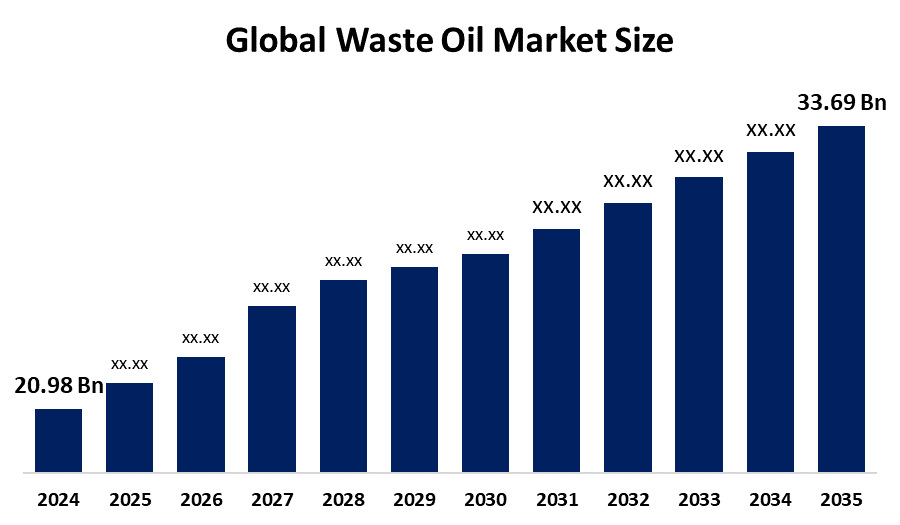
- The Global Waste Oil Market Size Was Estimated at USD 20.98 Billion in 2024
- The Market Size is Expected to Grow at a CAGR of around 4.4% from 2025 to 2035
- The Worldwide Waste Oil Market Size is Expected to Reach USD 33.69 Billion by 2035
- Asia Pacific is expected to grow the fastest during the forecast period.
Get more details on this report -
According to a research report published by Spherical Insights and Consulting, The Global Waste Oil Market Size Was Worth Around USD 20.98 Billion In 2024 And Is Predicted To Grow To Around USD 33.69 Billion By 2035 With A Compound Annual Growth Rate (CAGR) Of 4.4% From 2025 To 2035. Global shift towards circular economy, advanced re-refining technologies, increasing automotive waste generation, and stringent environmental regulations are all driving opportunities in the waste oil market.
Market Overview
The global industry segment involved in the collection, processing, recycling, and disposal of used or contaminated oils from automotive, industrial, and machinery sources is known as the waste oil market. These include various types of waste oils like used engine oil, hydraulic oil, gear oil, and industrial lubricants. Key technologies driving this sector include re-refining processes, thermal conversion to fuels, bioremediation, and advanced waste-to-energy systems, along with monitoring and treatment technologies that ensure compliance with environmental regulations and improve the efficiency of oil recovery and recycling. Government initiatives promote human health and the environment. For example, in September 2023, the Indian government introduced Extended Producer Responsibility (EPR) specifically for used oil under the Hazardous and Other Wastes (Management & Transboundary Movement) Second Amendment Rules, 2023.
In February 2024, the State Council of China released guidelines to build a national waste recycling system by 2025, including improved recovery and recycling of industrial wastes such as used oil. The policy aims to expand recycling infrastructure, strengthen collection systems, and support investment in resource-recovery industries as part of the circular economy strategy.
Report Coverage
This research report categorizes the waste oil market based on various segments and regions, forecasts revenue growth, and analyzes trends in each submarket. The report analyses the key growth drivers, opportunities, and challenges influencing the waste oil market. Recent market developments and competitive strategies, such as expansion, product launch, development, partnership, merger, and acquisition, have been included to draw the competitive landscape in the market. The report strategically identifies and profiles the key market players and analyses their core competencies in each sub-segment of the waste oil market.
Global Waste Oil Market Report Coverage
| Report Coverage | Details |
|---|---|
| Base Year: | 2024 |
| Market Size in 2024: | USD 20.98 Billion |
| Forecast Period: | 2025-2035 |
| Forecast Period CAGR 2025-2035 : | 4.4% |
| 2035 Value Projection: | USD 33.69 Billion |
| Historical Data for: | 2020-2023 |
| No. of Pages: | 210 |
| Tables, Charts & Figures: | 112 |
| Segments covered: | By Oil Type, By Treatment Method, By End User, By Region |
| Companies covered:: | Safety-Kleen, Veolia Environment S.A., Slicker Recycling Ltd., Tradebe, Argent Energy, Olleco, Darling Ingredients, Vertex Energy, Inc., Gecco Fuels, Oil Monster, Enva, J.J. Richards & Sons Pty Ltd., MIB Waste Services, Oil Salvage Ltd., Alexandria Petroleum Company |
| Pitfalls & Challenges: | Covid-19 Impact, Challenge, Future,Growth and Analysis |
Get more details on this report -
Driving Factors
Rapid technological innovation is one of the main drivers of growth in the waste oil market. Increasing environmental awareness and stringent government regulations aimed at reducing pollution and promoting sustainable waste management are key factors supporting market expansion. Advancements in technologies such as vacuum distillation, solvent extraction, hydrofinishing, and waste-to-energy conversion are improving the efficiency and cost-effectiveness of used oil processing. These innovations are encouraging greater investment and development within the industry. For instance, in February 2025, EnerPure Inc. announced the successful completion of its Sustainable Development Technology Canada (SDTC) project, which validated its patented used motor oil recycling technology. The project also supports the commercial deployment of regional recycling plants designed to convert waste oil into low-carbon marine fuel.
Restraining Factors
High development and deployment costs, limit standardized waste oil collection, illegal disposal and environmental hazards, limited commercial readiness, infrastructure limitations, uncertainty surrounding regulatory approvals, and collection logistics remain challenging are the main factors restricting the waste oil market.
Market Segmentation
The waste oil market share is classified into oil type, treatment method, and end user.
- The automotive oil segment dominated the market in 2024, approximately 45%, and is projected to grow at a substantial CAGR during the forecast period.
Based on the oil type, the waste oil market is divided into automotive oil, industrial oil, marine oil, and others. Among these, the automotive oil segment dominated the market in 2024, approximately 45%, and is projected to grow at a substantial CAGR during the forecast period. High volume of vehicle ownership, frequent oil changes in internal combustion engines, and established collection networks for used engine oils are driving the automotive oil industry.
- The recycling segment accounted for the largest share in 2024, approximately 35%, and is anticipated to grow at a significant CAGR during the forecast period.
Based on the treatment method, the waste oil market is divided into landfilling, incineration, recycling, reuse, and others. Among these, the recycling segment accounted for the largest share in 2024, approximately 35%, and is anticipated to grow at a significant CAGR during the forecast period. High value retention for high-quality base oil, cost-effectiveness, strong focus on circularity, energy efficiency, and stringent environmental regulations are driving the recycling industry.
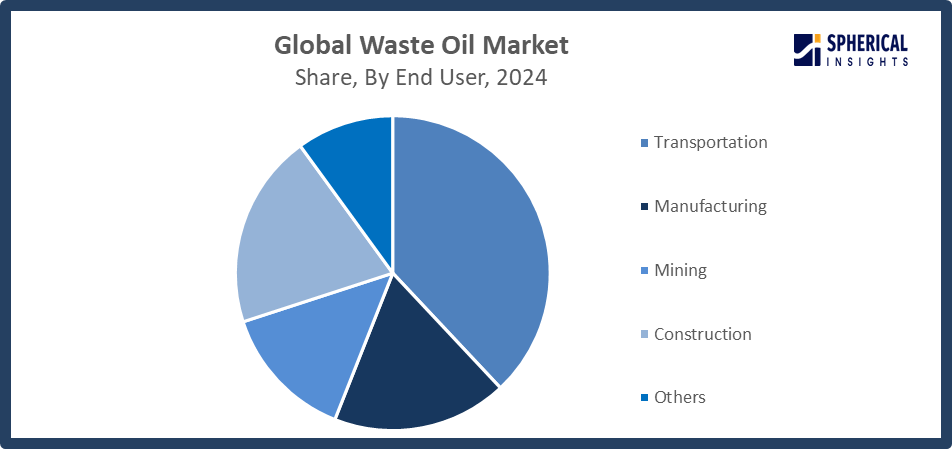
- The transportation segment accounted for the highest market revenue in 2024, approximately 38%, and is anticipated to grow at a significant CAGR during the forecast period.
Based on the end user, the waste oil market is divided into transportation, manufacturing, mining, construction, and others. Among these, the transportation segment accounted for the highest market revenue in 2024, approximately 38%, and is anticipated to grow at a significant CAGR during the forecast period. High volume of internal combustion engine vehicles, constant demand for maintenance, widespread global industrialization, and rising urbanization with mobility are bolstering the transportation market.
Get more details on this report -
Regional Segment Analysis of the Global Waste Oil Market
• North America (U.S., Canada, Mexico)
• Europe (Germany, France, U.K., Italy, Spain, Rest of Europe)
• Asia-Pacific (China, Japan, India, Rest of APAC)
• South America (Brazil and the Rest of South America)
• Middle East and Africa (UAE, South Africa, Rest of MEA)
North America is anticipated to hold the largest share of the waste oil market during the forecast period.

Get more details on this report -
Well-established waste oil collection and recycling infrastructure, stringent environmental regulations, and strong automotive and industrial sectors generating significant volumes of used oil are key factors driving the market in this region. Additionally, the widespread adoption of advanced re-refining and processing technologies supports high recycling rates and promotes circular economy practices. The region’s strong position is further reinforced by government programs that promote the proper handling, collection, reuse, and recycling of used oil to protect human health and the environment.
Government initiatives include several programs across the region. In the United States, the Oil Pollution Prevention (OPP) program made USD 6,000,000 available to support local used oil recycling projects across California. Additionally, the U.S. Environmental Protection Agency (EPA), in June 2025, provides regulatory guidance under 40 CFR Part 279, encouraging recycling practices and promoting education for businesses and consumers on proper oil recycling. In Canada, UOMA’s stewardship program, as of June 2025, reported that 83.6% of used oil available for collection in Canada was recovered in 2024, demonstrating strong recycling performance under regulated stewardship programs.
Asia-Pacific is expected to grow at the fastest CAGR in the waste oil market during the forecast period. Countries such as China, India, Japan, and South Korea are making significant investments in advanced recycling technologies, including vacuum distillation, solvent extraction, and hydrofinishing, which are further accelerating market growth. Rapid industrialization, rising vehicle ownership, and increasing lubricant consumption are also contributing to the expansion of the waste oil market in the region. Government initiatives are also playing a key role. In September 2023, India introduced Extended Producer Responsibility (EPR) for Used Oil, requiring lubricant producers and importers to finance the collection and recycling of used oil through registered recyclers. China generates approximately 7.8 million tonnes of waste mineral oil annually, which increased to around 8.577 million tonnes in 2022, significantly contributing to global waste oil generation. Meanwhile, Japan generates about 1.68 million kilolitres of used lubricants each year, with approximately 600,000 kilolitres collected annually, which are primarily reused as fuel or processed into recycled products.
Competitive Analysis:
The report offers the appropriate analysis of the key organizations/companies involved within the waste oil market, along with a comparative evaluation primarily based on their product offerings, business overviews, geographic presence, enterprise strategies, segment market share, and SWOT analysis. The report also provides an elaborative analysis focusing on the current news and developments of the companies, which includes product development, innovations, joint ventures, partnerships, mergers & acquisitions, strategic alliances, and others. This allows for the evaluation of the overall competition within the market.
List of Key Companies
- Safety-Kleen
- Veolia Environment S.A.
- Slicker Recycling Ltd.
- Tradebe
- Argent Energy
- Olleco
- Darling Ingredients
- Vertex Energy, Inc.
- Gecco Fuels
- Oil Monster
- Enva
- J.J. Richards & Sons Pty Ltd.
- MIB Waste Services
- Oil Salvage Ltd.
- Alexandria Petroleum Company
- Others
Key Target Audience
- Market Players
- Investors
- End-users
- Government Authorities
- Consulting and Research Firm
- Venture capitalists
- Value-Added Resellers (VARs)
Market Segment
This study forecasts revenue at global, regional, and country levels from 2020 to 2035. Spherical Insights has segmented the global waste oil market based on the below-mentioned segments:
Global Waste Oil Market, By Oil Type
- Automotive Oil
- Industrial Oil
- Marine Oil
- Others
Global Waste Oil Market, By Treatment Method
- Landfilling
- Incineration
- Recycling
- Reuse
- Others
Global Waste Oil Market, By End User
- Transportation
- Manufacturing
- Mining
- Construction
- Others
Global Waste Oil Market, By Regional Analysis
- North America
- US
- Canada
- Mexico
- Europe
- Germany
- UK
- France
- Italy
- Spain
- Russia
- Rest of Europe
- Asia Pacific
- China
- Japan
- India
- South Korea
- Australia
- Rest of Asia Pacific
- South America
- Brazil
- Argentina
- Rest of South America
- Middle East & Africa
- UAE
- Saudi Arabia
- Qatar
- South Africa
- Rest of the Middle East & Africa
Frequently Asked Questions (FAQ)
-
1. What role does technology play in the waste oil market?Advanced recycling technologies improve the efficiency and quality of re-refined oil production. Innovations in filtration, distillation, and catalytic processes helps increase recovery rates.
-
2. How is waste oil collected before recycling?Waste oil is typically collected from automotive service stations, industrial facilities, and transportation companies. Specialized collection systems transport the oil to treatment and recycling plants.
-
3. How does the circular economy relate to the waste oil market?The waste oil market supports circular economy principles by turning used lubricants into reusable resources. This reduces waste generation and minimizes dependence on virgin raw materials.
-
4. What environmental benefits does the waste oil market provide?Proper waste oil management reduces pollution, conserves natural resources, and lowers greenhouse gas emissions. Recycling used oil prevents contamination of soil and groundwater.
-
5. What future trends are expected in the waste oil market?Future trends include expansion of re-refining capacity, adoption of advanced purification technologies, and stronger environmental regulations. Digital tracking systems for waste oil collection may also emerge.
-
6. Why is the global waste oil market important for sustainability?The market plays a crucial role in reducing environmental pollution and conserving petroleum resources. By recycling used oil, industries can promote sustainable production and responsible waste management.
Need help to buy this report?