Global Waste Management Equipment Market Size, Share, and COVID-19 Impact Analysis, By Product Type (Waste Disposal Equipment (Dumpsters, Compactors, Trucks, and Others (Drum Crushers and Others), Waste Recycling & Sorting Equipment (Conveyors, Screeners, Shredder, and Others), By Waste Type (Hazardous and Non-Hazardous), By Application (Industrial Waste, Municipal Waste, and Others), and By Region (North America, Europe, Asia-Pacific, Latin America, Middle East, and Africa), Analysis and Forecast 2025 - 2035
Industry: Machinery & Equipment
Global Waste Management Equipment Market Size Insights Forecasts to 2035
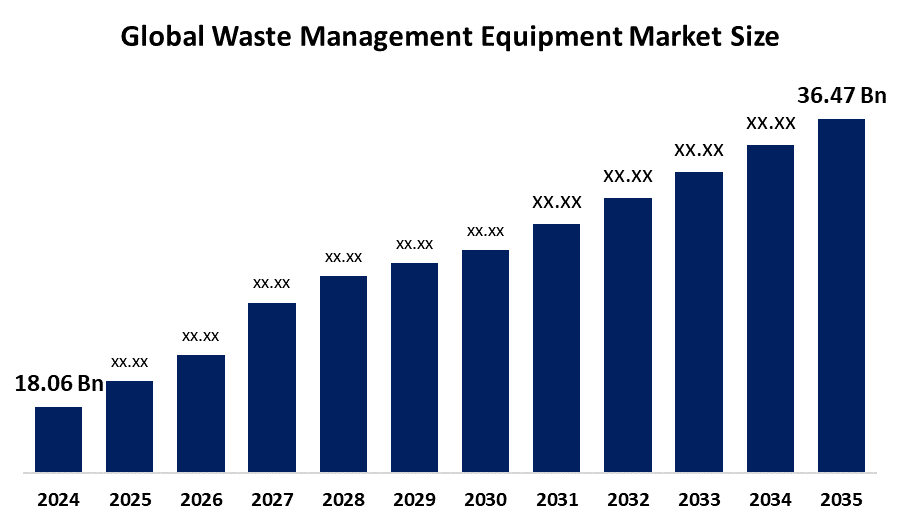
- The Global Waste Management Equipment Market Size Was Estimated at USD 18.06 Billion in 2024
- The Market Size is Expected to Grow at a CAGR of around 6.6% from 2025 to 2035
- The Worldwide Waste Management Equipment Market Size is Expected to Reach USD 36.47 Billion by 2035
- North America is expected to Grow the fastest during the forecast period.
Get more details on this report -
According to a Research Report Published by Spherical Insights and Consulting, The Global Waste Management Equipment Market Size was worth around USD 18.06 Billion in 2024 and is predicted to Grow to around USD 36.47 Billion by 2035 with a compound annual growth rate (CAGR) of 6.6% from 2025 to 2035. The market for global waste management equipment is growing due to rapid urbanization, increasing industrial waste volumes, and stringent government environmental regulations favoring recycling. Additionally, the rising adoption of AI-powered sorting, IoT, and circular economy initiatives drives demand for advanced, efficient machinery.
Market Overviews
The global waste management equipment market refers to machinery and systems used for the effective collection, transfer, processing, and disposal of waste, including equipment for handling both hazardous and non-hazardous materials from industrial, municipal, and other sources. Key equipment includes compactors, balers, shredders, sorting conveyors, recycling machines, and waste collection vehicles, widely used by municipalities, industrial facilities, and recycling centers. Key market drivers include rapid urbanization and industrialization, which significantly increase global waste volumes. For instance, the World Bank projects municipal solid waste generation to rise by 70% by 2050, necessitating efficient management solutions. Furthermore, stringent government regulations, such as California's SB 1383 mandating a 75% organic waste recycling rate, compel investment in advanced equipment.
Significant opportunities lie in the adoption of AI-powered autonomous sorting robots and the expansion of circular economy initiatives, which are pushing municipalities and corporations to upgrade infrastructure and improve material recovery rates. In December 2025, the NSW Government launched Round 2 of the Bin Trim Equipment Rebates Program, offering grants of $1,000-$50,000 for businesses to purchase balers, compactors, shredders, glass crushers, and smart scales. The initiative aims to promote waste avoidance, enhance recycling, and achieve an 80% waste recovery rate by 2030 across the state.
Report Coverage
This research report categorizes the waste management equipment market based on various segments and regions, forecasts revenue growth, and analyzes trends in each submarket. The report analyses the key growth drivers, opportunities, and challenges influencing the waste management equipment market. Recent market developments and competitive strategies, such as expansion, type launch, development, partnership, merger, and acquisition, have been included to draw the competitive landscape in the market. The report strategically identifies and profiles the key market players and analyses their core competencies in each sub-segment of the waste management equipment market.
Global Waste Management Equipment Market Report Coverage
| Report Coverage | Details |
|---|---|
| Base Year: | 2024 |
| Market Size in 2024 : | USD 18.06 Billion |
| Forecast Period: | 2025-2035 |
| Forecast Period CAGR 2025-2035 : | 6.6% |
| 2035 Value Projection: | USD 36.47 Billion |
| Historical Data for: | 2020-2023 |
| No. of Pages: | 174 |
| Tables, Charts & Figures: | 100 |
| Segments covered: | By Product Type, By Waste Type and COVID-19 Impact Analysis |
| Companies covered:: | TOMRA Systems ASA, Wast equip LLC, Komptech GmbH, CP Manufacturing Inc., Terex Corporation, McNeilus Truck and Manufacturing, Steinert GmbH, Dover Corporation, Oshkosh Corporation, Bollegraaf Recycling Solutions, Morita Holdings Corporation, Enerpat Group UK Ltd., Caterpillar Inc., Sierra International Machinery LLC, and Others |
| Pitfalls & Challenges: | COVID-19 Empact, Challenge, Future, Growth, & Analysis |
Get more details on this report -
Driving Factors
The global waste management equipment market is driven by rising waste generation, urbanization, and stringent environmental regulations. Worldwide, municipal solid waste reached 2.24 billion tons in 2023 and is projected to grow to 3.4 billion tons by 2050, creating strong demand for efficient waste collection, sorting, and treatment equipment. Rapid industrialization and expanding construction activities further contribute to increased industrial and construction waste. Governments worldwide are enforcing strict waste disposal and recycling regulations, boosting the adoption of advanced equipment such as compactors, shredders, and automated sorting systems. Additionally, growing environmental awareness and investments in smart waste management solutions are accelerating market growth.
Restraining Factors
The global waste management equipment market faces restraints because high capital expenses and maintenance costs prevent small and medium enterprises from using the technology. The presence of complex waste streams, together with the insufficient waste management systems in developing areas, decreases operational effectiveness. The market experiences growth slowdowns because mechanical and automated systems lead to operational expenses that increase by 15-20%.
Market Segmentation
The waste management equipment market share is classified into product type, waste type, and application.
- The waste recycling & sorting equipment segment dominated the market in 2024, approximately 66% and is projected to grow at a substantial CAGR during the forecast period.
Based on the product type, the waste management equipment market is divided into waste disposal equipment (dumpsters, compactors, trucks, and others (drum crushers and others), waste recycling & sorting equipment (conveyors, screeners, shredder, and others). Among these, the waste recycling & sorting equipment segment dominated the market in 2024 and is projected to grow at a substantial CAGR during the forecast period. The segment dominates due to strict government regulations mandating higher recycling rates and landfill diversion. Growing environmental awareness drives demand for efficient material recovery systems. Technological advancements in automated sorting, including AI and optical sensors, significantly improve processing efficiency and material purity, accelerating segment growth globally.
- The hazardous segment accounted for the largest share in 2024, approximately 56% and is anticipated to grow at a significant CAGR during the forecast period.
Based on the waste type, the waste management equipment market is divided into hazardous and non-hazardous. Among these, the hazardous segment accounted for the largest share in 2024 and is anticipated to grow at a significant CAGR during the forecast period. The growth is driven by stringent government regulations governing medical, chemical, and industrial waste disposal. Growing healthcare infrastructure generates substantial biomedical waste requiring specialized treatment. Rapid industrialization increases hazardous byproducts needing compliant processing. These factors drive demand for specialized equipment, including incinerators, autoclaves, and chemical treatment systems.
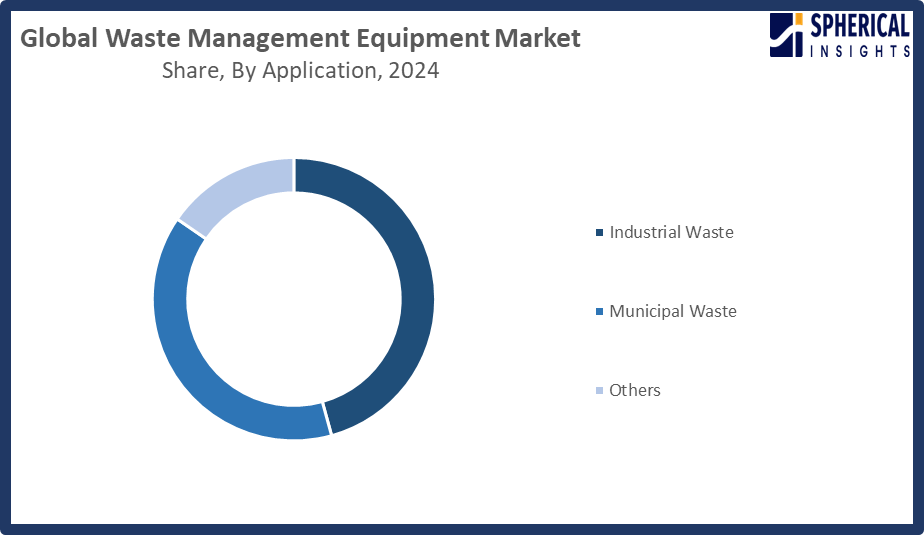
- The industrial waste segment accounted for the highest market revenue in 2024, approximately 46% and is anticipated to grow at a significant CAGR during the forecast period.
Based on the application, the waste management equipment market is divided into industrial waste, municipal waste, and others. Among these, the industrial waste segment accounted for the highest market revenue in 2024 and is anticipated to grow at a significant CAGR during the forecast period. The industrial waste segment grows owing to rapid global industrialization, particularly in the manufacturing and construction sectors. Strict environmental regulations mandate compliant waste processing, driving equipment demand. The U.S. generated 600 million tons of construction waste in 2021 alone, requiring heavy-duty shredders and compactors. Additionally, industries increasingly adopt circular economy practices, investing in recycling equipment for material recovery and cost reduction.
Get more details on this report -
Regional Segment Analysis of the Waste Management Equipment Market
- North America (U.S., Canada, Mexico)
- Europe (Germany, France, U.K., Italy, Spain, Rest of Europe)
- Asia-Pacific (China, Japan, India, Rest of APAC)
- South America (Brazil and the Rest of South America)
- The Middle East and Africa (UAE, South Africa, Rest of MEA)
Asia Pacific is anticipated to hold the largest share of the waste management equipment market over the predicted timeframe.

Get more details on this report -
Asia Pacific is anticipated to hold the largest share of the waste management equipment market over the predicted timeframe. Asia Pacific is expected to hold the 45% share of the global waste management equipment market due to rapid urbanization, industrialization, and rising municipal solid waste generation. China, India, and Japan are major contributors, producing significant residential and industrial waste. Government initiatives promoting circular economy practices, smart waste systems, and infrastructure development are accelerating adoption. India’s Solid Waste Management Rules 2026 mandate source segregation and decentralized processing, while China invests heavily in modern recycling plants. Additionally, in September 2024, India’s CPCB announced one-time financial support for recycling plants and machinery for fishing gear and high-littering plastics across 12 coastal areas, covering equipment such as funding shredders, crushers, extruders, and pollution control devices, boosting coastal waste recycling initiatives.
North America is expected to grow at a rapid CAGR in the waste management equipment market during the forecast period. North America is expected to have a 28% share and grow rapidly in the waste management equipment market due to strict environmental regulations, technological advancements, and the adoption of automated, AI-enabled systems. The U.S. and Canada lead growth, supported by policies like Extended Producer Responsibility (EPR) and incentives for sustainable waste processing. Rising consumer demand for recycling and circular economy practices drives investment in sorting, recycling, and waste-to-energy equipment. In September 2025, Vermont ANR released draft rules on food residuals management, defining mechanical depackaging standards, prohibiting commingling, and setting operational requirements to optimize organics recovery, with public comments and formal rulemaking forthcoming.
Europe’s waste management equipment market is growing steadily, driven by strict environmental regulations, high recycling targets, and government incentives. Germany, France, and the Netherlands lead the adoption of advanced sorting, recycling, and waste-to-energy equipment. The EU Circular Economy Action Plan and separate waste collection mandates boost investment. In July 2025, Regulation (EU) 2024/1157 updated waste shipment procedures, enhancing traceability, enforcing export rules, supporting pre-consented facilities, and requiring inspections, strengthening local waste management, protecting health, and advancing the circular economy under the European Green Deal.
Competitive Analysis:
The report offers the appropriate analysis of the key organizations/companies involved within the waste management equipment market, along with a comparative evaluation primarily based on their type of offering, business overviews, geographic presence, enterprise strategies, segment market share, and SWOT analysis. The report also provides an elaborative analysis focusing on the current news and developments of the companies, which includes type development, innovations, joint ventures, partnerships, mergers & acquisitions, strategic alliances, and others. This allows for the evaluation of the overall competition within the market.
List of Key Companies
- TOMRA Systems ASA
- Wast equip LLC
- Komptech GmbH
- CP Manufacturing Inc.
- Terex Corporation
- McNeilus Truck and Manufacturing
- Steinert GmbH
- Dover Corporation
- Oshkosh Corporation
- Bollegraaf Recycling Solutions
- Morita Holdings Corporation
- Enerpat Group UK Ltd.
- Caterpillar Inc.
- Sierra International Machinery LLC
- Others
Key Target Audience
- Market Players
- Investors
- End-users
- Government Authorities
- Consulting and Research Firm
- Venture capitalists
- Value-Added Resellers (VARs)
Recent Development
- In January 2026, ECER Inc, Dover, launched a commercial pickup service in Dover, New Hampshire, offering businesses and institutions a streamlined solution for electronics, computer, and IT equipment recycling, supporting responsible e-waste disposal, device upgrades, and efficient, secure management of outdated technology.
- In December 2025, Terex Ecotec appointed Blue Machinery as its official distributor in England, Scotland, and Wales, starting in 2026. Blue Machinery will represent Terex Ecotec’s full portfolio, including waste processing, biomass, material recovery, and green waste equipment, enhancing sustainable and high-performance environmental machinery offerings across the UK.
- In August 2025, Declaration Partners acquired a majority stake in CP Group, a San Diego-based sorting equipment manufacturer. The partnership provides capital and strategic resources to accelerate innovation, expand operations, and reinforce CP Group’s position as a leading provider of waste and recycling solutions in the industry.
- In May 2025, McNeilus Truck and Manufacturing, an Oshkosh Corporation business, expanded its side loader refuse and recycling vehicle production line at Dodge Center, Minnesota. The upgrade features Industry 4.0 technologies, enhancing quality, safety, throughput, and operational efficiency, supporting product innovation and customer-focused growth in waste collection solutions.
- In October 2024, Tomra Systems ASA acquired 80% of Germany-based C-Trace GmbH, a digital waste management solutions provider. The deal expands Tomra’s AI-driven recycling capabilities, aiming to digitize waste operations, boost global presence, and increase collection and recycling rates across its international customer base.
- In May 2023, Wastequip launched Compactor Service Solutions through its WRX service division, offering North America’s first end-to-end service hub. The platform enables quick scheduling of maintenance, installs, and repairs, providing commercial compactor and baler customers with comprehensive support throughout product lifecycles.
Market Segment
This study forecasts revenue at global, regional, and country levels from 2020 to 2035. Spherical Insights has segmented the waste management equipment market based on the below-mentioned segments:
Global Waste Management Equipment Market, By Product Type
- Waste Disposal Equipment
- Dumpsters
- Compactors
- Trucks
- Others (Drum Crushers and Others)
- Waste Recycling & Sorting Equipment
- Conveyors
- Screeners
- Shredder
- Others
Global Waste Management Equipment Market, By Waste Type
- Hazardous
- Non-hazardous
Global Waste Management Equipment Market, By Application
- Industrial Waste
- Municipal Waste
- Others
Global Waste Management Equipment Market, By Regional Analysis
- North America
- US
- Canada
- Mexico
- Europe
- Germany
- UK
- France
- Italy
- Spain
- Russia
- Rest of Europe
- Asia Pacific
- China
- Japan
- India
- South Korea
- Australia
- Rest of Asia Pacific
- South America
- Brazil
- Argentina
- Rest of South America
- Middle East & Africa
- UAE
- Saudi Arabia
- Qatar
- South Africa
- Rest of the Middle East & Africa
Frequently Asked Questions (FAQ)
-
1. What technological innovations are shaping trends in waste management equipment?Technological innovations like AI‑enabled sorting, robotics, and IoT sensors are reshaping waste management equipment, improving efficiency and accuracy. Automated systems can boost material recovery rates by up to 40% while reducing operational costs and labor requirements.
-
2. What economic benefits do waste management systems provide to municipalities and industries?Waste management systems reduce landfill costs by up to 30%, create jobs in recycling sectors, and generate revenue from recovered materials, contributing significantly to local economies while lowering environmental cleanup expenses and improving operational efficiency.
-
3. How is the adoption of automated and AI-based waste sorting equipment changing the market?The adoption of automated and AI‑based waste sorting equipment is transforming the market by increasing sorting accuracy to 95-98%, boosting material recovery rates by up to 40%, and reducing labor costs, driving wider industry implementation.
-
4. What impact does investment in smart waste infrastructure have on market growth?Investment in smart waste infrastructure significantly boosts waste management equipment market growth by enabling IoT‑enabled bins and AI systems, improving collection efficiency, reducing costs by up to 25%, and optimizing routes by 30%, which drives higher adoption of advanced sorting, monitoring, and analytics technologies.
-
5. How are sustainability and circular economy initiatives affecting market trends?Sustainability and circular economy initiatives are boosting demand for waste management equipment as governments target 50%+ recycling rates; these policies increase investment in advanced sorting and recycling systems to reduce landfill reliance and improve resource recovery.
-
6. What innovations in waste-to-energy technology are influencing equipment demand?Innovations in waste‑to‑energy (WtE) technology, including gasification, pyrolysis, and anaerobic digestion, are boosting equipment demand by improving efficiency (conversion efficiencies up to 90%) and reducing emissions, helping the USD 25.3 billion WtE equipment market grow toward USD 38 billion by 2033. These technologies support sustainable energy production from waste, driving investment in advanced processing systems.
-
7. What role do environmental policies play in accelerating equipment adoption?Environmental policies like Extended Producer Responsibility (EPR) and strict recycling mandates accelerate equipment adoption by requiring separate waste collection and higher recycling rates (often ≥50% targets), driving investments in sorting, processing, and recycling technologies worldwide.
-
8. How is the integration of IoT and digital monitoring transforming operational efficiency in waste management?Integration of IoT and digital monitoring in waste management improves operational efficiency by enabling real‑time tracking, predictive maintenance, and optimized routing, reducing collection costs by up to 30% and increasing system responsiveness and uptime.
Need help to buy this report?