Global Waste Heat Recovery Market Size, Share, and COVID-19 Impact Analysis, By Technique (Heat Exchangers, Heat Wheels, Recuperators, Regenerators, Boilers, and Others), By Application (Temperature Control, Pre-Heating Systems, Electricity Generation, and Others), By Region (North America, Europe, Asia-Pacific, Latin America, Middle East, and Africa), Analysis and Forecast 2025 - 2035
Industry: Chemicals & Materials
Global Waste Heat Recovery Market Size Insights Forecasts to 2035
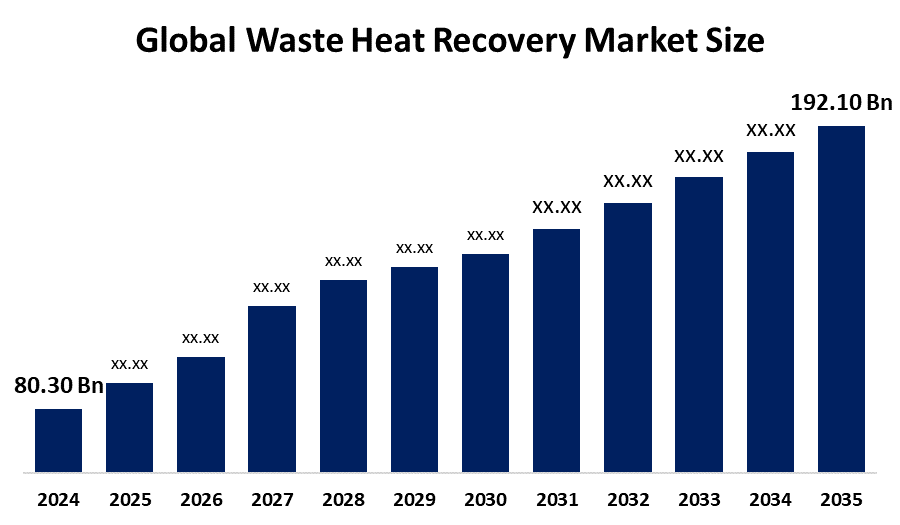
- The Global Waste Heat Recovery Market Size Was Estimated at USD 80.30 Billion in 2024
- The Market Size is Expected to Grow at a CAGR of around 8.25% from 2025 to 2035
- The Worldwide Waste Heat Recovery Market Size is Expected to Reach USD 192.10 Billion by 2035
- Asia Pacific is expected to Grow the fastest during the forecast period.
Get more details on this report -
According to a Research Report Published by Spherical Insights and Consulting, The Global Waste Heat Recovery Market Size was worth around USD 80.30 Billion in 2024 and is predicted to Grow to around USD 192.10 Billion by 2035 with a compound annual growth rate (CAGR) of 8.25% from 2025 to 2035. Possibilities for Recovering Waste Heat. Increased demand for energy efficiency, tighter environmental laws, industrial decarbonization programs, technological developments, and rising investments in sustainable energy solutions across the electricity generation and power generation sectors are all contributing factors to the market.
Market Overview
The global ecosystem of technologies, systems, equipment, and services intended to capture and transform excess thermal energy otherwise lost as exhaust or by product from industrial processes, power plants, cement kilns, steel furnaces, and chemical plants into usable electricity, steam, or process heat is referred to as the waste heat recovery market. Organic Rankine Cycle (ORC) units, heat exchangers, economizers, and sophisticated heat pumps are examples of core solutions that improve energy efficiency, cut fuel use, and lessen greenhouse gas emissions while offering significant cost savings. Waste heat recovery innovations operate across high (>600°C), medium (150–600°C), and low (<150°C) temperature ranges, enabling applications such as power generation, feedstock and air pre-heating, moisture removal, cooling, and other industrial or utility processes that effectively utilize recovered thermal energy.
In June 2023, Ministry of Power (India) launched the Advanced Industrial Technology Demonstration Center (AITDC), also called Unnat Takniki Pradarshan Kendra (UTPRERAK), to promote energy-efficient technologies, including waste heat recovery through industry demonstrations and knowledge sharing. One of the main factors driving the global waste heat recovery industry is the rising cost of electricity. Investment in waste heat recovery technology is being encouraged by regulatory support and growing energy costs.
Waste Heat Recovery Market Trends
- Organic Rankine cycle (ORC) devices are increasingly being used to generate power efficiently from industrial heat.
- High-temperature (>600°C) waste heat recovery is receiving more attention for energy-intensive sectors like glass, steel, and cement.
- The expansion of low (<150°C) and medium (150–600°C) temperature recovery solutions for space conditioning, moisture removal, and feedstock preheating.
- The combined heat and power (CHP) systems and renewable energy with waste heat recovery.
Report Coverage
This research report categorizes the waste heat recovery market based on various segments and regions, forecasts revenue growth, and analyzes trends in each submarket. The report analyzes the key growth drivers, opportunities, and challenges influencing the waste heat recovery market. Recent market developments and competitive strategies, such as expansion, Technique launch, development, partnership, merger, and acquisition, have been included to draw the competitive landscape in the market. The report strategically identifies and profiles the key market players and analyzes their core competencies in each sub-segment of the waste heat recovery market.
Global Waste Heat Recovery Market Report Coverage
| Report Coverage | Details |
|---|---|
| Base Year: | 2024 |
| Market Size in 2024 : | USD 80.30 Billion |
| Forecast Period: | 2025-2035 |
| Forecast Period CAGR 2025-2035 : | 8.25% |
| 2035 Value Projection: | USD 192.10 Billion |
| Historical Data for: | 2020-2023 |
| No. of Pages: | 158 |
| Tables, Charts & Figures: | 79 |
| Segments covered: | By Technique, By Application and COVID-19 Impact Analysis |
| Companies covered:: | ABB, Bosch, Caterpillar, Ceres Media, Clyde Bergemann, General Electric, Mitsubishi Heavy Industries, Ormat Technologies, Schneider Electric, Siemens, and Others |
| Pitfalls & Challenges: | COVID-19 Empact, Challenges, Future, Growth, & Analysis |
Get more details on this report -
Driving factors
The waste heat recovery market exists because industrial operations need to operate sustainably while their energy consumption needs to be reduced. Energy-intensive sectors like electricity generation and oil and gas and power generation are driving increased demand for waste heat recovery systems. The industrial sector needs to adopt energy-saving technologies because industrial activities and energy use have increased in cement and steel and chemical and oil and gas and power generation industries. Data shows that industrial facilities can retrieve 20 to 50% of their production waste heat during electricity generation operations.
Restraining Factor
High initial capital investment, difficult integration with current industrial processes, low awareness in small-scale industries, technological difficulties in low-temperature applications, and uneven policy support across regions are some of the significant obstacles to widespread adoption in the waste heat recovery market.
Market Segmentation
The global waste heat recovery market is divided into technique and application.
Global Waste Heat Recovery Market, By Technique:
- The heat exchangers segment dominated the market in 2024, approximately 42%, and is projected to grow at a substantial CAGR during the forecast period.
Based on the Technique, the waste heat recovery market is divided into heat exchangers, heat wheels, recuperators, regenerators, boilers, and others. Among these, the heat exchangers segment dominated the market in 2024, approximately 42%, and is projected to grow at a substantial CAGR during the forecast period. Heat exchangers are a result of their effectiveness, adaptability, and broad industrial use. Heat exchangers are also reasonably priced, require little upkeep, and are simple to incorporate with current systems.
The recuperators segment in the Waste Heat Recovery market is expected to grow at the fastest CAGR over the forecast period. The recuperators segment is due to the growing need for improved energy efficiency and cutting-edge heat recovery solutions in contemporary industrial systems.
Global Waste Heat Recovery Market, By Application:
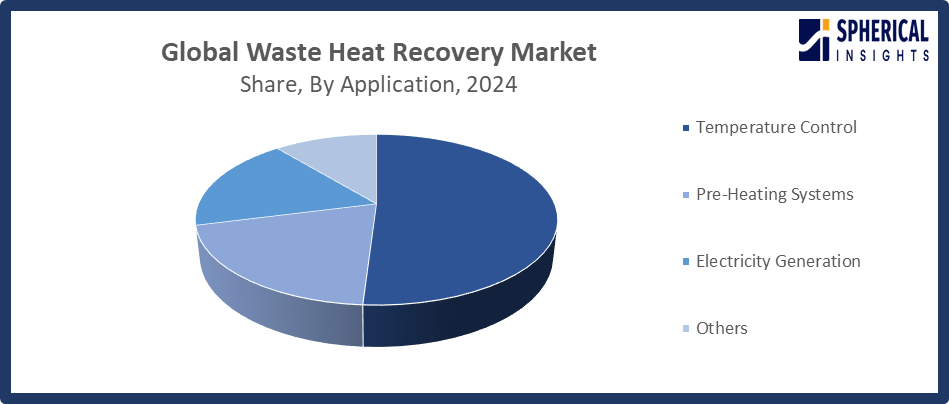
- The electricity generation segment accounted for the highest market revenue in 2024, approximately 51%, and is anticipated to grow at a significant CAGR during the forecast period.
Based on the application, the waste heat recovery market is divided into temperature control, pre-heating systems, electricity generation, and others. Among these, the electricity generation segment accounted for the highest market revenue in 2024, approximately 51%, and is anticipated to grow at a significant CAGR during the forecast period. The growing requirement to capture and transform industrial waste heat into usable electricity, especially in energy-intensive industries like power plants, cement, steel, and chemicals, is what propels the electricity generation segment. WHR systems are widely used to generate electricity, which highlights their vital significance in sustainable industrial practices and worldwide energy conservation initiatives.
Get more details on this report -
The temperature control segment in the Waste Heat Recovery market is expected to grow at the fastest CAGR over the forecast period. The temperature control segment is driven by rising demand for precise industrial process regulation, energy efficiency, and reduced operational costs.
Regional Segment Analysis of the Global Waste Heat Recovery Market
- North America (U.S., Canada, Mexico)
- Europe (Germany, France, U.K., Italy, Spain, Rest of Europe)
- Asia-Pacific (China, Japan, India, Rest of APAC)
- South America (Brazil and the Rest of South America)
- The Middle East and Africa (UAE, South Africa, Rest of MEA)
North America is expected to hold the largest share of the global waste heat recovery market over the forecast period.

Get more details on this report -
North America is expected to hold the largest share of the global waste heat recovery market over the forecast period. Significant industrialization, a solid electricity generation infrastructure, and strict environmental restrictions are the main drivers of North America. The region's emphasis on cutting greenhouse gas emissions and energy use has sped up the implementation of waste heat recovery technology in important industries like chemicals, steel, cement, power generation, and oil and gas. New advancements include Cleaver-Brooks' MiniMate compact deaerator launch in February 2025 and Siemens Energy's August 2025 supercritical CO2 pilot in Canada. The Tallgrass–University of Dayton–AES Ohio waste heat-to-power complex, whose construction started in 2024, and Climeon's June 2025 HeatPower 300 order for cement transporters are two recent announcements.
Asia Pacific is expected to grow at the fastest CAGR in the waste heat recovery market during the forecast period. In nations like China, India, Japan, and South Korea, market growth is primarily driven by rapid industrialization, growing electricity generation sectors, and rising energy demand. Adoption is being accelerated by government programs supporting sustainable industrial practices, renewable energy, and financial incentives for green technologies. China's January 2026 recommendations for green microgrids in the industrial sector and India's Bureau of Energy Efficiency regulations, which are strengthened by the Carbon Credit Trading Scheme (operationalized 2025–2026) and encourage emission-intensity reductions and WHR adoption, are examples of initiatives from the government.
Competitive Analysis:
The report offers the appropriate analysis of the key organizations/companies involved within the global waste heat recovery market, along with a comparative evaluation primarily based on their Technique of offering, business overviews, geographic presence, enterprise strategies, segment market share, and SWOT analysis. The report also provides an elaborate analysis focusing on the current news and developments of the companies, which includes Technique development, innovations, joint ventures, partnerships, mergers & acquisitions, strategic alliances, and others. This allows for the evaluation of the overall competition within the market.
Worldwide Top Key Players In The Waste Heat Recovery Market Include
- ABB
- Bosch
- Caterpillar
- Ceres Media
- Clyde Bergemann
- General Electric
- Mitsubishi Heavy Industries
- Ormat Technologies
- Schneider Electric
- Siemens
- Others
Key Target Audience
- Market Players
- Investors
- End-users
- Government Authorities
- Consulting And Research Firm
- Venture capitalists
- Value-Added Resellers (VARs)
Recent development
- In August 2022, Lafarge Emirates Cement launched an initiative to install an organic Rankine cycle waste heat recovery plant at its Fujairah cement facility, financed through a transition trade facility from Standard Chartered under its green finance program.
Market Segment
This study forecasts revenue at the global, regional, and country levels from 2020 to 2035. Spherical Insights has segmented the waste heat recovery market based on the following segments:
Global Waste Heat Recovery Market, By Technique
- Heat Exchangers
- Heat Wheels
- Recuperators
- Regenerators
- Boilers
- Others
Global Waste Heat Recovery Market, By Application
- Temperature Control
- Pre-Heating Systems
- Electricity Generation
- Others
Global Waste Heat Recovery Market, By Regional Analysis
- North America
- US
- Canada
- Mexico
- Europe
- Germany
- UK
- France
- Italy
- Spain
- Russia
- Rest of Europe
- Asia Pacific
- China
- Japan
- India
- South Korea
- Australia
- Rest of Asia Pacific
- South America
- Brazil
- Argentina
- Rest of South America
- Middle East & Africa
- UAE
- Saudi Arabia
- Qatar
- South Africa
- Rest of the Middle East & Africa
Frequently Asked Questions (FAQ)
-
1. What is the CAGR of the waste heat recovery market over the forecast period?The global waste heat recovery market is projected to expand at a CAGR of 8.25% during the forecast period.
-
2. Which region holds the largest share of the waste heat recovery market?North America is anticipated to hold the largest share of the waste heat recovery market over the predicted timeframe.
-
3. Who are the top companies operating in the global waste heat recovery market?ABB, Bosch, Caterpillar, Ceres Media, Clyde Bergemann, General Electric, Mitsubishi Heavy Industries, Ormat Technologies, Schneider Electric, Siemens, and Others.
-
4. What factors are driving the growth of the waste heat recovery market?Rising energy costs, demand for energy efficiency, stringent environmental regulations, industrial decarbonization initiatives, technological advancements, and government incentives are driving growth in the Waste Heat Recovery market.
-
5. What are market trends in the waste heat recovery market?Adoption of organic Rankine cycles, high- and medium-temperature recovery, integration with renewables, digital monitoring, industry decarbonization, and increasing investments in sustainable and energy-efficient industrial solutions are key Waste Heat Recovery market trends.
-
6. What are the main challenges restricting wider adoption of the v market?High capital investment, complex integration with existing processes, technological limitations in low-temperature recovery, lack of awareness in small-scale industries, and inconsistent regulatory and policy support restrict wider adoption.
Need help to buy this report?