Global Virtual Reality Market Size, Share, and COVID-19 Impact Analysis, By Type (Head-Mounted Display, Gesture-Tracking Device, and Projectors & Display Wall), By Technology (Semi & Fully Immersive and Non-Immersive), By Application (Aerospace & Defense, Consumer, Commercial, Healthcare, and Others), and By Region (North America, Europe, Asia-Pacific, Latin America, Middle East, and Africa), Analysis and Forecast 2025 - 2035
Industry: Information & Technology
Global Virtual Reality Market Insights Forecasts to 2035
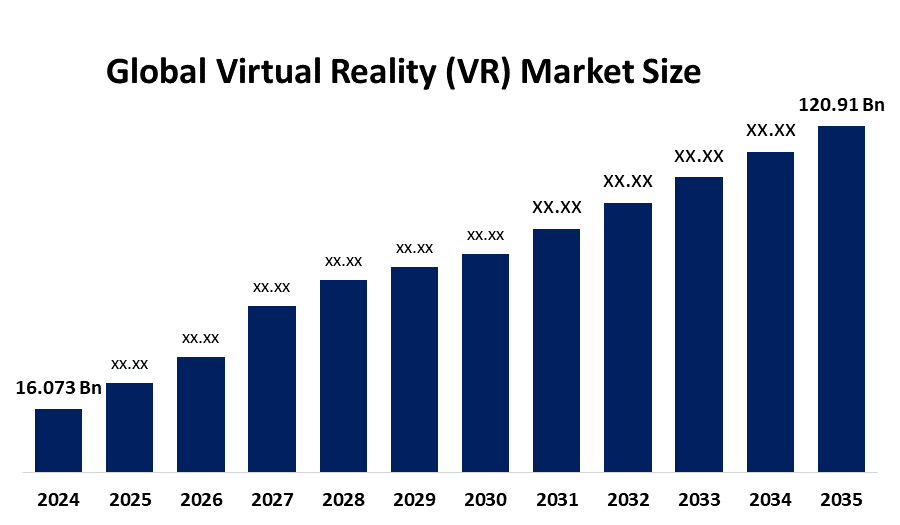
- The Global Virtual Reality Market Size Was Estimated at USD 16.073 Billion in 2024
- The Market Size is Expected to Grow at a CAGR of around 20.14% from 2025 to 2035
- The Worldwide Virtual Reality Market Size is Expected to Reach USD 120.91 Billion by 2035
- Asia Pacific is expected to grow the fastest during the forecast period.
Get more details on this report -
According to a research report published by Spherical Insights and Consulting, The Global Virtual Reality Market Size was worth around USD 16.073 Billion in 2024 and is predicted to Grow to around USD 120.91 Billion by 2035 with a compound annual growth rate (CAGR) of 20.14% from 2025 to 2035. Global innovations in VR headsets and software platforms, medical stimulation platforms, therapeutic VR solutions, and EdTech platforms using immersive learning experiences are all driving opportunities in the virtual reality market.
Market Overview
The global industry segment involved in the development, production, distribution, and commercialization of VR technologies that create immersive, computer-generated environments where user can interact with digital content in a simulated 3D space using specialized devices is known as the virtual reality market. These include massive VR hardware, VR software and platforms, and VR content and services across sectors like gaming, entertainment, healthcare, education, real estate, tourism, and industrial training. Government support plays an important role in promoting the growth of the VR market through funding for research and development, innovation grants, digital infrastructure investments, and policies encouraging emerging technologies. For example, In November 2022, China’s 5-year NVRIAP target shipment of 25 million VR devices by 2026, expected VR industry value CNY 350 billion, and development of 10 public service platforms and 100 key VR enterprises, strengthening the VR technology ecosystem.
In March 2025, India’s Ministry of Science and Technology & Assam Government developed VR-enabled metaverse learning platform called Gyandhara, program launched in 56 PM-SHRI schools in Assam to improve STEM learning by enabling students to learn science and mathematics through immersive VR environments.
Report Coverage
This research report categorizes the virtual reality market based on various segments and regions, forecasts revenue growth, and analyzes trends in each submarket. The report analyses the key growth drivers, opportunities, and challenges influencing the virtual reality market. Recent market developments and competitive strategies, such as expansion, product launch, development, partnership, merger, and acquisition, have been included to draw the competitive landscape in the market. The report strategically identifies and profiles the key market players and analyses their core competencies in each sub-segment of the virtual reality market.
Global Virtual Reality (VR) Market Report Coverage
| Report Coverage | Details |
|---|---|
| Base Year: | 2024 |
| Market Size in 2024: | USD 16.073 Billion |
| Forecast Period: | 2025-2035 |
| Forecast Period CAGR 2025-2035 : | CAGR of 20.14% |
| 2035 Value Projection: | USD 120.91 Billion |
| Historical Data for: | 2020-2023 |
| No. of Pages: | 210 |
| Tables, Charts & Figures: | 95 |
| Segments covered: | By Type, By Technology |
| Companies covered:: | Meta Platforms, Sony, HTC, Microsoft, Apple, Samsung Electronics, Valve, Google, NVIDIA, Qualcomm Technologies, Varjo Technologies, Pimax Innovation, HP Inc., Lenovo Group, ByteDance Ltd., Others, and Key Players |
| Pitfalls & Challenges: | COVID-19 Empact, Challenge, Future, Growth, & Analysis |
Get more details on this report -
Driving Factors
Rapid technological innovation is one of the main drivers of the virtual reality market's growth. increasing demand for immersive digital experiences, and expanding applications across multiple industries, which is the main factor driving the market for virtual reality. In this field, innovation and investment are driven by the rising popularity of immersive gaming and entertainment, improved displays and wireless headsets, increasing VR content development, and the integration of VR with emerging technologies such as artificial intelligence, cloud computing, and 5G networks are further accelerating market expansion. Government initiatives and digital transformation programs are also supporting the development of VR ecosystems globally.
In March 2024, the U.S. Fairfax County Department of Family Services Launch of the Exploring the Dimensions of Aging through Virtual Reality program, which uses VR simulations to train caregivers about issues faced by older adults with 193 participants engaged in VR sessions during the initial pilot phase in 2024 to improve caregiver training related to dementia, PTSD, and social isolation among elderly individuals
Restraining Factors
High development and deployment costs, health and safety concerns, limited availability of compatible VR content across platforms, data privacy and cybersecurity concerns, shortage of skilled VR developers, and technical issues are the main factors restricting the virtual reality market.
Market Segmentation
The virtual reality market share is classified into type, technology, and application
- The head-mounted display segment dominated the market in 2024, approximately 61%, and is projected to grow at a substantial CAGR during the forecast period.
Based on the type, the virtual reality market is divided into head-mounted display, gesture-tracking device, and projectors & display wall. Among these, the head mounted display segment dominated the market in 2024, approximately 61%, and is projected to grow at a substantial CAGR during the forecast period. The growing use of VR headsets in consumer, specialized equipment to enable VR experiences, offers portability, cost effective solution, and massive demand for higher resolution displays is driving the head-mounted display industry.
- The semi & fully immersive segment accounted for the largest share in 2024, approximately 35%, and is anticipated to grow at a significant CAGR during the forecast period.
Based on the technology, the virtual reality market is divided into semi & fully immersive and non-immersive. Among these, the semi & fully immersive segment accounted for the largest share in 2024, approximately 35%, and is anticipated to grow at a significant CAGR during the forecast period. Widely used for maximum realism and interaction, cost effective for simulation and training environments, offers interactive capabilities, and widely used in end use applications is driving the semi & fully immersive industry.
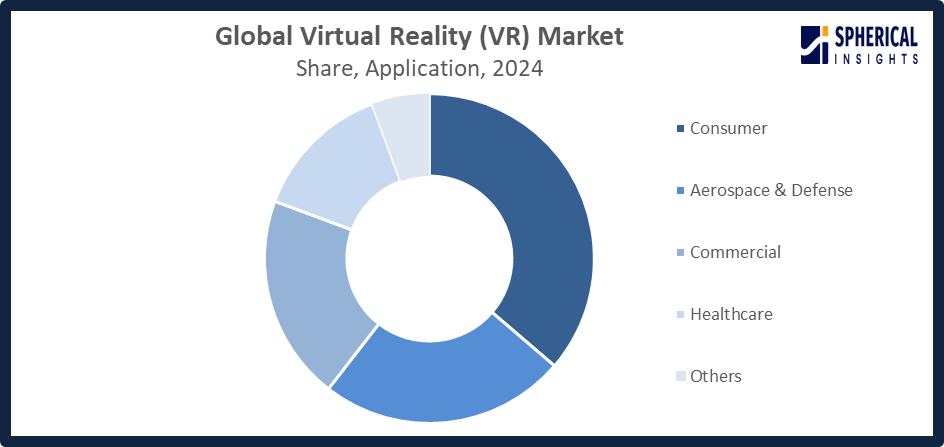
- The consumer segment accounted for the highest market revenue in 2024, approximately 32%, and is anticipated to grow at a significant CAGR during the forecast period.
Based on the application, the virtual reality market is divided into aerospace & defense, consumer, commercial, healthcare, and others. Among these, the consumer segment accounted for the highest market revenue in 2024, approximately 32%, and is anticipated to grow at a significant CAGR during the forecast period. Rise of hybrid work, increased demand for enterprise VR software, and global shift towards commercial leaderships to improve complex assembly processes is bolstering consumer market.
Get more details on this report -
Regional Segment Analysis of the Virtual Reality Market
- North America (U.S., Canada, Mexico)
- Europe (Germany, France, U.K., Italy, Spain, Rest of Europe)
- Asia-Pacific (China, Japan, India, Rest of APAC)
- South America (Brazil and the Rest of South America)
- The Middle East and Africa (UAE, South Africa, Rest of MEA)

Get more details on this report -
North America is anticipated to hold the largest share of the virtual reality market over the predicted timeframe.
North America is anticipated to hold the largest share of the virtual reality market over the predicted timeframe. Strong government backing for advanced technological infrastructure, high consumer adoption rates, substantial investment in VR R&D, and early enterprise and government use in sectors such as gaming, healthcare, aerospace, and defense are what propel North America. The region's position is further reinforced by government programs promoting strong funding for innovation in terms of both revenue and market penetration.
Government initiatives include Canada’s government, July 2024 funding for VR mission training and contributes USD 448,950 to enhance VR training simulations with AI improvements, and the U.S. VA Immersive program, July 2025 deploys more than 3,500 virtual reality headsets across VA medical centers to expand clinical and training use
Asia Pacific is expected to grow at a rapid CAGR in the virtual reality market during the forecast period. China, Japan, India, and South Korea are among the nations making significant investments in rapid digitalization, increasing adoption of VR technologies in gaming, education, healthcare, retail, and industrial sectors, expanding tech infrastructure, and supportive government initiatives. The demand for virtual reality is further accelerated by the expanding internet and mobile penetration accelerating VR adoption more quickly than in other regions.
Government launches include China’s national plan, November 2022, targeting 25 million VR device shipments and industry value of over 350 billion yuan by 2026, aiming to grow the VR industry and foster innovation. India’s MeitY, May 2025, launched AR/VR training under FutureSkills PRIME to prepare professionals in immersive technologies, and Japan’s Digital Agency, January 2026, integrates emerging technologies, including VR/immersive tech, to improve the productivity and security of government services.
Competitive Analysis:
The report offers the appropriate analysis of the key organizations/companies involved within the virtual reality market, along with a comparative evaluation primarily based on their product of offering, business overviews, geographic presence, enterprise strategies, segment market share, and SWOT analysis. The report also provides an elaborative analysis focusing on the current news and developments of the companies, which includes product development, innovations, joint ventures, partnerships, mergers & acquisitions, strategic alliances, and others. This allows for the evaluation of the overall competition within the market.
List of Key Companies
- Meta Platforms
- Sony
- HTC
- Microsoft
- Apple
- Samsung Electronics
- Valve
- NVIDIA
- Qualcomm Technologies
- Varjo Technologies
- Pimax Innovation
- HP Inc.
- Lenovo Group
- ByteDance Ltd.
- Others
Key Target Audience
- Market Players
- Investors
- End-users
- Government Authorities
- Consulting and Research Firm
- Venture capitalists
- Value-Added Resellers (VARs)
Recent Development
• In January 2026, Goertek unveiled a comprehensive next-generation XR portfolio, including VR optics and display components, at CES 2026 in Las Vegas, featuring advanced VR optics and mixed-reality references that demonstrate technology building blocks for future VR devices.
• In October 2025, Meta Platforms expanded VR functionality by releasing the Windows 11 Mixed Reality Link feature for Quest 3 and Quest 3S, enabling users to view multiple high-resolution desktops in VR.
• In September 2024, Meta Platforms announced the launch of the Meta Quest 3S mixed-reality headset at Meta Connect, offering a more affordable VR/MR device and expanding its Quest ecosystem.
Market Segment
This study forecasts revenue at global, regional, and country levels from 2020 to 2035. Spherical Insights has segmented the virtual reality market based on the below-mentioned segments:
Global Virtual Reality Market, By Type
- Head-Mounted Display
- Gesture-Tracking Device
- Projectors & Display Wall
Global Virtual Reality Market, By Technology
- Semi & Fully Immersive
- Non-Immersive
Global Virtual Reality Market, By Application
- Aerospace & Defense
- Consumer
- Commercial
- Healthcare
- Others
Global Virtual Reality Market, By Regional Analysis
- North America
- US
- Canada
- Mexico
- Europe
- Germany
- UK
- France
- Italy
- Spain
- Russia
- Rest of Europe
- Asia Pacific
- China
- Japan
- India
- South Korea
- Australia
- Rest of Asia Pacific
- South America
- Brazil
- Argentina
- Rest of South America
- Middle East & Africa
- UAE
- Saudi Arabia
- Qatar
- South Africa
- Rest of the Middle East & Africa
Frequently Asked Questions (FAQ)
-
1.How does VR integrate with other technologies?VR integrates with AI, 5G, cloud computing, IoT, and AR/MR. These enhance immersive experiences, real-time data processing, and enterprise application capabilities.
-
2.How is VR used in healthcare?VR is used for surgical training, therapy, rehabilitation, and mental health treatments. It allows immersive simulations and controlled environments for patient care and medical education.
-
3.What are VR trends for 2024–2035?Trends include standalone headsets, AI integration, enterprise adoption, location-based entertainment, high-resolution displays, wireless VR, and mixed reality applications.
-
4.What is semi-immersive VR?Semi-immersive VR uses large screens or projections to create virtual environments without fully isolating the user. It’s widely used in education, training, and architectural visualization for cost-effective simulations.
-
5.What are the key VR hardware products?VR hardware includes head-mounted displays (HMDs), motion sensors, controllers, haptic devices, and VR cameras. These enable immersive experiences across gaming, training, healthcare, and industrial applications.
-
6.What is the future outlook for VR?The VR market is expected to grow with increasing adoption in gaming, healthcare, education, and enterprise. Investment in high-end hardware, content development, and government initiatives will drive expansion through 2030.
Need help to buy this report?