United States Surface Computing Market Size, Share, and COVID-19 Impact Analysis, By Type (Two-Dimensional and Three-Dimensional), By Application (Banking, Automotive, Health Care, Hotels Entertainment, Retail, and Others), and United States Surface Computing Market Insights, Industry Trend, Forecasts to 2035
Industry: Information & Technology
United States Surface Computing Market Insights Forecasts to 2035
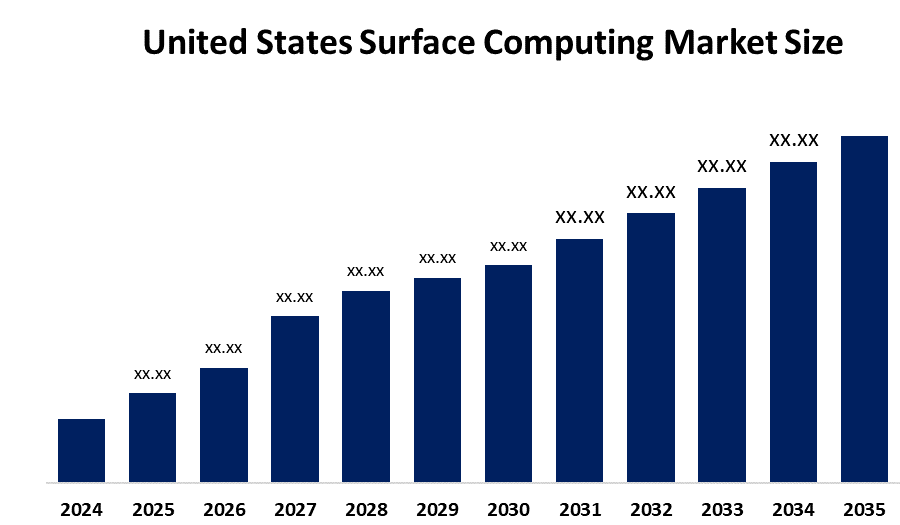
- The Market Size is Expected to Grow at a CAGR of Around 34.21% from 2025 to 2035
- The United States Surface Computing Market Size is expected to hold a Significant Share by 2035
Get more details on this report -
According to a research report published by Spherical Insights & Consulting, The United States Surface Computing Market Size is anticipated to Grow at a CAGR of 34.21% from 2025 to 2035. The United States surface computing market is driven by growing demand for interactive and touch-based interfaces, rapid digital transformation across industries, increasing adoption in retail, healthcare, education, and corporate sectors, and rising need for enhanced customer engagement and operational efficiency.
Market Overview
The United States surface computing market refers to the total revenue and demand generated from the development, production, sale, and adoption of surface computing technologies within the United States. The United States surface computing market is used to provide interactive, touch-based, and gesture-enabled computing solutions that enhance user engagement, collaboration, and operational efficiency. The market is primarily driven by growing demand for interactive and touch-based interfaces, rapid digital transformation across industries, increasing adoption in retail, healthcare, education, and corporate sectors, and rising need for enhanced customer engagement and operational efficiency.
The United States surface computing market presents key opportunities driven by expanding adoption across emerging sectors such as smart retail, healthcare, and education; integration with AI, IoT, and AR/VR technologies; development of interactive digital signage and kiosks; and increased deployment in corporate collaboration, hospitality, and public information systems. In February 2026, the National Science Foundation (NSF), through its CISE Directorate, allocated an estimated USD 280 million for Future Computing Research programs supporting AI, human-centered computing, and networking technologies. Individual awards ranging from USD 600,000 to USD 12 million are expected to accelerate interactive and touch-based computing innovations, further strengthening the growth of the United States surface computing market.
Report Coverage
This research report categorizes the market for the United States surface computing market based on various segments and regions, and forecasts revenue growth and analyses trends in each submarket. The report analyses the key growth drivers, opportunities, and challenges influencing the United States surface computing market. Recent market developments and competitive strategies, such as expansion, product launch, development, partnership, merger, and acquisition, have been included to draw the competitive landscape in the market. The report strategically identifies and profiles the key market players and analyses their core competencies in each sub-segment of the United States surface computing market.
United States Surface Computing Market Report Coverage
| Report Coverage | Details |
|---|---|
| Base Year: | 2024 |
| Forecast Period: | 2024-2035 |
| Forecast Period CAGR 2024-2035 : | CAGR of 34.21% |
| Historical Data for: | 2020-2023 |
| No. of Pages: | 210 |
| Tables, Charts & Figures: | 105 |
| Segments covered: | By Type, By Application |
| Companies covered:: | Microsoft Corporation, Samsung Electronics Co. Ltd., Dell Technologies, Inc., Apple Inc., Panasonic Corporation, ViewSonic Corporation, 3M Company, Elo Touch Solutions, LG Electronics Inc., Planar Systems Inc. (Leyard), Others, and |
| Pitfalls & Challenges: | COVID-19 Empact, Challenge, Future, Growth, & Analysis |
Get more details on this report -
Driving Factors
The United States surface computing market is driven by rising demand for interactive and immersive user experiences, rapid digital transformation in retail, healthcare, education, hospitality, and enterprise, and increased adoption of touch, gesture, and AI-enabled interfaces. Growth is supported by smart city initiatives, public sector digital services, advancements in multi-touch hardware and software platforms, and federal research funding that accelerates AI, networking, and human-centred computing innovation, expanding opportunities for deployment and commercialization.
Restraining Factors
The United States surface computing market is mostly constrained by high implementation and hardware costs, complex integration with existing systems, cybersecurity and data privacy concerns, rapid technological changes, and limited awareness among small and medium enterprises.
Market Segmentation
The United States surface computing market share is classified into type and application.
- The two-dimensional segment accounted for the largest revenue market share in 2024 and is expected to grow at a significant CAGR during the forecast period.
The United States surface computing market is segmented by type into two-dimensional and three-dimensional. Among these, the two-dimensional segment accounted for the largest revenue market share in 2024 and is expected to grow at a significant CAGR during the forecast period. This is due to It offers reduced costs, seamless integration with existing systems, and strong compatibility with current hardware. Its established use in retail, education, and corporate sectors, along with lower processing power needs, makes it a scalable and practical solution for widespread deployment.
- The retail segment dominated the share in 2024 and is anticipated to grow at a remarkable CAGR during the forecast period.
The United States surface computing market is segmented by application into banking, automotive, health care, hotels entertainment, retail, and others. Among these, the retail segment dominated the share in 2024 and is anticipated to grow at a remarkable CAGR during the forecast period. This is due to It has retained leading position in the U.S. surface computing market, fueled by strong demand for interactive kiosks, smart tables, and touch-enabled surfaces that improve customer engagement, self-service, and in-store experiences. The retail sector’s use of digital signage and product visualization has reinforced its market dominance.
Competitive Analysis:
The report offers the appropriate analysis of the key organizations/companies involved within the United States surface computing market, along with a comparative evaluation primarily based on their product offering, business overviews, geographic presence, enterprise strategies, segment market share, and SWOT analysis. The report also provides an elaborate analysis focusing on the current news and developments of the companies, which includes product development, innovations, joint ventures, partnerships, mergers & acquisitions, strategic alliances, and others. This allows for the evaluation of the overall competition within the market.
List of Key Companies
- Microsoft Corporation
- Samsung Electronics Co. Ltd.
- Dell Technologies, Inc.
- Apple Inc.
- Panasonic Corporation
- ViewSonic Corporation
- 3M Company
- Elo Touch Solutions
- LG Electronics Inc.
- Planar Systems Inc. (Leyard)
- Others
Key Target Audience
- Market Players
- Investors
- End-users
- Government Authorities
- Consulting and Research Firm
- Venture capitalists
- Value-Added Resellers (VARs)
Recent Developments:
• In February 2026, Samsung Electronics Co., Ltd. launched the WAFX-P premium Interactive Display for education and enterprise applications. The display features an AI Assistant, a 4K camera, multi-touch support for up to 50 users, dual-pen functionality, and USB-C connectivity, driving the adoption of interactive and touch-enabled surface computing technologies in the United States.
• In January 2026, ViewSonic Corporation launched the ViewBoard IFP35-1 and IFP41-1 series, Android 16-powered interactive displays featuring 64-point multi-touch capability, motion sensors, integrated audio, and myViewBoard software. These advancements enhance classroom collaboration and engagement, further boosting the adoption of interactive surface computing technologies in the United States.
Market Segment
This study forecasts revenue at the United States, regional, and country levels from 2020 to 2035. Spherical Insights has segmented the United States surface computing market based on the below-mentioned segments:
United States Surface Computing Market, By Type
- Two-Dimensional
- Three-Dimensional
United States Surface Computing Market, By Application
- Banking
- Automotive
- Health Care
- Hotels Entertainment
- Retail
- Others
Frequently Asked Questions (FAQ)
-
Q: What is the United States surface computing market size?A: United States surface computing market size is expected to grow at a CAGR of 34.21% during the forecast period 2025-2035.
-
Q: What are the key growth drivers of the market?A: The United States surface computing market is driven by growing demand for interactive and touch-based interfaces, rapid digital transformation across industries, and increasing adoption in retail, healthcare, education, and corporate sectors.
-
Q: What factors restrain the United States surface computing market?A: The United States surface computing market is mostly constrained by high implementation and hardware costs, complex integration with existing systems, cybersecurity and data privacy concerns, rapid technological changes, and limited awareness among small and medium enterprises.
-
Q: How is the market segmented by type?A: The market is segmented into two-dimensional and three-dimensional.
-
Q: Who are the key opportunities for this market?A: The United States surface computing market presents key opportunities in expanding adoption across emerging sectors, such as smart retail, healthcare, and education, and integration with AI, IoT, and AR/VR technologies.
Need help to buy this report?