United States Smart Waste Management Market Size, Share, and COVID-19 Impact Analysis, By Waste Type (Organic Waste, Plastic Waste, Metal Waste, and Hazardous Waste), By Technology (IoT Solutions, Artificial Intelligence, Data Analytics, and Smart Bins), By Application (Municipal Solid Waste Management, Industrial Waste Management, Construction Waste Management, and Electronic Waste Management), and United States Smart Waste Management Market Insights, Industry Trend, Forecasts to 2035
Industry: Energy & Power
United States Smart Waste Management Market Insights Forecasts to 2035
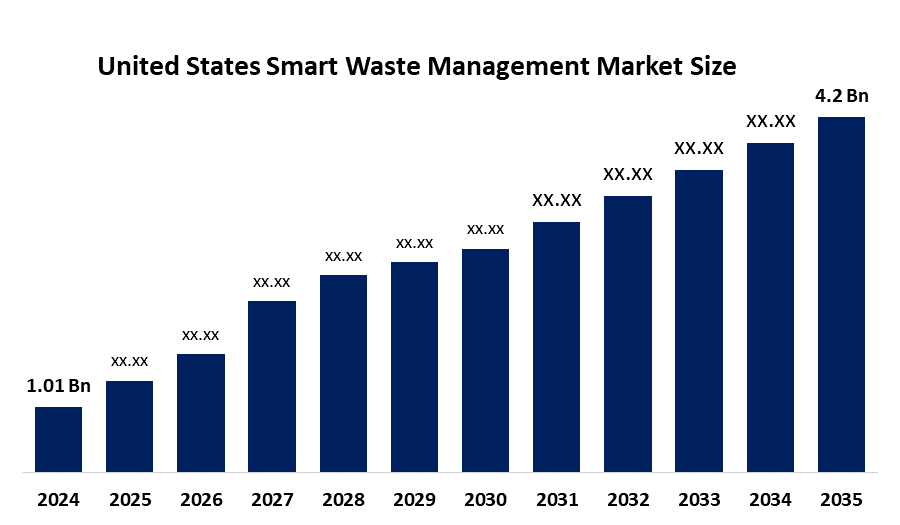
- The United States Smart Waste Management Market Size Was Estimated at USD 1.01 Billion in 2024
- The Market Size is Expected to Grow at a CAGR of Around 13.8% from 2025 to 2035
- The United States Smart Waste Management Market Size is Expected to Reach USD 4.2 Billion by 2035
Get more details on this report -
According to a research report published by Spherical Insights & Consulting, The United States Smart Waste Management Market Size is anticipated to reach USD 4.2 Billion by 2035, Growing at a CAGR of 13.8% from 2025 to 2035. The United States smart waste management market is driven by the increasing urbanization, rising waste generation, growing adoption of IoT-enabled waste management solutions, and strong government initiatives focused on sustainable waste disposal and environmental protection.
Market Overview
The United States smart waste management market refers to the industry which develops advanced waste collection and monitoring systems through Internet of Things and artificial intelligence and sensors and data analytics and smart bin technologies. The solutions enable municipalities and organizations to create waste collection routes which decrease their operational expenses while boosting their recycling performance and protecting the environment. The market expansion occurs because people produce more waste in urban settings and people become more aware of environmental sustainability and governments create waste disposal regulations and organizations embrace digital waste management solutions. Smart waste solutions provide organizations with the ability to track waste levels in real time while they create optimized collection routes for their vehicles and enhance their ability to manage resources.
The United States smart waste management market is witnessing several key trends which will determine its future development. The first trend shows that more people are starting to use IoT-enabled smart bins together with sensors which enable them to track waste levels in real time while increasing their collection efficiency. The second trend uses artificial intelligence with data analytics to create better waste collection routes and improve recycling methods. The increase in circular economy practices together with sustainability initiatives drives municipalities and industries to implement advanced waste management solutions which decrease landfill waste and support recycling efforts.
The United States government supports smart waste management initiatives through regulations, funding programs, and environmental policies which aim to reduce landfill waste while promoting sustainable waste management practices. The market expands because of investments made into smart city projects and digital infrastructure and waste recycling technologies. The waste management operations achieve better efficiency and sustainability through technological advancements which include automated waste sorting systems and smart monitoring platforms and AI-driven waste analytics.
Report Coverage
This research report categorizes the market for the United States smart waste management market based on various segments and regions, and forecasts revenue growth and analyses trends in each submarket. The report analyses the key growth drivers, opportunities, and challenges influencing the United States smart waste management market. Recent market developments and competitive strategies, such as expansion, product launch, development, partnership, merger, and acquisition have been included to draw the competitive landscape in the market. The report strategically identifies and profiles the key market players and analyses their core competencies in each sub-segment of the United States smart waste management market.
United States Smart Waste Management Market Report Coverage
| Report Coverage | Details |
|---|---|
| Base Year: | 2024 |
| Market Size in 2024: | USD 1.01 Billion |
| Forecast Period: | 2025-2035 |
| Forecast Period CAGR 2025-2035 : | CAGR of 13.8% |
| 2035 Value Projection: | USD 4.2 Billion |
| Historical Data for: | 2020-2023 |
| No. of Pages: | 210 |
| Tables, Charts & Figures: | 95 |
| Segments covered: | By Waste Type, By Technology |
| Companies covered:: | Waste Management Inc., Republic Services Inc., Covanta Holding Corporation, Veolia North America, Bigbelly Inc., SUEZ Recycling & Recovery, Rubicon Technologies, Sensoneo, Ecube Labs, Others, and Key Players |
| Pitfalls & Challenges: | COVID-19 Empact, Challenge, Future, Growth, & Analysis |
Get more details on this report -
Driving Factors
The smart waste management market in the United States experiences its main growth because cities expand while waste production increases, which creates a demand for better waste handling procedures. Municipalities that adopt IoT-enabled smart waste monitoring systems can track their waste levels during the day while creating better collection routes, which leads to reduced costs and better operational results. Government initiatives that support smart city development and sustainable waste management systems create a positive impact on market expansion. Environmental awareness has increased, while waste disposal regulations have become more stringent, which creates a market demand for advanced waste management technologies. The market growth receives support from technological progress which enhances artificial intelligence capabilities and sensor technology development and data analytics improvements that result in better waste sorting and recycling processes and operational efficiency.
Restraining Factors
The United States smart waste management market faces obstacles because smart waste infrastructure needs high initial investment costs which include expenses for sensors and connected bins and data management platforms. The adoption process in some areas will be delayed because technical skills required for waste management system integration with current systems are not available. The implementation of smart waste management solutions will face restrictions because organizations have concerns about data security and system upkeep and operational expenses.
Market Segmentation
The United States smart waste management market share is classified into waste type, technology, and application.
- The organic waste segment accounted for the largest revenue market in 2024 and is expected to grow at a significant CAGR during the forecast period.
The United States smart waste management market is segmented by waste type into organic waste, plastic waste, metal waste, and hazardous waste. Among these, the organic waste segment accounted for the largest revenue market in 2024 and is expected to grow at a significant CAGR during the forecast period. The dominance of this segment is attributed to the high volume of food and biodegradable waste generated from households, restaurants, and commercial establishments. The growing understanding of sustainable waste disposal methods and composting practices drives the demand for effective organic waste management systems. The smart waste management market experiences growth because government regulations promote waste segregation and recycling practices.
- The IoT solutions segment accounted for the largest share in 2024 and is expected to grow at a significant CAGR during the forecast period.
The United States smart waste management market is segmented by technology into IoT solutions, artificial intelligence, data analytics, and smart bins. Among these, the IoT solutions segment accounted for the largest share in 2024 and is expected to grow at a significant CAGR during the forecast period. The leading position of this segment exists because sensor technology based systems have become common practice to track waste levels in real time. The implementation of IoT systems enables municipalities to achieve three benefits which include optimized waste collection routes and reduced operational expenses and increased operational efficiency. The United States experiences an increase in smart city project implementations which drives greater adoption of IoT waste management technologies.
- The municipal solid waste management segment accounted for the largest share in 2024 and is expected to grow at a significant CAGR during the forecast period.
The United States smart waste management market is segmented by application into municipal solid waste management, industrial waste management, construction waste management, and electronic waste management. Among these, the municipal solid waste management segment accounted for the largest share in 2024 and is expected to grow at a significant CAGR during the forecast period. The segment shows its market leadership because urban areas generate more waste through their increasing population and their fast-paced urban development. Municipal authorities are increasingly adopting smart waste management solutions to improve waste collection efficiency and reduce environmental impact. The government initiatives which promote smart city infrastructure development together with sustainable waste management practices create additional support for this segment's expansion.
Competitive Analysis:
The report offers the appropriate analysis of the key organizations/companies involved within the United States smart waste management market, along with a comparative evaluation primarily based on their product offering, business overviews, geographic presence, enterprise strategies, segment market share, and SWOT analysis. The report also provides an elaborate analysis focusing on the current news and developments of the companies, which includes product development, innovations, joint ventures, partnerships, mergers & acquisitions, strategic alliances, and others. This allows for the evaluation of the overall competition within the market.
List of Key Companies
- Waste Management Inc.
- Republic Services Inc.
- Covanta Holding Corporation
- Veolia North America
- Bigbelly Inc.
- SUEZ Recycling & Recovery
- Rubicon Technologies
- Sensoneo
- Ecube Labs
- Others
Key Target Audience
- Market Players
- Investors
- End-users
- Government Authorities
- Consulting and Research Firm
- Venture capitalists
- Value-Added Resellers (VARs)
Recent Developments:
In March 2024, Bigbelly introduced advanced AI-enabled smart waste bins designed to improve real-time waste monitoring and optimize waste collection routes for municipalities across the United States, supporting the expansion of smart city waste management systems.
Market Segment
This study forecasts revenue at the United States, regional, and country levels from 2020 to 2035. Spherical Insights has segmented the United States smart waste management market based on the below-mentioned segments:
United States Smart Waste Management Market, By Waste Type
- Organic Waste
- Plastic Waste
- Metal Waste
- Hazardous Waste
United States Smart Waste Management Market, By Technology
- IoT Solutions
- Artificial Intelligence
- Data Analytics
- Smart Bins
United States Smart Waste Management Market, By Application
- Municipal Solid Waste Management
- Industrial Waste Management
- Construction Waste Management
- Electronic Waste Management
Frequently Asked Questions (FAQ)
-
1. What is the United States smart waste management market?The United States smart waste management market refers to the industry focused on using advanced technologies such as IoT, AI, and data analytics to improve waste collection, monitoring, recycling, and disposal processes.
-
2. What is the United States smart waste management market size?United States smart waste management market size is expected to grow from USD 1.01 billion in 2024 to USD 4.2 billion by 2035, growing at a CAGR of 13.8% during the forecast period 2025-2035.
-
3. What are the key drivers of the United States smart waste management market?Key drivers include increasing urbanization, rising waste generation, adoption of IoT-based waste monitoring systems, smart city initiatives, and growing environmental regulations.
-
4. Which weste types dominate the United States smart waste management market?Organic waste currently dominates due to the high volume of biodegradable waste generated in residential and commercial sectors.
-
5. What are the major trends in the United States smart waste management market?Major trends include IoT-enabled smart bins, AI-driven waste analytics, digital waste monitoring systems, and increasing focus on recycling and circular economy initiatives.
-
6. Who are the key companies operating in the United States smart waste management market?Major players include Waste Management Inc., Republic Services Inc., Veolia North America, Covanta Holding Corporation, Bigbelly Inc., Sensoneo, and Ecube Labs.
-
7. What is the future outlook for the United States smart waste management market?The market is expected to grow steadily due to smart city initiatives, increasing waste volumes, technological advancements, and government regulations supporting sustainable waste management practices.
Need help to buy this report?