United States Smart Lighting Market Size, Share, and COVID-19 Impact Analysis, By Offering (Hardware, Software, and Services), By Technology (Wired Technology and Wireless Technology), By Light Source (LED Lamps, Fluorescent Lamps, Compact Fluorescent Lamps, High Intensity Discharge Lamps, and Others), and United States Smart Lighting Market Insights, Industry Trend, Forecasts to 2035
Industry: Semiconductors & Electronics
United States Smart Lighting Market Insights Forecasts to 2035
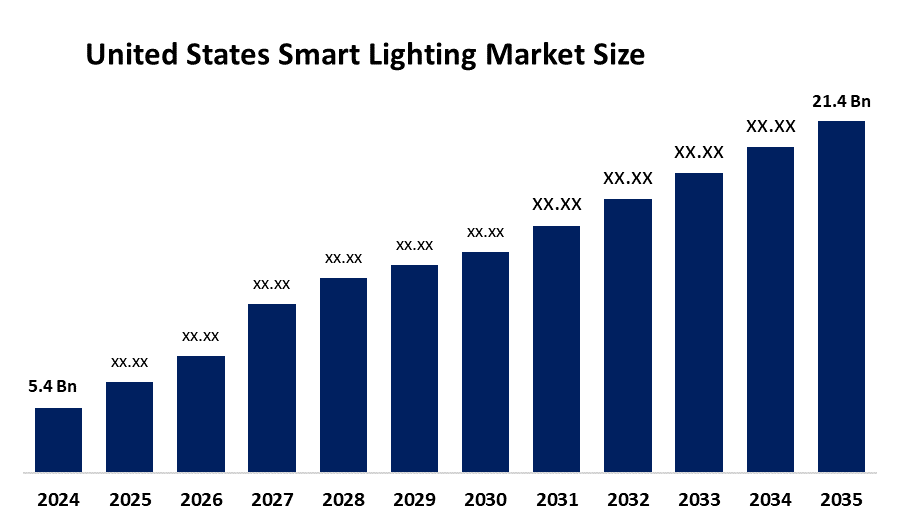
- The United States Smart Lighting Market Size Was Estimated at USD 5.4 Billion in 2024
- The Market Size is Expected to Grow at a CAGR of Around 13.3% from 2025 to 2035
- The United States Smart Lighting Market Size is Expected to Reach USD 21.4 Billion by 2035
Get more details on this report -
According to a research report published by Spherical Insights & Consulting, The United States Smart Lighting Market Size is anticipated to reach USD 6.67 Billion by 2035, Growing at a CAGR of 13.3% from 2025 to 2035. The United States smart lighting market is driven by the increasing demand for energy-efficient lighting systems, the expansion of smart homes and smart cities, and the growing adoption of internet of things (IoT) technologies in lighting infrastructure.
Market Overview
The United States smart lighting market comprises the sector which develops and installs advanced lighting systems that utilize IoT sensors and wireless networks and cloud technology for remote operation and system management and automatic operation. Users of these lighting systems can manage their lighting systems through mobile applications and central control systems which enable them to adjust brightness and color temperature and set timers and monitor energy consumption. The market contains multiple technologies which include LED-based smart bulbs and connected luminaires and lighting control systems and sensors and software platforms. The different solutions are used throughout residential and commercial and industrial environments to improve energy efficiency and decrease electricity use and better control lighting systems.
The United States smart lighting market is developing three main trends which will determine its upcoming growth. The first trend shows that smart home systems and connected home environments are expanding which creates greater needs for lighting systems that users can operate through their smartphones and voice command systems. The second trend shows that companies use IoT technologies together with artificial intelligence systems to create advanced lighting solutions which include occupancy detection and daylight harvesting and predictive maintenance capabilities. The third trend shows that government programs which support energy-saving lighting systems and environmentally friendly city infrastructure development drive the adoption of smart LED lighting systems that replace traditional street lights.
The US government also supports the smart lighting market through its regulations, financial incentives, and smart city programs. For instance, the US government, through its programs such as the Energy Star program, promotes the use of efficient lighting products through the certification and encouragement of the use of efficient lighting products, including LED lighting systems.
Report Coverage
This research report categorizes the market for the United States smart lighting market based on various segments and regions, and forecasts revenue growth and analyses trends in each submarket. The report analyses the key growth drivers, opportunities, and challenges influencing the United States smart lighting market. Recent market developments and competitive strategies, such as expansion, product launch, development, partnership, merger, and acquisition have been included to draw the competitive landscape in the market. The report strategically identifies and profiles the key market players and analyses their core competencies in each sub-segment of the United States smart lighting market.
United States Smart Lighting Market Report Coverage
| Report Coverage | Details |
|---|---|
| Base Year: | 2024 |
| Market Size in 2024: | USD 5.4 Billion |
| Forecast Period: | 2024-2035 |
| Forecast Period CAGR 2024-2035 : | CAGR of 13.3% |
| 2035 Value Projection: | USD 21.4 Billion |
| Historical Data for: | 2020-2023 |
| No. of Pages: | 240 |
| Tables, Charts & Figures: | 105 |
| Segments covered: | By Offering, By Technology |
| Companies covered:: | Signify N.V., Acuity Brands Inc., Honeywell International Inc., Cree Lighting, Lutron Electronics Co., Inc., Legrand SA, Eaton Corporation, Others, and |
| Pitfalls & Challenges: | COVID-19 Empact, Challenge, Future, Growth, & Analysis |
Get more details on this report -
Driving Factors
The United States smart lighting market is primarily driven by the the increasing demand for energy-saving lighting solutions in the residential and commercial sectors. Smart lighting systems help in saving a considerable amount of electrical energy, as the lighting levels are adjusted in accordance with the presence of people and the amount of natural light available. In addition, the rise of smart cities and smart buildings in the United States is also contributing to the increasing demand for smart lighting systems. Moreover, the technological advancements in the field of IoT connectivity, wireless communication, and cloud-based lighting management systems are also increasing the efficacy of smart lighting systems. In addition, the government regulations and initiatives in the direction of promoting the use of energy-saving and eco-friendly lighting solutions are also encouraging the adoption of smart lighting systems.
Restraining Factors
The United States smart lighting market also faces challenges. For instance, the high cost of installing smart lighting systems and infrastructures is one of the challenges that the smart lighting market in the United States faces. Cybersecurity threats, which smart lightning networks pose, may also pose a problem for the smart lighting market in the United States. Complexity in integrating smart lighting systems with existing infrastructure, as well as compatibility between smart lighting systems, may also pose challenges for the smart lighting market.
Market Segmentation
The United States smart lighting market share is classified into offering, technology, and light source.
- The hardware segment accounted for the largest revenue market in 2024 and is expected to grow at a significant CAGR during the forecast period.
The United States smart lighting market is segmented by offering into hardware, software, and services. Among these, the hardware segment accounted for the largest revenue market in 2024 and is expected to grow at a significant CAGR during the forecast period. The dominance of this segment is due to the increasing demand for smart bulbs, luminaires, lighting controls, sensors, and switches in residential and commercial buildings. The rapid development of smart buildings is also contributing to the increasing demand for smart lighting hardware components.
- The wireless technology segment accounted for the largest share in 2024 and is expected to grow at a significant CAGR during the forecast period.
The United States smart lighting market is segmented by technology into wired technology and wireless technology. Among these, the wireless technology segment accounted for the largest share in 2024 and is expected to grow at a significant CAGR during the forecast period. The dominance of this segment of communication technologies, which enables remote monitoring and automation of lighting systems. Moreover, the increasing popularity of IoT-enabled smart homes and devices is also contributing to the increasing demand for wireless smart lighting solutions.
- The led lamps segment accounted for the largest share in 2024 and is expected to grow at a significant CAGR during the forecast period.
The United States smart lighting market is segmented by light source into led lamps, fluorescent lamps, compact fluorescent lamps, high intensity discharge lamps, and others. Among these, the led lamps segment accounted for the largest share in 2024 and is expected to grow at a significant CAGR during the forecast period. The dominance of this segment is due to the high level of energy efficiency, long lifespan, nd low maintenance costs, as opposed to other conventional lighting systems. Moreover, the maintenance costs, as opposed to the cost of promoting energy-efficient lighting systems, are also contributing to the growth of smart lighting systems based on LEDs.
Competitive Analysis:
The report offers the appropriate analysis of the key organizations/companies involved within the United States smart lighting market, along with a comparative evaluation primarily based on their product offering, business overviews, geographic presence, enterprise strategies, segment market share, and SWOT analysis. The report also provides an elaborate analysis focusing on the current news and developments of the companies, which includes product development, innovations, joint ventures, partnerships, mergers & acquisitions, strategic alliances, and others. This allows for the evaluation of the overall competition within the market.
List of Key Companies
- Signify N.V.
- Acuity Brands Inc.
- Honeywell International Inc.
- Cree Lighting
- Lutron Electronics Co., Inc.
- Legrand SA
- Eaton Corporation
- Others
Key Target Audience
- Market Players
- Investors
- End-users
- Government Authorities
- Consulting and Research Firm
- Venture capitalists
- Value-Added Resellers (VARs)
Recent Developments:
In April 2024, Signify introduced new smart LED lighting solutions integrated with IoT-based control systems designed to enhance energy efficiency and provide advanced lighting automation for commercial buildings in the United States.
Market Segment
This study forecasts revenue at the United States, regional, and country levels from 2020 to 2035. Spherical Insights has segmented the United States smart lighting market based on the below-mentioned segments:
United States Smart Lighting Market, By Offering
- Hardware
- Software
- Services
United States Smart Lighting Market, By Technology
- Wired Technology
- Wireless Technology
United States Smart Lighting Market, By Light Source
- LED Lamps
- Fluorescent Lamps
- Compact Fluorescent Lamps
- High Intensity Discharge Lamps
- Others
Frequently Asked Questions (FAQ)
-
1. What is the United States smart lighting market?The United States smart lighting market refers to the industry focused on the development and deployment of connected lighting systems that can be controlled, monitored, and automated using IoT technologies.
-
2. What is the United States smart lighting market size?United States smart lighting market size is expected to grow from USD 5.4 billion in 2024 to USD 21.4 billion by 2035, growing at a CAGR of 13.3% during the forecast period 2025-2035.
-
3. What are the key drivers of the United States smart lighting market?The market is driven by increasing demand for energy-efficient lighting, expansion of smart homes and smart cities, and advancements in IoT-enabled lighting technologies.
-
4. Which technology dominate the United States smart lighting market?Wireless technology dominates due to the growing adoption of Wi-Fi, Bluetooth, and Zigbee-enabled smart lighting systems.
-
5. What are the major trends in the United States smart lighting market?Major trends include smart home adoption, IoT integration in lighting systems, and government initiatives promoting energy-efficient infrastructure.
-
6. Who are the key companies operating in the United States smart lighting market?Major players include Signify, Acuity Brands, Honeywell, Cree Lighting, Eaton, GE Lighting, and Lutron Electronics.
-
7. What is the future outlook for the United States smart lighting market?The market is expected to grow significantly due to increasing smart city initiatives, technological advancements in IoT-enabled lighting, and rising demand for energy-efficient lighting solutions.
Need help to buy this report?