United States of America Targeted Protein Degradation Market Size, Share, and COVID-19 Impact Analysis, By Modality (PROTAC, Molecular Glues, LYTACs, Others), By Therapeutic Area (Oncology, Neurology, Immunology and Others) By End User (Pharma/Biotech Companies, Hospitals, Academic and Research Institutes, Others), and U.S Targeted Protein Degradation Market Insights, Industry Trend, Forecasts to 2035
Industry: Healthcare
United States of America Targeted Protein Degradation Market Insights Forecasts to 2035
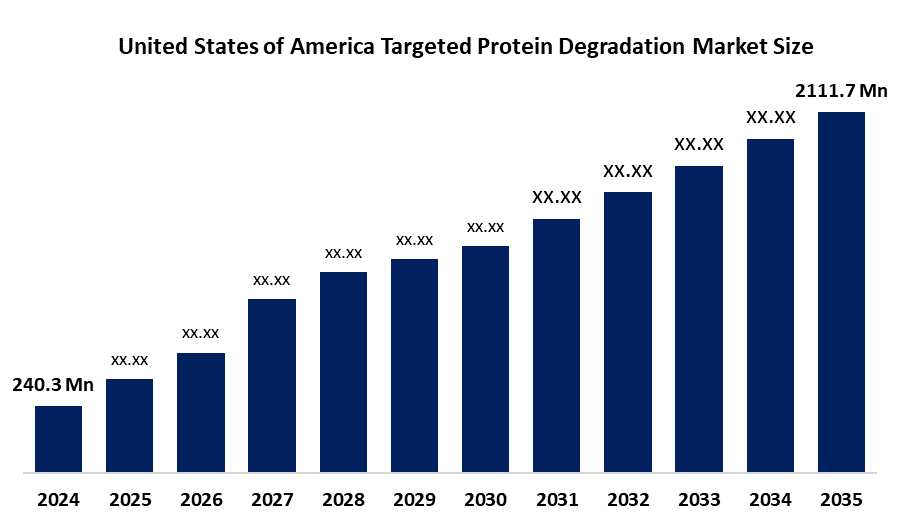
- The United States of America Targeted Protein Degradation Market Size Was Estimated at USD 240.3 Million in 2024
- The Market Size is Expected to Grow at a CAGR of Around 21.5% from 2025 to 2035
- United States of America Targeted Protein Degradation Market Size is Expected to Reach USD 2,111.7 Million by 2035
Get more details on this report -
According to a research report published by Spherical Insights & Consulting, the U.S Targeted Protein Degradation Market Size is anticipated to reach USD 2,111.7 Million by 2035, Growing at a CAGR of 21.5% from 2025 to 2035. The protein degradation market in the United States is driven by the rising prevalence of chronic diseases like cancers, neurodegenerative diseases like Alzheimer’s and Parkinson’s disease. Technological innovation in novel drug delivery systems and increased investments in pharmaceuticals and biotechnology.
Market Overview
The United States of America targeted protein degradation market refers to an advanced therapeutic approach, deploying specialised small molecules to orchestrate the destruction of pathogenic proteins by harnessing the body's innate quality control pathways. This strategy is employed to selectively eradicate specific disease drivers, eliminate aberrant or toxic protein accumulation, and preserve cellular homeostasis in both intracellular and extracellular environments.
The intensifying requirement for next-generation oncology regimens, coupled with a surge in precision medicine initiatives and novel therapeutic modalities, is propelling the adoption of targeted protein degradation across the American healthcare landscape. This therapeutic class commands high esteem within the scientific community for its versatility in addressing a vast spectrum of proteins across multiple medical specialities. Its appeal is further amplified by substantial technological maturation over the past decade, which has enabled superior selectivity and the ability to leverage cellular machinery in ways standard treatments cannot.
Market expansion is projected to accelerate, fuelled by robust venture capital investment and an increasing volume of discovery pipelines centred in major U.S. biotech hubs. Moreover, the strategic pivot of research beyond oncology has validated the platform, enhanced the visibility of targeted protein degradation, and catalysed broader industry acceptance.
Report Coverage
This research report categorises the United States of America targeted protein degradation market based on various segments and regions, and forecasts revenue growth and analyses trends in each submarket. The report analyses the key growth drivers, opportunities, and challenges influencing the U.S Targeted Protein Degradation market. Recent market developments and competitive strategies, such as expansion, product launch, development, partnership, merger, and acquisition, have been included to draw the competitive landscape in the market. The report strategically identifies and profiles the key market players and analyses their core competencies in each sub-segment of the United States targeted protein degradation market.
United States of America Targeted Protein Degradation Market Report Coverage
| Report Coverage | Details |
|---|---|
| Base Year: | 2024 |
| Market Size in 2024: | USD 240.3 Million |
| Forecast Period: | 2024-2035 |
| Forecast Period CAGR 2024-2035 : | CAGR of 21.5% |
| 2035 Value Projection: | USD 2111.7 Million |
| Historical Data for: | 2020-2023 |
| No. of Pages: | 240 |
| Tables, Charts & Figures: | 105 |
| Segments covered: | By Modality, By Therapeutic Area |
| Companies covered:: | Nurix Therapeutics, Kymera Therapeutics, C4 Therapeutics, AbbVie, Amgen, Bristol Myers Squibb, Eli Lilly, Gilead Sciences, Roche, Novartis, AstraZeneca, Agios Pharmaceuticals, Alnylam Pharmaceuticals, BeiGene, Blueprint medicines, Deciphera Pharmaceuticals, Exelixis, Neomorph, Vividion Therapeutics, ImmunoGen, and |
| Pitfalls & Challenges: | COVID-19 Empact, Challenge, Future, Growth, & Analysis |
Get more details on this report -
Driving Factors
The key driver of the targeted protein degradation market in the United States is due to strong unmet clinical needs, particularly in oncology. Technological innovation in novel drug delivery systems offers the ability to eliminate rather than merely inhibit target proteins, expanding the druggable proteome and attracting significant research and commercial interest. Substantial venture capital funding and strategic collaborations between emerging biotech firms and large pharmaceutical companies further accelerate pipeline development. The supportive regulatory environment under the U.S. Food and Drug Administration, particularly through expedited pathways in oncology and rare diseases, enhances investor confidence and shortens development timelines. Additionally, advancements in structural biology, proteomics, and AI-driven drug design strengthen platform scalability.
Restraining Factors
The targeted protein degradation market is constrained by the substantial costs required for research, manufacturing and scale-up of these advanced molecules, limited clinical data about the safety and efficacy of this treatment, and stringent regulatory scrutiny contributing to approval uncertainty.
Market Segmentation
The United States of America targeted protein degradation market share is classified into modality, therapeutic area, and end user
- The PROTAC segment accounted for the largest revenue of the market in 2024 and is expected to grow at a significant CAGR during the forecasted period.
The U.S targeted protein degradation market is segmented by product type into (PROTAC, molecular glues, LYTACs, and others. Among these, the PROTAC segment accounted for the largest revenue of the market in 2024 and is expected to grow at a significant CAGR during the forecasted period. This is because the PROTACs can be rationally designed and engineered to target almost any protein. Their ability to address previously undruggable targets, combined with advancing clinical pipelines and strong industry investment, positions the PROTAC segment for sustained growth
- The oncology segment accounted for the largest revenue of the market in 2024 and is expected to grow at a significant CAGR during the forecasted period.
Based on application, the U.S targeted protein degradation market is segmented into oncology, neurology, autoimmune disorders and others. Among these, the oncology segment accounted for the largest revenue of the market in 2024 and is expected to grow at a significant CAGR during the forecasted period. This is because if a cancer cell mutates, a drug cannot neutralise the newly mutated molecule, hence the cancer can relapse. However, TPDs can often still degrade these mutated proteins because they don't rely on the same binding mechanics. This ability to treat patients who have relapsed after standard therapy drives immense demand and investment in the oncology segment.
- The pharma/biotech segment accounted for the largest revenue of the market in 2024 and is expected to grow at a significant CAGR during the forecasted period.
The U.S targeted protein degradation market is segmented by end user into pharmaceutical/ biotechnology companies, hospitals, academic and research organisations and others. Among these, the pharma/biotech segment accounted for the largest revenue of the market in 2024 and is expected to grow at a significant CAGR during the forecasted period. Because pharma and biotech companies are the biggest purchasers of TPD screening tools, chemical libraries, and CRO (Contract Research Organisation) services. They are aggressively building pipelines to target undruggable proteins (targets that traditional drugs cannot hit). This requires massive upfront investment in research reagents and platforms, directly fuelling market revenue.
Competitive Analysis:
The report offers the appropriate analysis of the key organisations/companies involved within the United States of targeted protein degradation market, along with a comparative evaluation primarily based on their product offering, business overviews, geographic presence, enterprise strategies, segment market share, and SWOT analysis. The report also provides an elaborate analysis focusing on the current news and developments of the companies, which includes product development, innovations, joint ventures, partnerships, mergers & acquisitions, strategic alliances, and others. This allows for the evaluation of the overall competition within the market.
List of Key Companies
- Nurix Therapeutics
- Kymera Therapeutics
- C4 Therapeutics
- AbbVie
- Amgen
- Bristol Myers Squibb
- Eli Lilly
- Gilead Sciences
- Roche
- Novartis
- AstraZeneca
- Agios Pharmaceuticals
- Alnylam Pharmaceuticals
- BeiGene
- Blueprint medicines
- Deciphera Pharmaceuticals
- Exelixis
- Neomorph
- Vividion Therapeutics
- ImmunoGen
Key Target Audience
- Market Players
- Investors
- End-users
- Government Authorities
- Consulting and Research Firm
- Venture capitalists
- Value-Added Resellers (VARs)
Recent Developments
- In July 2025, Gilead Sciences and Kymera Therapeutics announced an exclusive option and licence agreement to accelerate development and commercialisation of oral molecular glue intended for broad oncology use, including breast cancers and other solid tumours.
- In Feb 2024, Novo Nordisk have entered into a collaboration and licensing agreement with Neomorph to discover, develop and commercialise molecular glue degraders for treating cardiometabolic and rare diseases in a deal worth up to USD1.46 billion.
- In Feb 2024, AbbVie bought into Neomorph’s glue platform to target undruggable oncology targets. This was AbbVie’s signal that it is moving beyond Venclexta/Imbruvica into next-gen degraders.
Market Segment
This study forecasts revenue at the United States, regional, and country levels from 2020 to 2035. Spherical Insights has segmented the United States of America targeted protein degradation market based on the below-mentioned segments:
United States of America Targeted Protein Degradation Market, By Modality
- PROTAC
- Molecular glues
- LYTACs
- Others
United States of America Targeted Protein Degradation Market, By Therapeutic Area
- Oncology
- Neurology
- Autoimmune disorders
- Others
United States of America Targeted Protein Degradation Market, By End User
- Pharmaceutical/Biotechnology companies
- Hospitals
- Research and Academic organisations
- Others
Frequently Asked Questions (FAQ)
-
Q. At what CAGR is the market projected to grow during the forecast period?A. The United States targeted protein degradation market is projected to grow at a CAGR of around 21.5% from 2025 to 2035
-
Q. What are the key growth drivers of the market?A. Rising prevalence of complex chronic diseases like cancers, neurodegenerative disorders and autoimmune disorders, innovation in drug development to develop novel drug delivery systems and therapies are the key growth drivers of the market.
-
Q: Who are the target audiences for this market report?A: The report targets market players, investors, end-users, government authorities, consulting and research firms, venture capitalists, and value-added resellers (VARs).
Need help to buy this report?