United States of America Anticoagulants Market Size, Share, and COVID-19 Impact Analysis, By Application (Atrial Fibrillation/Myocardial Infarction (Heart attack), Deep Vein Thrombosis, Pulmonary Embolism, and Others), By Drug Category (Vitamin K Antagonist, Direct Thrombin Inhibitors, Novel Oral Anticoagulants (NOACs), Heparin, and Others), By Route of Administration (Oral Anticoagulants and Injectable Anticoagulants), and United States of America Anticoagulants Market Insights, Industry Trend, Forecasts to 2035
Industry: Healthcare
United States of America Anticoagulants Market Insights Forecasts to 2035
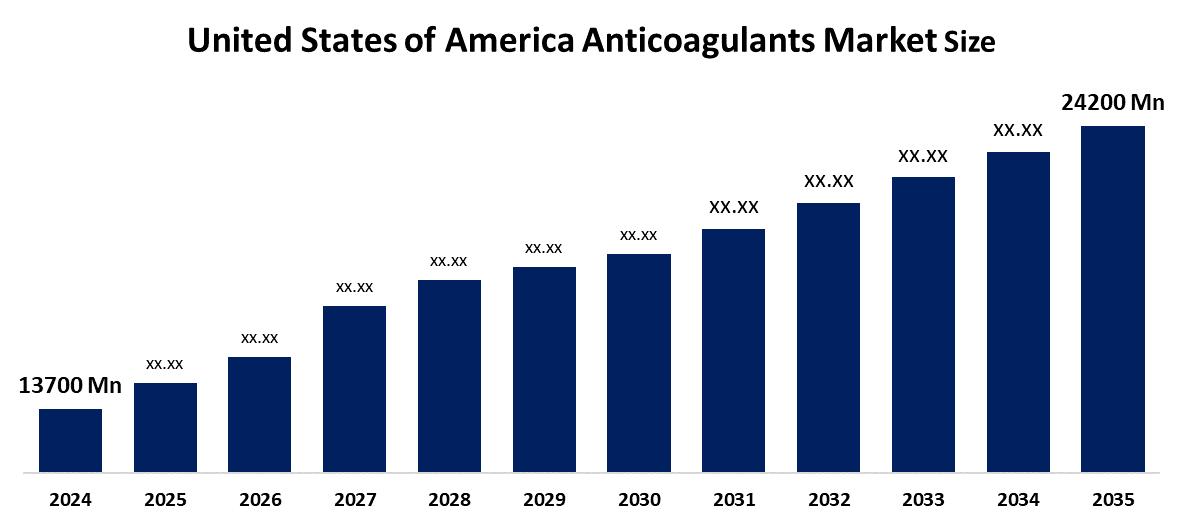
- The United States of America Anticoagulants Market Size Was Estimated at USD 13700 Million in 2024
- The Market Size is Expected to Grow at a CAGR of Around 5.31% from 2025 to 2035
- The United States of America Anticoagulants Market Size is Expected to Reach USD 24200 Million by 2035
Get more details on this report -
According to a research report published by Spherical Insights & Consulting, the United States of America Anticoagulants market size is anticipated to reach USD 24200 million by 2035, growing at a CAGR of 5.31% from 2025 to 2035. The market is driven by the rising prevalence of conditions such as obesity and cardiovascular ailments, innovation in the delivery systems of anticoagulants and government support through Medicare policies.
Market Overview
The United States of America anticoagulants market refers to therapies that inhibit blood coagulation to prevent life-threatening conditions like stroke, deep vein thrombosis, and pulmonary embolism. Landscape is defined by a decisive transition from traditional vitamin K antagonists toward Direct Oral Anticoagulants (DOACs), which offer more predictable pharmacological profiles.
Current innovations are pushing the boundaries of safety, specifically through the development of novel oral anticoagulants and specialised reversal agents designed to manage emergency bleeding. The market is primarily driven by a burgeoning geriatric demographic and the high prevalence of cardiovascular ailments such as atrial fibrillation. Growth is further bolstered by substantial government support, including NIH funding for vascular research and FDA expedited approval pathways that accelerate the entry of breakthrough molecules. Additionally, government incentives via the 21st Century Cures Act and expanded Medicare coverage for outpatient oral therapies have significantly enhanced patient accessibility and commercial viability. This synergy of regulatory backing, clinical advancement, and an increasing burden of chronic disease solidifies the U.S. as a dominant force in the global anticoagulation space.
Report Coverage
This research report categorises the market for the United States of America anticoagulants based on various segments and regions, and forecasts revenue growth and analyses trends in each submarket. The report analyses the key growth drivers, opportunities, and challenges influencing the United States of America Anticoagulants market. Recent market developments and competitive strategies, such as expansion, product launch, development, partnership, merger, and acquisition, have been included to draw the competitive landscape in the market. The report strategically identifies and profiles the key market players and analyses their core competencies in each sub-segment of the United States of America anticoagulants market.
United States of America Anticoagulants Market Report Coverage
| Report Coverage | Details |
|---|---|
| Base Year: | 2024 |
| Market Size in 2024: | USD 13700 Million |
| Forecast Period: | 2025-2035 |
| Forecast Period CAGR 2025-2035 : | 5.31% |
| 2035 Value Projection: | USD 24200 Million |
| Historical Data for: | 2020-2023 |
| No. of Pages: | 220 |
| Tables, Charts & Figures: | 89 |
| Segments covered: | By Application, By Drug Category, By Route of Administration |
| Companies covered:: | Bristol Myers Squibb, Pfizer, Bayer Pharmaceuticals, Boehringer Ingelheim, Daiichi Sankyo, Sanofi, Aspen Pharma USA, Amphastar Pharmaceuticals, Baxter International, Fresenius Kabi, Anthos Therapeutics, Covis Pharma, Ionis Pharmaceuticals, Aronara Therapeutics, and Others |
| Pitfalls & Challenges: | COVID-19 Impact, Challenges, Future, Growth, & Analysis |
Get more details on this report -
Driving Factors
The United States of America anticoagulants market is driven by an accelerating demographic shift toward an elderly population, which inherently faces a higher risk of cardiovascular complications such as atrial fibrillation and venous thromboembolism. The rising prevalence of chronic lifestyle conditions, including obesity and diabetes, acts as a persistent catalyst for long-term therapeutic demand. A significant driver is the clinical evolution from restrictive traditional therapies to Direct Oral Anticoagulants (DOACs), which offer superior patient compliance due to fixed dosing and the elimination of the need for frequent blood monitoring.
Furthermore, the industry is witnessing a surge in innovation centred on novel anticoagulants, which promise a decoupling of anti-thrombotic efficacy from bleeding risks, thereby expanding the treatable patient base. Regulatory momentum also plays a pivotal role; the FDA’s streamlined approval processes for novel molecules and specialised reversal agents provide a fertile environment for high-stakes R&D investment. Additionally, expanded healthcare access through Medicare and the integration of digital diagnostic tools such as wearable heart monitors that detect arrhythmias early have significantly increased the volume of pre-emptive prescriptions.
.
Restraining Factors
The anticoagulants market in United States of America is mostly constrained by the high cost of novel oral anticoagulants (NOACs), the looming patent expirations for major blockbusters, the clinical risk of major bleeding complications, rigorous safety and monitoring standards for high-alert medications, and pricing pressures from the Inflation Reduction Act, which mandates government-led price negotiations and creates unpredictable reimbursement patterns for pharmaceutical manufacturers.
Market Segmentation
The United States of America anticoagulants market share is classified into application, drug category and route of administration.
- The atrial fibrillation/myocardial infarction (heart attack) segment accounted for the largest revenue market share in 2024 and is expected to grow at a significant CAGR during the forecast period.
The United States of America Anticoagulants market is segmented by application into atrial fibrillation/myocardial infarction (heart attack), deep vein thrombosis, pulmonary embolism, and others. Among these, the atrial fibrillation/myocardial infarction (heart attack) segment accounted for the largest revenue market share in 2024 and is expected to grow at a significant CAGR during the forecast period. This is due to the ageing U.S. population, which has led to a surge in AF cases, necessitating long-term, daily thromboprophylaxis.
- The novel anticoagulants (NOACs) segment dominated the share in 2024 and is anticipated to grow at a remarkable CAGR during the forecast period.
Based on the drug category, the United States of America anticoagulants market is segmented into vitamin K antagonists, direct thrombin inhibitors, novel oral anticoagulants (NOACs), heparin, and others. Among these, the novel anticoagulants (NOACs) segment dominated the share in 2024 and is anticipated to grow at a remarkable CAGR during the forecast period. This dominance is attributed to their superior pharmacological profile compared to traditional Vitamin K Antagonists (like Warfarin), as they eliminate the need for constant international normalised ratio (INR) blood monitoring and have fewer dietary interactions.
- The oral anticoagulants segment accounted for the largest revenue market share in 2024 and is expected to grow at a significant CAGR during the forecast period.
The United States of America Anticoagulants market is segmented by route of administration into oral anticoagulants and injectable anticoagulants. Among these, the oral anticoagulants segment accounted for the largest revenue market share in 2024 and is expected to grow at a significant CAGR during the forecast period. Because of the convenience in outpatient settings, high patient adherence rates, and the non-invasive nature.
Competitive Analysis:
The report offers the appropriate analysis of the key organisations/companies involved within the United States of America Anticoagulants market, along with a comparative evaluation primarily based on their product offering, business overviews, geographic presence, enterprise strategies, segment market share, and SWOT analysis. The report also provides an elaborate analysis focusing on the current news and developments of the companies, which includes product development, innovations, joint ventures, partnerships, mergers & acquisitions, strategic alliances, and others. This allows for the evaluation of the overall competition within the market.
List of Key Companies
- Bristol Myers Squibb
- Pfizer
- Bayer Pharmaceuticals
- Boehringer Ingelheim
- Daiichi Sankyo
- Sanofi
- Aspen Pharma USA
- Amphastar Pharmaceuticals
- Baxter International
- Fresenius Kabi
- Anthos Therapeutics
- Covis Pharma
- Ionis Pharmaceuticals
- Aronara Therapeutics
- Others
Key Target Audience
- Market Players
- Investors
- End-users
- Government Authorities
- Consulting and Research Firm
- Venture capitalists
- Value-Added Resellers (VARs)
Recent Developments:
- In April 2025, Bristol Myers Squibb launched Eliquis Sprinkle, an oral suspension formulation of apixaban s designed for use in paediatric patients (from birth to <18 years) for the treatment of venous thromboembolism (VTE) and reduction in the risk of recurrent VTE, as well as for patients (including geriatric populations) who have difficulty swallowing tablets.
Market Segment
This study forecasts revenue at the United States, regional, and country levels from 2020 to 2035. Spherical Insights has segmented the United States of America Anticoagulants market based on the below-mentioned segments:
United States of America Anticoagulants Market, By Application
- Atrial Fibrillation/Myocardial Infarction (Heart Attack)
- Deep Vein Thrombosis
- Pulmonary Embolism
- Others
United States of America Anticoagulants Market, By Drug Category
- Vitamin K Antagonists,
- Direct Thrombin Inhibitors
- Novel Oral Anticoagulants (NOACs)
- Heparin
- Others
United States of America Anticoagulants Market, By Route of Administration
- Oral Anticoagulants
- Injectable Anticoagulants
Frequently Asked Questions (FAQ)
-
What is the projected market size and growth rate for the U.S. Anticoagulants market?The market size was estimated at USD 13,700 million in 2024 and is projected to reach USD 24,200 million by 2035. This represents a steady growth at a Compound Annual Growth Rate (CAGR) of 5.31% during the forecast period from 2025 to 2035.
-
Which drug category is currently dominant?The Novel Oral Anticoagulants (NOACs) segment dominated the market share in 2024. Due to their superior pharmacological profile, lack of required INR blood monitoring, and fewer dietary restrictions.
-
Which application segment holds the largest revenue share in the U.S. market?The Atrial Fibrillation (AF) / Myocardial Infarction (Heart Attack) segment accounted for the largest revenue share in 2024. Growth in this segment is fuelled by the aging U.S. population and a corresponding surge in AF cases that require long-term, daily preventative therapy.
-
Why is the oral route of administration preferred over injectable anticoagulants?The oral segment is the dominant delivery method because of its convenience in outpatient settings, high rates of patient adherence, and its non-invasive nature compared to injections. It allows patients to manage chronic conditions at home without frequent clinical intervention.
-
What are the primary factors driving the expansion of this market?Key drivers include: An accelerating demographic shift toward an elderly population at higher risk for stroke and VTE. Rising prevalence of chronic lifestyle conditions like obesity and diabetes. Government support, specifically through the 21st Century Cures Act and expanded Medicare coverage. Technological integration of digital diagnostic tools, such as wearable heart monitors.
-
What are the major challenges or restraining factors for market players?The market is primarily constrained by the high cost of NOACs, the looming patent expirations of blockbuster drugs, and the inherent clinical risk of bleeding complications. Additionally, the Inflation Reduction Act introduces pricing pressures through government-led price negotiations.
Need help to buy this report?