United States Hydrogen Generation Market Size, Share, and COVID-19 Impact Analysis, By System Type (Merchant and Captive), By Application (Methanol Production, Ammonia Production, Petroleum Refinery, Transportation, Power Generation, and Others), By Technology (Coal Gasification, Steam Methane Reforming, and Others), and United States Hydrogen Generation Market Insights, Industry Trend, Forecasts to 2035
Industry: Energy & Power
United States Hydrogen Generation Market Insights Forecasts to 2035
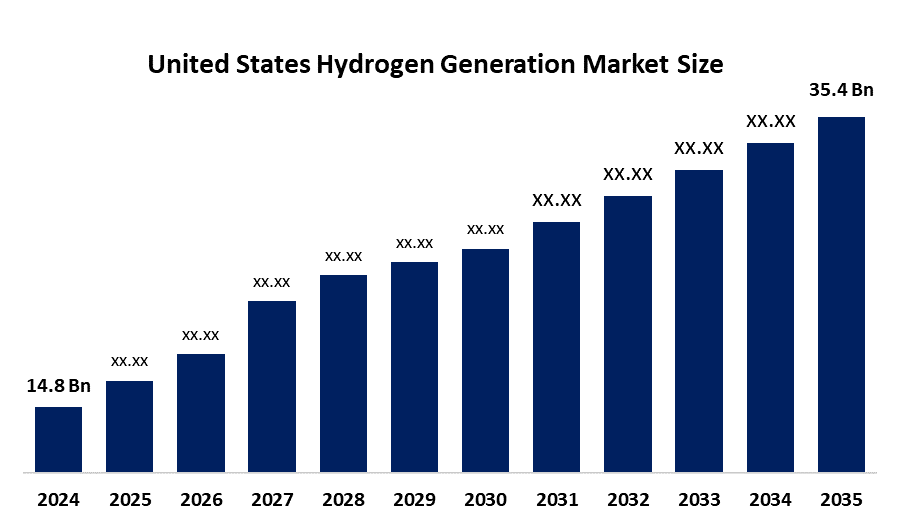
- The United States Hydrogen Generation Market Size Was Estimated at USD 14.8 Billion in 2024
- The Market Size is Expected to Grow at a CAGR of Around 8.2% from 2025 to 2035
- The United States Hydrogen Generation Market Size is Expected to Reach USD 35.4 Billion by 2035
Get more details on this report -
According to a research report published by Spherical Insights & Consulting, The United States Hydrogen Generation Market Size is anticipated to reach USD 35.4 Billion by 2035, Growing at a CAGR of 8.2% from 2025 to 2035. The United States hydrogen generation market is driven by increasing demand for clean energy, expanding hydrogen use in petroleum refining and ammonia production, government incentives for low-carbon hydrogen, and rising investments in hydrogen infrastructure and fuel cell technologies.
Market Overview
The United States hydrogen generation market refers to the industry that produces, stores, and distributes hydrogen gas that functions as an energy carrier and industrial feedstock. Hydrogen production occurs through three primary methods which include steam methane reforming and coal gasification and electrolysis, while hydrogen serves multiple purposes in petroleum refining and ammonia production and methanol production and power generation and transportation. The market operates under the effect of three different forces, which include industrial demand, energy transition policies, environmental regulations, and technological advancements in hydrogen production technologies. The hydrogen generation infrastructure development in the United States experiences rapid growth because organizations focus on decarbonization and the public demands clean hydrogen solutions. The market expansion occurs because hydrogen demand in refining and chemical industries increases while hydrogen fuel cell vehicle market grows and government agencies support green hydrogen projects and investments in renewable hydrogen production technologies rise.
The United States Hydrogen Generation market is witnessing three key trends which will determine its future development. The first trend shows an increase in hydrogen production through electrolysis which uses renewable energy sources, such as solar and wind power, to produce hydrogen. The hydrogen sector benefits from infrastructure development which includes pipelines, storage facilities, and refueling stations to help advance hydrogen usage in both transportation and industrial applications. The third area of study investigates how new technologies in hydrogen production and carbon capture systems improve
The government of the United States has been supportive of the hydrogen generation market by implementing policies and providing funding and infrastructure development programs to promote clean energy and reduce carbon emissions. Moreover, investments in hydrogen hubs, renewable hydrogen, and R&D are helping to promote hydrogen as a clean and renewable form of energy. Technologies such as advanced electrolysis, carbon capture and store, and digital technologies are being integrated to optimize hydrogen production and reduce environmental impact.
Report Coverage
This research report categorizes the market for the United States hydrogen generation market based on various segments and regions, and forecasts revenue growth and analyses trends in each submarket. The report analyses the key growth drivers, opportunities, and challenges influencing the United States hydrogen generation market. Recent market developments and competitive strategies, such as expansion, product launch, development, partnership, merger, and acquisition have been included to draw the competitive landscape in the market. The report strategically identifies and profiles the key market players and analyses their core competencies in each sub-segment of the United States hydrogen generation market.
United States Hydrogen Generation Market Report Coverage
| Report Coverage | Details |
|---|---|
| Base Year: | 2024 |
| Market Size in 2024: | USD 14.8 Billion |
| Forecast Period: | 2024-2035 |
| Forecast Period CAGR 2024-2035 : | 8.2% |
| 2035 Value Projection: | USD 35.4 Billion |
| Historical Data for: | 2020-2023 |
| No. of Pages: | 240 |
| Tables, Charts & Figures: | 105 |
| Segments covered: | By Type, By Application |
| Companies covered:: | Air Products and Chemicals Inc., Linde plc, Air Liquide, Plug Power Inc., Cummins Inc., ExxonMobil Corporation, Chevron Corporation, Bloom Energy, Others, and Key Players. |
| Pitfalls & Challenges: | COVID-19 Empact, Challenge, Future, Growth, & Analysis |
Get more details on this report -
Driving Factors
The United States hydrogen generation market is primarily driven by the increasing demand for clean and sustainable forms of energy. Hydrogen is commonly used in petroleum refining processes and ammonia production, which are considered key hydrogen generation applications in the country. The increasing support from the government for low-carbon hydrogen production, hydrogen fuel cell technology, and the integration of renewable energy is also contributing to the hydrogen generation market's growth. Furthermore, the increasing hydrogen infrastructure, hydrogen fuel cell vehicles, and investments in green hydrogen are fueling the hydrogen generation market's growth in the United States are accelerating the growth of the hydrogen generation market in the United States.
Restraining Factors
The United States hydrogen generation market has restraints in terms of the cost of technology used in the production of hydrogen, especially in green hydrogen production through electrolysis technology. Moreover, limited infrastructures in hydrogen handling and storage, coupled with high investment costs in infrastructure, may be restraints to the US hydrogen generation market growth. The price volatility of natural gas and the complexity involved in transporting and distributing hydrogen may also be restraints to the growth of the US hydrogen generation market.
Market Segmentation
The United States hydrogen generation market share is classified into system type, application, and technology.
- The merchant segment accounted for the largest revenue market in 2024 and is expected to grow at a significant CAGR during the forecast period.
The United States hydrogen generation market is segmented by system type into merchant and captive. Among these, the merchant segment accounted for the largest revenue market in 2024 and is expected to grow at a significant CAGR during the forecast period. The dominance can be attributed to the rising demand for external hydrogen supply in different sectors such as petroleum refining, chemicals, and electronics. Merchant hydrogen production enables large industrial users to purchase hydrogen directly from the supply, thus eliminating the need to install in-house hydrogen production facilities to ensure a constant and uninterrupted hydrogen supply.
- The petroleum refinery segment accounted for the largest share in 2024 and is expected to grow at a significant CAGR during the forecast period.
The United States hydrogen generation market is segmented by application into methanol production, ammonia production, petroleum refinery, transportation, power generation, and others. Among these, the petroleum refinery segment accounted for the largest share in 2024 and is expected to grow at a significant CAGR during the forecast period. Hydrogen has been largely utilized in refining activities like hydrocracking to remove impurities like sulfur from crude oil, thus creating cleaner fuels in line with environmental regulations. The presence of refining facilities in the United States boosts the need for hydrogen in this field.
- The steam methane reforming segment accounted for the largest share in 2024 and is expected to grow at a significant CAGR during the forecast period.
The United States hydrogen generation market is segmented by technology into coal gasification, steam methane reforming, and others. Among these, the steam methane reforming segment accounted for the largest share in 2024 and is expected to grow at a significant CAGR during the forecast period. The most commonly used technology for producing hydrogen is SMR, as it is a cost-effective technology for producing hydrogen. In SMR technology, hydrogen is produced from natural gas on a large scale at a lower production cost. Therefore, SMR technology is used in most of the hydrogen production plants in the United States.
Competitive Analysis:
The report offers the appropriate analysis of the key organizations/companies involved within the United States hydrogen generation market, along with a comparative evaluation primarily based on their product offering, business overviews, geographic presence, enterprise strategies, segment market share, and SWOT analysis. The report also provides an elaborate analysis focusing on the current news and developments of the companies, which includes product development, innovations, joint ventures, partnerships, mergers & acquisitions, strategic alliances, and others. This allows for the evaluation of the overall competition within the market.
List of Key Companies
- Air Products and Chemicals Inc.
- Linde plc
- Air Liquide
- Plug Power Inc.
- Cummins Inc.
- ExxonMobil Corporation
- Chevron Corporation
- Bloom Energy
- Others
Key Target Audience
- Market Players
- Investors
- End-users
- Government Authorities
- Consulting and Research Firm
- Venture capitalists
- Value-Added Resellers (VARs)
Recent Developments:
In March 2024, the U.S. Department of Energy announced funding for several regional hydrogen hubs aimed at accelerating clean hydrogen production, infrastructure development, and commercialization across the United States, supporting the country’s transition to a low-carbon energy system.
Market Segment
This study forecasts revenue at the United States, regional, and country levels from 2020 to 2035. Spherical Insights has segmented the United States hydrogen generation market based on the below-mentioned segments:
United States Hydrogen Generation Market, By System Type
- Merchant
- Captive
United States Hydrogen Generation Market, By Application
- Methanol Production
- Ammonia Production
- Petroleum Refinery
- Transportation
- Power Generation
- Others
United States Hydrogen Generation Market, By Technology
- Coal Gasification
- Steam Methane Reforming
- Others
Frequently Asked Questions (FAQ)
-
1. What is the United States hydrogen generation market?The United States hydrogen generation market refers to the industry involved in the production, supply, and distribution of hydrogen gas used for industrial, transportation, and energy applications.
-
2. What is the United States hydrogen generation market size?United States hydrogen generation market size is expected to grow from USD 14.8 billion in 2024 to USD 35.4 billion by 2035, growing at a CAGR of 8.2% during the forecast period 2025-2035.
-
3. What are the key drivers of the United States hydrogen generation market?The market is driven by growing demand for clean energy, government support for hydrogen projects, expansion of hydrogen infrastructure, and increasing use of hydrogen in refining and chemical industries.
-
4. Which application dominates the United States hydrogen generation market?Petroleum refinery applications currently dominate due to the extensive use of hydrogen in refining processes.
-
5. What are the major trends in the United States hydrogen generation market?Key trends include growth of green hydrogen production, expansion of hydrogen infrastructure, and increasing adoption of hydrogen fuel cell technologies.
-
6. Who are the key companies operating in the United States hydrogen generation market?Major players include Air Products, Linde plc, Air Liquide, Plug Power, Cummins, ExxonMobil, and Chevron.
-
7. What is the future outlook for the United States hydrogen generation market?The market is expected to grow steadily due to increasing demand for clean energy, government incentives for hydrogen production, and technological advancements in hydrogen generation technologies.
Need help to buy this report?