United States Home Appliance Market Size, Share, and COVID-19 Impact Analysis, By Type (Major Appliances (Refrigeration Equipment, Cooking Appliances, Washing & Drying Equipment, Heating & Cooling Appliances, Others), Small Appliances (Coffee makers, Food Processors, Humidifiers, Microwave Ovens, Others), and Smart Home Appliances), By Distribution Channel (Supermarkets & Hypermarkets, Specialty Stores, Online/E-Commerce, and Others), and United States Home Appliance Market Insights, Industry Trend, Forecasts to 2035
Industry: Consumer Goods
United States Home Appliance Market Insights Forecasts to 2035
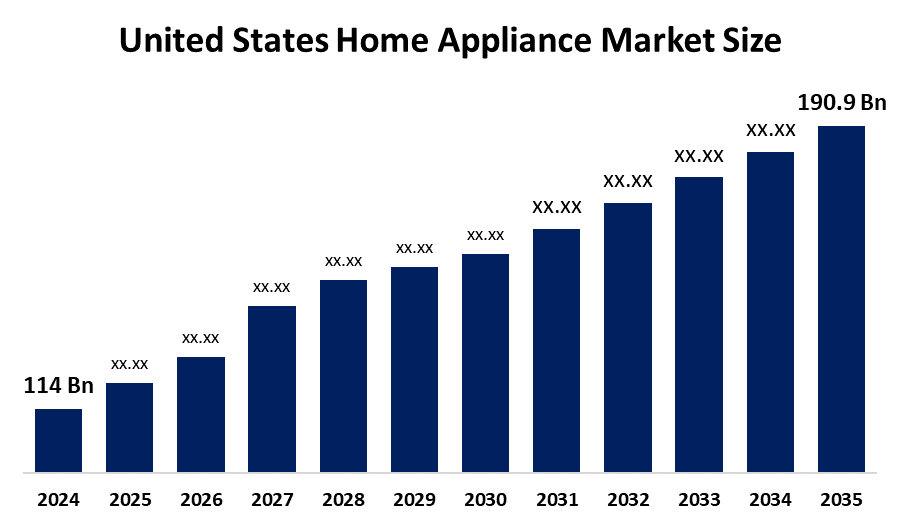
- The United States Home Appliance Market Size Was Estimated at USD 114 Billion in 2024
- The Market Size is Expected to Grow at a CAGR of Around 4.8% from 2025 to 2035
- The United States Home Appliance Market Size is Expected to Reach USD 190.9 Billion by 2035
Get more details on this report -
According to a research report published by Spherical Insights & Consulting, The United States Home Appliance Market Size Is Anticipated To Reach USD 190.9 Billion By 2035, Growing At A CAGR Of 4.8% From 2025 To 2035. The United States Home Appliance market is driven by the increasing urbanization, rising disposable income, growing demand for energy-efficient appliances, and the rapid adoption of smart home technologies.
Market Overview
The United States Home Appliance Market refers to the industry involved in the manufacturing distribution and sale of electrical and mechanical devices used for household functions such as cooking cleaning refrigeration heating and cooling. The market includes major appliances small appliances and smart connected devices integrated with IoT technology. The market growth is supported by increasing housing construction home renovation trends rising consumer preference for premium and energy-efficient appliances and technological advancements such as AI-enabled smart appliances.
The United States home appliance market is witnessing three key trends that will determine its future development. Consumers are increasingly adopting Wi-Fi-enabled and AI-powered appliances that work with smart home systems including Amazon Alexa and Google Assistant and smart hubs. The demand for ENERGY STAR-certified appliances is growing because the U.S. Department of Energy has established regulations to support ENERGY STAR certification. Online platforms like Amazon and direct-to-consumer brand websites are transforming appliance distribution. Consumers are choosing high-end kitchen appliances and modular home solutions.
The U.S. Department of Energy (DOE) established energy efficiency regulations for appliances to help reduce energy usage and minimize environmental damage. These standards encourage manufacturers to design products that comply with ENERGY STAR guidelines and federal conservation requirements. The federal and state governments provide tax credits and rebate programs to encourage people to use energy-efficient and smart appliances. The United States home appliance industry develops product innovations through sustainability regulations and carbon emission reduction regulations which also establish long-term market growth.
Report Coverage
This research report categorizes the market for the United States home appliance market based on various segments and regions, and forecasts revenue growth and analyses trends in each submarket. The report analyses the key growth drivers, opportunities, and challenges influencing the United States home appliance market. Recent market developments and competitive strategies, such as expansion, product launch, development, partnership, merger, and acquisition, have been included to draw the competitive landscape in the market. The report strategically identifies and profiles the key market players and analyses their core competencies in each sub-segment of the United States Home appliance market.
United States Home Appliance Market Report Coverage
| Report Coverage | Details |
|---|---|
| Base Year: | 2024 |
| Market Size in 2024: | USD 114 Billion |
| Forecast Period: | 2025-2035 |
| Forecast Period CAGR 2025-2035 : | 4.8% |
| 2035 Value Projection: | USD 190.9 Billion |
| Historical Data for: | 2020-2023 |
| No. of Pages: | 210 |
| Tables, Charts & Figures: | 99 |
| Segments covered: | By Type, By Distribution Channel |
| Companies covered:: | Whirlpool Corporation, GE Appliances, Samsung Electronics, LG Electronics, Electrolux North America, BSH Home Appliances, Others |
| Pitfalls & Challenges: | Covid 19 Impact Challanges, Future, Growth and Analysis |
Get more details on this report -
Driving Factors
The United States home appliance market is primarily driven by Increasing disposable income, which allows consumers to spend on high-quality and technologically advanced appliances. Rapid urbanization and constant development of housing units further fuel the demand for necessary household appliances, especially in newly developed residential units. The increasing trend of smart home ecosystems has substantially fuelled the demand for connected appliances with AI and IoT technology. Moreover, increasing consumer awareness about energy efficiency and sustainability is encouraging the purchase of energy star-certified appliances. Technological advancements such as artificial intelligence, automation, and IoT-based remote monitoring are further improving the functionality of appliances. Moreover, replacement demand for old appliances is steadily fueling the growth of the market.
Restraining Factors
However, despite the steady growth, the market does have some limitations. The raw material prices, especially steel and aluminium, keep fluctuating, thereby increasing the cost of production. The supply chain disruptions might cause delays in the production and distribution process. The premium smart appliance with a high price point hinders adoption in the market.
Market Segmentation
The United States home appliance market share is classified into type and vessel type.
- The major appliances segment accounted for the largest revenue market in 2024 and is expected to grow at a significant CAGR during the forecast period.
The United States home appliance market is segmented by type into major appliances (refrigeration equipment, cooking appliances, washing & drying equipment, heating & cooling appliances, others), small appliances (coffee makers, food processors, humidifiers, microwave ovens, others), and smart home appliances. Among these, the major appliances segment accounted for the largest revenue market in 2024 and is expected to grow at a significant CAGR during the forecast period. The dominance of this segment is driven by the demand for high-value products such as refrigerators, washing machines, air conditioners, and cooking appliances. These products are considered essential household appliances and have a higher price point compared to small appliances. Moreover, the rise in residential construction and renovation activities also supports this segment. However, smart home appliances are expected to register the fastest growth rate, driven by the adoption of AI and IoT.
- The supermarkets & hypermarkets segment accounted for the largest share in 2024 and is expected to grow at a significant CAGR during the forecast period.
The United States home appliance market is segmented by distribution channel into supermarkets & hypermarkets, specialty stores, online/e-commerce, and others. Among these, the supermarkets & hypermarkets segment accounted for the largest share in 2024 and is expected to grow at a significant CAGR during the forecast period. The dominance of the as consumers prefer product demonstration, consultation, installation, and services for high-priced appliances. However, the online/e-commerce segment is the fastest-growing segment due to increased digital penetration, attractive discounts, easy comparison of products, flexible payment terms, and delivery services. The increased growth of Amazon is also adding to the growth of online sales.
Competitive Analysis:
The report offers the appropriate analysis of the key organizations/companies involved within the United States home appliance market, along with a comparative evaluation primarily based on their product offering, business overviews, geographic presence, enterprise strategies, segment market share, and SWOT analysis. The report also provides an elaborate analysis focusing on the current news and developments of the companies, which includes product development, innovations, joint ventures, partnerships, mergers & acquisitions, strategic alliances, and others. This allows for the evaluation of the overall competition within the market.
List of Key Companies
- Whirlpool Corporation
- GE Appliances
- Samsung Electronics
- LG Electronics
- Electrolux North America
- BSH Home Appliances
- Others
Key Target Audience
- Market Players
- Investors
- End-users
- Government Authorities
- Consulting and Research Firm
- Venture capitalists
- Value-Added Resellers (VARs)
Recent Developments:
In February 2025, the United States department of energy (DOE) suspended seven major energy efficiency mandates for appliances, including certain washers and water heaters, allowing manufacturers more flexibility.
In March 2025, Samsungs bespoke AI lineup was launched in the U.S. market, featuring AI Vision Inside technology that uses cameras to track up to 50 food items in refrigerators.
Market Segment
This study forecasts revenue at the United States, regional, and country levels from 2020 to 2035. Spherical Insights has segmented the United States home appliance market based on the below-mentioned segments:
United States Home Appliance Market, By Type
- Major Appliances
- Refrigeration Equipment
- Cooking Appliances
- Washing & Drying Equipment
- Heating & Cooling Appliances
- Others
- Small Appliances
- Coffee makers
- Food Processors
- Humidifiers
- Microwave Ovens
- Others
- Smart Home Appliances
United States Home Appliance Market, By Distribution Channel
- Supermarkets & Hypermarkets
- Specialty Stores
- Online/E-Commerce,
- Others
Frequently Asked Questions (FAQ)
-
1. What is the United States home appliance market?It refers to the industry involved in manufacturing, distributing, and selling household electrical appliances across the United States.
-
2. What is the United States home appliance market size?United States home appliance market size is expected to grow from USD 114 billion in 2024 to USD 190.9 billion by 2035, growing at a CAGR of 4.8% during the forecast period 2025-2035.
-
3. What are the key drivers of the United States home appliance market?Urbanization, smart home adoption, rising disposable income, and energy efficiency demand.
-
4. Who are the key companies operating in the United States home appliance market?Major players include Whirlpool Corporation, GE Appliances, Samsung Electronics, LG Electronics, Electrolux North America, and BSH Home Appliances
-
5. What is the future outlook for the United States home appliance market?The market is expected to grow steadily due to technological innovation, premiumization trends, and expanding online retail channels.
Need help to buy this report?