United States Digital Twin Market Size, Share, and COVID-19 Impact Analysis, By Type (Parts Twin, Product Twin, Process Twin, and System Twin), By Application (Predictive Maintenance, Business Optimization, Product Design & Development, and Others), and United States Digital Twin Market Insights, Industry Trend, Forecasts to 2035
Industry: Electronics, ICT & Media
United States Digital Twin Market Insights Forecasts to 2035
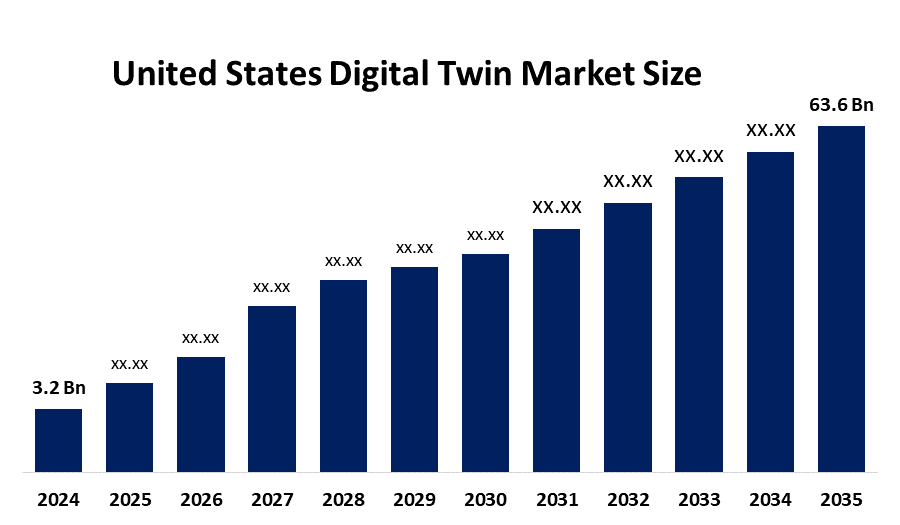
- The United States Digital Twin Market Size Was Estimated at USD 3.2 Billion in 2024
- The Market Size is Expected to Grow at a CAGR of Around 31.2% from 2025 to 2035
- The United States Digital Twin Market Size is Expected to Reach USD 63.6 Billion by 2035
Get more details on this report -
According to a research report published by Spherical Insights & Consulting, the United States Digital Twin market size is anticipated to reach USD 63.6 billion by 2035, growing at a CAGR of 31.2% from 2025 to 2035. The United States digital twin market is driven by increasing adoption of Industry 4.0 technologies, rising demand for predictive maintenance, expansion of smart manufacturing facilities, and integration of IoT and AI across industrial operations.
Market Overview
The United States digital twin market refers to the industry that focuses on creating a digital replica of a real physical asset and operational system and its processes using real-time data, sensor information, and artificial intelligence and simulation technologies. Digital twins help organizations monitor their operational performance while predicting equipment failures, creating their operational systems, and managing their product development process. The industry is growing at a fast rate due to the adoption of the technology by the manufacturing and energy and utilities, automotive and aerospace, healthcare, and smart infrastructure industries. The industrial automation industry and the smart factory industry together form a huge demand for digital twin platforms.
The United States digital twin market currently experiences various important market developments which will determine its future growth path. The use of predictive maintenance is gaining momentum at a rapid pace as organizations are attempting to reduce downtime and maintenance costs by real-time monitoring and analysis. The combination of AI, IoT, and cloud technology is making real-time simulation and decision-making easier. The application of digital twins in smart cities, renewable energy, and infrastructure projects is gaining momentum. Government initiatives in smart manufacturing and digital infrastructure development and Industry 4.0 implementation drive the market expansion.
Government initiatives in advanced manufacturing and industrial automation and modernization of domestic production existing today drive organizations to implement digital twin technology. The development of 5G connectivity and smart infrastructure and secure cloud infrastructure enables organizations to conduct real-time data integration and simulation activities.
Report Coverage
This research report categorizes the market for the United States digital twin market based on various segments and regions, and forecasts revenue growth and analyses trends in each submarket. The report analyses the key growth drivers, opportunities, and challenges influencing the United States digital twin market. Recent market developments and competitive strategies, such as expansion, product launch, development, partnership, merger, and acquisition, have been included to draw the competitive landscape in the market. The report strategically identifies and profiles the key market players and analyses their core competencies in each sub-segment of the United States digital twin market.
United States Digital Twin Market Report Coverage
| Report Coverage | Details |
|---|---|
| Base Year: | 2024 |
| Market Size in 2024: | USD 3.2 Billion |
| Forecast Period: | 2025-2035 |
| Forecast Period CAGR 2025-2035 : | CAGR of 31.2% |
| 2035 Value Projection: | USD 63.6 Billion |
| Historical Data for: | 2020-2023 |
| No. of Pages: | 210 |
| Tables, Charts & Figures: | 95 |
| Segments covered: | By Type, By Application |
| Companies covered:: | Microsoft Corporation, General Electric, PTC Inc., Ansys, Inc., Autodesk, Inc., IBM Corporation, Bentley Systems, Inc., Oracle Corporation, and Key Players |
| Pitfalls & Challenges: | COVID-19 Empact, Challenge, Future, Growth, & Analysis |
Get more details on this report -
Driving Factors
The digital twin market in the United States relies on the increasing adoption of smart manufacturing systems and Industry 4.0 solutions. Organizations adopt digital twin solutions because they need improved predictive maintenance and operational efficiency. The market grows as organizations invest in IoT sensors along with systems that offer continuous monitoring solutions. The market grows as organizations invest in intelligent infrastructure, equipment for renewable energy monitoring, and Internet of Things (IoT) devices. The market grows as organizations invest in artificial intelligence along with cloud computing solutions. Organizations invest in digital twin solutions because they need advanced analytics along with digital twin solutions that offer remote asset management and scalable system growth.
Restraining Factors
The United States digital twin market is restrained by the high initial investment costs and the complexity of integrating with existing systems. Concerns over data security and privacy for cloud-based solutions limit adoption. The lack of skilled workers along with interoperability issues between various systems hinder organizations from undertaking their operations to their fullest potential.
Market Segmentation
The United States digital twin market share is classified into type and application.
- The product twin segment accounted for the largest revenue market in 2024 and is expected to grow at a significant CAGR during the forecast period.
The United States digital twin market is segmented by type into parts twin, product twin, process twin, and system twin. Among these, the product twin segment accounted for the largest revenue market in 2024 and is expected to grow at a significant CAGR during the forecast period. it is used throughout the entire life cycle of the product. Before a product is manufactured, a digital twin of the product is created to test the performance of the product. The automotive industry, aerospace industry, electronics industry, and other industries rely heavily on digital twins to launch products quickly and improve product quality.
- The predictive maintenance segment accounted for the largest share in 2024 and is expected to grow at a significant CAGR during the forecast period.
The United States digital twin market is segmented by application into predictive maintenance, business optimization, product design & development, and others. Among these, the predictive maintenance segment accounted for the largest share in 2024 and is expected to grow at a significant CAGR during the forecast period. Predictive maintenance is the market driver since digital twins enable real-time monitoring and prediction of when the equipment could fail. This allows industries to avoid unexpected downtime, lower the cost of maintenance, and optimize efficiency. Since digital twins can make equipment reliable and extend its life, it is easy for organizations to see the return on investment.
Competitive Analysis:
The report offers the appropriate analysis of the key organizations/companies involved within the United States digital twin market, along with a comparative evaluation primarily based on their product offering, business overviews, geographic presence, enterprise strategies, segment market share, and SWOT analysis. The report also provides an elaborate analysis focusing on the current news and developments of the companies, which includes product development, innovations, joint ventures, partnerships, mergers & acquisitions, strategic alliances, and others. This allows for the evaluation of the overall competition within the market.
List of Key Companies
- Microsoft Corporation
- General Electric
- PTC Inc.
- Ansys, Inc.
- Autodesk, Inc.
- IBM Corporation
- Bentley Systems, Inc.
- Oracle Corporation
Key Target Audience
- Market Players
- Investors
- End-users
- Government Authorities
- Consulting and Research Firm
- Venture capitalists
- Value-Added Resellers (VARs)
Recent Developments:
In March 2025, Emerson strengthened its industrial automation and simulation portfolio and improved digital twin capabilities across the energy and process industries by completing the integration of AspenTech.
In January 2025, Siemens and NVIDIA extended their partnership to allow digital twin environments and AI-powered industrial simulation for smart manufacturing and factory optimisation.
Market Segment
This study forecasts revenue at the United States, regional, and country levels from 2020 to 2035. Spherical Insights has segmented the United States digital twin market based on the below-mentioned segments:
United States Digital Twin Market, By Type
- Parts Twin
- Product Twin
- Process Twin
- System Twin
United States Digital Twin Market, By Application
- Predictive Maintenance
- Business Optimization
- Product Design & Development
- Others
Frequently Asked Questions (FAQ)
-
1. What is the United States digital twin market?The market involves technologies that create virtual replicas of physical assets, systems, or processes using IoT, AI, and simulation to monitor performance, predict failures, and optimize operations across industries.
-
2. What is the United States digital twin market size?United States Digital Twin market size is expected to grow from USD 3.2 billion in 2024 to USD 63.6 billion by 2035, growing at a CAGR of 31.2% during the forecast period 2025–2035.
-
3. What are the key drivers of the United States digital twin market?Industry 4.0 adoption, smart manufacturing expansion, predictive maintenance demand, IoT sensor deployment, and integration of AI and cloud technologies.
-
4. Which segment dominates the United States digital twin market?Product Twin dominates by type, and Predictive Maintenance dominates by application.
-
5. What are the major trends in the United States digital twin market?AI-integrated simulations, real-time monitoring, smart infrastructure adoption, and digital twin use in energy and manufacturing optimization.
-
6. Who are the key companies operating in the United States digital twin market?Major players include Microsoft, General Electric, PTC, Ansys, Autodesk, IBM, Bentley Systems, and Oracle
-
7. What is the future outlook for the United States digital twin market?The market is expected to grow rapidly through 2035 due to increasing automation, industrial digitalization, and the adoption of smart factories and connected infrastructure.
Need help to buy this report?