United States AI in Retail Market Size, Share, and COVID-19 Impact Analysis, By Component (Solution and Services), By Technology (Machine Learning, Natural Language Processing, Chatbots, Image & Video Analytics, and Swarm Intelligence), and United States AI in Retail Market Insights, Industry Trend, Forecasts to 2035
Industry: Information & Technology
United States AI in Retail Market Insights Forecasts to 2035
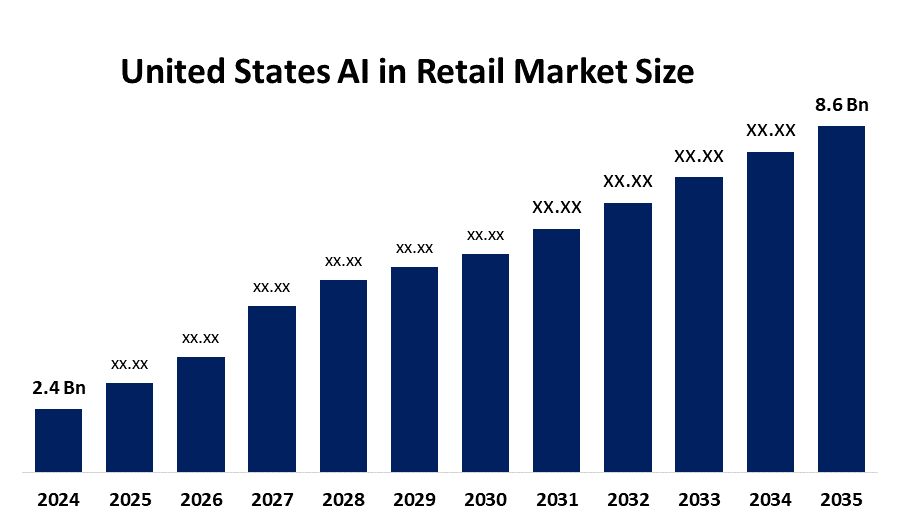
- The United States AI in Retail Market Size Was Estimated at USD 2.4 Billion in 2024
- The Market Size is Expected to Grow at a CAGR of Around 12.3% from 2025 to 2035
- The United States AI in Retail Market Size is Expected to Reach USD 8.6 Billion by 2035
Get more details on this report -
According to a research report published by Spherical Insights & Consulting, The United States Ai In Retail Market Size is anticipated to reach USD 8.6 Billion by 2035, Growing at a CAGR of 12.3% from 2025 to 2035. The United States ai in retail market is driven by the increasing adoption of advanced analytics, rising demand for personalized shopping experiences, growth in e-commerce platforms, and the need for retailers to improve operational efficiency and inventory management.
Market Overview
The United States ai in retail market refers to the use of artificial intelligence technologies which retailers implement to enhance their customer service and supply chain operations and pricing methods and business automation procedures. AI solutions which include machine learning and natural language processing and computer vision and predictive analytics are used to study consumer behavior and predict future product demand and create customized marketing campaigns. Retailers are increasingly adopting AI- powered tools which include recommendation engines and virtual assistants and smart inventory systems and automated checkout technologies to enhance their operational performance and market position.
The United States ai in retail market is witnessing three key trends which are driving its development into the future. First, retailers are increasingly implementing AI-driven recommendation systems which provide personalized product suggestions based on consumer behavior and purchase history. Second, computer vision and image analytics technologies are being used for automated checkout systems, store surveillance, and shelf monitoring to improve operational efficiency. AI-powered chatbots together with virtual assistants are changing customer service through their capacity to deliver instant support while enhancing customer interactions throughout both online and physical retail environments.
The United States government supports artificial intelligence development through its investments in digital infrastructure and research programs and technology innovation initiatives. The government through its digital transformation policies and smart retail technology policies encourages retailers to implement artificial intelligence solutions which will improve their business performance. The collaboration between technology companies and retail organizations results in faster development of advanced artificial intelligence applications for retail operations.
Report Coverage
This research report categorizes the market for the United States ai in retail market based on various segments and regions, and forecasts revenue growth and analyses trends in each submarket. The report analyses the key growth drivers, opportunities, and challenges influencing the United States ai in retail market. Recent market developments and competitive strategies, such as expansion, product launch, development, partnership, merger, and acquisition have been included to draw the competitive landscape in the market. The report strategically identifies and profiles the key market players and analyses their core competencies in each sub-segment of the United States ai in retail market.
United States AI in Retail Market Report Coverage
| Report Coverage | Details |
|---|---|
| Base Year: | 2024 |
| Market Size in 2024: | USD 2.4 Billion |
| Forecast Period: | 2025-2035 |
| Forecast Period CAGR 2025-2035 : | CAGR of 12.3% |
| 2035 Value Projection: | USD 8.6 Billion |
| Historical Data for: | 2020-2023 |
| No. of Pages: | 210 |
| Tables, Charts & Figures: | 95 |
| Segments covered: | By Components, By Technology |
| Companies covered:: | IBM Corporation, Microsoft Corporation, Google LLC, Amazon Web Services (AWS), Oracle Corporation, Salesforce Inc., NVIDIA Corporation, SAP SE, Others, and Key Players |
| Pitfalls & Challenges: | COVID-19 Empact, Challenge, Future, Growth, & Analysis |
Get more details on this report -
Driving Factors
The retail market in the United States today depends on the rising adoption of AI-powered analytics and automation tools which retailers utilize to improve their operational processes. The growing need for personalized shopping experiences drives retailers to implement AI-based recommendation systems and predictive analytics solutions. The increasing popularity of e-commerce platforms together with multi-channel retailing methods creates a greater need for artificial intelligence solutions. Retailers use AI technologies to improve their inventory management processes and demand forecasting capabilities and pricing strategies and supply chain activities. The increasing implementation of chatbots and virtual assistants and computer vision technologies in retail environments leads to better customer interaction and more efficient operations which drives market expansion.
Restraining Factors
The United States ai in retail market faces several restraints, including high implementation costs associated with AI technologies and infrastructure. Data privacy concerns and cybersecurity risks related to customer data management also create challenges for retailers adopting AI systems.
Market Segmentation
The United States ai in retail market share is classified into components and technology.
- The solutions segment accounted for the largest revenue market in 2024 and is expected to grow at a significant CAGR during the forecast period.
The United States AI in Retail market is segmented by component into solutions and services. Among these, the solutions segment accounted for the largest revenue market in 2024 and is expected to grow at a significant CAGR during the forecast period. The dominance of the solution segment is attributed to several factors. First, retailers are increasingly adopting AI-based software solutions such as recommendation engines, demand forecasting tool and smart investor management systems to improve operational efficiency. Second, AI-powered solutions help retailers enhance customer experience through personalized product suggestions and targeted marketing strategies.
- The machine learning segment accounted for the largest share in 2024 and is expected to grow at a significant CAGR during the forecast period.
The United States ai in retail market is segmented by technology into machine learning, natural language processing, chatbots, image and video analytics, and swarm intelligence. Among these, the machine learning segment accounted for the largest share in 2024 and is expected to grow at a significant CAGR during the forecast period. The dominance of this segment is driven by multiple factors. First, machine learning algorithms are widely used in retail for demand forecasting, inventory optimization, and predictive analytics. Second, retailers utilize machine learning to analyze customer purchasing behavior and deliver personalized product recommendations. Third, the technology enables dynamic pricing strategies and real-time decision-making, helping retailers improve sales performance and operational efficiency.
Competitive Analysis:
The report offers the appropriate analysis of the key organizations/companies involved within the United States AI in Retail market, along with a comparative evaluation primarily based on their product offering, business overviews, geographic presence, enterprise strategies, segment market share, and SWOT analysis. The report also provides an elaborate analysis focusing on the current news and developments of the companies, which includes product development, innovations, joint ventures, partnerships, mergers & acquisitions, strategic alliances, and others. This allows for the evaluation of the overall competition within the market.
List of Key Companies
- IBM Corporation
- Microsoft Corporation
- Google LLC
- Amazon Web Services (AWS)
- Oracle Corporation
- Salesforce Inc.
- NVIDIA Corporation
- SAP SE
- Others
Key Target Audience
- Market Players
- Investors
- End-users
- Government Authorities
- Consulting and Research Firm
- Venture capitalists
- Value-Added Resellers (VARs)
Recent Developments:
In May 2024, Amazon Web Services (AWS) introduced new AI-powered retail analytics tools designed to help retailers improve demand forecasting, optimize inventory management, and enhance personalized customer experiences across online and offline retail channels.
Market Segment
This study forecasts revenue at the United States, regional, and country levels from 2020 to 2035. Spherical Insights has segmented the United States AI in retail market based on the below-mentioned segments:
United States AI in Retail Market, By Component
- Solution
- Services
United States AI in Retail Market, By Technology
- Machine Learning
- Natural Language Processing
- Chatbots
- Image and Video Analytics
- Swarm Intelligence
Frequently Asked Questions (FAQ)
-
1. What is the United States ai in retail market?The United States AI in retail market refers to the adoption and integration of artificial intelligence technologies in retail operations to enhance customer experience, optimize supply chain management, and improve decision-making processes.
-
2. What is the United States ai in retail market size?United States ai in retail market size is expected to grow from USD 2.4 billion in 2024 to USD 8.6 billion by 2035, growing at a CAGR of 12.3% during the forecast period 2025-2035.
-
3. What are the key drivers of the United States ai in retail market?The market is driven by increasing adoption of AI technologies, growth in e-commerce platforms, demand for personalized shopping experiences, and the use of predictive analytics for inventory and supply chain management.
-
4. Which technologies dominate the United States ai in retail market?Machine learning currently dominates the market due to its extensive use in demand forecasting, recommendation engines, and customer behavior analysis.
-
5. What are the major trends in the United States ai in retail market?Key trends include AI-powered personalized recommendations, automated checkout systems, AI-driven customer service chatbots, and advanced analytics for retail operations.
-
6. Who are the key companies operating in the United States ai in retail market?Major players include IBM, Microsoft, Google, Amazon Web Services, Oracle, Salesforce, NVIDIA, and SAP.
-
7. What is the future outlook for the United States ai in retail market?The market is expected to grow steadily due to increasing digital transformation in the retail sector, rising adoption of AI technologies, and the expansion of e-commerce and omnichannel retail strategies.
Need help to buy this report?