United Kingdom Cell Culture Media Market Size, Share, By Type (Media And Supplements), By Cell Type (Animal Cells, Plant Cells, And Bacterial Cells), By Application (Regenerative Medicine, Biopharmaceutical Production, And Research), And United Kingdom Cell Culture Media Market Insights, Industry Trend, Forecasts to 2035.
Industry: Healthcare
United Kingdom Cell Culture Media Market Insights Forecasts to 2035
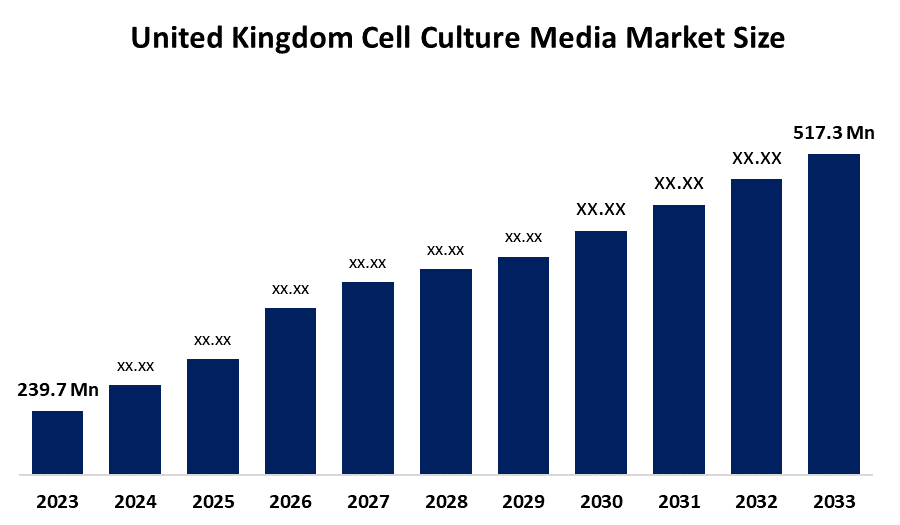
- United Kingdom Cell Culture Media Market Size 2024: USD 239.7 Mn
- United Kingdom Cell Culture Media Market Size 2035: USD 517.3 Mn
- United Kingdom Cell Culture Media Market CAGR 2024: 7.24%
- United Kingdom Cell Culture Media Market Segments: Type, Cell Type, and Application
Get more details on this report -
The United Kingdom cell culture media market includes the businesses that create, produce, distribute and sell custom-formulated growth medium designed specifically to support cell growth including proliferation and maintenance outside the body where all conditions are regulated. To accurately produce cell culture media, it is essential to have certain predefined nutrients such as amino acids, growth factors such as cytokines, salts, and energy sources available in a solution that can be adjusted for specific types and species of cells in order to minimize variation and reduce the risk of contamination. Additionally, the cell culture market in the UK includes the media that is used for basic research and the large-scale production of industrial biochemical products
The cell culture media in UK are backed by government support, including the UK Life Sciences Sector, the Life Sciences Innovative Manufacturing Fund (LSIMF), aimed at bolstering domestic supply chains, accelerating the commercialisation of innovative products, and establishing the UK as one of the leading global hubs for biopharmaceutical manufacture. This will drive increased demand for media designed for advanced therapeutic manufacturing. Additionally, both the Medicines and Healthcare products Regulatory Agency (MHRA) and the National Institute for Health and Care Excellence (NICE) promote pro-innovation procurement practices within the market.
As technology advances, UK cell culture media providers are now using innovative development of serum-free and chemically-defined media formulation technologies provides enhanced consistency, decreased biological variability, and safer bioprocessing for therapeutic processing. Furthermore, the continued evolution of specialized media developed specifically for 3D and organic culture systems has greatly improved the predictive potential for drug screening and the modelling of disease thereby further enhancing both research and clinical pipeline advantages of media products in UK.
Market Dynamics of the United Kingdom Cell Culture Media Market:
The UK cell culture media market is driven by the rapid growth of the biopharmaceutical and biotechnology industries, increased need for high-quality media to grow cells, increased media use is the increasing number of private investments, increased emphasis on the development of serum-free and chemically defined media formulations, rise in highest level of reliability and reproducibility between research and clinical applications, and increased companies dependency on cell-based assay methods to discover and evaluate potential drugs and toxicity levels.
The UK cell culture media market is restrained by the high costs associated with developing advanced, chemically defined media, stringent regulatory and quality compliance requirements, increased cost of manufacturing, and lack of skilled labours
The future of UK cell culture media market is bright and promising, with versatile opportunities emerging from the growth of regenerative medicine and cell-based therapies such as CAR-T and similar personalized medicine platforms continues at a rapid pace. As a result of increasing biopharmaceutical product development and production activities focusing on stem cell research and developing vaccines, will likely demand innovative culture media solutions. Further, continued governmental support provide opportunities for UK media producers to enter new geographic markets, enabling them to leverage and utilize more effectively the resources available through a globally integrated supply chain.
United Kingdom Cell Culture Media Market Report Coverage
| Report Coverage | Details |
|---|---|
| No. of Pages: | 170 |
| Tables, Charts & Figures: | 90 |
Get more details on this report -
Market Segmentation
The United Kingdom Cell Culture Media Market share is classified into type, cell type, and application.
By Type:
The UK cell culture media is divided by type into media and supplements. Among these, the media segment held the largest revenue market share in 2024 and is predicted to grow at a remarkable CAGR during the forecast period. Support variety of biological processes in research and industrial applications, forming the foundation for growing cells in vitro, and researchers focusing on regulatory compliance aiming for a more defines culture environment all contribute to the media segment's largest share and higher spending on cell culture media when compared to other type.
By Cell Type:
The UK cell culture media is divided by cell type into plant cell, animal cell, and bacterial cell. Among these, the animal cell segment dominated the share in 2024 and is anticipated to grow at a remarkable CAGR during the forecast period. The animal cell segment dominates because of massive demand for biopharmaceuticals and R&D in human health, advances in cell therapy creating personalized treatments, and demand for biopharmaceutical production.
By Application:
The UK cell culture media is divided by application into regenerative medicine, biopharmaceutical production, and research. Among these, the biopharmaceutical production segment held the largest market share in 2024 and is predicted to grow at a significant CAGR during the forecast period. Rising demand for biologic drugs, including monoclonal antibodies, increasing prevalence of chronic diseases, and significant investments in this sector supported by government initiatives all contribute to the biopharmaceutical production segment's largest share and higher spending on cell culture media when compared to other application.
Competitive Analysis:
The report offers the appropriate analysis of the key organisations/companies involved within the UK cell culture media market, along with a comparative evaluation primarily based on their product offering, business overviews, geographic presence, enterprise strategies, segment market share, and SWOT analysis. The report also provides an elaborative analysis focusing on the current news and developments of the companies, which includes product development, innovations, joint ventures, partnerships, mergers & acquisitions, strategic alliances, and others. This allows for the evaluation of the overall competition within the market.
Top Key Companies in United Kingdom Cell Culture Media Market:
- Thermo Fisher Scientific
- Merck KGaA
- Sartorius AG
- Lonza Group Ltd
- Avantor
- Becton, Dickinson and Company
- Danaher Corporation
- Corning Incorporated
- FUJIFILM
- AstraZeneca
- GSK
- Abcam
- Autolus Therapeutics
- Others
Recent Developments in United Kingdom Cell Culture Media Market:
In October 2024, Sartorius AG completed the acquisition of Regenerative Medicine Technologies, a specialist in cell culture media, which significantly expanded its portfolio in the biopharmaceutical market.
In August 2024, Newcastle-based drug discovery partner released a new imaging suite and a new Fibroblast-to-Myofibroblast Transition assay to increase high-throughput screening capabilities for anti-fibrotic drug candidates using their in vitro models.
In June 2024, the Liverpool-based company invested in a new manufacturing facility to meet the rising demand for single-use solutions. This expansion supports the launch of several powder transfer products, including the ChargeBag XL for large-scale transfers.
Key Target Audience
- Market Players
- Investors
- End-users
- Government Authorities
- Consulting and Research Firm
- Venture capitalists
- Value-Added Resellers (VARs)
Market Segment
This study forecasts revenue at the United Kingdom, regional, and country levels from 2020 to 2035. Spherical Insights has segmented the UK cell culture media market based on the below-mentioned segments:
United Kingdom Cell Culture Media Market, By Type
- Media
- Supplements
United Kingdom Cell Culture Media Market, By Cell Type
- Animal Cells
- Plant Cells
- Bacterial Cells
United Kingdom Cell Culture Media Market, By Application
- Regenerative Medicine
- Biopharmaceutical Production
- Research
Frequently Asked Questions (FAQ)
-
Q: What is the UK cell culture media market size?A: UK cell culture media market is expected to grow from USD 239.7 million in 2024 to USD 517.3 million by 2035, growing at a CAGR of 7.24% during the forecast period 2025-2035.
-
Q: What are the key growth drivers of the market?A: Market growth is driven by the rapid expansion of the biopharmaceutical and biotechnology sectors, increasing demand for high-quality media to support large-scale cell growth, rising investment in stem cell and regenerative medicine research, shift toward serum-free, chemically defined media formulations, improved reliability and reproducibility in research and clinical applications, growing use of cell-based assays in drug discovery and toxicity screening by pharmaceutical companies further boosts media consumption across laboratories.
-
Q: What factors restrain the UK cell culture media market?A: Constraints include the high cost of advanced and chemically defined media, stringent regulatory and quality compliance requirements, increase production costs, lengthen approval timelines, and limit adoption among smaller research laboratories.
-
Q: How is the market segmented by type?A: The market is segmented into media and supplements.
-
Q: Who are the key players in the UK cell culture media market?A: Key companies include Thermo Fisher Scientific, Merck KGaA, Sartorius AG, Lonza Group Ltd, Avantor, Becton, Dickinson and Company, Danaher Corporation, Corning Incorporated, FUJIFILM, AstraZeneca, GSK, Abcam, Autolus Therapeutics, and Others.
-
Q: Who are the target audiences for this market report?A: The report targets market players, investors, end-users, government authorities, consulting and research firms, venture capitalists, and value-added resellers (VARs).
Need help to buy this report?