United Arab Emirates Solar Energy Market Size, Share, By Type (Solar Photovoltaic (PV), Concentrated Solar Power (CSP), Solar Thermal, Hybrid Systems), By Technology (Crystalline Silicon PV, Thin-Film PV, Parabolic Trough CSP, Solar Power Tower CSP, Bifacial & Tracking Systems), By Application (Utility-Scale, Commercial & Industrial, Residential, Off-Grid & Others), By End Use (Government & Utilities, Commercial & Industrial, Residential, Others), United Arab Emirates Solar Energy Market Insights, Industry Trend, Forecasts to 2035.
Industry: Energy & Power
United Arab Emirates Solar Energy Market Insights Forecasts to 2035
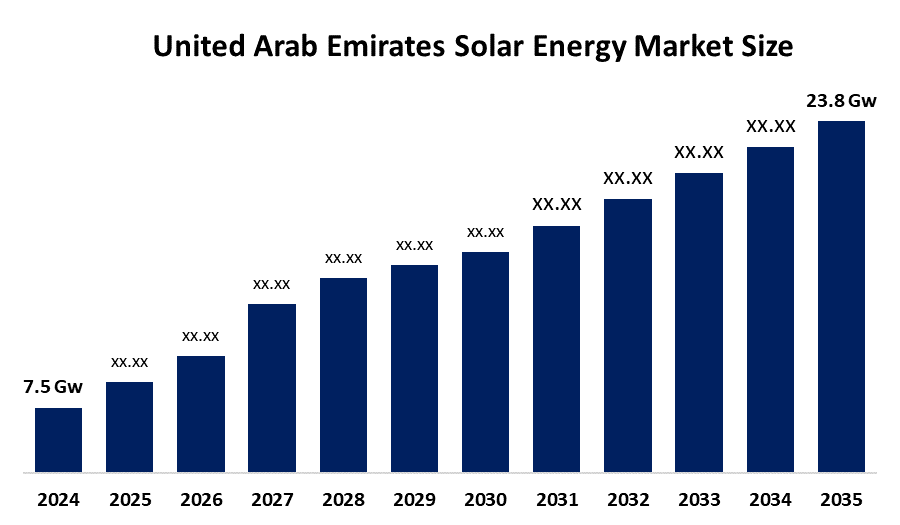
- United Arab Emirates Solar Energy Market Size 2024: 7.5 Gigawatt
- United Arab Emirates Solar Energy Market Size 2035: 23.8 Gigawatt
- United Arab Emirates Solar Energy Market CAGR 2024: 11.07%
- United Arab Emirates Solar Energy Market Segments: Technology, Delivery Method, Application, Mode, and End Use.
Get more details on this report -
The United Arab Emirates solar energy market consists of manufacturing, installing, and maintaining PV and CSP systems for utility-scale, residential, and commercial use. It is primarily driven by the UAE Net Zero 2050 goal, the Dubai Clean Energy Strategy 2050 and declining technology costs. Because the UAE has a high amount of solar irradiance, the country solar market will continue to thrive by utilising an abundant resource such as sunlight to produce electricity and thermal energy as part of the UAE's efforts to transition to sustainable energy sources and to diversify energy sources being used. Significant drivers of demand for solar in the UAE are the extremely low tariffs available to utilities through competitive tender processes and large-scale utility projects such as the Mohammed bin Rashid Al Maktoum Solar Park, and the rapid increase in commercial and residential adoption of rooftop and distributed solar panel systems. As a direct consequence of investment in the development of infrastructure and the participation of the private sector, demand for advanced solar technologies such as bifacial panels and integration of energy storage systems continues to grow at an accelerating rate.
The UAE solar energy market has been greatly influenced by the government of the UAE through its various initiatives. Through a large outlay of funds into the area of renewable energy and through the establishment of ambitious initiatives and regulations that affect how renewable energy is produced, the government has set the stage for growth in this market. In particular, the UAE Energy Strategy 2050 will result in a projected increase in the production of energy from clean energy sources by 2050, with significant contributions coming from the use of solar energy. In addition, regulatory frameworks for these projects are provided by authorities such as the Dubai Electricity and Water Authority and Emirates Water and Electricity Company. The continued investment in solar generation through Artificial Intelligence-optimised forecasting, expanded incentives for distributed generation and hybrid photovoltaic- and concentrating solar power-based energy storage systems, is expected to result in double-digit growth rates through 2035.
Market Dynamics of the United Arab Emirates Solar Energy Market:
The driving factors of UAE solar energy market include the United Arab Emirates Energy Strategy 2050 and Net Zero by 2050 commitments, plummeting costs of solar PV modules and batteries, and surging electricity demand from urbanization, industrialization and desalination. The rapid rollout of gigawatt-scale parks ad incentives like net metering has accelerated capacity additions. The residential and commercial and industrial sectors experience increased adoption of distributed solar systems because people now understand sustainability better and companies commit to decarbonization and public and private organizations work together.
The challenges faced by the UAE solar energy market include substantial initial capital requirements for utility-scale and hybrid projects and environmental stresses from desert conditions that reduce panel efficiency and durability and the need for advanced grid infrastructure to manage intermittency. The project encounters three main obstacles which include regulatory requirements for permits and land allocation, the need for imported components, and the expensive energy storage systems required for reliable dispatchable power. The current incentive system for smaller-scale systems needs to be improved because it restricts multiple segments from achieving better system performance and wider system adoption.
The UAE shows strong growth prospects which will establish the country as a worldwide center for solar technology development through its integrated PV-BESS and advanced CSP hybrid systems. AI technology will improve energy systems through better performance optimization and enhanced surface bifacial systems and tracking systems which will deliver greater energy output through international developer and local utility partnerships. The increased use of solar energy will result in improved energy self-sufficiency and lower greenhouse gas emissions and sustainable development which will drive strong growth during the entire forecast period.
United Arab Emirates Solar Energy Market Report Coverage
| Report Coverage | Details |
|---|---|
| Base Year: | 2024 |
| Market Size in 2024: | USD 7.5 Gigawatt |
| Forecast Period: | 2024-2035 |
| Forecast Period CAGR 2024-2035 : | 11.07% |
| 2035 Value Projection: | USD 23.8 Gigawatt |
| Historical Data for: | 2020-2023 |
| No. of Pages: | 240 |
| Tables, Charts & Figures: | 105 |
| Segments covered: | By Type, By Technology |
| Companies covered:: | Masdar (Abu Dhabi Future Energy Company), Dubai Electricity and Water Authority (DEWA), Emirates Water and Electricity Company (EWEC), Abu Dhabi National Energy Company (TAQA), ACWA Power, AMEA Power, Enviromena, SirajPower, Yellow Door Energy, EDF Renewables, TotalEnergies, Shanghai Electric, and |
| Pitfalls & Challenges: | COVID-19 Empact, Challenge, Future, Growth, & Analysis |
Get more details on this report -
Market Segmentation
The United Arab Emirates solar energy market share is classified into type, technology, application, and end use.
By Type:
The United Arab Emirates solar energy market is divided by type into solar photovoltaic (PV), concentrated solar power (CSP), solar thermal, and hybrid systems. Among these, solar photovoltaic (PV) dominated the share in 2024 and is anticipated to grow at a remarkable CAGR during the forecast period. PV leads due to its cost-competitiveness, scalability, and suitability for both large-scale parks and distributed installations in the UAE's high-irradiance environment. The integration of advanced PV in flagship projects and declining module costs have accelerated adoption.
By Technology:
The UAE solar energy market is divided by technology into crystalline silicon PV, thin-film PV, parabolic trough CSP, solar power tower CSP, bifacial & tracking systems. Among these, crystalline silicon PV dominated in 2024 and is anticipated to grow at a remarkable CAGR during the forecast period. Crystalline silicon PV dominates as it delivers high efficiency and cost-effectiveness for high-throughput utility projects, comprehensive performance in desert conditions, and seamless grid integration. It forms the backbone of national initiatives like the Al Dhafra and Mohammed bin Rashid parks
By Application:
The UAE solar energy market is divided by application into utility-scale, commercial & industrial, residential, off-grid & others. Among these, utility-scale dominated in 2024 and is anticipated to grow at a remarkable CAGR during the forecast period. As fuelled by mega-projects such as the Mohammed bin Rashid Al Maktoum Solar Park and Al Dhafra, alongside competitive tenders achieving ultra-low tariffs and government mandates for renewable integration. Key enablers include long-term PPAs and storage hybridization for baseload reliability. Expanded grid connectivity and policy alignment with net-zero goals will further propel utility-scale dominance.
By End Use:
The United Arab Emirates solar energy market is divided by end use into government & utilities, commercial & industrial, residential, and others. Among these, government & utilities dominated the share in 2024 and are anticipated to grow at a remarkable CAGR during the forecast period. The surge in solar incorporation into national grids, particularly through utility-scale parks and public infrastructure, has solidified government dominance. Integrated solar facilities in utilities reduce integration times and enable direct policy execution. Partnerships with global developers and stringent regulatory compliance favour government and utility settings over independent or consumer-led deployments.
Competitive Analysis:
The report offers the appropriate analysis of the key organisations/companies involved within the United Arab Emirates solar energy market, along with a comparative evaluation primarily based on their product offering, business overviews, geographic presence, enterprise strategies, segment market share, and SWOT analysis. The report also provides an elaborative analysis focusing on the current news and developments of the companies, which includes product development, innovations, joint ventures, partnerships, mergers & acquisitions, strategic alliances, and others. This allows for the evaluation of the overall competition within the market.
Top Key Companies in United Arab Emirates Solar Energy Market:
- Masdar (Abu Dhabi Future Energy Company)
- Dubai Electricity and Water Authority (DEWA)
- Emirates Water and Electricity Company (EWEC)
- Abu Dhabi National Energy Company (TAQA)
- ACWA Power
- AMEA Power
- Enviromena
- SirajPower
- Yellow Door Energy
- EDF Renewables
- TotalEnergies
- Shanghai Electric
Key Target Audience
- Market Players
- Investors
- End-users
- Government Authorities
- Consulting and Research Firm
- Venture capitalists
- Value-Added Resellers (VARs)
Market Segment
This study forecasts revenue at the UAE, regional, and country levels from 2020 to 2035. Spherical insights has segmented the United Arab Emirates solar energy market based on the below-mentioned segments:
United Arab Emirates Solar Energy Market, By Type
- Solar Photovoltaic (PV)
- Concentrated Solar Power (CSP)
- Solar Thermal
- Hybrid Systems
United Arab Emirates Solar Energy Market, By Technology
- Crystalline Silicon PV
- Thin-Film PV
- Parabolic Trough CSP
- Solar Power Tower CSP
- Bifacial & Tracking Systems
United Arab Emirates Solar Energy Market, By Application
- Utility-Scale
- Commercial & Industrial
- Residential
- Off-Grid & Others
United Arab Emirates Solar Energy Market, By End Use
- Government & Utilities
- Commercial & Industrial
- Residential
- Others
Frequently Asked Questions (FAQ)
-
1. What is the size of the United Arab Emirates solar energy market in 2024?The United Arab Emirates solar energy market reached 7.5 gigawatts (GW) of installed capacity in 2024. The market reflects cumulative installed solar capacity across utility-scale, commercial, and residential segments.
-
2. What is the projected size of the UAE solar energy market by 2035?The UAE solar energy market is projected to reach 23.8 gigawatts (GW) by 2035, expanding at a compound annual growth rate (CAGR) of 11.07% during 2025–2035. Growth is driven by large-scale solar park expansions and distributed solar adoption.
-
3. What is driving growth in the UAE solar energy market?Key growth drivers include: UAE Net Zero 2050 commitment, Dubai Clean Energy Strategy 2050, Declining solar PV and battery costs, Ultra-low tariffs achieved through competitive tenders, Expansion of large-scale projects such as Mohammed bin Rashid Al Maktoum Solar Park, Increasing rooftop solar adoption in commercial and residential sectors.
-
4. Which segment dominates the UAE solar energy market?The Utility-Scale segment dominates the UAE solar energy market. Government-backed mega projects and long-term power purchase agreements (PPAs) continue to drive large-capacity additions.
-
5. Which technology leads the UAE solar energy market?Crystalline Silicon PV is the leading technology segment due to: High efficiency, Cost competitiveness, Strong performance in desert conditions, Wide adoption in major national solar projects. Advanced technologies such as bifacial modules and tracking systems are also gaining momentum.
-
6. What are the major challenges in the UAE solar energy market?Key challenges include High upfront capital investment for hybrid and storage-integrated systems, Desert climate impacts on panel efficiency, Grid integration and intermittency management, Dependence on imported components, High cost of large-scale energy storage systems.
-
7. Who are the major companies operating in the UAE solar energy market?Key players include Masdar (Abu Dhabi Future Energy Company), Dubai Electricity and Water Authority (DEWA), Emirates Water and Electricity Company (EWEC), Abu Dhabi National Energy Company (TAQA), ACWA Power, AMEA Power, Enviromena, SirajPower, Yellow Door Energy, EDF Renewables, TotalEnergies, Shanghai Electric.
-
8. What role does the government play in the UAE solar energy market?Government authorities such as: Dubai Electricity and Water Authority (DEWA), Emirates Water and Electricity Company (EWEC) play a central role in issuing tenders, regulating projects, and integrating solar power into national grids. The market is strongly policy-driven rather than purely private-sector driven
-
9. Which applications are expanding in the UAE solar market?While utility-scale dominates, the Commercial & Industrial (C&I) and Residential rooftop segments are expanding due to sustainability commitments and cost savings from on-site solar generation.
-
10. What technologies are expected to shape the future of the UAE Solar Energy Market?Future growth is expected from: Bifacial solar modules, Solar tracking systems, PV + Battery Energy Storage Systems (BESS), Hybrid PV + CSP projects, AI-driven energy forecasting and optimization.
Need help to buy this report?