Global Underground Waste Containers Market Size, Share, and COVID-19 Impact Analysis, By Container Type (Metal Containers, Plastic Containers, and Hybrid Containers), By Waste Type (General Municipal Solid Waste, Recyclables, and Organic Waste), By Installation Type (Permanent Systems and Semi-permanent Systems), and By Region (North America, Europe, Asia-Pacific, Latin America, Middle East, and Africa), Analysis and Forecast 2025 - 2035
Industry: Machinery & Equipment
Global Underground Waste Containers Market Size Insights Forecasts to 2035
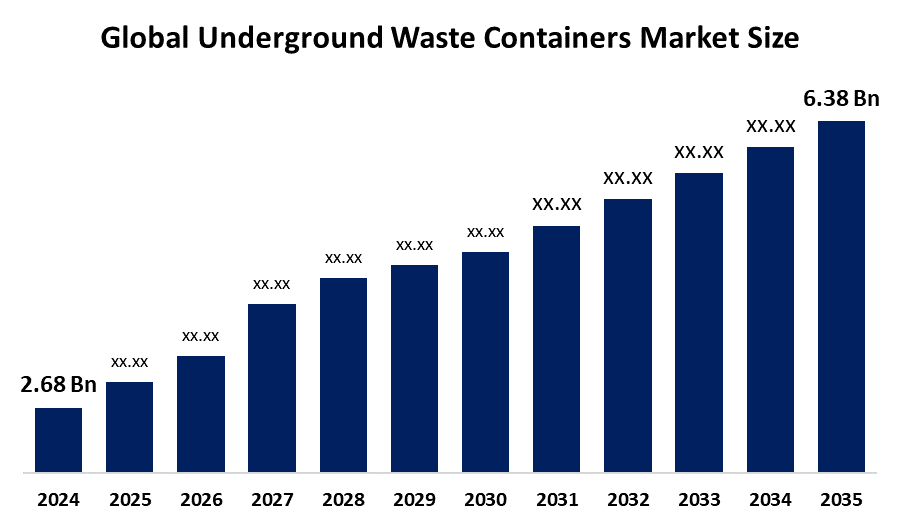
- The Global Underground Waste Containers Market Size Was Estimated at USD 2.68 Billion in 2024
- The Market Size is Expected to Grow at a CAGR of around 8.2% from 2025 to 2035
- The Worldwide Underground Waste Containers Market Size is Expected to Reach USD 6.38 Billion by 2035
- Asia Pacific is expected to Grow the fastest during the forecast period.
Get more details on this report -
According to a Research Report Published by Spherical Insights and Consulting, The Global Underground Waste Containers Market Size was worth around USD 2.68 Billion in 2024 and is predicted to Grow to around USD 6.38 Billion by 2035 with a compound annual growth rate (CAGR) of 8.2% from 2025 to 2035. Global need for space-optimized waste management and smart city initiatives, rapid urbanization, integration of IoT for monitoring, rising demand for hygienic, odor-controlled disposal, and government-backed sustainability initiatives are all driving opportunities in the underground waste containers market.
Market Overview
The global industry segment devoted to design, manufacturing, installation, and maintenance of waste storage containers that are placed below ground level to collect municipal, residential, commercial, and industrial waste is known as the underground waste containers market. These include various types of underground waste containers such as modular underground bins, semi-underground containers, and fully underground waste collection systems. It also covers waste collection equipment, installation services, and maintenance solutions used by municipalities, residential complexes, commercial facilities, and smart city projects to manage solid waste more efficiently. In November 2024, the U.S. EPA highlighted progress on its official National Recycling Strategy, which includes grant funding (156 grants awarded across communities, states, and tribes) aimed at upgrading recycling and waste management infrastructure.
In April 2024, the Hong Kong Municipal Solid Waste Charging Scheme implemented a “polluter pays” system designed to reduce the volume of waste generated and processed. In November 2023, the India BMC issued an official e-tender for the design, installation, testing, and commissioning of underground bin lifting mechanisms on 32 municipal refuse compactors as part of its solid waste management services, demonstrating concrete municipal investment in underground waste container infrastructure. The quick speed of technological advancement is one of the main drivers of the underground waste containers market's expansion.
Report Coverage
This research report categorizes the underground waste containers market based on various segments and regions, forecasts revenue growth, and analyzes trends in each submarket. The report analyses the key growth drivers, opportunities, and challenges influencing the underground waste containers market. Recent market developments and competitive strategies, such as expansion, product launch, development, partnership, merger, and acquisition, have been included to draw the competitive landscape in the market. The report strategically identifies and profiles the key market players and analyses their core competencies in each sub-segment of the underground waste containers market.
Global Underground Waste Containers Market Report Coverage
| Report Coverage | Details |
|---|---|
| Base Year: | 2024 |
| Market Size in 2024 : | USD 2.68 Billion |
| Forecast Period: | 2025-2035 |
| Forecast Period CAGR 2025-2035 : | 8.2% |
| 2035 Value Projection: | USD 6.38 Billion |
| Historical Data for: | 2020-2023 |
| No. of Pages: | 185 |
| Tables, Charts & Figures: | 96 |
| Segments covered: | By Container Type, By Waste Type and COVID-19 Impact Analysis |
| Companies covered:: | Sotkon, Sutera In-Ground, Envac, ESE World B.V., Nord Engineering srl, Caverion Corporation, Sensoneo, Oktagon GmbH, Ecoloxia Environmental Group Inc., Oge Metal, Reflex Zlin Ltd., Zweva Environment bvba, Meulenbroek, Stream Environment Sdn.Bhd., Veolia Environment S.A., SUEZ Group, and Others |
| Pitfalls & Challenges: | Covid 19 Impact Challenges, Future, Growth and Analysis |
Get more details on this report -
Driving Factors
Rapid technological innovation is one of the main drivers of the underground waste containers market's growth. Rapid urbanization and population growth, advancements in smart waste management technologies, and increasing environmental awareness among consumers and local governments is the main factor driving the market for underground waste containers. In this field, innovation and investment are driven by the infrastructure modernization projects in smart cities and commercial developments, governments and municipalities emphasizing sustainable waste management practices, supported by policies and regulations targeting waste reduction, recycling, and improved collection systems, which encourages investment in advanced container technologies. In March 2025, Sensoneo announced the deployment of its loT fill-level sensors across Bay Area Rapid Transit (BART) facilities in the U.S., marking a real-world rollout of smart waste monitoring technology that supports underground and large waste container optimization.
Restraining Factors
High development and deployment costs, Maintenance and operational complexities, lack of skilled personnel, space and infrastructure limitations, stringent regulations with planning hurdles, and logistical challenges that slow the widespread adoption are the main factors restricting the underground waste containers market.
Market Segmentation
The underground waste containers market share is classified into container type, waste type, and installation type.
- The metal containers segment dominated the market in 2024, approximately 58%, and is projected to grow at a substantial CAGR during the forecast period.
Based on the container type, the underground waste containers market is divided into metal containers, plastic containers, and hybrid containers. Among these, the metal containers segment dominated the market in 2024, approximately 58%, and is projected to grow at a substantial CAGR during the forecast period. Superior durability, strength, and long lifespan, the ability to withstand underground pressure, resist corrosion, and provide secure waste storage, are driving the metal containers industry.
- The general municipal solid waste segment accounted for the largest share in 2024, approximately 40%, and is anticipated to grow at a significant CAGR during the forecast period.
Based on the waste type, the underground waste containers market is divided into general municipal solid waste, recyclables, and organic waste. Among these, the general municipal solid waste segment accounted for the largest share in 2024, approximately 40%, and is anticipated to grow at a significant CAGR during the forecast period. The highest volume waste generation, densely populated underground areas, infrastructure efficiency, reduced logistics cost, and stringent environmental regulations for urban hygiene management are driving the general municipal solid waste industry.
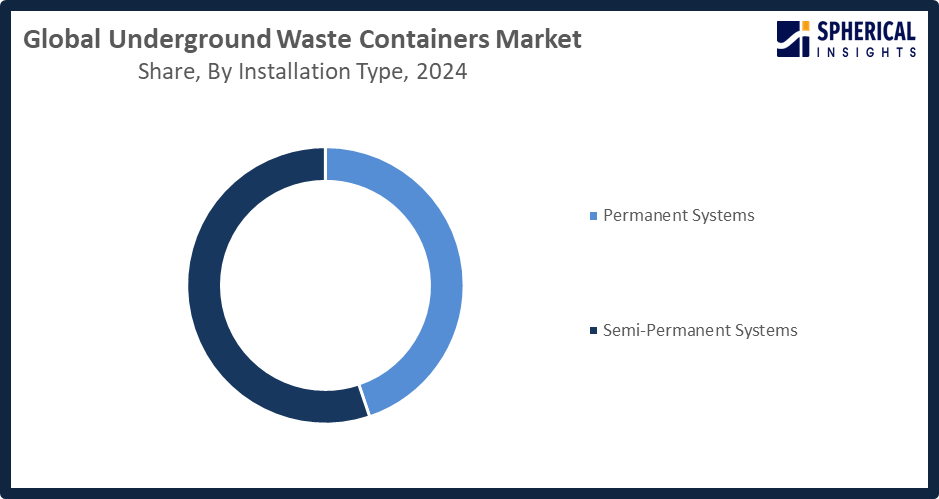
- The semi-permanent segment accounted for the highest market revenue in 2024, approximately 55%, and is anticipated to grow at a significant CAGR during the forecast period.
Based on the installation type, the underground waste containers market is divided into permanent systems and semi-permanent systems. Among these, the semi-permanent segment accounted for the highest market revenue in 2024, approximately 45%, and is anticipated to grow at a significant CAGR during the forecast period. Required less labour with lower capital investment, is frequently chosen for retrofitting, allows for high volume storage, provides significant odour reduction, and durability in harsh environments, bolstering the semi-permanent market.
Get more details on this report -
Regional Segment Analysis of the Underground Waste Containers Market
- North America (U.S., Canada, Mexico)
- Europe (Germany, France, U.K., Italy, Spain, Rest of Europe)
- Asia-Pacific (China, Japan, India, Rest of APAC)
- South America (Brazil and the Rest of South America)
- The Middle East and Africa (UAE, South Africa, Rest of MEA)
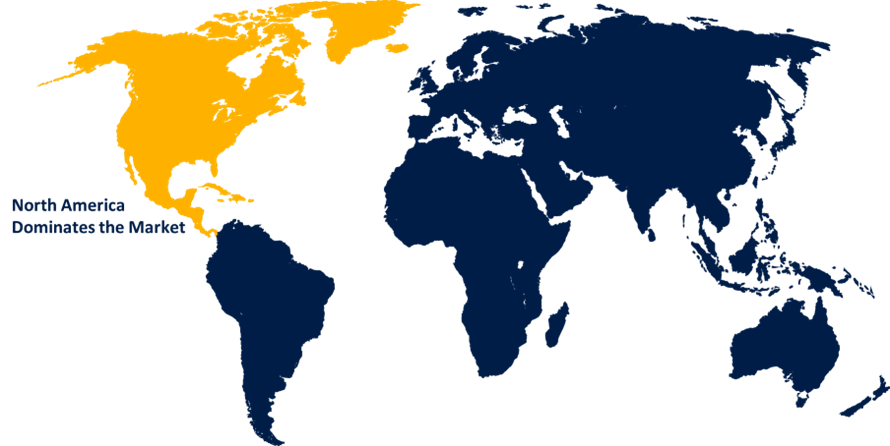
North America is anticipated to hold the largest share of the underground waste containers market over the predicted timeframe.
Get more details on this report -
North America is anticipated to hold the largest share of the underground waste containers market over the predicted timeframe. Strong government backing for well-developed waste management infrastructure, high urbanisation levels, and strong adoption of advanced waste solutions in major cities and municipalities are what propel North America. The region's position is further reinforced by government programs prioritizing modern waste management infrastructure, including advanced container systems. Government initiatives include Environment and Climate Change Canada indicator Solid waste diversion and disposal, November 2024 shows total solid waste generated nationwide increased to 36.5 million tonnes by 2022, while only 27.1% was diverted from disposal highlighting to improve diversion rates and reduce landfill reliance and the U.S. EPA Facts and Figures about Materials, Waste and Recycling, January 2026 on municipal solid waste (MSW) generation, recycling, composting, and landfilling underscores the need for better waste collection and containment systems.
Asia Pacific is expected to grow at a rapid CAGR in the underground waste containers market during the forecast period. China, India, Japan, and South Korea are among the nations making significant investments in expanding infrastructure projects and rising demand for efficient waste containment solutions across emerging economies. Rapid urbanisation, growing municipal investments in sustainable waste systems, smart city initiatives, and increased focus on modern waste collection technologies driving the market. Government launches include Japan's Municipal solid waste generation and disposal in FY2023 survey on March 2025, plan improved waste containment systems under the Waste Disposal and Public Cleansing Law and promote efficient storage and collection strategies, China plan of action to improve treatment of solid waste on 4 January 2026 reflecting the annual utilization of bulk solid waste should be about 4.5 billion tons, and annual volume of recycled major renewable sources should be 510 million tons, per the plan by 2030, and India Swachh Bharat Mission Phase 2 (2021-26) to strengthen scientific management of solid waste and sanitation infrastructure across urban and rural areas.
Competitive Analysis:
The report offers the appropriate analysis of the key organizations/companies involved within the underground waste containers market, along with a comparative evaluation primarily based on their product of offering, business overviews, geographic presence, enterprise strategies, segment market share, and SWOT analysis. The report also provides an elaborative analysis focusing on the current news and developments of the companies, which includes product development, innovations, joint ventures, partnerships, mergers & acquisitions, strategic alliances, and others. This allows for the evaluation of the overall competition within the market.
List of Key Companies
- Sotkon
- Sutera In-Ground
- Envac
- ESE World B.V.
- Nord Engineering srl
- Caverion Corporation
- Sensoneo
- Oktagon GmbH
- Ecoloxia Environmental Group Inc.
- Oge Metal
- Reflex Zlin Ltd.
- Zweva Environment bvba
- Meulenbroek
- Stream Environment Sdn.Bhd.
- Veolia Environment S.A.
- SUEZ Group
- Others
Key Target Audience
- Market Players
- Investors
- End-users
- Government Authorities
- Consulting and Research Firm
- Venture capitalists
- Value-Added Resellers (VARs)
Recent Development
- In January 2026, Envac Group launched the world’s first automatic collection system for infectious waste at CHU Rennes University Hospital in France. The solution combines pneumatic underground transport and on-site waste treatment, improving safety and automation in healthcare waste handling.
- In November 2025, Envac Group showcased advanced automated underground waste collection solutions at the Cityscape Global exhibition in Riyadh, demonstrating innovations designed for smart cities and sustainable urban infrastructure.
- In February 2025, Bigbelly launched new manufacturing operations in the U.S. to enhance production capabilities for smart waste management systems in response to North American demand.
Market Segment
This study forecasts revenue at global, regional, and country levels from 2020 to 2035. Spherical Insights has segmented the underground waste containers market based on the below-mentioned segments:
Global Underground Waste Containers Market, By Container Type
- Metal Containers
- Plastic Containers
- Hybrid Containers
Global Underground Waste Containers Market, By Waste Type
- General Municipal Solid Waste
- Recyclables
- Organic Waste
Global Underground Waste Containers Market, By Installation Type
- Permanent Systems
- Semi-Permanent Systems
Global Underground Waste Containers Market, By Regional Analysis
- North America
- US
- Canada
- Mexico
- Europe
- Germany
- UK
- France
- Italy
- Spain
- Russia
- Rest of Europe
- Asia Pacific
- China
- Japan
- India
- South Korea
- Australia
- Rest of Asia Pacific
- South America
- Brazil
- Argentina
- Rest of South America
- Middle East & Africa
- UAE
- Saudi Arabia
- Qatar
- South Africa
- Rest of the Middle East & Africa
Frequently Asked Questions (FAQ)
-
1. What are the key benefits of underground waste containers?Underground waste containers increase waste storage capacity while using minimal surface space. Underground storage reduces unpleasant odors and improves urban aesthetics. They also reduce the frequency of waste collection.
-
2. How do underground waste containers support smart city initiatives?These containers can be integrated with sensors that monitor fill levels. Smart waste management systems optimize collection routes and reduce operational costs. This technology improves efficiency in urban waste management.
-
3. What is the typical capacity of underground waste containers?Most underground waste containers have capacities ranging from 3 cubic meters to 5 cubic meters or more. Larger containers allow cities to reduce the frequency of waste collection. Capacity depends on design and intended use.
-
4. How do underground waste containers improve urban hygiene?By storing waste underground, they limit exposure to animals, insects, and weather conditions. This reduces contamination and foul smells. As a result, urban sanitation levels improve.
-
5. What technological innovations are emerging in this market?Manufacturers are integrating IoT sensors and smart monitoring systems. Some containers include access control systems and automated lifting mechanisms. These innovations help improve efficiency and waste tracking.
-
6. What is the future outlook for the underground waste containers market?The market is expected to grow steadily due to rising urban populations and stricter waste regulations. Smart city programs and sustainability initiatives will drive adoption. Emerging economies are expected to offer strong growth opportunities.
Need help to buy this report?