Global Treehouse Glamping Market Size, Share, and COVID-19 Impact Analysis, By Age Group (18-32 years, 33-50 years, 51-65 years, and Above 65 years), By Booking Mode (Online and Offline), and by Region (North America, Europe, Asia-Pacific, Latin America, Middle East, and Africa), Analysis and Forecast 2025 - 2035
Industry: Consumer Goods
Global Treehouse Glamping Market Insights Forecasts to 2035
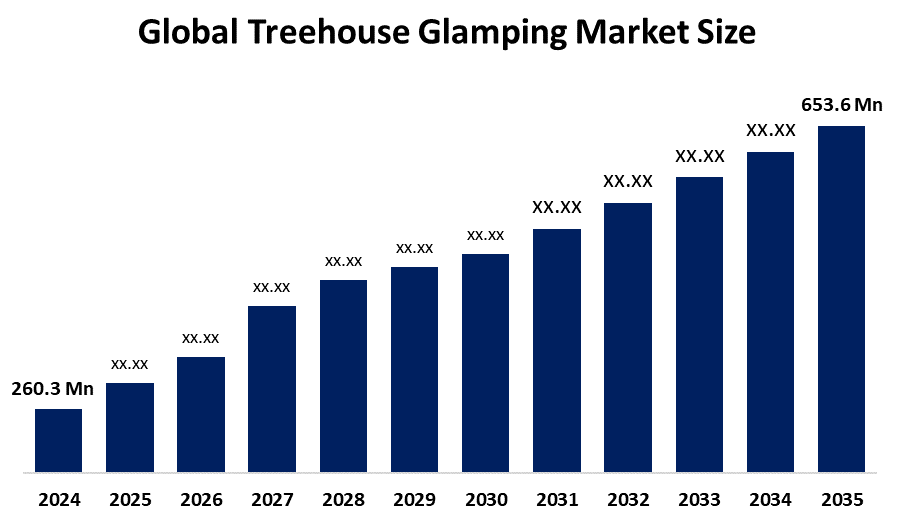
- The Global Treehouse Glamping Market Size Was Estimated at USD 260.3 Million in 2024
- The Market Size is Expected to Grow at a CAGR of around 8.73 % from 2025 to 2035
- The Worldwide Treehouse Glamping Market Size is Expected to Reach USD 653.6 Million by 2035
- Europe is expected to grow the fastest during the forecast period.
Get more details on this report -
According to a research report published by Spherical Insights and Consulting, The Global Treehouse Glamping Market Size was worth around USD 260.3 Million in 2024 and is predicted to Grow to around USD 653.6 Million by 2035 with a compound annual growth rate (CAGR) of 8.73% from 2025 to 2035. Future opportunities in the treehouse glamping market include eco-tourism growth, luxury outdoor experiences, wellness retreats, sustainable accommodations, themed stays, digital nomad travel, influencer marketing, and expansion in under-developed scenic regions.
Market Overview
The Treehouse Glamping Market Size refers to premium, nature-based accommodations built on elevated structures that combine outdoor experiences with modern comfort and luxury. Governments worldwide are promoting eco-tourism and sustainable lodging through forest conservation programs, rural tourism missions, and green hospitality incentives. For instance, several countries report that over 30% of eco-tourism travelers prefer sustainable accommodations, encouraging investment in low-impact stays. National tourism boards also support treehouse stays under adventure and wellness tourism initiatives. Key driving factors include rising demand for experiential travel, increased focus on sustainability, growing interest in wellness retreats, and higher disposable incomes. Social media influence and the popularity of unique, Instagram-worthy accommodations further accelerate market adoption globally.
Report Coverage
This research report categorizes the treehouse glamping market based on various segments and regions, forecasts revenue growth, and analyzes trends in each submarket. The report analyses the key growth drivers, opportunities, and challenges influencing the treehouse glamping market. Recent market developments and competitive strategies, such as expansion, product launch, development, partnership, merger, and acquisition, have been included to draw the competitive landscape in the market. The report strategically identifies and profiles the key market players and analyzes their core competencies in each sub-segment of the treehouse glamping market.
Global Treehouse Glamping Market Report Coverage
| Report Coverage | Details |
|---|---|
| Base Year: | 2024 |
| Market Size in 2024: | USD 260.3 Million |
| Forecast Period: | 2024-2035 |
| Forecast Period CAGR 2024-2035 : | CAGR of 8.73% |
| 2035 Value Projection: | USD 653.6 Million |
| Historical Data for: | 2020-2023 |
| No. of Pages: | 240 |
| Tables, Charts & Figures: | 100 |
| Segments covered: | By Age Group, By Region |
| Companies covered:: | Treehouse-Villas Thailand, Bangkok Tree House, Rabeang Pasak Treehouse Resort, Keemala, Orion Tree Houses B&B, Moulin de la Jarousse, Costa Rica Tree House Lodge, Lala Mukha Tented Resort Khao Yai, Pai Treehouse Resort, Tree House Hideaway.,And Other Playas |
| Pitfalls & Challenges: | COVID-19 Empact, Challenges, Future, Growth, & Analysis |
Get more details on this report -
Driving Factors
The treehouse glamping market is driven by rising demand for eco-friendly and experiential travel, growing interest in wellness and nature-based tourism, and increasing disposable incomes. Government support for sustainable tourism and rural development encourages eco-lodging investments. Social media influence and preference for unique, Instagram-worthy stays boost consumer interest. Improved accessibility to forest and scenic destinations, expansion of luxury outdoor accommodations, and post-pandemic preference for secluded travel experiences further support market growth.
Restraining Factors
High construction and maintenance costs, environmental regulations, limited scalability, seasonal demand, safety concerns, and restricted access to forest locations hinder the widespread growth of the treehouse glamping market.
Market Segmentation
The treehouse glamping market share is classified into age group and booking mode.
- The 18-32 years segment accounted for the largest share in 2024 and is anticipated to grow at a significant CAGR during the forecast period.
Based on the age group, the treehouse glamping market is divided into 18-32 years, 33-50 years, 51-65 years, and above 65 years. Among these, the 18-32 years segment accounted for the largest share in 2024 and is anticipated to grow at a significant CAGR during the forecast period. The 18–32 years age group leads the treehouse glamping market due to strong preferences for unique, adventure-oriented, and eco-friendly travel experiences. High social media engagement, flexible travel patterns, growing disposable incomes, and interest in wellness and nature-based stays further drive demand, supporting both current market dominance and rapid future growth.
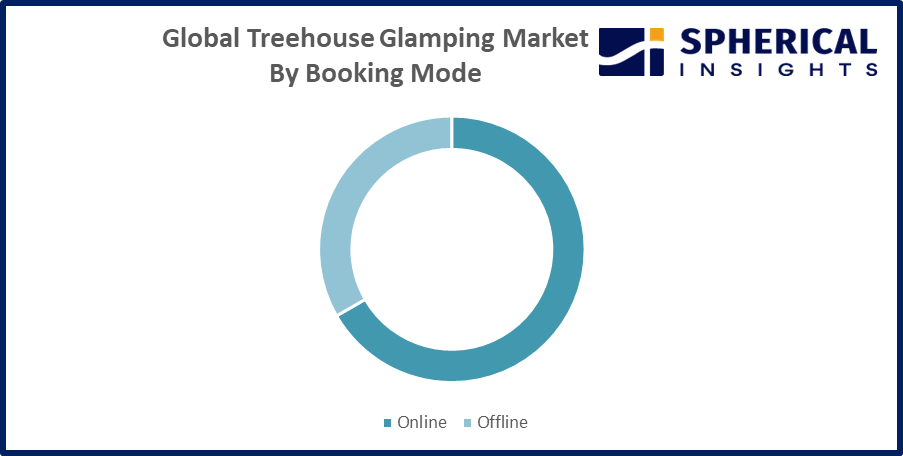
- The offline segment accounted for the highest market revenue in 2024 and is anticipated to grow at a significant CAGR during the forecast period.
Based on the booking mode, the treehouse glamping market is divided into online and offline. Among these, the offline segment accounted for the highest market revenue in 2024 and is anticipated to grow at a significant CAGR during the forecast period. Offline booking led in 2024 due to travelers preferring personalized assistance, customized itineraries, and direct communication for premium treehouse stays. Online booking is expected to grow rapidly driven by increasing smartphone usage, easy price comparison, digital payment adoption, and the rising influence of online travel platforms and social media promotions.
Get more details on this report -
Regional Segment Analysis of the Treehouse Glamping Market
- North America (U.S., Canada, Mexico)
- Europe (Germany, France, U.K., Italy, Spain, Rest of Europe)
- Asia-Pacific (China, Japan, India, Rest of APAC)
- South America (Brazil and the Rest of South America)
- The Middle East and Africa (UAE, South Africa, Rest of MEA)
Asia Pacific is anticipated to hold the largest share of the treehouse glamping market over the predicted timeframe.
Asia Pacific is anticipated to hold the largest share of the treehouse glamping market over the predicted timeframe. Asia Pacific is anticipated to hold the largest share of the treehouse glamping market due to abundant natural landscapes, tropical forests, and biodiversity across countries like Thailand, Indonesia, India, and Australia. Strong growth in eco-tourism, rising disposable incomes, expanding middle-class populations, and government initiatives promoting sustainable and rural tourism further support regional market dominance.

Get more details on this report -
Europe is expected to grow at a rapid CAGR in the treehouse glamping market during the forecast period. Europe is expected to grow at a rapid CAGR in the treehouse glamping market due to rising demand for sustainable and nature-based travel, strong eco-tourism policies, and increasing interest in unique accommodation experiences. Supportive government regulations, well-developed tourism infrastructure, growing wellness tourism, and high environmental awareness among travelers further accelerate adoption across countries such as France, Germany, and the Nordic region.
Competitive Analysis:
The report offers the appropriate analysis of the key organizations/companies involved within the treehouse glamping market, along with a comparative evaluation primarily based on their product offering, business overviews, geographic presence, enterprise strategies, segment market share, and SWOT analysis. The report also provides an elaborative analysis focusing on the current news and developments of the companies, which includes product development, innovations, joint ventures, partnerships, mergers & acquisitions, strategic alliances, and others. This allows for the evaluation of the overall competition within the market.
List of Key Companies
- Treehouse-Villas Thailand
- Bangkok Tree House
- Rabeang Pasak Treehouse Resort
- Keemala
- Orion Tree Houses B&B
- Moulin de la Jarousse
- Costa Rica Tree House Lodge
- Lala Mukha Tented Resort Khao Yai
- Pai Treehouse Resort
- Tree House Hideaway.
Key Target Audience
- Market Players
- Investors
- End-users
- Government Authorities
- Consulting and Research Firm
- Venture capitalists
- Value-Added Resellers (VARs)
Recent Development
- In October 2025, Western Australia has launched 17 innovative accommodation projects to boost tourism and regional growth, including eco-friendly and nature-based stays such as treehouse-style glamping. The initiative supports sustainable tourism, enhances visitor experiences, and strengthens the region’s position in the growing treehouse glamping market.
Market Segment
This study forecasts revenue at global, regional, and country levels from 2020 to 2035. Spherical Insights has segmented the treehouse glamping market based on the below-mentioned segments:
Global Treehouse Glamping Market, By Age Group
- 18-32 years
- 33-50 years
- 51-65 years
- Above 65 years
Global Treehouse Glamping Market, By Booking Mode
- Online
- Offline
Global Treehouse Glamping Market, By Regional Analysis
- North America
- US
- Canada
- Mexico
- Europe
- Germany
- UK
- France
- Italy
- Spain
- Russia
- Rest of Europe
- Asia Pacific
- China
- Japan
- India
- South Korea
- Australia
- Rest of Asia Pacific
- South America
- Brazil
- Argentina
- Rest of South America
- Middle East & Africa
- UAE
- Saudi Arabia
- Qatar
- South Africa
- Rest of the Middle East & Africa
Frequently Asked Questions (FAQ)
-
1. What is the CAGR of the treehouse glamping market over the forecast period?The global treehouse glamping market is projected to expand at a CAGR of 8.73% during the forecast period.
-
2. What is the market size of the treehouse glamping market?The global treehouse glamping market size is expected to grow from USD 260.3 Million in 2024 to USD 653.6 Million by 2035, at a CAGR of 8.73 % during the forecast period 2025-2035.
-
3. Which region holds the largest share of the treehouse glamping market?Asia Pacific is anticipated to hold the largest share of the treehouse glamping market over the predicted timeframe.
-
4. Who are the top 10 companies operating in the global treehouse glamping market?Treehouse-Villas Thailand, Bangkok Tree House, Rabeang Pasak Treehouse Resort, Keemala, Orion Tree Houses B&B, Moulin de la Jarousse, Costa Rica Tree House Lodge, Lala Mukha Tented Resort Khao Yai, Pai Treehouse Resort, and Tree House Hideaway.
-
5. What factors are driving the growth of the treehouse glamping market?Rising demand for eco-friendly travel, unique accommodations, wellness tourism, social media influence, higher disposable incomes, government eco-tourism initiatives, and post-pandemic preference for secluded nature-based stays.
-
6. What are the market trends in the treehouse glamping market?Trends include luxury nature stays, sustainable eco-tourism, digital bookings, wellness retreats, themed glamping experiences, influencer marketing, and remote work-friendly outdoor accommodations.
-
7. What are the main challenges restricting the wider adoption of the treehouse glamping market?High setup costs, limited land availability, seasonal demand, and maintenance complexities are the main challenges restricting treehouse glamping adoption.
Need help to buy this report?