Global Traffic Equipment Market Size, Share, and COVID-19 Impact Analysis, By Product (Traffic Lights, Traffic Safety Signs, Traffic Barriers, Traffic Cones, Traffic Entry Gates, and Others), By Technology (Conventional Equipment and Smart Equipment), By Application (Urban Traffic Management, Highway Management, Parking Management, Work Zone Safety, And Others), and By Region (North America, Europe, Asia-Pacific, Latin America, Middle East, and Africa), Analysis and Forecast 2025 - 2035
Industry: Machinery & Equipment
Global Traffic Equipment Market Size Insights Forecasts to 2035
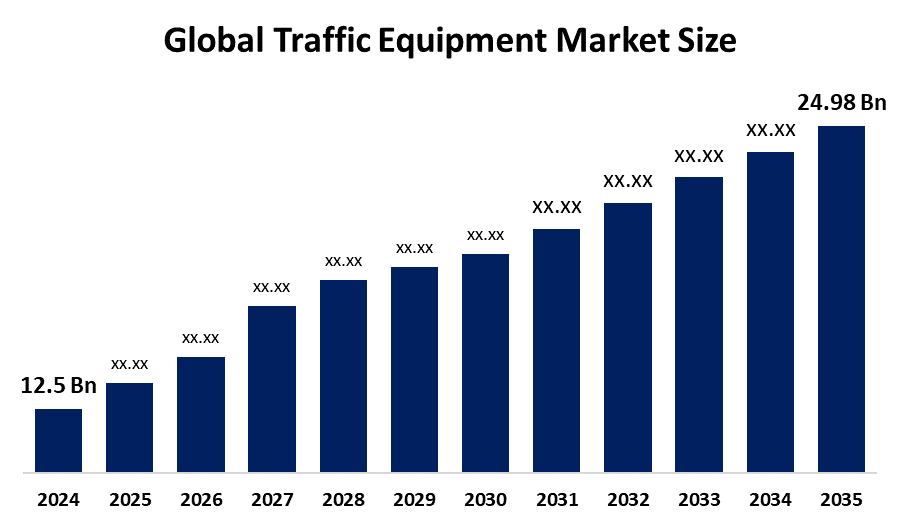
- The Global Traffic Equipment Market Size Was Estimated at USD 12.5 Billion in 2024
- The Market Size is Expected to Grow at a CAGR of around 6.5% from 2025 to 2035
- The Worldwide Traffic Equipment Market Size is Expected to Reach USD 24.98 Billion by 2035
- Asia Pacific is expected to Grow the fastest during the forecast period.
Get more details on this report -
According to a Research Report Published by Spherical Insights and Consulting, The Global Traffic Equipment Market Size was worth around USD 12.5 Billion in 2024 and is predicted to Grow to around USD 24.98 Billion by 2035 with a compound annual growth rate (CAGR) of 6.5% from 2025 to 2035. Global expansion of AI and IoT integration for real-time traffic management, adoption of energy-efficient solutions, upgraded infrastructure with connected sensors, and automated enforcement tools are all driving opportunities in the traffic equipment market.
Market Overview
The global industry segment devoted to the production, installation, and management of devices and systems used to regulate, monitor, and control road traffic to improve safety, reduce congestion, and enhance transportation efficiency is known as the traffic equipment market. These include massive Intelligent Transportation Systems (ITS), adaptive traffic signals, AI-based traffic analytics, IoT-enabled sensors, automatic number plate recognition (ANPR), and smart parking systems, which allow real-time monitoring and better traffic flow management. Governments play a crucial role in the development of this market because they are the primary investors and regulators responsible for road infrastructure, traffic safety policies, and smart city initiatives.
For example, in December 2023, India’s Smart Cities Mission covered 100 smart cities, including New Delhi ITMS expansion, traffic equipment installed with 3750 IP cameras, 1400 red-light violation detectors, and 850 speed enforcement radars, with a strong focus on intelligent traffic management systems. In November 2021, the U.S. IIJA invested USD 13.2 billion allocated for road safety, smart traffic systems, and intelligent transportation technologies, implemented by USDT for smart traffic signals and highway safety equipment.
Through infrastructure funding, regulatory standards, road safety programs, and digital mobility initiatives, governments drive the adoption of advanced traffic equipment and intelligent traffic management systems to create safer, more efficient, and sustainable transportation networks.
Report Coverage
This research report categorizes the traffic equipment market based on various segments and regions, forecasts revenue growth, and analyzes trends in each submarket. The report analyses the key growth drivers, opportunities, and challenges influencing the traffic equipment market. Recent market developments and competitive strategies, such as expansion, product launch, development, partnership, merger, and acquisition, have been included to draw the competitive landscape in the market. The report strategically identifies and profiles the key market players and analyzes their core competencies in each sub-segment of the traffic equipment market.
Global Traffic Equipment Market Report Coverage
| Report Coverage | Details |
|---|---|
| Base Year: | 2024 |
| Market Size in 2024 : | USD 12.5 Billion |
| Forecast Period: | 2025-2035 |
| Forecast Period CAGR 2025-2035 : | 6.5% |
| 2035 Value Projection: | USD 24.98 Billion |
| Historical Data for: | 2020-2023 |
| No. of Pages: | 189 |
| Tables, Charts & Figures: | 95 |
| Segments covered: | By Product, By Technology and COVID-19 Impact Analysis |
| Companies covered:: | Siemens Mobility, SWARCO AG, KapschTrafficCom AG, Cubic Corporation, Thales Group, Econolite Group, Inc., TransCore LP, Q-Free ASA, Iteris, Inc., Indra Sistemas, S.A., 3M Company, Teledyne FLIR LLC, Hikvision, Conduent Inc., RoadSafe Traffic Systems, Inc., and Others |
| Pitfalls & Challenges: | COVID-19 Impact, Challenges, Future, Growth, & Analysis |
Get more details on this report -
Driving Factors
Rapid technological innovation is one of the main drivers of the traffic equipment market's growth. Increasing urbanization and the rapid rise in vehicle ownership worldwide are the main factors driving the market for traffic equipment. In this field, innovation and investment are driven by the road infrastructure, intelligent transportation systems (ITS), and smart city initiatives to improve road safety and traffic flow. The growing focus on reducing road accidents and fatalities, stricter traffic regulations, and the need for real-time traffic monitoring and data-driven traffic management are further supporting market growth.
In March 2023, the Government of Goa launched an ITMS to monitor traffic violations and improve road safety. The system collects violation data from traffic cameras, ANPR systems, and other digital enforcement equipment, which are integrated with the national e-challan platform managed by the government.
Restraining Factors
High development and deployment costs, slow down the adoption of modern traffic equipment, lack of technical expertise, complex implementation processes, data privacy and cybersecurity concerns, and operational complexities are the main factors restricting the traffic equipment market.
Market Segmentation
The traffic equipment market share is classified into product, technology, and end use.
- The traffic lights segment dominated the market in 2024, approximately 27%, and is projected to grow at a substantial CAGR during the forecast period.
Based on the product, the traffic equipment market is divided into traffic lights, traffic safety signs, traffic barriers, traffic cones, traffic entry gates, and others. Among these, the traffic lights segment dominated the market in 2024, approximately 27%, and is projected to grow at a substantial CAGR during the forecast period. The growing need in reducing traffic congestion, increasing road safety, rising urbanization and vehicle ownership, rapid infrastructure development, and increasing investment in smart city projects is driving the traffic lights industry.
- The conventional equipment segment accounted for the largest share in 2024, approximately 56%, and is anticipated to grow at a significant CAGR during the forecast period.
Based on the technology, the traffic equipment market is divided into conventional equipment and smart equipment. Among these, the conventional equipment segment accounted for the largest share in 2024, approximately 56%, and is anticipated to grow at a significant CAGR during the forecast period. Cost effectiveness, rapidly growing smart technologies, ease of installation, low maintenance requirements, and providing reliability with standardized long-standing governmental regulations are driving the conventional equipment industry.
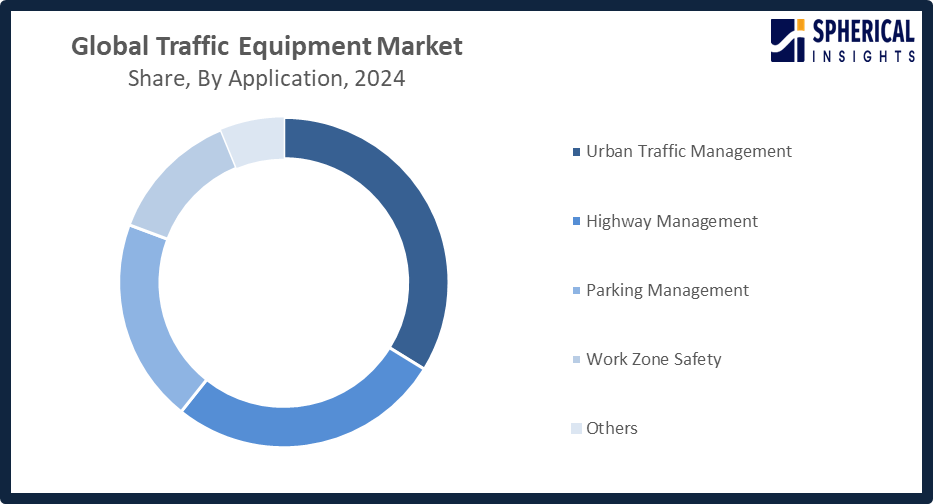
- The urban traffic management segment accounted for the highest market revenue in 2024, approximately 30%, and is anticipated to grow at a significant CAGR during the forecast period.
Based on the application, the traffic equipment market is divided into urban traffic management, highway management, parking management, work zone safety, and others. Among these, the urban traffic management segment accounted for the highest market revenue in 2024, approximately 30%, and is anticipated to grow at a significant CAGR during the forecast period. Rapid urbanization, rising vehicle density, urgent need to mitigate traffic congestion in cities, significant investment in smart cities initiatives, and adoption of AI-driven traffic systems are bolstering the urban traffic management market.
Get more details on this report -
Regional Segment Analysis of the Traffic Equipment Market
- North America (U.S., Canada, Mexico)
- Europe (Germany, France, U.K., Italy, Spain, Rest of Europe)
- Asia-Pacific (China, Japan, India, Rest of APAC)
- South America (Brazil and the Rest of South America)
- The Middle East and Africa (UAE, South Africa, Rest of MEA)
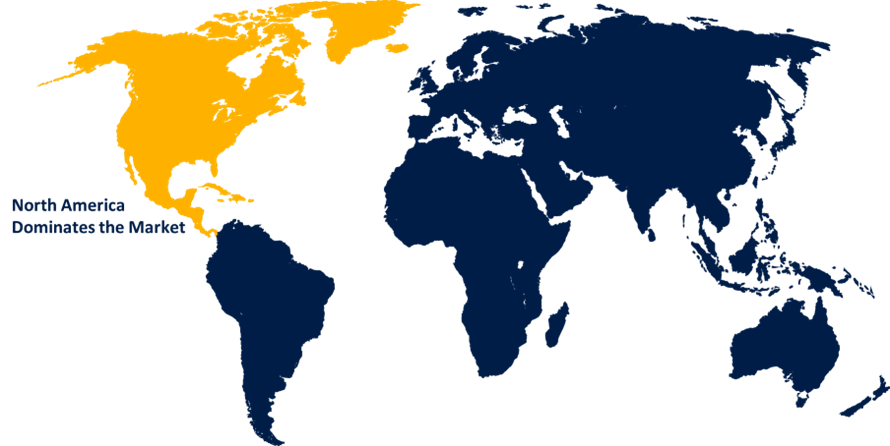
North America is anticipated to hold the largest share of the traffic equipment market over the predicted timeframe.
Get more details on this report -
North America is anticipated to hold the largest share of the traffic equipment market over the predicted timeframe. Strong government backing for continuous funding through infrastructure bills and road safety initiatives ensures steady demand for traffic equipment such as sensors, cameras, and control systems, which propel North America. The region's position is further reinforced by government investment in transportation infrastructure, early adoption of intelligent transportation systems (ITS), and advanced technological capabilities.
Government initiatives include USDOT's December 2024, to expand the use of Al in transportation systems, U.S. ITS deployment and Accelerating Deployment Program, August 2024 focusing on expanding connected vehicle systems, loT-based traffic infrastructure, and interoperable traffic technologies, Canada's Transport System Modernization & Technology Adoption, February 2024, supports the adoption of advanced traffic sensors, monitoring equipment, and data-driven traffic management systems.
Asia Pacific is expected to grow at a rapid CAGR in the traffic equipment market during the forecast period. China, India, Japan, and South Korea are among the nations making significant investments in intelligent traffic management systems, smart signals, surveillance cameras, and highway modernization projects to manage increasing congestion and improve road safety. The demand for sophisticated traffic equipment is further accelerated by the region's large population base, increasing urban traffic pressure, and strong policy support for modern transportation systems.
Government launches include India's ATMS on National Highways, February 2026, confirmed plans to deploy Al-based ATMS, Singapore's LTA, October 2025 for confirmed adaptive traffic signal control system called GLIDE and South Korea's February 2025 completed an ITS construction project supported by government subsidies (KRW 65 billion) and began implementing an expanded Smart Traffic Signal Operation System at major intersections.
Competitive Analysis:
The report offers the appropriate analysis of the key organizations/companies involved within the traffic equipment market, along with a comparative evaluation primarily based on their product offerings, business overviews, geographic presence, enterprise strategies, segment market share, and SWOT analysis. The report also provides an elaborate analysis focusing on the current news and developments of the companies, which includes product development, innovations, joint ventures, partnerships, mergers & acquisitions, strategic alliances, and others. This allows for the evaluation of the overall competition within the market.
List of Key Companies
- Siemens Mobility
- SWARCO AG
- KapschTrafficCom AG
- Cubic Corporation
- Thales Group
- Econolite Group, Inc.
- TransCore LP
- Q-Free ASA
- Iteris, Inc.
- Indra Sistemas, S.A.
- 3M Company
- Teledyne FLIR LLC
- Hikvision
- Conduent Inc.
- RoadSafe Traffic Systems, Inc.
- Others
Key Target Audience
- Market Players
- Investors
- End-users
- Government Authorities
- Consulting and Research Firm
- Venture capitalists
- Value-Added Resellers (VARs)
Recent Development
- In March 2026, At Intertraffic 2026, Indra Group showcased new connected vehicle technologies, advanced sensors, Al systems, and V2X communication solutions aimed at smart mobility and traffic infrastructure. Their innovations include gantry-free tolling, real-time vehicle detection and identification systems, and platforms for integrated urban/interurban traffic management.
- In February 2026, Street Smart officially launched Vision Suite, a new integrated traffic control platform at the 2026 ATSSA Annual Convention & Traffic Expo. The platform unifies signals, work zones, fleet operations, and site security under one system to provide real-time visibility, intelligent automation, and remote control across deployments, improving field safety and traffic operations.
- In June 2025, Indian Highways Management Company Ltd (IHMCL) rolled out an Al-powered Advanced Traffic Management System (ATMS) on the Dwarka Expressway capable of detecting 14 types of traffic violations in real time essentially a deployment of new traffic equipment technology by a corporate operator.
Market Segment
This study forecasts revenue at global, regional, and country levels from 2020 to 2035. Spherical Insights has segmented the traffic equipment market based on the below-mentioned segments:
Global Traffic Equipment Market, By Product
- Traffic Lights
- Traffic Safety Signs
- Traffic Barriers
- Traffic Cones
- Traffic Entry Gates
- Others
Global Traffic Equipment Market, By Technology
- Conventional Equipment
- Smart Equipment
Global Traffic Equipment Market, By Application
- Urban Traffic Management
- Highway Management
- Parking Management
- Work Zone Safety
- Others
Global Traffic Equipment Market, By Regional Analysis
- North America
- US
- Canada
- Mexico
- Europe
- Germany
- UK
- France
- Italy
- Spain
- Russia
- Rest of Europe
- Asia Pacific
- China
- Japan
- India
- South Korea
- Australia
- Rest of Asia Pacific
- South America
- Brazil
- Argentina
- Rest of South America
- Middle East & Africa
- UAE
- Saudi Arabia
- Qatar
- South Africa
- Rest of the Middle East & Africa
Frequently Asked Questions (FAQ)
-
1. Which technologies are shaping the traffic equipment market?AI, IoT, cloud computing, and V2X (vehicle-to-everything) communications are key technologies. These enable real-time traffic monitoring and predictive analytics. They also improve adaptive signal control and smart city integration.
-
2. How is AI used in traffic equipment?AI processes video and sensor data to detect violations, optimize signal timing, and predict congestion. It reduces human error and improves real-time decision-making.
-
3. How does traffic equipment improve road safety?By detecting violations, monitoring congestion, and managing work zones. Real-time alerts prevent accidents and enforce regulations effectively.
-
4. How do parking management systems impact cities?They optimize space usage, reduce congestion, and improve mobility. Smart meters, sensors, and mobile apps integrate with city traffic systems.
-
5. How does cloud computing affect traffic equipment?Cloud platforms store and analyze data from multiple locations. They enable centralized control, real-time analytics, and predictive traffic management.
-
6. What is the future outlook of the market?The market is expected to grow steadily with AI, smart city adoption, and government initiatives. Increasing focus on road safety and connected mobility will continue to drive demand.
Need help to buy this report?