Global Textile Waste Recycling Machine Market Size, Share, and COVID-19 Impact Analysis, By Machine Type (Mechanical Recycling Machines, Chemical Recycling Machines, and Thermal Recycling Machines), By Fabric Type (Cotton, Polyester, Nylon, Wool, and Others), By Capacity (Up to 1,000 kg/h, Up to 2,000 kg/h, Up to 3000 kg/h, and Above 3000 kg/h), By Application (Fiber-to-fiber Recycling, Non-fiber Applications, Apparel Manufacturing, Home Textiles, and Technical Textiles), and By Region (North America, Europe, Asia-Pacific, Latin America, Middle East, and Africa), Analysis and Forecast 2025 - 2035.
Industry: Machinery & Equipment
Global Textile Waste Recycling Machine Market Insights Forecasts to 2035
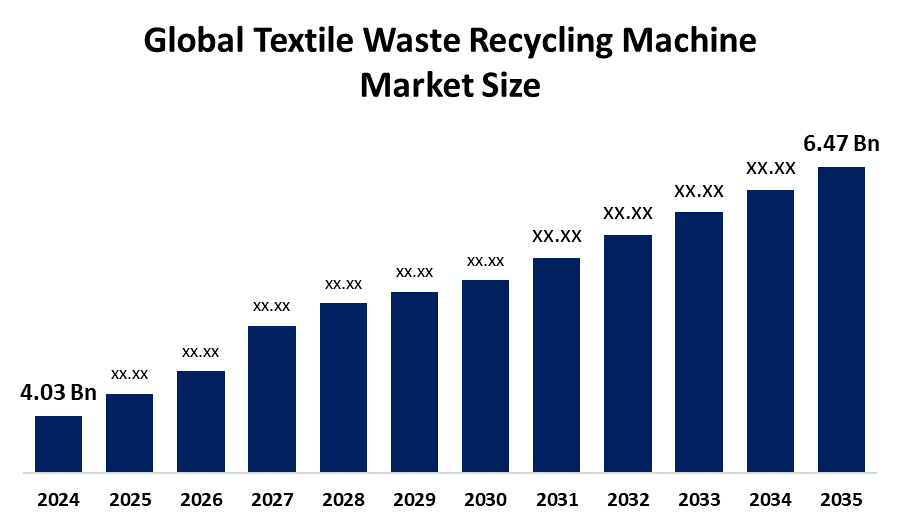
- The Global Textile Waste Recycling Machine Market Size Was Estimated at USD 4.03 Billion in 2024
- The Market Size is Expected to Grow at a CAGR of around 4.4% from 2025 to 2035
- The Worldwide Textile Waste Recycling Machine Market Size is Expected to Reach USD 6.47 Billion by 2035
- North America is expected to grow the fastest during the forecast period.
Get more details on this report -
According to a research report published by Spherical Insights and Consulting, the global textile waste recycling machine market size was worth around USD 4.03 billion in 2024 and is predicted to grow to around USD 6.47 billion by 2035 with a compound annual growth rate (CAGR) of 4.4% from 2025 to 2035. The market is growing due to rising environmental concerns, strict government regulations (like EU EPR) on waste reduction, and increased demand for sustainable fashion. Advancements in chemical/mechanical technologies enable efficient, high-quality recycling of complex, blended materials.
Market Overview
The global textile waste recycling machine market refers to industrial equipment designed to process discarded textiles, such as clothing, fabric scraps, and yarn waste, by using mechanical processes (shredding, carding) or chemical methods (using solvents) to break them down into reusable fibers, thereby reducing landfill waste and enabling sustainable production. These machines are used across applications like fiber-to-fiber recycling, apparel manufacturing, and technical textiles to create closed-loop systems. The market is gaining momentum due to the rapid growth of textile waste worldwide; according to global estimates, nearly 92 million tons of textile waste are generated annually, while less than 15% is recycled. Rising environmental concerns, stricter government regulations on waste disposal, and increasing demand for sustainable fashion are key drivers encouraging industries to adopt recycling technologies. Additionally, the global apparel industry produces more than 100 billion garments each year, creating substantial recycling opportunities.
Advancements in automated fiber separation, shredding, and sorting technologies are further improving efficiency, while investments in circular economy initiatives and sustainable textile production are creating significant market growth opportunities. In October 2025, the EU introduced the Amendment to the Waste Framework Directive (Directive (EU) 2025/1892), requiring Extended Producer Responsibility for textile producers. Companies must finance textile waste collection, sorting, and recycling. Member states must adopt the law by June 2027, with full implementation expected by mid-2028, boosting recycling infrastructure investment.
Textile Waste Recycling Machine Market Growth Factors
- Rising Global Textile Waste: The rapid growth of the fashion industry generates huge textile waste, increasing the demand for recycling machines. Globally, about 92 million tons of textile waste are produced each year, and much of it ends up in landfills. This growing waste crisis is pushing industries to adopt textile recycling technologies and machinery for efficient processing.
- Growing Demand for Sustainable and Circular Fashion: Consumers and fashion brands are increasingly focusing on sustainability and recycled materials. Global fiber production reached 124 million tonnes in 2023 and is expected to reach 160 million tonnes by 2030, which increases the need for recycling solutions and advanced textile recycling machines.
- Government Regulations and Recycling Initiatives: Many governments are introducing policies to reduce landfill waste and promote recycling. For example, the EU mandates separate textile waste collection by 2025, encouraging investments in recycling infrastructure and machinery. These regulations are significantly accelerating the adoption of textile waste recycling equipment worldwide.
Report Coverage
This research report categorizes the textile waste recycling machine market based on various segments and regions, forecasts revenue growth, and analyzes trends in each submarket. The report analyses the key growth drivers, opportunities, and challenges influencing the textile waste recycling machine market. Recent market developments and competitive strategies, such as expansion, type launch, development, partnership, merger, and acquisition, have been included to draw the competitive landscape in the market. The report strategically identifies and profiles the key market players and analyses their core competencies in each sub-segment of the textile waste recycling machine market.
Global Textile Waste Recycling Machine Market Report Coverage
| Report Coverage | Details |
|---|---|
| Base Year: | 2024 |
| Market Size in 2024: | USD 4.03 Billion |
| Forecast Period: | 2025-2035 |
| Forecast Period CAGR 2025-2035 : | 4.4% |
| 2035 Value Projection: | USD 6.47 Billion |
| Historical Data for: | 2020-2023 |
| No. of Pages: | 220 |
| Tables, Charts & Figures: | 87 |
| Segments covered: | By Machine Type, By Fabric Type, By Capacity, By Application, By Regional Analysis |
| Companies covered:: | Andritz AG, Pistoni SRL, Ecotex Group, Autefa Solutions, Loptex, Tomra Systems ASA, Dell’Orco & Villani, Laroche, Saurer Group, Balkan Textile Machinery, Rieter Group, HSN Machinery, Margasa Projects and Textile Engineering, SN Surgicare and Healthcare Science, and Others |
| Pitfalls & Challenges: | COVID-19 Impact, Challenges, Future, Growth, & Analysis |
Get more details on this report -
Driving Factors
The textile waste recycling machine market is driven by rapid technological advancements in recycling machinery, such as automated sorting and fiber-recovery systems, which are improving efficiency and reducing processing time. Increasing investments in recycling infrastructure by private companies and waste management firms are also supporting market expansion. Additionally, the growth of the global textile and apparel industry, which produces over 100 billion garments annually, creates significant post-industrial and post-consumer waste requiring recycling solutions. Rising corporate sustainability commitments and ESG goals are encouraging manufacturers to adopt recycling technologies to reduce environmental impact and recover valuable raw materials from discarded textiles.
Restraining Factors
The global textile waste recycling machine market faces several restraints due to high operational and technological challenges. Advanced recycling machines require high initial investment and maintenance costs, limiting adoption by small and medium enterprises. In addition, complex sorting of mixed-fiber textiles increases processing costs. Mechanical recycling can reduce fiber quality by 20-30% per cycle, restricting reuse in high-value products. Limited recycling infrastructure and inefficient waste collection systems in many regions further slow market growth.
Market Segmentation
Machine Type Insights
The mechanical recycling machines dominated the textile waste recycling machine market with the 58% market share, due to cost-effectiveness and operational simplicity. They enable large-scale shredding, sorting, and fiber regeneration while processing diverse fabric waste with minimal chemicals. Improved machine design preserves fiber quality, and easy integration with automated textile production lines supports widespread adoption and steady market growth.
The chemical recycling machines segment is the fastest growing segment with a significant CAGR during the forecast period, as its ability to process mixed and synthetic fibers such as polyester and nylon, which mechanical recycling cannot efficiently handle. Increasing demand for high-quality recycled fibers and closed-loop textile production is accelerating adoption.
Fabric Type Insights
The cotton dominated the market with the 45% market share, due to its widespread use, representing about 22% of global fiber production. Its natural, biodegradable fibers are easily processed by mechanical recycling machines. Strong demand for recycled cotton from fashion brands seeking sustainable sourcing and circular economy goals further drives this segment's growth and market leadership.
The polyester segment is the fastest growing segment with a significant CAGR during the forecast period, as fiber production (54%) creates massive waste volumes. Its fast growth is driven by innovations in chemical recycling that can break down complex blends into virgin-quality monomers, enabling true circularity for the ubiquitous synthetic material.
Capacity Insights
The up to 2,000 kg/h segment dominated the market with the 52% market share, owing to its optimal balance of industrial-scale output and manageable operational costs. These mid-range capacity machines are ideal for regional recycling facilities and textile collection centers, providing sufficient throughput to handle growing waste volumes without requiring the massive infrastructure investment of larger systems.
The above 3000 kg/h segment is the fastest growing segment with a notable CAGR during the forecast period, as demand from large-scale commercial recyclers and integrated textile mills. These high-capacity machines achieve economies of scale, processing massive waste volumes efficiently to meet stringent regulations and rising corporate sustainability targets.
Application Insights
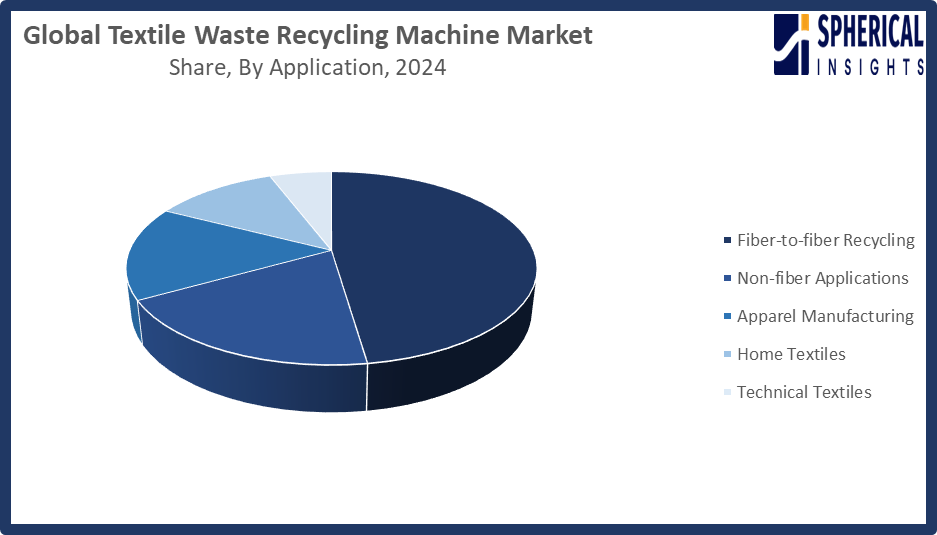
The fiber-to-fiber recycling segment dominated the market with the 48% market share, because it creates true circularity, transforming waste textiles directly into new fibers for apparel. This closed-loop model is highly valued by fashion brands pursuing sustainability goals and circular economy commitments, enabling them to reduce virgin material dependence while meeting consumer demand for environmentally responsible products.
The apparel manufacturing segment is the fastest growing segment for the foreseen period, due to brands integrating recycling in-house for supply chain control, cost efficiency, and sustainability targets. Direct fiber-to-yarn recycling reduces waste, secures material sources, and meets consumer demand for circular fashion, accelerating adoption across production facilities.
Get more details on this report -
Regional Segment Analysis of the Textile Waste Recycling Machine Market
- North America (U.S., Canada, Mexico)
- Europe (Germany, France, U.K., Italy, Spain, Rest of Europe)
- Asia-Pacific (China, Japan, India, Rest of APAC)
- South America (Brazil and the Rest of South America)
- The Middle East and Africa (UAE, South Africa, Rest of MEA)
Asia Pacific Market Trends
Asia Pacific dominated the textile waste recycling machine market with the 38% market share, due to its dominant textile manufacturing base and rising waste generation. Countries such as China, India, Bangladesh, and Vietnam produce a large portion of the world’s garments. The region accounts for over 55% of global textile production, generating significant post-industrial waste that requires recycling solutions. Additionally, the Asia Pacific produces millions of tons of textile waste annually, encouraging investments in recycling technologies. Government initiatives promoting circular economy practices and sustainable manufacturing, along with expanding recycling infrastructure, are further accelerating the adoption of textile waste recycling machines across the region. In October 2025, Saurer highlighted India as a key growth hub, introducing technologies like Zinser 51 and Autocoro 11 Recycling Xtreme. With its Karjan facility, Saurer emphasizes automation, digitalization, and sustainability, supporting India’s position as the second-largest ring-spinning market and a leader in recycled staple fiber production.
Indian Textile Waste Recycling Machine Market Trends
India's textile waste recycling machine market is growing rapidly, driven by approximately 7.8 million tons of annual textile waste generation and increasing demand for recycled yarn from domestic and international brands. Key trends include automated processing technologies adoption, with companies like Trützschler establishing multiple TRUECYCLED installations across spinning mills in Panipat, Coimbatore, and Tirupur, producing 8-36 tons of recycled yarn daily using over 50% pre-consumer waste. The India-EU Free Trade Agreement is further accelerating investments in European recycling machinery for export-quality production.
North America Market Trends
North America is the fastest growing market for the textile waste recycling machine, with an approximate 24% share, driven by rising textile waste and strong sustainability regulations. The United States alone generates around 17 million tons of textile waste annually, with only about 15% recycled, creating demand for recycling technologies. Increasing adoption of circular economy practices, investments in recycling infrastructure, and policies such as textile Extended Producer Responsibility (EPR) programs are encouraging companies to install advanced recycling machines. Additionally, growing consumer demand for sustainable fashion and recycled fibers is accelerating market growth across the region.
U. S. Textile Waste Recycling Machine Market Trends
The U.S. textile waste recycling machine market is growing rapidly, driven by rising sustainability initiatives and technological advancements. The U.S. textile recycling market is projected to reach $1.29 billion by 2032. Key trends include AI-powered sorting adoption, with companies like TOMRA implementing systems that improve processing speeds and accuracy while reducing labor dependency. This growth is further fueled by the EPA's focus on textile recycling through its Sustainable Materials Management Program and the fact that only 15% of textiles were recycled in 2021, creating significant expansion opportunities.
Europe Textile Waste Recycling Machine Market Trends
Europe is experiencing steady growth in the textile waste recycling machine market due to strict environmental regulations and strong circular economy initiatives. The European Union generates nearly 12.6 million tons of textile waste annually, yet only about 22% is separately collected for reuse or recycling. Policies such as mandatory separate textile waste collection by 2025 and upcoming Extended Producer Responsibility (EPR) schemes by 2027 are encouraging investment in textile recycling infrastructure and advanced recycling machines across countries like Germany, France, and the Netherlands.
U. K. Textile Waste Recycling Machine Market Trends
The U.K. is witnessing notable growth in the textile waste recycling machine market, characterized by rising textile waste generation and increasing circular economy initiatives. The UK produces around 3.26 million tonnes of textile waste annually, yet only about 16% is recycled, creating strong demand for recycling technologies. Additionally, 49% of used textiles are disposed of in general waste, encouraging investments in advanced textile recycling infrastructure and machinery.
Competitive Analysis:
The report offers the appropriate analysis of the key organizations/companies involved within the textile waste recycling machine market, along with a comparative evaluation primarily based on their type of offering, business overviews, geographic presence, enterprise strategies, segment market share, and SWOT analysis. The report also provides an elaborative analysis focusing on the current news and developments of the companies, which includes type development, innovations, joint ventures, partnerships, mergers & acquisitions, strategic alliances, and others. This allows for the evaluation of the overall competition within the market.
List of Key Companies
- Andritz AG
- Pistoni SRL
- Ecotex Group
- Autefa Solutions
- Loptex
- Tomra Systems ASA
- Dell'Orco & Villani
- Laroche
- Saurer Group
- Balkan Textile Machinery
- Rieter Group
- HSN Machinery
- Margasa Projects and Textile Engineering
- SN Surgicare and Healthcare Science
- Others
Key Target Audience
- Market Players
- Investors
- End-users
- Government Authorities
- Consulting and Research Firm
- Venture capitalists
- Value-Added Resellers (VARs)
Recent Development
- In October 2025, Tomra Recycling, part of Norway-based Tomra ASA, released its e-book “AI in Recycling: Unlocking New Possibilities”, highlighting how AI and deep learning enhance global recycling by enabling complex material sorting, autonomous systems, and improved circularity in waste management processes.
- In September 2024, AUTEFA Solutions showcased its latest nonwoven and fiber processing innovations at ITMA Asia + CITME in Shanghai. The company highlighted OCTIR wool carding sets designed for processing fine wool, cashmere, and silk, offering improved fiber control, higher throughput, enhanced yarn quality, and energy-efficient textile manufacturing solutions.
- In May 2024, Saurer showcased its latest spinning and twisting technologies at ITM Istanbul, featuring energy-efficient machines like Autoairo 11, Autocoro 11 Xtreme Edition, and Zinser 51. The innovations enable versatile yarn production, including recycled fibers, supporting sustainable, high-quality spinning for fashion, interior, and technical textiles.
- In February 2024, Dell’Orco & Villani, an Italian textile machinery leader, highlighted its advanced recycling machines capable of processing garments with buttons and zippers without pre-sorting. Featuring TWIN Carding Opener technology, these machines preserve fiber length, supporting efficient, customized textile waste recycling and strong global after-sales service.
- In December 2023, ANDRITZ launched a new textile recycling line at Sfilacciatura Negro’s plant in Biella, Italy, designed to process post-consumer textile waste. The automated system removes hard components, improves energy efficiency, and produces recycled fiber bales up to 350 kg, supporting circular textile production and expanding recycling capabilities.
- In October 2023, Loptex launched the Sorter Easy Link EXA, a modular fiber recycling system for pre- and post-consumer textile waste. Featuring advanced color-sorting cameras, KPI tracking, remote predictive maintenance, and Green Label certification, the system enhances sustainability, efficiency, and quality in fiber recycling operations.
Market Segment
This study forecasts revenue at global, regional, and country levels from 2020 to 2035. Spherical Insights has segmented the Textile Waste Recycling Machine market based on the below-mentioned segments:
Global Textile Waste Recycling Machine Market, By Machine Type
- Mechanical Recycling Machines
- Chemical Recycling Machines
- Thermal Recycling Machines
Global Textile Waste Recycling Machine Market, By Fabric Type
- Cotton
- Polyester
- Nylon
- Wool
- Others
Global Textile Waste Recycling Machine Market, By Capacity
- Up to 1,000 kg/h
- Up to 2,000 kg/h
- Up to 3000 kg/h
- Above 3000 kg/h
Global Textile Waste Recycling Machine Market, By Application
- Fiber-to-fiber Recycling
- Non-fiber Applications
- Apparel Manufacturing
- Home Textiles
- Technical Textiles
Global Textile Waste Recycling Machine Market, By Regional Analysis
- North America
- US
- Canada
- Mexico
- Europe
- Germany
- UK
- France
- Italy
- Spain
- Russia
- Rest of Europe
- Asia Pacific
- China
- Japan
- India
- South Korea
- Australia
- Rest of Asia Pacific
- South America
- Brazil
- Argentina
- Rest of South America
- Middle East & Africa
- UAE
- Saudi Arabia
- Qatar
- South Africa
- Rest of the Middle East & Africa
Frequently Asked Questions (FAQ)
-
How is the rising volume of global textile waste impacting the demand for textile waste recycling machines?The rising volume of textile waste is increasing the demand for recycling machines. Globally, about 92 million tons of textile waste are generated annually, while less than 15% is recycled, driving investments in advanced recycling technologies.
-
What key technological innovations are improving efficiency in the textile waste recycling machine market?Key technological innovations such as AI-based sorting, hyperspectral imaging, and automated recycling systems are improving efficiency in textile waste recycling machines. AI fiber-sorting technology can increase recycling efficiency by about 30%, while automated systems achieve over 95% material identification accuracy, enabling faster and more accurate textile waste processing.
-
How are circular economy initiatives influencing growth in the textile waste recycling machine industry?Circular economy initiatives are accelerating growth in the textile waste recycling machine industry, as only 0.3% of textile materials currently come from recycled sources, while 120 million tons of textile waste are generated annually, increasing demand for advanced recycling technologies.
-
What role does investment in sustainable infrastructure play in expanding the textile waste recycling machine market?Investment in sustainable infrastructure drives market expansion by enabling advanced systems for collection, sorting, and processing textile waste. The EPA's $100 million allocation under Biden's Investing in America agenda represents the largest recycling investment in 30 years, funding 25 communities through the Solid Waste Infrastructure for Recycling program.
-
How are automation and AI-based sorting technologies shaping trends in textile waste recycling machines?Automation and AI-based sorting technologies are transforming textile waste recycling machines by improving accuracy and speed. AI-driven systems can identify textile fibers with up to 97-99% accuracy and increase material recovery efficiency by about 30%, enabling faster, automated textile waste sorting and higher-quality recycled materials.
-
How are advancements in fiber recovery technologies influencing the future growth of the textile waste recycling machine market?Advancements in fiber recovery technologies, such as chemical depolymerization and enzyme-based recycling, are boosting textile recycling efficiency by up to 70%, enabling high-quality fiber regeneration and expanding the adoption of advanced textile waste recycling machines globally.
-
How are sustainability commitments from fashion brands shaping market trends in textile recycling equipment?Sustainability commitments from fashion brands are driving demand for textile recycling equipment, as 51% of brands now use recycled materials, and companies aim to reach 45% recycled polyester use by 2025, encouraging investment in advanced textile recycling technologies and machinery.
Need help to buy this report?