Global Tetrakis Hydroxymethyl Phosphonium Sulfate Market Size, Share, and COVID-19 Impact Analysis, By Function (Biocide, Iron Sulfide Scavenger, Flame Retardant, Tanning Agent, and Others), By Application (Oil and Gas, Agrochemicals, Water Treatment, Oilfield Chemicals, Personal Care, Textile, and Others), and By Region (North America, Europe, Asia-Pacific, Latin America, Middle East, and Africa), Analysis and Forecast 2025 - 2035
Industry: Chemicals & Materials
Global Tetrakis Hydroxymethyl Phosphonium Sulfate Market Size Insights Forecasts to 2035
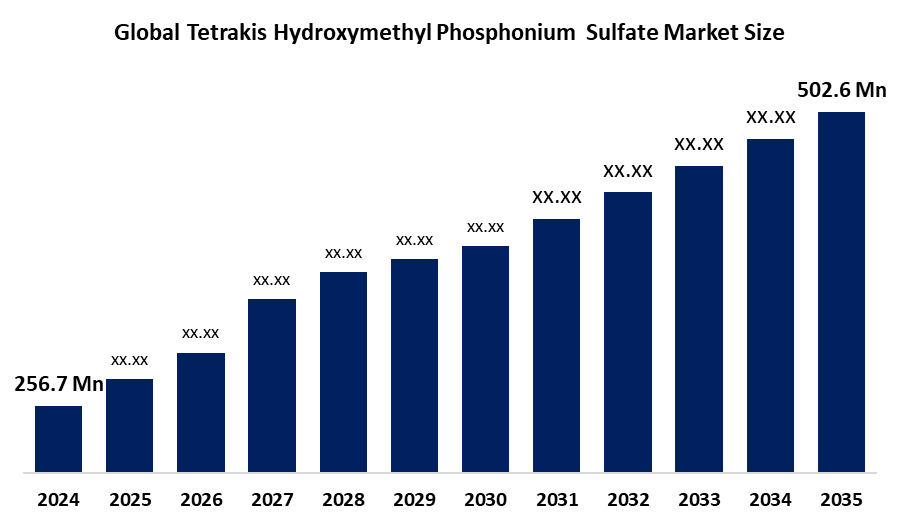
- The Global Tetrakis Hydroxymethyl Phosphonium Sulfate Market Size Was Estimated at USD 256.7 Million in 2024
- The Market Size is Expected to Grow at a CAGR of around 6.3% from 2025 to 2035
- The Worldwide Tetrakis Hydroxymethyl Phosphonium Sulfate Market Size is Expected to Reach USD 502.6 Million by 2035
- North America is expected to grow the fastest during the forecast period.
Get more details on this report -
According to a Research Report Published by Spherical Insights and Consulting, The Global Tetrakis Hydroxymethyl Phosphonium Sulfate Market Size was worth around USD 256.7 Million in 2024 and is predicted to Grow to around USD 502.6 Million by 2035 with a compound annual growth rate (CAGR) of 6.3% from 2025 to 2035. The global Tetrakis Hydroxymethyl Phosphonium Sulfate Market Size is growing due to increasing requests for environmentally safe and biodegradable biocides, which are used in water treatment and oil and gas operations, because of strict environmental regulations. The product achieves widespread use because it provides effective iron sulfide removal while serving as a safe replacement for dangerous conventional biocides.
Market Overview
The worldwide tetrakis hydroxymethyl phosphonium sulfate (THPS) market refers to the production and commercialization of THPS, which functions as a biocide, flame retardant, iron sulfide scavenger, and tanning agent throughout various industries from oil and gas to water treatment, textiles, leather and paper processing. The biofouling and corrosion control effectiveness of THPS results from its strong antimicrobial properties, while its flame-retardant characteristics improve safety in textile applications. The market experiences growth because industrial water treatment needs expand, oilfield operations increase, and environmental regulations require companies to use biodegradable, low-toxicity chemicals. The worldwide consumption of THPS reached more than 185000 metric tons in 2024, marking a 14 % increase from 2021, as industries increasingly adopt THPS for environmentally friendly processing methods.
The company has opportunities to create new eco-friendly products, to develop wastewater treatment solutions, and to expand its operations in fast-growing markets. The U.S. Environmental Protection Agency (EPA) released Draft PR Notice 2026-NEW in February 2026, which provides updated guidelines for minor registration amendments according to Federal Insecticide, Fungicide and Rodenticide Act (FIFRA) regulations. The proposal replaces PR Notice 98-10 because it establishes notification procedures for biocides that help companies to update THPS formulas more quickly while enabling them to develop nearly 20% of their low-toxicity products.
Report Coverage
This research report categorizes the global Tetrakis Hydroxymethyl Phosphonium Sulfate Market Size based on various segments and regions, forecasts revenue growth, and analyzes trends in each submarket. The report analyses the key growth drivers, opportunities, and challenges influencing the Tetrakis Hydroxymethyl Phosphonium Sulfate Market Size. Recent market developments and competitive strategies, such as expansion, type launch, development, partnership, merger, and acquisition, have been included to draw the competitive landscape in the market. The report strategically identifies and profiles the key market players and analyses their core competencies in each sub-segment of the Tetrakis Hydroxymethyl Phosphonium Sulfate Market Size.
Tetrakis Hydroxymethyl Phosphonium Sulfate Market Report Coverage
| Report Coverage | Details |
|---|---|
| Base Year: | 2024 |
| Market Size in 2024: | USD 256.7 Million |
| Forecast Period: | 2025-2035 |
| Forecast Period CAGR 2025-2035 : | CAGR of 6.3% |
| 2035 Value Projection: | USD 502.6 Million |
| Historical Data for: | 2020-2023 |
| No. of Pages: | 240 |
| Tables, Charts & Figures: | 120 |
| Segments covered: | By Function, By Application |
| Companies covered:: | Arkema, Clariant AG, DuPont, Solvay S.A., Merck KGaA, Prasol Chemicals, Changshu NewTech Chemicals, SMC Global, FINORIC LLC, Zhejiang Xinhua Chemical, Hubei Xingfa Chemicals Group, IRO GROUP INC., Jiangsu Danai Chemical, Jiangxi Fuerxin Medicine Chemical, and other key players |
| Pitfalls & Challenges: | COVID-19 Empact, Challenge, Future, Growth, & Analysis |
Get more details on this report -
Driving Factors
The global tetrakis hydroxymethyl phosphonium sulfate (THPS) market is driven by its extensive use as a biocide, flame retardant, and iron sulfide scavenger in oil & gas and water treatment industries. Market growth receives support from three main factors, which include expanding industrial activities, new environmental regulations and rising demand for sustainable chemical products. The main factor that drives market growth stems from increasing oil and gas operations because THPS helps improve operational efficiency through its ability to control bacterial growth and eliminate iron sulfide, which forms water-soluble complexes. The August 2025 drilling surge in the United States increased THPS needs because Baker Hughes reported North American rig counts increased from 707 to 724, which included a rise in U.S. rigs from 539 to 542, thus creating a higher need for THPS in biocidal uses.
Restraining Factors
The global Tetrakis Hydroxymethyl Phosphonium Sulfate Market Size faces restrictions because of strict environmental regulations, which limit phosphorus discharge, together with high raw material expenses and competition from other biocidal products. THPS degrades into phosphorus byproducts, which are restricted by wastewater nutrient limits under wastewater treatment standards. The American Chemistry Council reports that U.S. specialty chemicals production experienced a 3.2% decline in 2024 because of mounting regulatory pressures.
Market Segmentation
The Tetrakis Hydroxymethyl Phosphonium Sulfate Market Size share is classified into function and application.
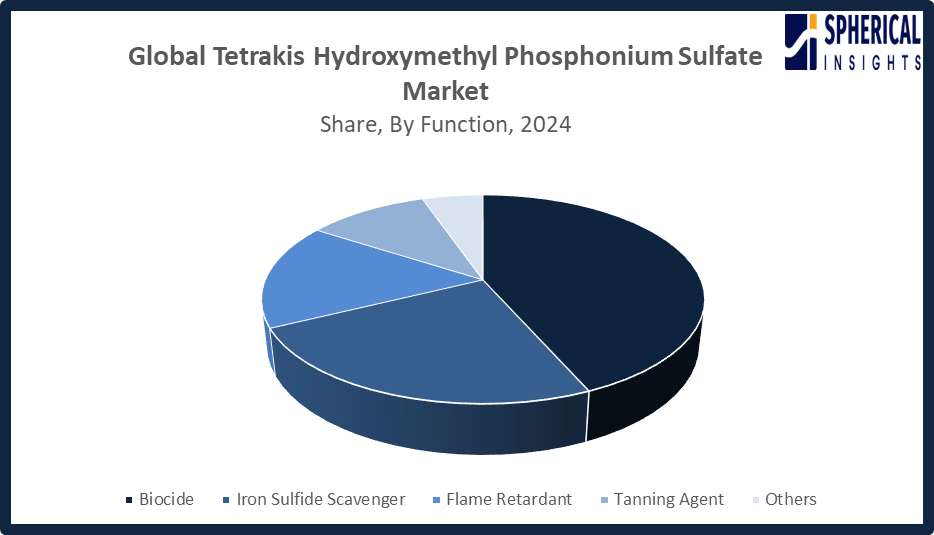
- The biocide segment dominated the market in 2024, approximately 43% and is projected to grow at a substantial CAGR during the forecast period.
Based on the function, the Tetrakis Hydroxymethyl Phosphonium Sulfate Market Size is divided into biocide, iron sulfide scavenger, flame retardant, tanning agent, and others. Among these, the biocide segment dominated the market in 2024, approximately 43% and is projected to grow at a substantial CAGR during the forecast period. The segment's leadership demonstrated its best possible performance through THPS, which exhibited strong antibacterial properties and maintained environmental safety for water treatment, oilfield operations and paper manufacturing. The industry expanded its antimicrobial products because regulations pushed companies to develop safer antibacterial solutions. North American, European and Asia-Pacific industries switched from using persistent biocides to THPS because of its ability to break down and its minimal environmental hazards.
Get more details on this report -
- The oil and gas segment accounted for the highest market revenue in 2024, approximately 41% and is anticipated to grow at a significant CAGR during the forecast period.
Based on the application, the Tetrakis Hydroxymethyl Phosphonium Sulfate Market Size is divided into oil and gas, agrochemicals, water treatment, oilfield chemicals, personal care, textile, and others. Among these, the oil and gas segment accounted for the highest market revenue in 2024, approximately 42% and is anticipated to grow at a significant CAGR during the forecast period. This dominance was driven by THPS’s strong microbial control in drilling fluids and produced-water systems. Widely used in upstream and midstream operations, it combats sulfate-reducing bacteria that cause corrosion and hydrogen sulfide. Sulfate-reducing bacteria alone contribute to over 40% of microbial-induced corrosion cases in oilfields, with annual industry losses estimated at $2 billion. Its rapid degradation, low bioaccumulation, and high solubility make it safer than aldehyde biocides, supporting sustainable oilfield water management.
Regional Segment Analysis of the Tetrakis Hydroxymethyl Phosphonium Sulfate Market Size
- North America (U.S., Canada, Mexico)
- Europe (Germany, France, U.K., Italy, Spain, Rest of Europe)
- Asia-Pacific (China, Japan, India, Rest of APAC)
- South America (Brazil and the Rest of South America)
- The Middle East and Africa (UAE, South Africa, Rest of MEA)
Asia Pacific is anticipated to hold the largest share of the Tetrakis Hydroxymethyl Phosphonium Sulfate Market Size over the predicted timeframe.

Get more details on this report -
Asia Pacific is anticipated to hold the largest share of the Tetrakis Hydroxymethyl Phosphonium Sulfate Market Size over the predicted timeframe. Asia Pacific is expected to hold the 41% share of the tetrakis hydroxymethyl phosphonium sulfate (THPS) market, driven by rapid industrialization, expanding oil and gas exploration, and rising demand for industrial water treatment chemicals. China leads due to strong oilfield and textile activities, while India benefits from expanding water treatment infrastructure. Japan and South Korea support growth through advanced manufacturing and strict wastewater regulations, encouraging biodegradable biocides. In February 2026, India’s Union Budget allocated INR 600 crore (USD 72 million) for three Chemical Parks. The initiative supports specialty chemicals, including biocides and phosphorus compounds, boosting domestic production. It may reduce 70% import reliance and raise THPS-related output by 5-10%.
North America is expected to grow at a rapid CAGR in the Tetrakis Hydroxymethyl Phosphonium Sulfate Market Size during the forecast period. North America is expected to have a 25% share in the tetrakis hydroxymethyl phosphonium sulfate (THPS) market, driven by expanding shale oil and gas production, advanced water treatment infrastructure, and strict environmental regulations favoring low-toxicity biocides. The United States leads due to active shale drilling and rising produced-water management needs, while Canada supports growth through oil sands and wastewater treatment projects. In June 2025, the U.S. EPA finalised the 2026 Pesticide General Permit, effective October 31, 2026, regulating biocide discharges, including THPS, in oil and gas operations. The rule favors low-persistence products, potentially raising THPS demand 5-7% in compliant sectors, while increasing monitoring costs by 10–15%.
Europe’s tetrakis hydroxymethyl phosphonium sulfate (THPS) market is driven by strict environmental regulations, advanced water treatment systems, and strong sustainability targets. Germany, France, and the United Kingdom lead adoption due to tight wastewater standards and industrial hygiene norms. Germany’s strong chemical sector supports demand, while the UK and France promote eco-friendly biocides. In January 2026, the European Commission launched a public consultation to review the Biocidal Products Regulation (EU) No 528/2012 through 2027.
Competitive Analysis:
The report offers the appropriate analysis of the key organizations/companies involved within the Tetrakis Hydroxymethyl Phosphonium Sulfate Market Size, along with a comparative evaluation primarily based on their type of offering, business overviews, geographic presence, enterprise strategies, segment market share, and SWOT analysis. The report also provides an elaborative analysis focusing on the current news and developments of the companies, which includes type development, innovations, joint ventures, partnerships, mergers & acquisitions, strategic alliances, and others. This allows for the evaluation of the overall competition within the market.
List of Key Companies
- Arkema
- Clariant AG
- DuPont
- Solvay S.A.
- Merck KGaA
- Prasol Chemicals
- Changshu NewTech Chemicals
- SMC Global
- FINORIC LLC
- Zhejiang Xinhua Chemical
- Hubei Xingfa Chemicals Group
- IRO GROUP INC.
- Jiangsu Danai Chemical
- Jiangxi Fuerxin Medicine Chemical
- Others
Key Target Audience
- Market Players
- Investors
- End-users
- Government Authorities
- Consulting and Research Firm
- Venture capitalists
- Value-Added Resellers (VARs)
Recent Development
- In December 2025, the U.S. EPA continued FIFRA registration reviews, promoting low-toxicity biocides like THPS for oilfield use. Nearly 45% of policies prioritized biodegradable alternatives. THPS approvals supported 30% growth in compliant oil and gas applications, while stricter phosphorus discharge limits raised user compliance costs by 10–15%.
- In November 2025, Clariant announced a strategic joint venture with FUHUA to develop non-halogenated, phosphorus-based flame retardants. Subject to regulatory approvals, the partnership targets next-generation solutions for construction, automotive, and electronics sectors amid tightening environmental and technical regulations.
- In March 2022, SMC Global expanded its Middle East and Africa presence by opening a distribution facility in Jebel Ali Free Trade Zone (JAFZA). The hub supports specialty oilfield biocides, including THPS and glutaraldehyde, strengthening regional supply and serving West African and South American markets.
Market Segment
This study forecasts revenue at global, regional, and country levels from 2020 to 2035. Spherical Insights has segmented the Tetrakis Hydroxymethyl Phosphonium Sulfate Market Size based on the below-mentioned segments:
Global Tetrakis Hydroxymethyl Phosphonium Sulfate Market Size, By Function
- Biocide
- Iron Sulfide Scavenger
- Flame Retardant
- Tanning Agent
- Others
Global Tetrakis Hydroxymethyl Phosphonium Sulfate Market Size, By Application
- Oil and Gas
- Agrochemicals
- Water Treatment
- Oilfield Chemicals
- Personal Care
- Textile
- Others
Global Tetrakis Hydroxymethyl Phosphonium Sulfate Market Size, By Regional Analysis
- North America
- US
- Canada
- Mexico
- Europe
- Germany
- UK
- France
- Italy
- Spain
- Russia
- Rest of Europe
- Asia Pacific
- China
- Japan
- India
- South Korea
- Australia
- Rest of Asia Pacific
- South America
- Brazil
- Argentina
- Rest of South America
- Middle East & Africa
- UAE
- Saudi Arabia
- Qatar
- South Africa
- Rest of the Middle East & Africa
Frequently Asked Questions (FAQ)
-
1. How do stringent environmental regulations like REACH and EPA mandates impact THPS production costs and overall market accessibility?Stringent regulations increase THPS production costs by requiring compliance measures, testing, and registration. This creates market barriers for smaller manufacturers while favoring established players who can absorb these expenses.
-
2. How have fluctuations in crude oil prices impacted demand for THPS in oilfield chemical applications during 2024-2025?Fluctuations in crude oil prices during 2024-2025 impacted THPS demand in oilfield applications. Brent crude averaged $80.00/barrel in 2024 but declined to $69.00/barrel in 2025, a 13.6% decrease. Lower oil prices reduced drilling activity and operator capital expenditure, limiting demand for THPS biocides in oilfield operations.
-
3. How are technological advancements in production methods affecting THPS manufacturing efficiency and environmental compliance?Technological advancements enable more efficient synthesis routes with higher yields and reduced waste, lowering production costs while improving environmental compliance through minimized phosphorus by-product generation and reduced energy consumption.
-
4. How does competition from alternative biocides like glutaraldehyde impact THPS market penetration in water treatment applications?Glutaraldehyde's lower cost and established efficacy in certain water systems create price competition, limiting THPS market penetration despite THPS's superior biodegradability and environmental profile in regulated applications.
-
5. How do FDA food contact substance regulations impact THPS market opportunities in paper and packaging applications?FDA regulations requiring Food Contact Notifications (FCNs) create market barriers. Only FCN No. 955, effective since 2010, permits THPS as a preservative in paper coatings at levels not exceeding 400 ppm, limiting market access to approved suppliers and applications.
-
6. What impact do trade policies between China and Western countries have on global THPS supply chains and pricing structures?Trade policies between China and Western countries disrupt global THPS supply chains, with the Asia Pacific serving as a major production and export base. These tensions increase costs and delays, forcing manufacturers to restructure logistics. Approximately 200-300 thousand tonnes of global THPS production in 2026 remains concentrated in Asia, making pricing vulnerable to tariff-related volatility.
-
7. How is the textile industry's demand for flame retardants and antimicrobial treatments driving THPS adoption across global manufacturing hubs?Rising global safety standards and demand for antimicrobial textiles are driving THPS adoption. As an effective, formaldehyde-free flame retardant and biocide, it is increasingly used in manufacturing hubs to meet stringent regulations.
Need help to buy this report?