Global Synthetic And Bio Emulsion Polymers Market Size, Share, and COVID-19 Impact Analysis, By Polymer Type (Acrylics, Vinyl Acetate Polymers, Styrene-Butadiene Latex, Polyurethane Dispersions, Bio-Based Emulsion Polymers, and Others), By Renewable Content (Synthetic Emulsion Polymers Less Than 24% and Bio-Based Emulsion Polymers More Than 25%), By Application (Paints & Coatings, Adhesives & Sealants, Paper & Paperboard Coatings, Textiles & Nonwovens, Construction & Cement Modification, and Others), and By Region (North America, Europe, Asia-Pacific, Latin America, Middle East, and Africa), Analysis and Forecast 2025 - 2035
Industry: Chemicals & Materials
Global Synthetic And Bio Emulsion Polymers Market Insights Forecasts to 2035
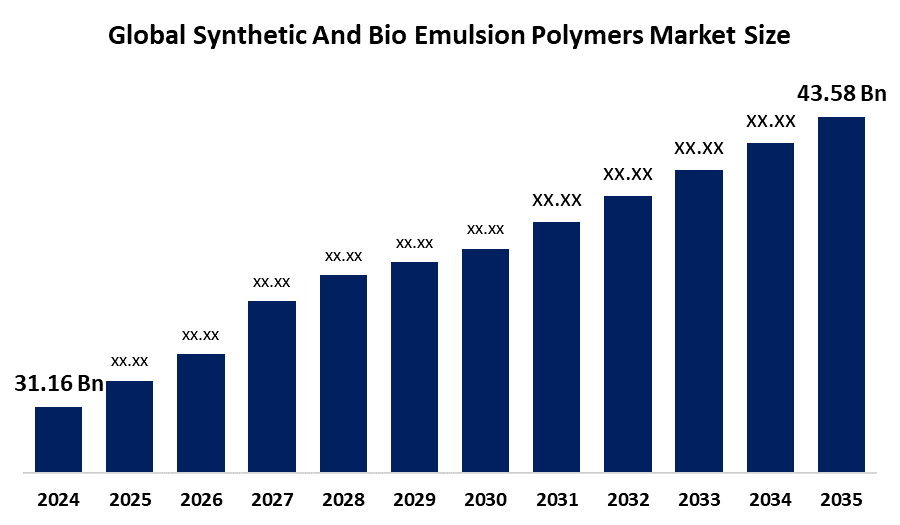
- The Global Synthetic And Bio Emulsion Polymers Market Size Was Estimated at USD 31.16 Billion in 2024
- The Market Size is Expected to Grow at a CAGR of around 3.1% from 2025 to 2035
- The Worldwide Synthetic And Bio Emulsion Polymers Market Size is Expected to Reach USD 43.58 Billion by 2035
- North America is expected to grow the fastest during the forecast period.
Get more details on this report -
According to a Research Report Published by Spherical Insights and Consulting, The Global Synthetic And Bio Emulsion Polymers Market Size was Worth Around USD 31.16 Billion in 2024 and is Predicted to Grow to Around USD 43.58 Billion by 2035 with a Compound Annual Growth Rate (CAGR) of 3.1% from 2025 to 2035. Global innovations in sustainable material development, AI-driven production, expansion of bio-based monomers, and increasing advanced polymerization techniques and automation are all driving opportunities in the synthetic and bio emulsion polymers market.
Market Overview
The global industry segment devoted to worldwide production, distribution, and consumption of polymer dispersions formed through emulsion polymerization, in which monomers are polymerized in an aqueous medium to create stable colloidal systems used as binders, film-formers, and performance enhancers is known as the synthetic and bio emulsion polymers market. These include development of low-VOC and zero-VOC water-based formulations, nano-emulsion technologies, bio-based polymer chemistry, and high-performance specialty polymers with enhanced durability, adhesion, flexibility, and environmental resistance. Government regulations and policy frameworks play a critical role in shaping the market, particularly through environmental standards. For example,In 2023, the U.S. TSCA law monitors over 84,000 chemical substances supporting innovation and safer, bio-based alternatives in polymers promoting the shift toward water-based and low-VOC emulsion polymers.
In February 2023, India’s Ministry of Chemicals & Fertilizers capital investment outlay increased to Rs10 lakh crore, a major rise in infrastructure spending. This directly boosts demand for paints, coatings, adhesives, and construction chemicals, all key applications of emulsion polymers.
Report Coverage
This research report categorizes the synthetic and bio emulsion polymers market based on various segments and regions, forecasts revenue growth, and analyzes trends in each submarket. The report analyses the key growth drivers, opportunities, and challenges influencing the synthetic and bio emulsion polymers market. Recent market developments and competitive strategies, such as expansion, product launch, development, partnership, merger, and acquisition, have been included to draw the competitive landscape in the market. The report strategically identifies and profiles the key market players and analyses their core competencies in each sub-segment of the synthetic and bio emulsion polymers market.
Global Synthetic And Bio Emulsion Polymers Market Report Coverage
| Report Coverage | Details |
|---|---|
| Base Year: | 2024 |
| Market Size in 2024: | USD 31.16 Billion |
| Forecast Period: | 2024-2035 |
| Forecast Period CAGR 2024-2035 : | 3.1% |
| 2035 Value Projection: | USD 43.58 Billion |
| Historical Data for: | 2020-2023 |
| No. of Pages: | 240 |
| Tables, Charts & Figures: | 100 |
| Segments covered: | By Application ,By Renewable Content |
| Companies covered:: | BASF SE, Dow Inc., Arkema SA, Wacker Chemie AG, Celanese Corporation, Synthomer plc, DIC Corporation, Clariant AG, Lubrizol Corporation, Solvay S.A., Asahi Kasei Corporation, Trinseo S.A., Allnex GmbH, Covestro AG, AkzoNobel, and Other Key Players |
| Pitfalls & Challenges: | COVID-19 Empact, Challenges, Future, Growth, & Analysis |
Get more details on this report -
Driving Factors
Rapid technological innovation is one of the main drivers of the Global Synthetic And Bio Emulsion Polymers Market Size growth. Rising demand from end-use industries, increasing urbanization and infrastructure development worldwide, which is the main factor driving the market for synthetic and bio emulsion polymers. In this field, innovation and investment are driven by the development of low-VOC and water-based formulations, bio-based polymers from renewable sources, nano-emulsion technologies, and high-performance materials with improved durability, flexibility, and environmental resistance.
In March 2023, the USDA officially announced and launched the inaugural National Biobased Products Day, highlighting federal efforts to expand the use and commercialization of biobased products, including bio-based polymers used in coatings, adhesives, and related applications.
Restraining Factors
High development and deployment costs, fluctuations in global economic conditions, supply chain disruptions, performance limitations compared to conventional synthetic alternative, inconsistent availability of bio-based input, and need for significant capital investment are the main factors restricting the synthetic and bio emulsion polymers market.
Market Segmentation
The Synthetic And Bio Emulsion Polymers Market share is classified into polymer type, renewable content, and application.
- The acrylics segment dominated the market in 2024, approximately 42%, and is projected to grow at a substantial CAGR during the forecast period.
Based on the polymer type, the Global Synthetic And Bio Emulsion Polymers Market Size is divided into acrylics, vinyl acetate polymers, styrene-butadiene latex, polyurethane dispersions, bio-based acrylics polymers, and others. Among these, the acrylics segment dominated the market in 2024, approximately 42%, and is projected to grow at a substantial CAGR during the forecast period. The growing need for low volatile organic compound emissions, excellent durability, superior versatility, high weather resistance, and strong adhesion for high demand applications, is driving the acrylics industry.
- The synthetic emulsion polymers less than 24% segment accounted for the largest share in 2024, approximately 95%, and is anticipated to grow at a significant CAGR during the forecast period.
Based on the renewable content, the Global Synthetic And Bio Emulsion Polymers Market Size is divided into synthetic emulsion polymers less than 24% and bio-based emulsion polymers more than 25%. Among these, the synthetic emulsion polymers less than 24% segment accounted for the largest share in 2024, approximately 95%, and is anticipated to grow at a significant CAGR during the forecast period. Superior cost-efficiency, established manufacturing infrastructure, high performance in various applications, and supports large scale production is driving the synthetic emulsion polymers less than 24% industry.
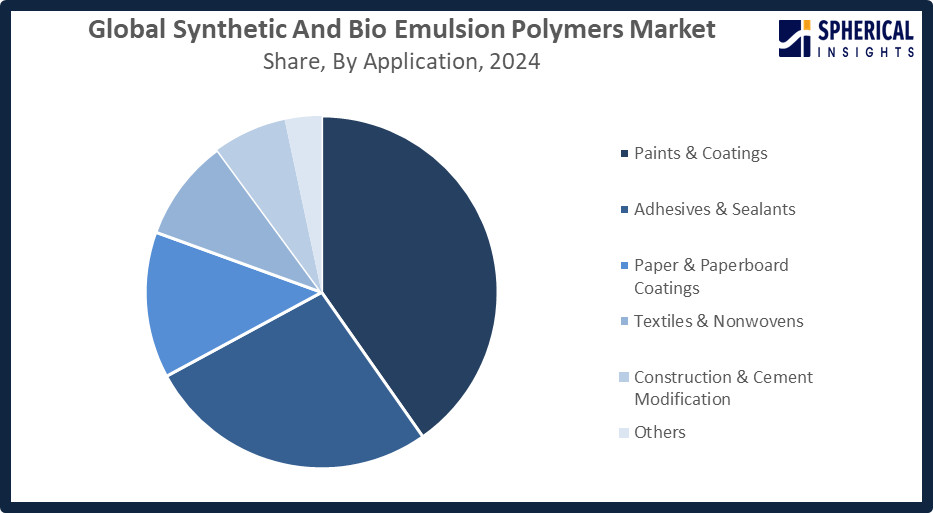
- The paints & coatings segment accounted for the highest market revenue in 2024, approximately 46%, and is anticipated to grow at a significant CAGR during the forecast period.
Based on the application, the Global Synthetic And Bio Emulsion Polymers Market Size is divided into paints & coatings, adhesives & sealants, paper & paperboard coatings, textiles & nonwovens, construction & cement modification, and others. Among these, the paints & coatings segment accounted for the highest market revenue in 2024, approximately 46%, and is anticipated to grow at a significant CAGR during the forecast period. High demand from booming construction and automotive sectors, mandatory regulatory shift towards low VOC products, and widely used in both interior and exterior applications bolstering paints & coatings market.
Get more details on this report -
Regional Segment Analysis of the Synthetic And Bio Emulsion Polymers Market
- North America (U.S., Canada, Mexico)
- Europe (Germany, France, U.K., Italy, Spain, Rest of Europe)
- Asia-Pacific (China, Japan, India, Rest of APAC)
- South America (Brazil and the Rest of South America)
- The Middle East and Africa (UAE, South Africa, Rest of MEA)
Asia Pacific is anticipated to hold the largest share of the synthetic and bio emulsion polymers market over the predicted timeframe.
Asia Pacific is anticipated to hold the largest share of the Global Synthetic And Bio Emulsion Polymers Market Size over the predicted timeframe. China, India, and Japan are experiencing massive infrastructure development and construction growth. Strong government backing for industrial growth, sustainable materials adoption, cost-effective production, and massive infrastructure development and construction growth are what propel Asia Pacific. The region's position is further reinforced by government programs promote industrial expansion, sustainability, and technological adoption and also provide financial incentives, subsidies, and research grants to encourage innovation in bio-based and sustainable polymer technologies.

Get more details on this report -
Government initiatives are accelerating the shift toward sustainable polymers. In China, the city of Huaihua announced in March 2024 a major investment of 2.187 billion yuan to develop a complete bio-based industry chain. Meanwhile, Japan introduced the Act on Promotion of Resource Circulation for Plastics in April 2022, encouraging the use of recycled and bio-based plastics—directly supporting the adoption of sustainable polymers.
North America is expected to grow at a rapid CAGR in the Global Synthetic And Bio Emulsion Polymers Market Size during the forecast period. United States and Canada are among the nations making significant investments in the development of high-performance, low-VOC, and bio-based formulations. The demand for synthetic and bio emulsion polymers is further accelerated by the region's major federal and state-level funding for sustainable chemical technologies, green manufacturing, and circular economy projects for innovation and scaling of bio-based polymers.
Government initiatives are accelerating innovation in sustainable polymers. In the United States, the U.S. Economic Development Administration awarded approximately USD51 million in July 2024 to the Sustainable Polymers Tech Hub to strengthen the polymer industry. Additionally, the U.S. National Science Foundation launched a USD9.5 million interdisciplinary funding initiative called SPEED in May 2024, supporting safe, sustainable, and high-value polymers. Meanwhile, in Canada, Western Economic Diversification Canada announced a USD1 million investment in September 2018 to support research into biodegradable plastics and green polymer technologies.
Competitive Analysis:
The report offers the appropriate analysis of the key organizations/companies involved within the Global Synthetic And Bio Emulsion Polymers Market Size, along with a comparative evaluation primarily based on their product of offering, business overviews, geographic presence, enterprise strategies, segment market share, and SWOT analysis. The report also provides an elaborative analysis focusing on the current news and developments of the companies, which includes product development, innovations, joint ventures, partnerships, mergers & acquisitions, strategic alliances, and others. This allows for the evaluation of the overall competition within the market.
List of Key Companies
- BASF SE
- Dow Inc.
- Arkema SA
- Wacker Chemie AG
- Celanese Corporation
- Synthomer plc
- DIC Corporation
- Clariant AG
- Lubrizol Corporation
- Solvay S.A.
- Asahi Kasei Corporation
- Trinseo S.A.
- Allnex GmbH
- Covestro AG
- AkzoNobel
- Others
Key Target Audience
- Market Players
- Investors
- End-users
- Government Authorities
- Consulting and Research Firm
- Venture capitalists
- Value-Added Resellers (VARs)
-
In February 2026, Henkel Adhesive Technologies announced a strategic collaboration with Sekab to integrate bio-based raw materials into high-performance industrial adhesives. This initiative aims to accelerate the transition from fossil-based to renewable inputs and supports sustainability in polymer-based systems, including emulsion adhesives.
-
In April 2025, Lubrizol launched Carbopol® BioSense, its first readily biodegradable ingredient within the Carbopol portfolio. Designed for emulsion systems, it delivers high sensory performance along with strong sustainability credentials, supporting applications in personal care and other formulations.
-
In February 2025, AkzoNobel introduced a new waterborne wood coating with 20% bio-based content under its Sikkens Wood Coatings line. This launch highlights advancements in sustainable emulsion-based products using renewable raw materials while maintaining high performance.
Market Segment
This study forecasts revenue at global, regional, and country levels from 2020 to 2035. Spherical Insights has segmented the Global Synthetic And Bio Emulsion Polymers Market Size based on the below-mentioned segments:
Global Synthetic And Bio Emulsion Polymers Market, By Polymer Type
- Acrylics
- Vinyl Acetate Polymers
- Styrene-Butadiene Latex
- Polyurethane Dispersions
- Bio-Based Emulsion Polymers
- Others
Global Synthetic And Bio Emulsion Polymers Market, By Renewable Content
- Synthetic Emulsion Polymers Less Than 24%
- Bio-Based Emulsion Polymers More Than 25%
Global Synthetic And Bio Emulsion Polymers Market, By Application
- Paints & Coatings
- Adhesives & Sealants
- Paper & Paperboard Coatings
- Textiles & Nonwovens
- Construction & Cement Modification
- Others
Global Synthetic And Bio Emulsion Polymers Market, By Regional Analysis
- North America
- US
- Canada
- Mexico
- Europe
- Germany
- UK
- France
- Italy
- Spain
- Russia
- Rest of Europe
- Asia Pacific
- China
- Japan
- India
- South Korea
- Australia
- Rest of Asia Pacific
- South America
- Brazil
- Argentina
- Rest of South America
- Middle East & Africa
- UAE
- Saudi Arabia
- Qatar
- South Africa
- Rest of the Middle East & Africa
Frequently Asked Questions (FAQ)
-
1. What technological advancements are shaping the synthetic and bio emulsion polymers market?Advances include low-VOC formulations, biodegradable polymers, high-performance waterborne emulsions, and smart coatings that improve durability, adhesion, and environmental performance.
-
2. How is environmental regulation impacting the market?Regulations like VOC limits and sustainability mandates are pushing manufacturers toward waterborne and bio-based emulsions, accelerating adoption and innovation.
-
3. What are emerging trends in the market?Trends include bio-based emulsions, hybrid polymers, circular economy integration, smart coatings, and waterborne low-VOC technologies.
-
4. Can bio-based polymers match synthetic performance?Modern bio-based emulsions can achieve comparable adhesion, durability, and chemical resistance in many applications, though cost and specialized performance can remain barriers.
-
5. What is the main difference between synthetic and bio-based polymers?Synthetic polymers are primarily fossil-fuel derived, while bio-based polymers come from renewable resources, providing sustainability benefits and often reduced environmental impact.
-
6. What is the future outlook of the market?The market is expected to grow steadily, driven by sustainability, urbanization, industrial demand, and technological advancements in bio-based and high-performance emulsion polymers across global regions.
Need help to buy this report?