Global Sports Nutrition Ingredients Market Size, Share, and COVID-19 Impact Analysis, By Ingredient Type (Protein, Probiotics & Specialty Amino Acids, Vitamins & Minerals, Collagen & Botanicals, and Carbohydrates & Energy Ingredients), By Product Type (Dietary Supplements, Functional Sports & Hydration Beverages, Nutrition Bars & Snacks, Meal Replacements & Ready-to-Eat Packs, and Energy Shots & Gels), By Application (Professional & Semi-professional Athletes, Recreational Fitness Enthusiasts and Lifestyle Consumers, and Others), and By Region (North America, Europe, Asia-Pacific, Latin America, Middle East, and Africa), Analysis and Forecast 2025 - 2035
Industry: Food & Beverages
Key Market Trends & Opportunities
The sports nutrition ingredients market has a number of opportunities to grow, due to the inclination towards developing products tailored to women’s specific physiological needs and health, growth in gummies and functional food products, and development of innovative plant-based proteins.
- Trends towards personalized nutrition
- Demand for ready-to-drink beverages, energy bars, and fast-dissolving convenient formats
- Focus on plant-based and sustainable alternatives
Global Sports Nutrition Ingredients Market Insights Forecasts to 2035
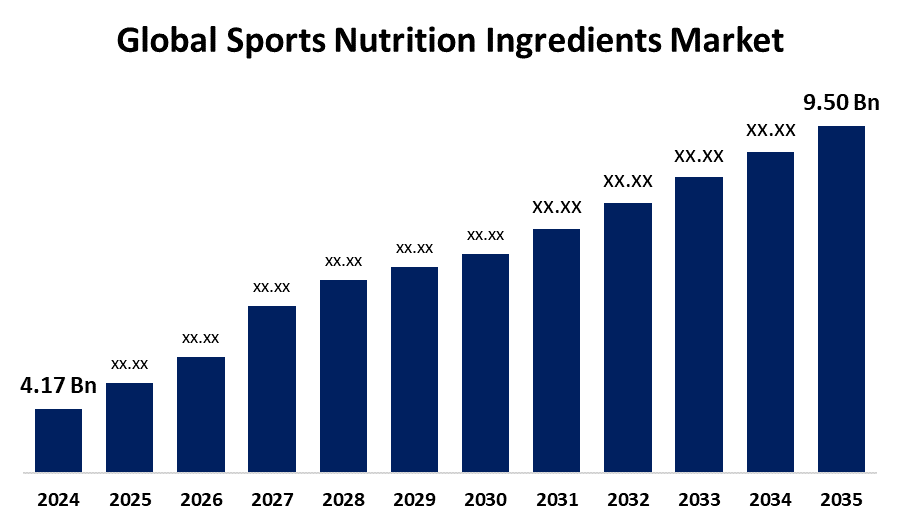
- The Global Sports Nutrition Ingredients Market Size Was Estimated at USD 4.17 Billion in 2024
- The Market Size is Expected to Grow at a CAGR of around 7.77% from 2025 to 2035
- The Worldwide Sports Nutrition Ingredients Market Size is Expected to Reach USD 9.50 Billion by 2035
Get more details on this report -
Major Players
Fonterra Co-operative Group Limited, Glanbia Public Limited Company, Kerry Group PLC, Roquette Freres SA, Ajinomoto Company Inc, Lonza Group Ltd, Sabinsa Corporation, Nexira Inc, Rousselot Inc, FrieslandCampina Ingredients, Ingredion Incorporated, Tate and Lyle PLC, DSM Firmenich, and BASF SE
Market Overview
The sports nutrition ingredients market is the market producing raw materials, like proteins, amino acids, vitamins, and botanicals used for creating supplements, powders, and beverages for enhancing athletic performance, energy, and recovery. Sports nutrition ingredients are bioactive compounds used in dietary supplements, functional beverages, and performance-enhancing products designed to support physical activity. These ingredients target muscle growth, energy production, hydration, endurance, strength, and post-workout recovery, and are typically categorized into proteins & amino acids, performance enhancers, energy-support ingredients, hydration & electrolyte blends, recovery-support compounds, and plant-based and adaptogenic ingredients. Formulations incorporated with such ingredients, including amino acids, creatine, electrolytes, adaptogens, botanical extracts, recovery compounds, and functional carbohydrates are designed for optimizing performance, muscle recovery, endurance, and metabolic health.
Innovation and market expansion are anticipated as a result of major players' growing R&D expenditures and expanding partnerships. For instance, in November 2025, Tirlan is injecting €126 million (US$146 million) into a state-of-the-art whey processing facility at its Ballyragget site in Kilkenny, Ireland.
Report Coverage
This research report categorizes the sports nutrition ingredients market based on various segments and regions, forecasts revenue growth, and analyzes trends in each submarket. The report analyses the key growth drivers, opportunities, and challenges influencing the sports nutrition ingredients market. Recent market developments and competitive strategies such as expansion, type launch, development, partnership, merger, and acquisition have been included to draw the competitive landscape in the market. The report strategically identifies and profiles the key market players and analyses their core competencies in each sub-segment of the sports nutrition ingredients market.
Sports Nutrition Ingredients Market Report Coverage
| Report Coverage | Details |
|---|---|
| Base Year: | 2024 |
| Market Size in 2024: | USD 4.17 Billion |
| Forecast Period: | 2025-2035 |
| Forecast Period CAGR 2025-2035 : | 7.77% |
| 2035 Value Projection: | USD 9.50 Billion |
| Historical Data for: | 2020-2023 |
| No. of Pages: | 240 |
| Tables, Charts & Figures: | 122 |
| Segments covered: | By Ingredient Type, By Product Type, By Application |
| Companies covered:: | Fonterra Co-operative Group Limited, Glanbia Public Limited Company, Kerry Group PLC, Roquette Freres SA, Ajinomoto Company Inc, Lonza Group Ltd, Sabinsa Corporation, Nexira Inc, Rousselot Inc, FrieslandCampina Ingredients, Ingredion Incorporated, Tate and Lyle PLC, DSM Firmenich, BASF SE |
| Pitfalls & Challenges: | Covid 19 Impact Challenges, Future, Growth and Analysis |
Get more details on this report -
Driving Factors
Benefits of sports nutrition
Increasing demand for sports nutrition products among athletes and fitness enthusiasts, as well as the growing popularity of supplements containing essential amino acids, are contributing to driving the sports nutrition ingredients market.
Social media marketing
This includes targeting the consumer base beyond elite athletes. Using influencer endorsements, creating educational content, and emphasizing transparency in ingredients are some strategies that aid in supporting the sports nutrition ingredients market.
Use of organic ingredients
One of the main benefits of organic products is the small amount or absence of pesticides, which are the root cause of various diseases, and also preserves all the properties and the intrinsic benefits of plants.
Restraining Factors
Counterfeit products
The ease of availability and affordability of counterfeit products filler such as starch, harmful chemicals, heavy metals, or undisclosed dangerous stimulants, negatively affect the market growth.
Market Segment Insights
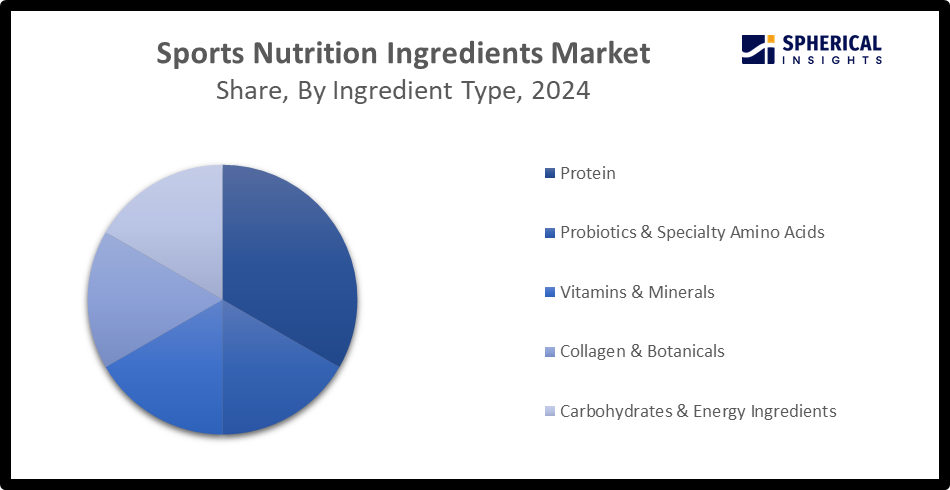
By Ingredient Type: Protein (Largest) versus Probiotics & Specialty Amino Acids (Fastest Growing)
The protein segment held the largest market share of over 31.0% in 2024, owing to its increased use in powders, ready-to-drink beverages, and nutrition bars. Products like energy drinks, protein bars, protein shakes, and dietary supplements are being developed and consumed. These developments involve a defatting process to adjust caloric composition. While probiotics & specialty amino acids like HMB, leucine, and glutamine are projected to grow rapidly, due to their role in gut health modulation, recovery optimization, and immune support benefits. This ingredient type aids in improving nutrient absorption, immune function, and recovery.
Get more details on this report -
By Product Type: Dietary Supplements (Dominant) versus Functional Sports & Hydration Beverages (Fastest Growing)
The dietary supplements segment held the dominant share of about 42.0% in the sports nutrition ingredients market, owing to the consumers’ increased emphasis on preventative health and physical performance. Dietary supplements used by athletes, which are added to the diet, mainly include vitamins, minerals, amino acids, herbs or botanicals, and/or a combination of ingredients. While ready-to-drink performance beverages and fortified hydration products are convenient formulations. Functional beverages represent a palatable and efficient way to hydrate and reintegrate electrolytes, carbohydrates, and other nutrients employed and/or lost during physical training.
By Application: Professional & Semi-professional athletes (Largest) versus Recreational fitness enthusiasts and lifestyle consumers (Fastest Growing)
The professional & semi-professional athletes segment is capturing the largest revenue share in the market due to increasing consumption of high-protein and clinically proven supplements for supporting muscle hypertrophy, recovery, and endurance. Dietary supplements that enhance exercise and athletic performance have various forms like tablets, capsules, liquid powders, and bars. Recreational fitness enthusiasts and lifestyle consumers seek products for general wellness, weight management, and energy for supporting daily activities, rather than solely for extreme muscle gain.
Regional Segment Analysis of the Sports Nutrition Ingredients Market
- North America (U.S., Canada, Mexico)
- Europe (Germany, France, U.K., Italy, Spain, Rest of Europe)
- Asia-Pacific (China, Japan, India, Rest of APAC)
- South America (Brazil and the Rest of South America)
- The Middle East and Africa (UAE, South Africa, Rest of MEA)
North America is anticipated to hold the largest share of the Sports Nutrition Ingredients market over the predicted timeframe.

Get more details on this report -
North America is anticipated to hold the largest share of around 41.0% in the sports nutrition ingredients market over the predicted timeframe. The market ecosystem in North America is strong, due to mature retail infrastructure, strong e-commerce penetration, and increased consumer awareness of fitness and wellness trends. Further, an increasing supplement usage among fitness enthusiasts and athletes, demand for protein-rich products due to awareness of muscle recovery benefits, and growing health-club and endurance sports participation, are contributing to propel the sports nutrition ingredients market. The U.S. is leading the region’s sports nutrition ingredients market, driven by an increasing need for protein-rich, clean-label, and functional products among fitness consumers.
Asia Pacific is expected to grow at a rapid CAGR of about 10.8% in the sports nutrition ingredients market during the forecast period. The Asia Pacific area has a thriving market for sports nutrition ingredients due to increasing fitness trends, urbanization, and a health-conscious lifestyle. Governments in countries like China, Japan, and India are implementing stringent regulation frameworks for ensuring ingredient quality, safety, and transparent labeling. China is the leading country in the Asia Pacific market, holding the dominant share, owing to the government-backed initiatives such as “Healthy China 2030” promoting healthy diets and fitness.
Competitive Analysis:
The report offers the appropriate analysis of the key organizations/companies involved within the sports nutrition ingredients market, along with a comparative evaluation primarily based on their type of offering, business overviews, geographic presence, enterprise strategies, segment market share, and SWOT analysis. The report also provides an elaborative analysis focusing on the current news and developments of the companies, which includes type development, innovations, joint ventures, partnerships, mergers & acquisitions, strategic alliances, and others. This allows for the evaluation of the overall competition within the market.
List of Key Companies
- Fonterra Co-operative Group Limited
- Glanbia Public Limited Company
- Kerry Group PLC
- Roquette Freres SA
- Ajinomoto Company Inc
- Lonza Group Ltd
- Sabinsa Corporation
- Nexira Inc
- Rousselot Inc
- FrieslandCampina Ingredients
- Ingredion Incorporated
- Tate and Lyle PLC
- DSM Firmenich
- BASF SE
- Others
Key Target Audience
- Market Players
- Investors
- End-users
- Government Authorities
- Consulting And Research Firm
- Venture capitalists
- Value-Added Resellers (VARs)
Industry Development
- In December 2025, Morrisons partnered with Liverpool, U.K.-based sports nutrition, health and wellness brand Applied Nutrition on an exclusive, three-year agreement that involves Morrisons formulating, producing, and selling Applied Nutrition-branded meals and food products.
- In August 2025, Glanbia to sell Body & Fit online sports-nutrition business. Body & Fit’s portfolio includes protein powders, bars and sports nutrition supplements. Glanbia’s Optimum Nutrition brand, covering similar categories, is also sold on the platform, according to Body & Fit’s website.
- In May 2025, IMCD N.V., a global leading partner for the distribution and formulation of speciality chemicals and ingredients, signed an agreement to acquire 100% of the shares in TECOM Ingredients S.A. (“TECOM”).
Market Segment
This study forecasts revenue at global, regional, and country levels from 2020 to 2035. Spherical Insights has segmented the Sports Nutrition Ingredients market based on the below-mentioned segments:
Global Sports Nutrition Ingredients Market, By Ingredient Type
- Protein
- Probiotics & Specialty Amino Acids
- Vitamins & Minerals
- Collagen & Botanicals
- Carbohydrates & Energy Ingredients
Global Sports Nutrition Ingredients Market, By Product Type
- Dietary Supplements
- Functional Sports & Hydration Beverages
- Nutrition Bars & Snacks
- Meal Replacements & Ready-to-Eat Packs
- Energy Shots & Gels
Global Sports Nutrition Ingredients Market, By Application
- Professional & Semi-professional Athletes
- Recreational Fitness Enthusiasts and Lifestyle Consumers
- Others
Global Sports Nutrition Ingredients Market, By Regional Analysis
- North America
- US
- Canada
- Mexico
- Europe
- Germany
- UK
- France
- Italy
- Spain
- Russia
- Rest of Europe
- Asia Pacific
- China
- Japan
- India
- South Korea
- Australia
- Rest of Asia Pacific
- South America
- Brazil
- Argentina
- Rest of South America
- Middle East & Africa
- UAE
- Saudi Arabia
- Qatar
- South Africa
- Rest of the Middle East & Africa
Frequently Asked Questions (FAQ)
-
1. What is the market size of the sports nutrition ingredients market?The global sports nutrition ingredients market size is expected to grow from USD 4.17 Billion in 2024 to USD 9.50 Billion by 2035, at a CAGR of 7.77% during the forecast period 2025-2035.
-
2. Which region holds the largest share of the sports nutrition ingredients market?North America is anticipated to hold the largest share of the sports nutrition ingredients market over the predicted timeframe.
-
3. What is the forecasted CAGR of the Global Sports Nutrition Ingredients Market from 2024 to 2035?The market is expected to grow at a CAGR of around 7.77% during the period 2024–2035.
-
4. Who are the top companies that are involved in the Global Sports Nutrition Ingredients Market?Key players include Fonterra Co-operative Group Limited, Glanbia Public Limited Company, Kerry Group PLC, Roquette Freres SA, Ajinomoto Company Inc, Lonza Group Ltd, Sabinsa Corporation, Nexira Inc, Rousselot Inc, FrieslandCampina Ingredients, Ingredion Incorporated, Tate and Lyle PLC, DSM Firmenich, and BASF SE.
-
5. What are the main drivers in the sports nutrition ingredients market?An increasing benefit of sports nutrition, social media marketing, and the use of organic products are major factors driving the sports nutrition ingredients market.
-
6. What challenges are limiting the adoption of sports nutrition ingredients?Factors like the emergence of counterfeit products remain key restraints in the sports nutrition ingredients market.
-
7. What are the key trends in the sports nutrition ingredients market?The upsurging trend towards personalized nutrition, demand for ready-to-drink beverages, energy bars, & fast-dissolving convenient formats, and emphasis on plant-based & sustainable alternatives, are major key trends in the sports nutrition ingredients market.
-
1. What is the CAGR of the edge AI in automotive market over the forecast period?The global edge AI in automotive market is projected to expand at a CAGR of 21.5% during the forecast period.
-
2. Which region holds the largest share of the edge AI in automotive market?North America is anticipated to hold the largest share of the edge AI in automotive market over the predicted timeframe.
-
3. Who are the top companies operating in the global edge AI in automotive market?Ambarella, AMD (Xilinx), Aptiv PLC, Continental AG, DENSO Corporation, Horizon Robotics, Infineon Technologies, Intel (Mobileye), NVIDIA, NXP Semiconductors, Qualcomm, Renesas Electronics, Samsung Semiconductor, STMicroelectronics, and Others.
-
4. What factors are driving the growth of edge AI in automotive market?Growth of the edge AI in automotive market is driven by rising adoption of autonomous vehicles, increasing demand for real-time data processing, expansion of ADAS, connected vehicle technologies, and advancements in AI-enabled automotive semiconductors.
-
5. What are market trends in the edge AI in automotive market?Key trends in the edge AI in automotive market include integration of AI chips in vehicles, growth of smart cabins, expansion of ADAS technologies, development of autonomous driving platforms, and increased collaboration between automakers and semiconductor companies.
-
6. What are the main challenges restricting wider adoption of the edge AI in automotive market?Major challenges in the edge AI in automotive market include high development costs, complex hardware integration, limited edge processing power, cybersecurity risks, data management difficulties, and regulatory concerns affecting deployment of AI-enabled automotive technologies.
Need help to buy this report?