Global Soil Pressure Gauges Market Size, Share, and COVID-19 Impact Analysis, By Product Type (Digital Soil Pressure Gauges, Analog Soil Pressure Gauges, Wireless Soil Pressure Gauges, and Portable Soil Pressure Gauges), By Technology (Piezoresistive Technology, Capacitive Technology, Strain Gauge Technology, and Optical Technology), By Application (Construction and Civil Engineering, Agriculture and Soil Management, Environmental Monitoring, and Transportation and Railways), and By Region (North America, Europe, Asia-Pacific, Latin America, Middle East, and Africa), Analysis and Forecast 2025 - 2035
Industry: Construction & Manufacturing
Global Soil Pressure Gauges Market Size Insights Forecasts to 2035
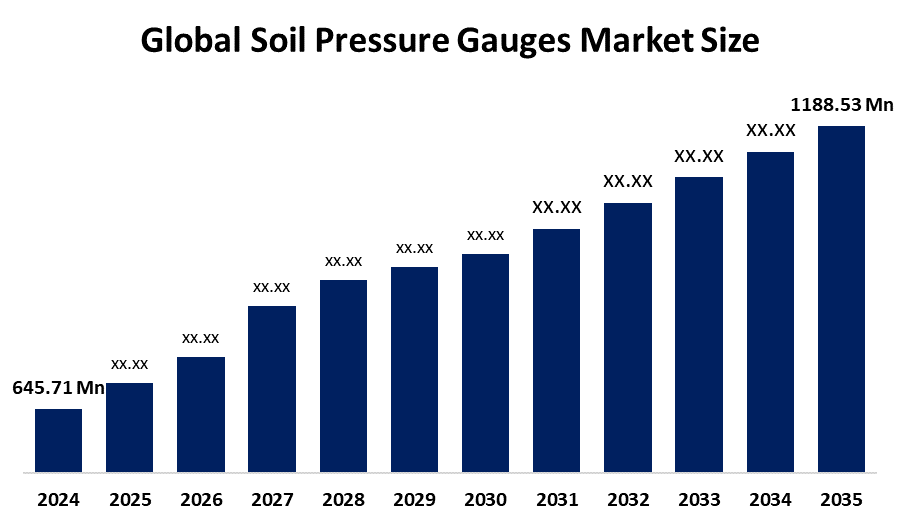
- The Global Soil Pressure Gauges Market Size Was Estimated at USD 645.71 Million in 2024
- The Market Size is Expected to Grow at a CAGR of around 5.7% from 2025 to 2035
- The Worldwide Soil Pressure Gauges Market Size is Expected to Reach USD 1188.53 Million by 2035
- Asia Pacific is expected to Grow the fastest during the forecast period.
Get more details on this report -
According to a Research Report Published by Spherical Insights and Consulting, The Global Soil Pressure Gauges Market Size was worth around USD 645.71 Million in 2024 and is predicted to Grow to around USD 1188.53 Million by 2035 with a compound annual growth rate (CAGR) of 5.7% from 2025 to 2035. The soil pressure gauges market is growing due to rapid urbanization, increased infrastructure projects, and stringent geotechnical safety regulations. Furthermore, the adoption of IoT-enabled, digital sensors for real-time monitoring and precision agriculture is driving demand for advanced soil sensing solutions.
Market Overview
The global soil pressure gauges market covers precision instruments (vibrating wire, strain gauge, hydraulic, and digital types) designed to measure total and effective earth pressure, pore water pressure, and stress distribution in soil, rock, and fill materials for long-term structural monitoring. Key uses include geotechnical instrumentation in dams, tunnels, embankments, high-rise foundations, retaining walls, pipelines, bridges, slope stability projects, mining operations, and landslide early-warning systems to ensure structural safety and performance. In January 2026, ISO 18674-1 was published, standardizing the use of strain gauges and strainmeters for geotechnical monitoring. It covers performance monitoring of 1-D, 2-D, and 3-D structures, geotechnical fills, and works, enabling stress and force evaluation to support design verification, construction adjustments, and stability assessment.
Primary market drivers are booming global infrastructure development, stringent safety regulations for critical civil works, rising urbanization and smart city projects, increasing focus on disaster resilience (landslides, earthquakes), and technological upgrades toward wireless/IoT-enabled real-time monitoring. Opportunities exist in digital/smart gauges with AI analytics, integration into digital twin platforms, expansion in emerging Asia-Pacific and Middle East markets, and demand for durable sensors in harsh environments. In October 2025, China’s 14th Five-Year Plan National Key R&D Program funds projects advancing soil pressure gauge technologies. Led by the Beijing Academy of Agriculture and Forestry Sciences, the Precision Intelligent Fertilization Technology project develops rapid soil and crop sensors and smart fertilization machinery, with field demonstrations across major crop regions.
Report Coverage
This research report categorizes the soil pressure gauges market based on various segments and regions, forecasts revenue growth, and analyzes trends in each submarket. The report analyses the key growth drivers, opportunities, and challenges influencing the soil pressure gauges market. Recent market developments and competitive strategies, such as expansion, type launch, development, partnership, merger, and acquisition, have been included to draw the competitive landscape in the market. The report strategically identifies and profiles the key market players and analyses their core competencies in each sub-segment of the soil pressure gauges market.
Global Soil Pressure Gauges Market Report Coverage
| Report Coverage | Details |
|---|---|
| Base Year: | 2024 |
| Market Size in 2024 : | USD 645.71 Million |
| Forecast Period: | 2025-2035 |
| Forecast Period CAGR 2025-2035 : | 5.7% |
| 2035 Value Projection: | USD 1188.53 Million |
| Historical Data for: | 2020-2023 |
| No. of Pages: | 163 |
| Tables, Charts & Figures: | 84 |
| Segments covered: | By Product Type, By Technology and COVID-19 Impact Analysis |
| Companies covered:: | Geokon, Inc., Kyowa Electronic Instruments, ICT International, Geosense Ltd., Tokyo Measuring Instruments Lab, RST Instruments, SISGEO S.p.A., Encardio-Rite Group, Campbell Scientific, Inc., Keller Group plc, Changzhou Jintan Sensor, Soil Instruments Limited, Tokyo Measuring Instruments Laboratory, Changzhou Jintan Sensor Co., Ltd., and Others |
| Pitfalls & Challenges: | COVID-19 Empact, Challenges, Future, Growth, & Analysis |
Get more details on this report -
Driving Factors
The global soil pressure gauges market is driven by rapid urbanization and infrastructure growth, which are boosting demand, as these instruments are critical for assessing soil stability and load-bearing capacity in tunnels, high-rise buildings, dams, and subways. Precision agriculture also fuels growth, with farmers using gauges to monitor soil compaction and moisture, optimizing irrigation and reducing water usage by up to 30% without affecting yields. Additionally, technological innovations such as IoT, AI, and wireless sensor networks enable real-time monitoring and remote data collection, enhancing measurement accuracy, operational efficiency, and overall productivity across construction and agricultural applications.
Restraining Factors
The global soil pressure gauges market is hindered by high costs, with hardware representing 60-70% of total expenses and annual calibration adding 8-12%, limiting adoption. Technical challenges, such as reading drift, sensor damage during concrete pouring, and complex on-site calibration, alongside supply chain dependencies and policy uncertainties, further restrict market growth and broader implementation.
Market Segmentation
The soil pressure gauges market share is classified into product type, technology and application.
- The digital soil pressure gauges segment dominated the market in 2024, approximately 35% and is projected to grow at a substantial CAGR during the forecast period.
Based on the product type, the soil pressure gauges market is divided into digital soil pressure gauges, analog soil pressure gauges, wireless soil pressure gauges, and portable soil pressure gauges. Among these, the digital soil pressure gauges segment dominated the market in 2024 and is projected to grow at a substantial CAGR during the forecast period. The segment dominance is due to its high precision, real-time data collection, and compatibility with advanced monitoring systems. These gauges enable remote monitoring, integration with IoT platforms, and improved operational efficiency, making them essential for construction, agriculture, and geotechnical projects. Their reliability and automation capabilities continue to drive widespread adoption globally.
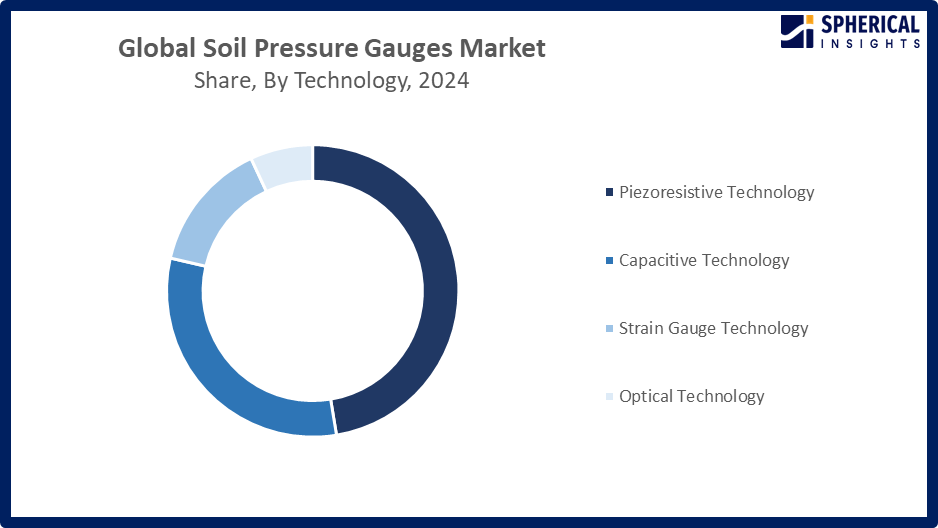
- The piezoresistive technology segment accounted for the largest share in 2024, approximately 47% and is anticipated to grow at a significant CAGR during the forecast period.
Based on the technology, the soil pressure gauges market is divided into piezoresistive technology, capacitive technology, strain gauge technology, and optical technology. Among these, the piezoresistive technology segment accounted for the largest share in 2024 and is anticipated to grow at a significant CAGR during the forecast period. The piezoresistive technology segment market growth is attributed to its high reliability, accuracy, and cost-effectiveness in measuring soil pressure. Widely adopted in construction, civil engineering, and agricultural applications, it provides consistent performance under varying conditions. Its established use, ease of integration with monitoring systems, and robust functionality continue to drive significant market growth.
Get more details on this report -
- The construction and civil engineering segment accounted for the highest market revenue in 2024, approximately 55% and is anticipated to grow at a significant CAGR during the forecast period.
Based on the application, the soil pressure gauges market is divided into construction and civil engineering, agriculture and soil management, environmental monitoring, and transportation and railways. Among these, the construction and civil engineering segment accounted for the highest market revenue in 2024 and is anticipated to grow at a significant CAGR during the forecast period. The segment market growth is owing to rapid infrastructure development, urbanization, and large-scale building projects. Soil pressure gauges are critical for assessing ground stability, foundation loads, and structural safety in tunnels, bridges, dams, and high-rise buildings. Rising investments in safe and sustainable construction practices further drive adoption and market expansion.
Regional Segment Analysis of the Soil Pressure Gauges Market
- North America (U.S., Canada, Mexico)
- Europe (Germany, France, U.K., Italy, Spain, Rest of Europe)
- Asia-Pacific (China, Japan, India, Rest of APAC)
- South America (Brazil and the Rest of South America)
- The Middle East and Africa (UAE, South Africa, Rest of MEA)
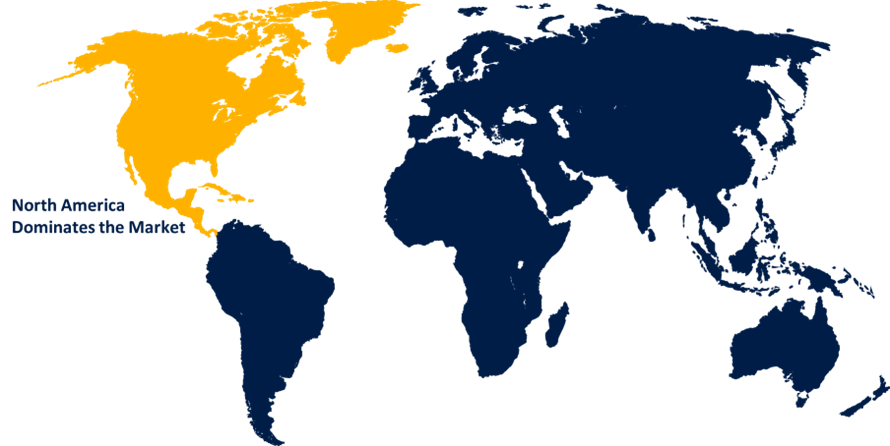
North America is anticipated to hold the largest share of the soil pressure gauges market over the predicted timeframe.
Get more details on this report -
North America is anticipated to hold the largest share of the soil pressure gauges market over the predicted timeframe. The region's growth in the soil pressure gauges market is driven primarily by the United States, where extensive infrastructure projects, urban development, and stringent construction safety regulations fuel demand. The adoption of digital and wireless soil pressure monitoring systems in highways, bridges, and commercial construction enhances measurement accuracy and efficiency. In 2024, North America accounted for approximately 40% of the global market, reflecting high investment in geotechnical engineering and technological integration, while continued government infrastructure initiatives are expected to sustain growth over the forecast period. In November 2025, a bipartisan group reintroduced the PRECISE Act to expand farmer access to precision-agriculture tools through USDA programs. Led by Rep. Ashley Hinson (R-Iowa) and supported by Reps. Finstad, Panetta, and Gray, it offers GPS equipment, soil-mapping, sensors, and software with loans covering up to 90% of costs.
Asia Pacific is expected to grow at a rapid CAGR in the soil pressure gauges market during the forecast period. The region is rapidly growing in the soil pressure gauges market, led by China and India, due to massive infrastructure development, urbanization, and industrial projects. Increasing investments in highways, railways, and commercial construction drive demand for precise soil monitoring. Adoption of advanced digital and wireless gauges enhances efficiency and safety, while government initiatives supporting smart cities and resilient infrastructure further accelerate market growth, making the region the fastest-growing globally.
In Europe, the soil pressure gauges market is growing due to increased focus on sustainable infrastructure, stringent soil monitoring regulations, and investment in geotechnical research, particularly in Germany, France, and the UK. The EU Soil Monitoring Law and agricultural innovation initiatives are driving adoption of advanced soil measurement technologies for construction safety and environmental management, supporting steady regional market expansion in 2024 and beyond. In October 2025, the EU Soil Monitoring Law was adopted, creating the first EU-wide framework to assess and improve soil health by 2050. Horizon Europe projects, TRAILS4SOIL, EUROSION, and TERRASAFE, are providing tools, data, and governance models to help Member States monitor soils, promote sustainable practices, and manage contamination.
Competitive Analysis:
The report offers the appropriate analysis of the key organizations/companies involved within the soil pressure gauges market, along with a comparative evaluation primarily based on their type of offering, business overviews, geographic presence, enterprise strategies, segment market share, and SWOT analysis. The report also provides an elaborative analysis focusing on the current news and developments of the companies, which includes type development, innovations, joint ventures, partnerships, mergers & acquisitions, strategic alliances, and others. This allows for the evaluation of the overall competition within the market.
List of Key Companies
- Geokon, Inc.
- Kyowa Electronic Instruments
- ICT International
- Geosense Ltd.
- Tokyo Measuring Instruments Lab
- RST Instruments
- SISGEO S.p.A.
- Encardio-Rite Group
- Campbell Scientific, Inc.
- Keller Group plc
- Changzhou Jintan Sensor
- Soil Instruments Limited
- Tokyo Measuring Instruments Laboratory
- Changzhou Jintan Sensor Co., Ltd.
- Others
Key Target Audience
- Market Players
- Investors
- End-users
- Government Authorities
- Consulting and Research Firm
- Venture capitalists
- Value-Added Resellers (VARs)
Recent Development
- In March 2026, the FAO launched the Zambia Soil Partnership and Global Soil Doctors Programme, supported by the U.S. and Japan. The initiative installs Cosmic Ray Neutron Sensor stations and strengthens national soil analysis to enhance resilient agrifood systems.
- In February 2026, the UK construction sector, investing £1.2 billion annually in ground investigation, faces £120 million losses from unforeseen conditions. Additional funding will expand the BGS Common Ground project, scaling Glasgow pilot tools into a national geotechnical data service, integrating geological knowledge to improve efficiency and reduce construction risks.
- In December 2025, the PRECISE Act was reintroduced to enhance farmers' access to advanced ag-tech via USDA conservation programs. The bill offers cost-share payments covering up to 90% for tools like soil-mapping sensors and GPS-guided equipment, aiming to increase crop yields, lower input costs, and promote sustainable farming practices.
- In January 2025, Romania launched the SMM-ChaPS Project under PNCDI IV, a 24-month initiative developing silicone capacitive chain pressure sensors to monitor soil mass. This demonstration project aims to advance soil pressure gauge technology, validating innovative sensor systems for more accurate and efficient soil monitoring in agricultural and research applications.
- In November 2023, Soil Instruments launched its Sensly data management platform, replacing the Argus system. Operating on secure cloud technology, Sensly offers customizable dashboards, blueprints for easy setup, and enhanced geotechnical insights, providing users of all expertise levels a seamless, efficient, and personalized soil monitoring and data analysis experience.
Market Segment
This study forecasts revenue at global, regional, and country levels from 2020 to 2035. Spherical Insights has segmented the soil pressure gauges market based on the below-mentioned segments:
Global Soil Pressure Gauges Market, By Product Type
- Digital Soil Pressure Gauges
- Analog Soil Pressure Gauges
- Wireless Soil Pressure Gauges
- Portable Soil Pressure Gauges
Global Soil Pressure Gauges Market, By Technology
- Piezoresistive Technology
- Capacitive Technology
- Strain Gauge Technology
- Optical Technology
Global Soil Pressure Gauges Market, By Application
- Construction and Civil Engineering
- Agriculture and Soil Management
- Environmental Monitoring
- Transportation and Railways
Global Soil Pressure Gauges Market, By Regional Analysis
- North America
- US
- Canada
- Mexico
- Europe
- Germany
- UK
- France
- Italy
- Spain
- Russia
- Rest of Europe
- Asia Pacific
- China
- Japan
- India
- South Korea
- Australia
- Rest of Asia Pacific
- South America
- Brazil
- Argentina
- Rest of South America
- Middle East & Africa
- UAE
- Saudi Arabia
- Qatar
- South Africa
- Rest of the Middle East & Africa
Frequently Asked Questions (FAQ)
-
1. How are technological innovations like digital and wireless gauges influencing market expansion?Technological innovations like digital and wireless soil pressure gauges, now used in nearly 50% of new geotechnical installations, boost market expansion by enabling real‑time, remote monitoring, reducing manual inspections by 30% and improving data accuracy and analysis efficiency by 40%, driving adoption across infrastructure, construction, and smart city projects.
-
2. What role do regulatory standards and safety requirements play in market growth?Regulatory standards and safety requirements drive market growth by mandating soil pressure monitoring in critical projects; compliance rates exceed 60% in major infrastructure builds, increasing demand for reliable gauges to meet safety and performance benchmarks.
-
3. How are smart cities and sustainable construction initiatives affecting market demand?Smart city and sustainable construction initiatives are boosting soil pressure gauge demand, with smart infrastructure spending expected to surpass $820 billion by 2026, driving real‑time geotechnical monitoring for safety, resilience, and environmental compliance.
-
4. What are the latest trends in geotechnical monitoring and soil pressure measurement?Latest trends include AI‑enabled real‑time monitoring, IoT‑connected wireless soil pressure gauges, and cloud‑based data analytics, with adoption rising over 35 % annually as digital geotechnical solutions replace manual systems for safer infrastructure management.
-
5. How are economic factors such as construction budgets and government spending influencing market growth?Rising construction budgets and increased government infrastructure spending, projected to exceed $6 trillion annually by 2027, are boosting soil pressure gauge demand as projects require enhanced geotechnical monitoring for safety and compliance.
-
6. How is the adoption of IoT and BIM integration shaping the soil pressure gauges market?IoT and BIM integration are transforming the soil pressure gauges market by enabling real‑time, networked monitoring, reducing project delays by up to 25 %, and improving geotechnical data accuracy and decision‑making across infrastructure projects.
-
7. What challenges or restraints are limiting market expansion in developing regions?In developing regions, limited budgets, inadequate technical expertise, and poor infrastructure slow soil pressure gauge adoption, with over 40 % of projects lacking proper geotechnical monitoring, restricting market expansion.
Need help to buy this report?