Global Sodium Tetraborate Market Size, Share, and COVID-19 Impact Analysis, By Type (Anhydrous Sodium Tetraborate, Pentahydrate Sodium Tetraborate, and Decahydrate Sodium Tetraborate), By Application (Glass & Ceramics, Detergents & Cleaners, Metallurgy, Textiles & Flame Retardants, Agriculture (Micronutrient), Pharmaceutical & Cosmetics, and Adhesives & Sealants), By End-Use (Construction, Chemicals, Automotive, Consumer Goods, Agriculture, Pharmaceutical, Textile & Apparel, and Electronics), and By Region (North America, Europe, Asia-Pacific, Latin America, Middle East, and Africa), Analysis and Forecast 2025 - 2035
Industry: Chemicals & Materials
Global Sodium Tetraborate Market Size Insights Forecasts to 2035
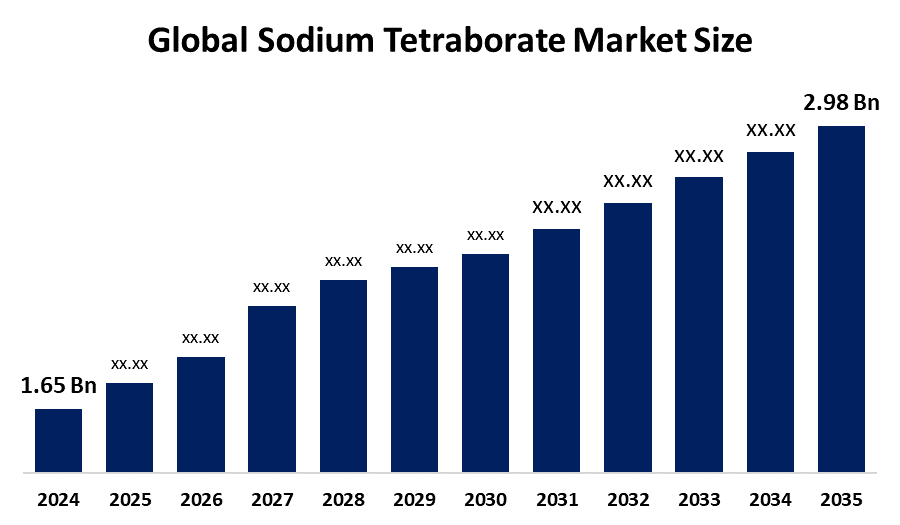
- The Global Sodium Tetraborate Market Size Was Estimated at USD 1.65 Billion in 2024
- The Market Size is Expected to Grow at a CAGR of around 5.52% from 2025 to 2035
- The Worldwide Sodium Tetraborate Market Size is Expected to Reach USD 2.98 Billion by 2035
- Asia Pacific is expected to Grow the fastest during the forecast period.
Get more details on this report -
According to a Research Report Published by Spherical Insights and Consulting, The Global Sodium Tetraborate Market Size was worth around USD 1.65 Billion in 2024 and is predicted to Grow to around USD 2.98 Billion by 2035 with a compound annual growth rate (CAGR) of 5.52% from 2025 to 2035. The sodium tetraborate market is expanding because agricultural micronutrient fertilisers and fiberglass insulation for construction and glass and ceramic manufacturing both drive market demand. The market growth is driven by rising demand for water-softening agents in detergents and the increasing use of eco-friendly, sustainable product formulations.
Market Overview
Sodium tetraborate, commonly referred to as borax, serves multiple purposes because it functions as a glass and ceramics manufacturing flux, which improves product durability and thermal resistance while serving as a detergent buffering component and a micronutrient for soils that lack boron. The main factors that drive market growth include rising glass industry demand for borosilicate glass, which automotive and construction companies require and sodium tetraborate's increasing use in environmentally friendly detergent products, which serve as sustainable substitutes for phosphate.
Agricultural practices present a major market opportunity because more than 30% of worldwide agricultural fields suffer from boron deficiency which creates a strong requirement for boron-based fertilisers that enhance crop production. From agricultural uses, sodium tetraborate use within the globe reached 25% of total consumption during 2024, and farm demand for boron showed yearly growth at 4-6% because farmers discovered how important boron is for developing plant cell walls and reproductive systems. The global borax supply chain faces increasing security threats starting January 2026 because Turkey and the U.S. control most borax reserves, which creates uncertainties during the current political climate. The U.S. 2025 National Security Strategy establishes domestic boron mining as a primary goal while funding 5E Advanced Materials' Fort Cady project with $20 million and streamlining supply chain operations through permitting reforms.
Report Coverage
This research report categorizes the sodium tetraborate market based on various segments and regions, forecasts revenue growth, and analyzes trends in each submarket. The report analyses the key growth drivers, opportunities, and challenges influencing the sodium tetraborate market. Recent market developments and competitive strategies, such as expansion, type launch, development, partnership, merger, and acquisition, have been included to draw the competitive landscape in the market. The report strategically identifies and profiles the key market players and analyses their core competencies in each sub-segment of the sodium tetraborate market.
Global Sodium Tetraborate Market Report Coverage
| Report Coverage | Details |
|---|---|
| Base Year: | 2024 |
| Market Size in 2024 : | USD 1.65 Billion |
| Forecast Period: | 2025-2035 |
| Forecast Period CAGR 2025-2035 : | 5.52% |
| 2035 Value Projection: | USD 2.98 Billion |
| Historical Data for: | 2020-2023 |
| No. of Pages: | 184 |
| Tables, Charts & Figures: | 109 |
| Segments covered: | By Type, By Application and COVID-19 Impact Analysis |
| Companies covered:: | Rio Tinto Group, Searles Valley Minerals, Eti Maden AS, Minera Santa Rita S.R.L., Borax Morarji Limited, American Borate Company, Inkabor S.A., Quiborax, Borax Argentina S.A., Dalian Jinma, Fengcheng, Rose Mill Co., Liaoning Boron Technology Co., Ltd., Gujarat Boron Derivatives Pvt. Ltd., and Others |
| Pitfalls & Challenges: | COVID-19 Empact, Challenge, Future, Growth, & Analysis |
Get more details on this report -
Driving Factors
The global sodium tetraborate market exists because manufacturers need the compound as a flux to produce glass and ceramics products, which require lower melting points and improved product durability. The production process of borosilicate glass for pharmaceuticals, solar energy tubes and laboratory equipment requires this specific type of glass. A significant growth area exists because laboratory equipment, optics and electronics industries require more borosilicate glass. The agricultural industry requires boron as a micronutrient, which serves as the main driver for this market. Sodium tetraborate in fertilizer formulations becomes essential for crop yield improvement because more than 30% of agricultural land globally experiences boron deficiency.
Restraining Factors
The sodium tetraborate market encounters various limiting factors because some areas impose strict environmental regulations that treat the substance as hazardous material and require special use permits. The dynamic raw material market causes price shifts that exceed 15% annually and directly affect profit margins. Market development faces limitations from both boron-free solutions and environmentally safe cleaning products, which sustain competition in areas that value environmental protection.
Market Segmentation
The sodium tetraborate market share is classified into type, application, and end-use.
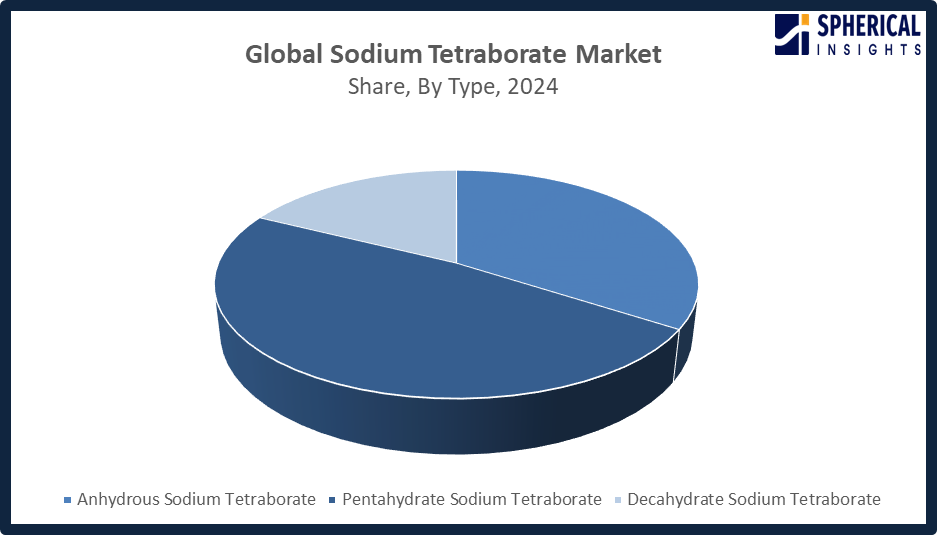
- The pentahydrate sodium tetraborate segment dominated the market in 2024, approximately 48% and is projected to grow at a substantial CAGR during the forecast period.
Based on the type, the sodium tetraborate market is divided into anhydrous sodium tetraborate, pentahydrate sodium tetraborate, and decahydrate sodium tetraborate. Among these, the pentahydrate sodium tetraborate segment dominated the market in 2024, approximately 48% and is projected to grow at a substantial CAGR during the forecast period. The high solubility, stability and versatility of pentahydrates make them suitable for use in both industrial and consumer applications. The main markets for these products are glass and ceramics production, detergent manufacturing and agricultural operations. The demand for pentahydrate increases because solar panel production expands in China and India, and pentahydrate enables the creation of advanced borosilicate glass through its manufacturing process.
Get more details on this report -
- The glass & ceramics segment accounted for the largest share in 2024, approximately 35% and is anticipated to grow at a significant CAGR during the forecast period.
Based on the application, the sodium tetraborate market is divided into glass & ceramics, detergents & cleaners, metallurgy, textiles & flame retardants, agriculture (micronutrient), pharmaceutical & cosmetics, and adhesives & sealants. Among these, the glass & ceramics segment accounted for the largest share in 2024, approximately 35% and is anticipated to grow at a significant CAGR during the forecast period. The glass and ceramics segment, due to construction, automotive and solar panel markets show increasing demand for borosilicate and specialty glass products. Sodium tetraborate serves as a vital component in high-performance glass and ceramic production because it improves thermal resistance and strength, and durability across multiple industrial sectors, which are experiencing global growth.
- The construction segment accounted for the highest market revenue in 2024, approximately 30% and is anticipated to grow at a significant CAGR during the forecast period.
Based on the end-use, the sodium tetraborate market is divided into construction, chemicals, automotive, consumer goods, agriculture, pharmaceutical, textile & apparel, and electronics. Among these, the construction segment accounted for the highest market revenue in 2024, approximately 30% and is anticipated to grow at a significant CAGR during the forecast period. The construction industry experiences rapid expansion because infrastructure development, urban growth and demand for long-lasting building materials are increasing. Sodium tetraborate functions as a key material in glass production and fiberglass insulation, and ceramic manufacturing, which together support the development of energy-saving structures for contemporary buildings and environmentally friendly construction initiatives across the globe.
Regional Segment Analysis of the Sodium Tetraborate Market
- North America (U.S., Canada, Mexico)
- Europe (Germany, France, U.K., Italy, Spain, Rest of Europe)
- Asia-Pacific (China, Japan, India, Rest of APAC)
- South America (Brazil and the Rest of South America)
- The Middle East and Africa (UAE, South Africa, Rest of MEA)
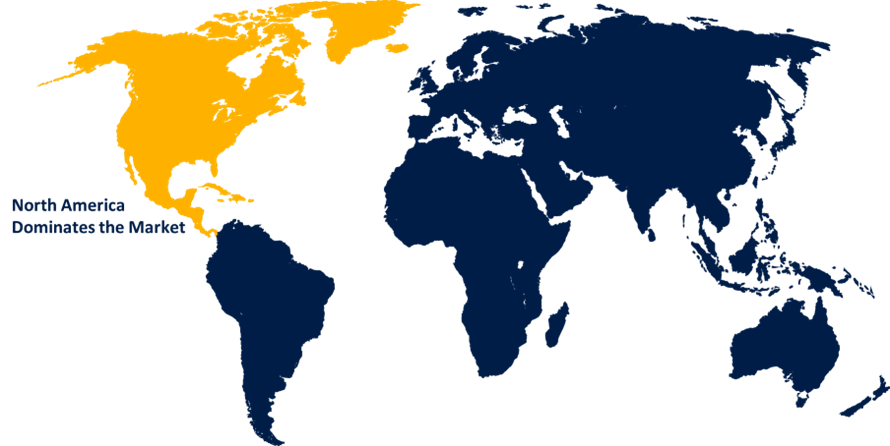
North America is anticipated to hold the largest share of the sodium tetraborate market over the predicted timeframe.
Get more details on this report -
North America is anticipated to hold the largest share of the sodium tetraborate market over the predicted timeframe. North America is expected to maintain a 35% share of the global sodium tetraborate market due to its secure, high-quality domestic supply and strong downstream demand. The region’s dominance is anchored by the Rio Tinto Borax Mine, one of the world’s richest borate deposits, supplying about 30% of global refined borates annually. This ensures long-term supply stability. The United States leads consumption, driven by specialty glass and industrial applications, while trade-related risks have encouraged supportive policies. In Canada, steady demand from glass manufacturing, agriculture, and industrial cleaning, along with investments in sustainable chemical production, further strengthens regional growth. In March 2025, Canada proposed listing boric acid and sodium tetraborate under the Canadian Environmental Protection Act Schedule 1 to address health risks. Meanwhile, Asia, Africa, and the U.S. promoted boron-based fertilisers through subsidies, increasing demand across agriculture and sustainable industrial applications.
Asia Pacific is expected to grow at a rapid CAGR in the sodium tetraborate market during the forecast period. Asia Pacific is projected to grow at the fastest CAGR in the sodium tetraborate market, driven by rapid industrialisation and expanding end-use industries. China leads regional consumption with about 28.7% global share in 2024, supported by strong glass production and high import dependency reflecting robust demand. India benefits from Make in India initiatives and pharmaceutical expansion, while Japan drives demand through advanced electronics and semiconductor applications. Together, these economies account for over 70% of regional consumption, positioning the Asia Pacific for sustained growth.
Europe’s sodium tetraborate market growth is driven by strong demand from the glass, ceramics, and detergent industries, supported by sustainability regulations and advanced manufacturing standards. Germany leads regional consumption due to its robust automotive and specialty glass sectors, while France and Italy contribute through ceramics and industrial applications. Additionally, increasing emphasis on eco-friendly detergents and energy-efficient construction materials supports steady sodium tetraborate demand across Europe.
Competitive Analysis:
The report offers the appropriate analysis of the key organizations/companies involved within the sodium tetraborate market, along with a comparative evaluation primarily based on their type of offering, business overviews, geographic presence, enterprise strategies, segment market share, and SWOT analysis. The report also provides an elaborative analysis focusing on the current news and developments of the companies, which includes type development, innovations, joint ventures, partnerships, mergers & acquisitions, strategic alliances, and others. This allows for the evaluation of the overall competition within the market.
List of Key Companies
- Rio Tinto Group
- Searles Valley Minerals
- Eti Maden AS
- Minera Santa Rita S.R.L.
- Borax Morarji Limited
- American Borate Company
- Inkabor S.A.
- Quiborax
- Borax Argentina S.A.
- Dalian Jinma
- Fengcheng
- Rose Mill Co.
- Liaoning Boron Technology Co., Ltd.
- Gujarat Boron Derivatives Pvt. Ltd.
- Others
Key Target Audience
- Market Players
- Investors
- End-users
- Government Authorities
- Consulting and Research Firm
- Venture capitalists
- Value-Added Resellers (VARs)
Recent Development
- In January 2026, Rio Tinto announced plans to sell its California boron assets, including Mojave Desert mining operations and Los Angeles port facilities, which supply about 30% of global demand. The move follows the U.S. designation of boron as a critical mineral for economic and national security applications.
- In July 2025, Indo Borax & Chemicals Limited (IBCL) commenced commercial dispatches of Boron Oxide from its Pithampur, Madhya Pradesh facility. The company informed BSE and NSE on July 31. The move expands IBCL’s value-added portfolio, with Company Secretary Pravin Chavan confirming initial dispatch operations.
- In June 2025, GlassPoint partnered with Searles Valley Minerals in California to deploy 750 MWth of solar thermal technology at its Trona facility. The project aims to cut up to 500,000 metric tons of CO2 annually, strengthening domestic boron production and enhancing U.S. mineral competitiveness while replacing coal-fired power.
- In May 2024, Allen, an engineer and marketer with over 16 years at Rio Tinto, was highlighted for leading the Asia-Pacific technical marketing team for borates and aluminium. Based in APAC, he supports customers with product development, technical solutions, and new application expansion across regional markets.
Market Segment
This study forecasts revenue at global, regional, and country levels from 2020 to 2035. Spherical Insights has segmented the sodium tetraborate market based on the below-mentioned segments:
Global Sodium Tetraborate Market, By Type
- Anhydrous Sodium Tetraborate
- Pentahydrate Sodium Tetraborate
- Decahydrate Sodium Tetraborate
Global Sodium Tetraborate Market, By Application
- Glass & Ceramics
- Detergents & Cleaners
- Metallurgy
- Textiles & Flame Retardants
- Agriculture (Micronutrient)
- Pharmaceutical & Cosmetics
- Adhesives & Sealants
Global Sodium Tetraborate Market, By End-Use
- Construction
- Chemicals
- Automotive
- Consumer Goods
- Agriculture
- Pharmaceutical
- Textile & Apparel
- Electronics
Global Sodium Tetraborate Market, By Regional Analysis
- North America
- US
- Canada
- Mexico
- Europe
- Germany
- UK
- France
- Italy
- Spain
- Russia
- Rest of Europe
- Asia Pacific
- China
- Japan
- India
- South Korea
- Australia
- Rest of Asia Pacific
- South America
- Brazil
- Argentina
- Rest of South America
- Middle East & Africa
- UAE
- Saudi Arabia
- Qatar
- South Africa
- Rest of the Middle East & Africa
Frequently Asked Questions (FAQ)
-
1. What impact do stringent environmental regulations in Europe and North America have on sodium tetraborate production and trade?Stringent EU regulations ban sodium tetraborate in cosmetics (0% allowance), while the US EPA classifies it as Toxicity Category I for eye irritation. These restrictions raise compliance costs and limit market access for consumer applications.
-
2. How is the trend toward phosphate-free detergents influencing the demand for sodium tetraborate as an eco-friendly alternative?The phosphate-free detergent trend, now over 70% of European formulations, has increased sodium tetraborate demand by 6-8% annually, as manufacturers replace phosphates with borate-based builders to meet environmental regulations and sustainability targets.
-
3. How are raw material price fluctuations, particularly in Turkey and the US, affecting the profitability of sodium tetraborate manufacturers?Raw material price volatility in Turkey and the U.S. has caused borate price swings of 10–20% annually, impacting manufacturers’ margins by 5-8%, increasing production costs, and creating short-term profitability fluctuations globally.
-
4. What impact does the shift toward electric vehicles have on sodium tetraborate demand for lithium-ion battery components?The shift toward electric vehicles is increasing sodium tetraborate demand, as boron compounds are used in lithium-ion battery components, glass fibers, and thermal management materials, supporting battery efficiency, durability, and lightweight vehicle design.
-
5. How are innovations in boron recovery and recycling technologies influencing the sustainability of the sodium tetraborate market?Innovations in boron recovery reduce extraction costs by 30-50% compared to mining, enhance resource efficiency, and support circular economy principles, significantly improving market sustainability and reducing environmental impact.
-
6. What is the impact of the construction industry's growth on sodium tetraborate demand for fire-retardant materials and insulation?Construction growth drives sodium tetraborate demand due to its fire-retardant use in insulation, coatings, and textiles. The segment held over 30% market share in 2024, supported by strict safety regulations and infrastructure expansion.
-
7. How are emerging applications in nuclear technology and neutron shielding affecting the sodium tetraborate market outlook?Emerging nuclear and neutron shielding applications are positively influencing the sodium tetraborate market outlook, as boron’s high neutron absorption capacity increases demand in nuclear reactors, radiation shielding materials, and advanced energy infrastructure projects globally.
Need help to buy this report?