Global Smart Water Meters Market Size, Share, and COVID-19 Impact Analysis, By Meter Type (Electromagnetic Meter, Ultrasonic Meter, and Mechanical Meter), By Technology (AMR and AMI), By Application (Residential, Commercial, and Industrial), and By Region (North America, Europe, Asia-Pacific, Latin America, Middle East, and Africa), Analysis and Forecast 2025 - 2035
Industry: Machinery & Equipment
Global Smart Water Meters Market Size Insights Forecasts to 2035
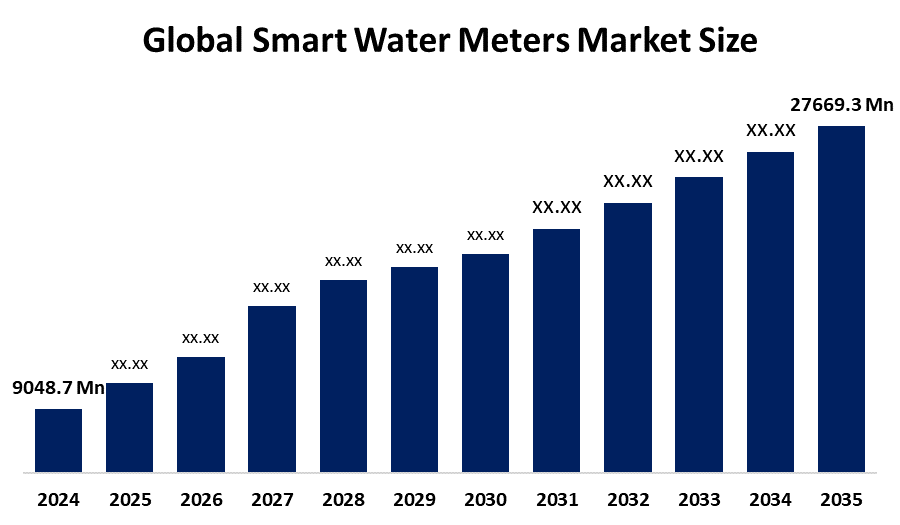
- The Global Smart Water Meters Market Size Was Estimated at USD 9048.7 Million in 2024
- The Market Size is Expected to Grow at a CAGR of around 10.7% from 2025 to 2035
- The Worldwide Smart Water Meters Market Size is Expected to Reach USD 27669.3 Million By 2035
- Asia Pacific is expected to Grow the fastest during the forecast period.
Get more details on this report -
According to a Research Report Published by Spherical Insights and Consulting, The Global Smart Water Meters Market Size was worth around USD 9048.7 Million in 2024 and is predicted to Grow to around USD 27669.3 Million by 2035 with a compound annual growth rate (CAGR) of 10.7% from 2025 to 2035. Global integration of AI and IoT, expansion of smart city projects, rising regulatory mandates for accurate, real time data, and the replacement of conventional meters with advanced ultrasonic technology are all driving opportunities in the smart water meters market.
Market Overview
The global industry segment focused on the production, deployment, and management of advanced water metering devices that use digital and IoT technologies to monitor water consumption in real time, enhance billing accuracy, detect leaks, and optimize water resource management is known as the smart water meters market. These include integration of wireless communication, cloud-based data analytics, AI-driven predictive maintenance, and remote monitoring systems, enabling utilities and consumers to manage water usage more efficiently. Government initiatives promote water conservation, support the adoption of smart infrastructure, fund pilot projects, and facilitate public–private partnerships to expand smart water metering networks globally.
In September 2025, the U.S. EPA provides guidance on Advanced Metering Infrastructure (AMI) for water utilities, promoting the use of smart meters to improve billing accuracy, water use monitoring, leak detection, and overall resource management as part of water conservation and infrastructure efficiency efforts.
In May 2024, India’s Smart Cities Mission includes smart water management, under the AMRUT digital water supply projects including 100% consumer metering and automated monitoring systems being implemented across urban areas. The quick speed of technological advancement is one of the main drivers of the smart water meters market expansion.
Report Coverage
This research report categorizes the smart water meters market based on various segments and regions, forecasts revenue growth, and analyzes trends in each submarket. The report analyses the key growth drivers, opportunities, and challenges influencing the smart water meters market. Recent market developments and competitive strategies, such as expansion, product launch, development, partnership, merger, and acquisition, have been included to draw the competitive landscape in the market. The report strategically identifies and profiles the key market players and analyses their core competencies in each sub-segment of the smart water meters market.
Global Smart Water Meters Market Report Coverage
| Report Coverage | Details |
|---|---|
| Base Year: | 2024 |
| Market Size in 2024 : | USD 9048.7 Million |
| Forecast Period: | 2025-2035 |
| Forecast Period CAGR 2025-2035 : | 10.7% |
| 2035 Value Projection: | USD 27669.3 Million |
| Historical Data for: | 2020-2023 |
| No. of Pages: | 169 |
| Tables, Charts & Figures: | 87 |
| Segments covered: | By Meter Type, By Technology and COVID-19 Impact Analysis |
| Companies covered:: | Itron Inc., Sensus, Badger Meter, Inc., Kamstrup A/S, Diehl Stiftung & Co. KG, Landis+Gyr, Honeywell International Inc., Neptune Technology Group Inc., Aclara Technologies LLC, Arad Group, B METERS Srl, Zenner International GmbH & Co. KG, Wasion Group Holdings, Apator S.A., Jiangxi Sanchuan Water Meter Co., Ltd., and Others |
| Pitfalls & Challenges: | Covid 19 Impact Challenges, Future, Growth and Analysis |
Get more details on this report -
Driving Factors
Rapid technological innovation is one of the main drivers of the smart water meters market's growth. Increasing need for efficient water management and conservation amid rising urbanization and water scarcity, which is the main factor driving the market for smart water meters. In this field, innovation and investment are driven by the growing need for IoT integration, AI-based analytics, and remote monitoring, enhance operational efficiency, enable accurate billing, and empower consumers with real-time water usage data. Additionally, regulatory mandates and incentive programs promoting sustainable water use further accelerate market adoption.
In September 2025, China’s National Development and Reform Commission (NDRC) and other ministries issued an opinion to strengthen water resource utilization, which includes increasing digital metering adoption and smart water meter deployment as part of water savings and network leak detection modernization.
Restraining Factors
High development and deployment costs, significant infrastructure investment requirements, Compatibility issues with existing legacy water systems, data security and privacy concern, and lack of standardized technologies are the main factors restricting the smart water meters market.
Market Segmentation
The smart water meters market share is classified into meter type, technology, and application.
- The electromagnetic meter segment dominated the market in 2024, approximately 60%, and is projected to grow at a substantial CAGR during the forecast period.
Based on the meter type, the smart water meters market is divided into electromagnetic meter, ultrasonic meter, and mechanical meter. Among these, the electromagnetic meter segment dominated the market in 2024, approximately 60%, and is projected to grow at a substantial CAGR during the forecast period. High accuracy with extreme durability, favoured in municipal and industrial applications, minimizes maintenance costs, and provides long operational life is driving the electromagnetic meter industry.
- The AMR segment accounted for the largest share in 2024, approximately 57%, and is anticipated to grow at a significant CAGR during the forecast period.
Based on the technology, the smart water meters market is divided into AMR and AMI. Among these, the AMR segment accounted for the largest share in 2024, approximately 57%, and is anticipated to grow at a significant CAGR during the forecast period. Cost-effective solution, ease of installation, high compatibility with existing water infrastructure, and its ability to retroactively upgrade traditional mechanical meters is driving the AMR industry.
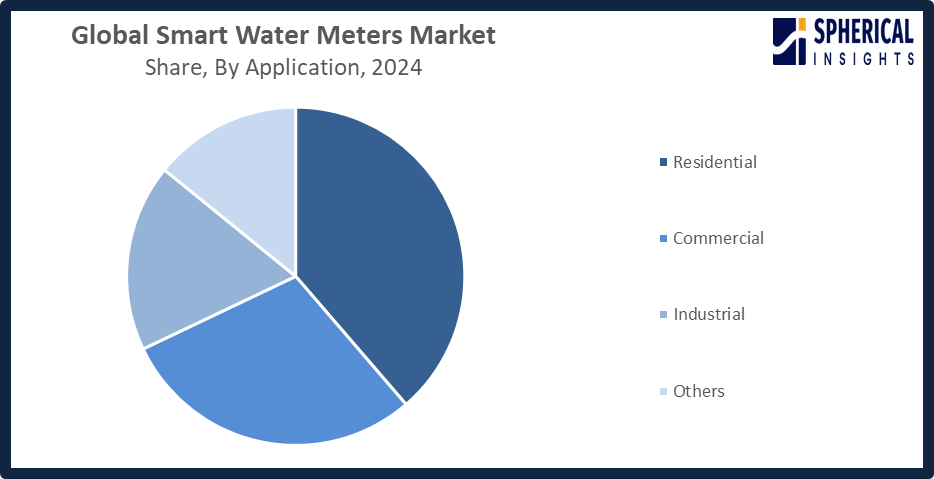
- The residential segment accounted for the highest market revenue in 2024, approximately 50%, and is anticipated to grow at a significant CAGR during the forecast period.
Based on the application, the smart water meters market is divided into residential, commercial, and industrial. Among these, the residential segment accounted for the highest market revenue in 2024, approximately 50%, and is anticipated to grow at a significant CAGR during the forecast period. Massive government-led deployments to improve billing accuracy, reduce non-revenue water losses, rising water scarcity awareness, and increasing IoT adoption is bolstering residential market.
Get more details on this report -
Regional Segment Analysis of the Smart Water Meters Market
- North America (U.S., Canada, Mexico)
- Europe (Germany, France, U.K., Italy, Spain, Rest of Europe)
- Asia-Pacific (China, Japan, India, Rest of APAC)
- South America (Brazil and the Rest of South America)
- The Middle East and Africa (UAE, South Africa, Rest of MEA)
North America is anticipated to hold the largest share of the smart water meters market over the predicted timeframe.

Get more details on this report -
North America is anticipated to hold the largest share of the smart water meters market over the predicted timeframe. The United States and Canada are key contributors, where smart water meters are widely deployed as part of utility upgrades and efficiency drives. Strong government backing for high adoption of AMI and loT-enabled systems that provide real-time two-way communication, predictive maintenance, and leak detection are what propel North America. The region's position is further reinforced by government programs well-established utility infrastructure, early adoption of digital water management solutions, and significant investments in water system modernization.
Government initiatives include the U.S. EPA's December 2024 with the U.S. Bureau of Reclamation issued a waiver under the Build America, Buy America Act for Advanced Metering Infrastructure (AMI) water meters used in federally funded infrastructure projects and Canada's June 2024 establishment of Canada Water Agency provides a national platform supporting improved water data systems, infrastructure modernization, and digital solutions including smart metering as part of freshwater governance policy.
Asia Pacific is expected to grow at a rapid CAGR in the smart water meters market during the forecast period. China, India, Japan, and South Korea are among the nations making significant investments in smart city infrastructure, loT platforms, and cloud-based data analytics. The demand for sophisticated smart water meters is further accelerated by the region's rapid urbanization, increasing industrialization, and large population bases, and strong government support.
Government launches include Japan's JICA, which signed an agreement in May 2025 to provide 510 million yen to support the installation of smart water meters and related equipment for the WASA in Faisalabad, Pakistan and China's March 2023 elevated smart cities and digital infrastructure including smart water metering technologies as national development priorities through policies and pilot programs led by major authorities such as the MOHURD.
Competitive Analysis:
The report offers the appropriate analysis of the key organizations/companies involved within the smart water meters market, along with a comparative evaluation primarily based on their product of offering, business overviews, geographic presence, enterprise strategies, segment market share, and SWOT analysis. The report also provides an elaborative analysis focusing on the current news and developments of the companies, which includes product development, innovations, joint ventures, partnerships, mergers & acquisitions, strategic alliances, and others. This allows for the evaluation of the overall competition within the market.
List of Key Companies
- Itron Inc.
- Sensus
- Badger Meter, Inc.
- Kamstrup A/S
- Diehl Stiftung & Co. KG
- Landis+Gyr
- Honeywell International Inc.
- Neptune Technology Group Inc.
- Aclara Technologies LLC
- Arad Group
- B METERS Srl
- Zenner International GmbH & Co. KG
- Wasion Group Holdings
- Apator S.A.
- Jiangxi Sanchuan Water Meter Co., Ltd.
- Others
Key Target Audience
- Market Players
- Investors
- End-users
- Government Authorities
- Consulting and Research Firm
- Venture capitalists
- Value-Added Resellers (VARs)
Recent Development
- In January 2026, HPL Electric & Power- Ltd. Launched Neeram Pulse, a new smart water metering solution (utility-grade, AMR/AMI-ready) and opened a new manufacturing facility in Gurugram to produce smart water meters geared toward utility and smart city deployments.
- In November 2025, Wessex Water announced a long-term collaboration with Honeywell to deliver advanced smart meters and associated communication systems to upgrade its network as part of its smart metering program through the AMP8 period.
- In September 2025, Netmore Group was selected to deploy and manage network services for a 1 million smart water meter rollout across the UK on behalf of Severn Trent, with Itron and Diehl as meter suppliers and Vodafone lot for NB-IoT connectivity.
- In October 2024, JANZ, Subsidiary of SIT Group won a public tender to supply approximately 99,600 residential smart water meters under a multi-year delivery plan, expanding the company's global deployment footprint.
Market Segment
This study forecasts revenue at global, regional, and country levels from 2020 to 2035. Spherical Insights has segmented the smart water meters market based on the below-mentioned segments:
Global Smart Water Meters Market, By Meter Type
- Electromagnetic Meter
- Ultrasonic Meter
- Mechanical Meter
Global Smart Water Meters Market, By Technology
- AMR
- AMI
Global Smart Water Meters Market, By Application
- Residential
- Commercial
- Industrial
Global Smart Water Meters Market, By Regional Analysis
- North America
- US
- Canada
- Mexico
- Europe
- Germany
- UK
- France
- Italy
- Spain
- Russia
- Rest of Europe
- Asia Pacific
- China
- Japan
- India
- South Korea
- Australia
- Rest of Asia Pacific
- South America
- Brazil
- Argentina
- Rest of South America
- Middle East & Africa
- UAE
- Saudi Arabia
- Qatar
- South Africa
- Rest of the Middle East & Africa
Frequently Asked Questions (FAQ)
-
1. How do smart water meters reduce water waste?They provide continuous monitoring and detect abnormal flow patterns. Alerts can be sent instantly for leaks or bursts. This prevents prolonged water loss and supports conservation efforts.
-
2. What is the difference between AMR and AMI meters?AMR (Automatic Meter Reading) meters allow one-way data transfer to utilities. AMI (Advanced Metering Infrastructure) meters enable two-way communication. AMI supports real-time monitoring, analytics, and remote control.
-
3. What technological advancements are being used in smart water meters?IoT integration, AI analytics, cloud-based monitoring, and leak detection sensors are common. Some meters use ultrasonic measurement for higher accuracy. Real-time dashboards are also provided to users.
-
4. How accurate are smart water meters compared to traditional meters?Smart meters generally offer higher precision with digital sensors. Ultrasonic meters have error margins as low as ±1%. Traditional mechanical meters may drift over time.
-
5. Can consumers access their water usage in real time?Yes, many systems provide mobile or web dashboards. Users can track daily, weekly, or monthly consumption. This helps manage usage habits proactively.
-
6. How do smart water meters integrate with smart city initiatives?They provide real-time water data for urban planning and sustainability. Integration with energy and waste management systems is possible. They support analytics for resource optimization.
Need help to buy this report?