Global Smart Electrogastrogram Recorder Market Size, Share, and COVID-19 Impact Analysis, By Product Type (Portable Electrogastrogram Recorder, Desktop Electrogastrogram Recorder, Wearable Electrogastrogram Recorder, and Others), By Application (Hospitals, Clinics, Research Institutes, and Others), and By Region (North America, Europe, Asia-Pacific, Latin America, Middle East, and Africa), Analysis and Forecast 2025 - 2035
Industry: Healthcare
Global Smart Electrogastrogram Recorder Market Insights Forecasts to 2035
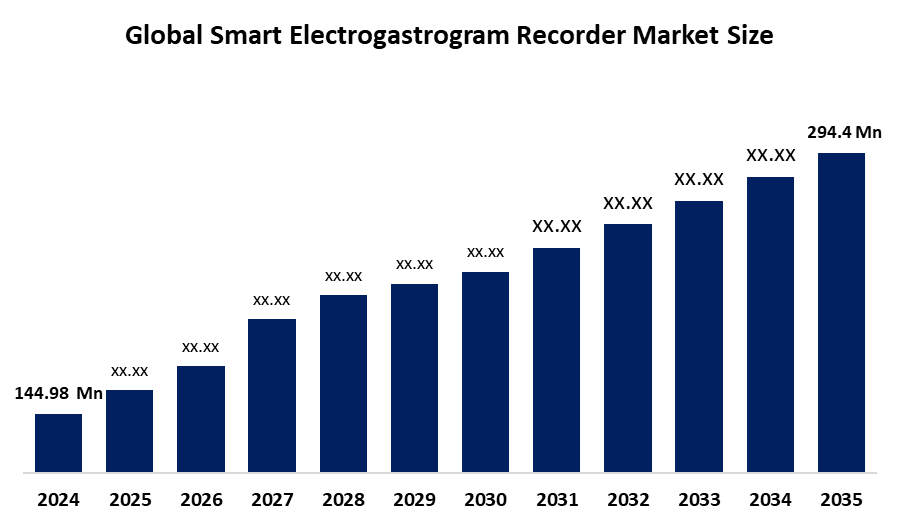
- The Global Smart Electrogastrogram Recorder Market Size Was Estimated at USD 144.98 Million in 2024
- The Market Size is Expected to Grow at a CAGR of around 6.65% from 2025 to 2035
- The Worldwide Smart Electrogastrogram Recorder Market Size is Expected to Reach USD 294.4 Million by 2035
- Asia Pacific is expected to grow the fastest during the forecast period.
Get more details on this report -
According to a research report published by Spherical Insights and Consulting, the global smart electrogastrogram recorder market size was worth around USD 144.98 million in 2024 and is predicted to grow to around USD 294.4 million by 2035 with a compound annual growth rate (CAGR) of 6.65% from 2025 to 2035. Opportunities in advanced gastrointestinal diagnostics, non-invasive monitoring, individualized healthcare, wearable device integration, remote patient management, technological innovation, and growing adoption in clinical and research settings are all presented by the smart electrogastrogram recorder market.
Market Overview
The market for smart electrogastrogram recorders (EGGs) consists of the trade and technology ecosystem linked to high-tech gadgets used for capturing and studying the electrical activity of the stomach. The smart recorders used non-invasive sensors and digital methods to observe gastric motility, thus giving timely, precise data for the diagnosis and treatment of gastrointestinal disorders, e.g., gastroparesis, functional dyspepsia, and others caused due to motility issues. China, India, the UK, and Germany drive the smart electrogastrogram recorder market, with healthcare modernization, insurance expansion, and research investments collectively projected to boost the sector by 89.4% through 2035. The U.S. government launched FDA regulations (21 CFR § 876.1735) for smart electrogastrogram recorders, mandating performance standards, labeling, and biocompatibility testing to ensure safe, non-invasive gastric motility monitoring. The growing incidence of functional gastrointestinal illnesses, such as gastroparesis, dyspepsia, and IBS, which call for objective motility assessment rather than symptom-based diagnosis, is driving the smart electrogastrogram recorder market. The demand for objective diagnostic tools supporting clinical assessment and therapy monitoring is being driven by the ongoing growth of diagnoses for irritable bowel syndrome, gastroparesis, and functional dyspepsia.
Report Coverage
This research report categorizes the smart electrogastrogram recorder market based on various segments and regions, forecasts revenue growth, and analyzes trends in each submarket. The report analyses the key growth drivers, opportunities, and challenges influencing the smart electrogastrogram recorder market. Recent market developments and competitive strategies, such as expansion, product launch, development, partnership, merger, and acquisition, have been included to draw the competitive landscape in the market. The report strategically identifies and profiles the key market players and analyzes their core competencies in each sub-segment of the smart electrogastrogram recorder market.
Driving Factors
Global Smart Electrogastrogram Recorder Market Report Coverage
| Report Coverage | Details |
|---|---|
| Base Year: | 2024 |
| Market Size in 2024: | USD 144.98 Million |
| Forecast Period: | 2024-2035 |
| Forecast Period CAGR 2024-2035 : | CAGR of 6.65% |
| 2035 Value Projection: | USD 294.4 Million |
| Historical Data for: | 2020-2023 |
| No. of Pages: | 240 |
| Tables, Charts & Figures: | 105 |
| Segments covered: | By Product ,By Application |
| Companies covered:: | BioPac Systems Inc, Brain Products GmbH, Cadwell Industries, Compumedics Limited, EB Neuro S.p.A., GE Healthcare, Medtronic, Natus Medical Incorporated, Neurosoft, NIHON KOHDEN, Noraxon USA Inc, Philips Healthcare, RDS Medical, Schiller AG, Others, and other players |
| Pitfalls & Challenges: | COVID-19 Empact, Challenge, Future, Growth, & Analysis |
Get more details on this report -
The use and expansion of the smart electrogastrogram recorder in clinical and research settings are mostly driven by a number of important considerations. Compared to endoscopic and manometric stomach motility evaluation methods, there is a growing preference for non-invasive diagnostic techniques that minimize patient pain and procedure hazards. Additionally, market expansion is supported by patients' and healthcare professionals' rising knowledge of the advantages of non-invasive gastrointestinal monitoring. Opportunities for ambulatory electrogastrography supporting virtual gastroenterology consultations and longitudinal symptom evaluation are being created by the growing use of telemedicine platforms and remote patient monitoring devices.
Restraining Factors
The market for smart electrogastrogram recorders is being restricted by a number of factors, including high device costs, low awareness among healthcare professionals, a lack of established protocols, technological complexity, and regulatory obstacles. These factors all work together to prevent widespread acceptance and delay worldwide market progress.
Market Segmentation
The smart electrogastrogram recorder market share is classified into product type and application.
- The portable electrogastrogram recorder segment accounted for the largest share in 2024 and is anticipated to grow at a significant CAGR during the forecast period.
Based on the product type, the smart electrogastrogram recorder market is divided into portable electrogastrogram recorder, desktop electrogastrogram recorder, wearable electrogastrogram recorder, and others. Among these, the portable electrogastrogram recorder segment accounted for the largest share in 2024 and is anticipated to grow at a significant CAGR during the forecast period. The main driving forces behind the portable electrogastrogram recorder are the device's mobility, ease of use, and ability to provide accurate, real-time monitoring of gastric electrical activity in various places, like clinics, hospitals, and home care. The portable electrogastrogram recorder segment is benefiting from the collaboration of digital health platforms, wearable technology, and wireless connections, which are all making data analysis and remote patient monitoring easier.
- The hospitals segment accounted for the highest market revenue in 2024 and is anticipated to grow at a significant CAGR during the forecast period.
Based on the application, the smart electrogastrogram recorder market is divided into hospitals, clinics, research institutes, and others. Among these, the hospitals segment accounted for the highest market revenue in 2024 and is anticipated to grow at a significant CAGR during the forecast period. The reliable equipment availability and technical support services, hospitals maintain procurement partnerships with major manufacturers of medical devices. Constant increase driven by functional gastrointestinal disorder diagnosis and inclusion of electrogastrography into conventional diagnostic protocols for gastroparesis and dyspepsia evaluation.

Get more details on this report -
Regional Segment Analysis of the Smart Electrogastrogram Recorder Market
- North America (U.S., Canada, Mexico)
- Europe (Germany, France, U.K., Italy, Spain, Rest of Europe)
- Asia-Pacific (China, Japan, India, Rest of APAC)
- South America (Brazil and the Rest of South America)
- The Middle East and Africa (UAE, South Africa, Rest of MEA)
North America is anticipated to hold the largest share of the smart electrogastrogram recorder market over the predicted timeframe.
North America is anticipated to hold the largest share of the smart electrogastrogram recorder market over the predicted timeframe. The healthcare infrastructure in North America is composed of high-quality facilities, the most recent innovative diagnostic methods, and technologies that have already received approval from the regulatory authorities. The region is populated with the best gastroenterology departments, research institutes, and hospitals that are fully committed to the early detection and proper diagnosis of gastrointestinal disorders, among which are gastroparesis, functional dyspepsia, and chronic nausea. The country has a well-established gastroenterology leadership and very sophisticated healthcare delivery systems that create the need for high-quality diagnostic equipment, which is in line with clinical performance and evidence-based practice standards. The U.S. government is increasing support for gastrointestinal diagnostics through HR 3396, which dedicates $15 million every year, as well as through a $3.2 million NIH grant given in February 2025 for advancing human gastric motility research and innovation.

Get more details on this report -
Asia Pacific is expected to grow at a rapid CAGR in the smart electrogastrogram recorder market during the forecast period. The Asia Pacific region aforementioned factors, combined with the rapid urbanization taking place, the healthcare infrastructure, and the access to modern medical facilities getting better in the countries of China, India, Japan, and South Korea, are the reasons behind the demand for non-invasive gastric monitoring solutions getting higher. The governments of the Asia Pacific countries are the ones that play the main role in the gastro-intestinal diagnostics (in the case of China they digitize the process using $12.5B, for India it is the $595M Ayushman Bharat expansion, and Japan it is the $2.8B motility research grant) which all ultimately leads to the Smart Electrogastrogram adoption and infrastructure development getting faster.
Competitive Analysis:
The report offers the appropriate analysis of the key organizations/companies involved within the smart electrogastrogram recorder market, along with a comparative evaluation primarily based on their product offering, business overviews, geographic presence, enterprise strategies, segment market share, and SWOT analysis. The report also provides an elaborative analysis focusing on the current news and developments of the companies, which includes product development, innovations, joint ventures, partnerships, mergers & acquisitions, strategic alliances, and others. This allows for the evaluation of the overall competition within the market.
List of Key Companies
- BioPac Systems Inc
- Brain Products GmbH
- Cadwell Industries
- Compumedics Limited
- EB Neuro S.p.A.
- GE Healthcare
- Medtronic
- Natus Medical Incorporated
- Neurosoft
- NIHON KOHDEN
- Noraxon USA Inc
- Philips Healthcare
- RDS Medical
- Schiller AG
- Others
Key Target Audience
- Market Players
- Investors
- End-users
- Government Authorities
- Consulting and Research Firm
- Venture capitalists
- Value-Added Resellers (VARs)
Recent Development
- In July 2025, Philips launched a strategic partnership to expand Smart Electrogastrogram Recorder patient monitoring, integrating wireless EGG-compatible sensors for real-time telemedicine, potentially benefiting 15 million users globally and enhancing remote gastrointestinal care.
Market Segment
This study forecasts revenue at global, regional, and country levels from 2020 to 2035. Spherical Insights has segmented the smart electrogastrogram recorder market based on the below-mentioned segments:
Global Smart Electrogastrogram Recorder Market, By Product Type
- Portable Electrogastrogram Recorder
- Desktop Electrogastrogram Recorder
- Wearable Electrogastrogram Recorder
- Others
Global Smart Electrogastrogram Recorder Market, By Application
- Hospitals
- Clinics
- Research Institutes
- Others
Global Smart Electrogastrogram Recorder Market, By Regional Analysis
- North America
- US
- Canada
- Mexico
- Europe
- Germany
- UK
- France
- Italy
- Spain
- Russia
- Rest of Europe
- Asia Pacific
- China
- Japan
- India
- South Korea
- Australia
- Rest of Asia Pacific
- South America
- Brazil
- Argentina
- Rest of South America
- Middle East & Africa
- UAE
- Saudi Arabia
- Qatar
- South Africa
- Rest of the Middle East & Africa
Frequently Asked Questions (FAQ)
-
1. What is the CAGR of the smart electrogastrogram recorder market over the forecast period?The global smart electrogastrogram recorder market is projected to expand at a CAGR of 6.65% during the forecast period.
-
2. What is the market size of the smart electrogastrogram recorder market?The global smart electrogastrogram recorder market size is expected to grow from USD 144.98 million in 2024 to USD 294.4 million by 2035, at a CAGR of 6.65% during the forecast period 2025-2035.
-
3. Which region holds the largest share of the smart electrogastrogram recorder market?North America is anticipated to hold the largest share of the smart electrogastrogram recorder market over the predicted timeframe.
-
4. Who are the top 10 companies operating in the global smart electrogastrogram recorder market?BioPac Systems Inc, Brain Products GmbH, Cadwell Industries, Compumedics Limited, EB Neuro S.p.A., GE Healthcare, Medtronic, Natus Medical Incorporated, Neurosoft, NIHON KOHDEN, Noraxon USA Inc, Philips Healthcare, RDS Medical, Schiller AG, and others
-
5. What factors are driving the growth of the smart electrogastrogram recorder market?Driving factors for the Smart Electrogastrogram Recorder market include rising prevalence of gastrointestinal disorders, growing demand for non‑invasive diagnostics, technological improvements (e.g., wireless, AI‑enabled analysis), expanding healthcare infrastructure, and increased telemedicine and outpatient monitoring adoption.
-
6. What are the market trends in the Smart Electrogastrogram Recorder market?Market trends feature integration of wireless and AI‑powered data analytics, growth of portable and wearable EGG devices, expansion of telemedicine‑based gastric monitoring, and increasing use in ambulatory or home‑care settings.
-
7. What are the main challenges restricting the wider adoption of the Smart Electrogastrogram Recorder market?Main challenges restraining wider adoption include high device cost, limited clinical awareness and training for EGG interpretation, inconsistent reimbursement policies, and competition from established diagnostic alternatives such as scintigraphy or manometry.
Need help to buy this report?