Global Skin Cancer Molecular Diagnostics Market Size, Share, and COVID-19 Impact Analysis, By Cancer Type (Melanoma and Non-Melanoma), By End-User (Hospitals & Diagnostic Laboratories, Research Institutions & Academic Labs, and Pharmaceutical & Biotech Companies), and By Region (North America, Europe, Asia-Pacific, Latin America, Middle East, and Africa), Analysis and Forecast 2025 - 2035
Industry: Healthcare
Global Skin Cancer Molecular Diagnostics Market Size Insights Forecasts to 2035
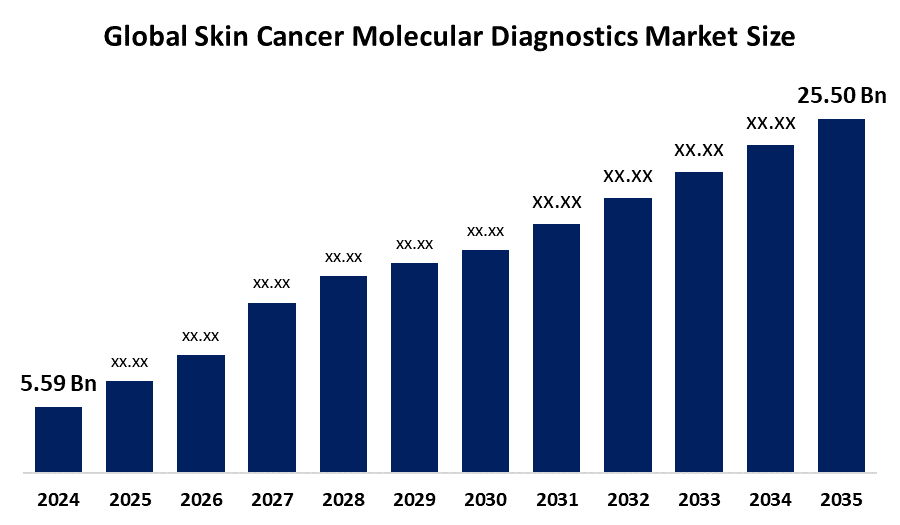
- The Global Skin Cancer Molecular Diagnostics Market Size Was Estimated at USD 5.59 Billion in 2024
- The Market Size is Expected to Grow at a CAGR of around 14.79% from 2025 to 2035
- The Worldwide Skin Cancer Molecular Diagnostics Market Size is Expected to Reach USD 25.50 Billion by 2035
- Asia Pacific is expected to Grow the fastest during the forecast period.
Get more details on this report -
According to a Research Report Published by Spherical Insights and Consulting, The Global Skin Cancer Molecular Diagnostics Market Size was worth around USD 5.59 Billion in 2024 and is predicted to Grow to around USD 25.50 Billion by 2035 with a compound annual growth rate (CAGR) of 14.79% from 2025 and 2035. The market for skin cancer molecular diagnostics has a number of opportunities to grow due to the inclination towards a proactive, non-invasive and highly personalised paradigm, shifting away from reactive symptom-based treatments. Furthermore, advancements in genomics, proteomics, microbiome analysis, and AI, for identifying the molecular signatures of skin conditions, ultimately enable precise, tailored interventions.
Market Overview
The global industry of skin cancer molecular diagnostics focuses on using genetic testing (DNA/RNA) and biomarkers to detect, classify, and guide treatment for skin cancers like melanoma and non-melanoma. Although, skin cancer is a significant and increasing global health burden, the current diagnostic workflow able to provide clinically actionable results with significant training and expertise as well as patient accessibility to workflow. Molecular biomarkers are transforming the diagnostics and treatment delivery in oncology. Herein, commercially available, clinically validated, and emerging skin cancer molecular biomarkers are reviewed.
Innovation and market expansion are anticipated as a result of major players' growing R&D expenditures and the expanding product pipelines, and partnering with regional players to strengthen the market presence. Further, small biotech firms and startups emphasizing innovation in liquid biopsy solutions products, which aid in gaining market share in the niche segments. The quick development of artificial intelligence technology built on deep learning algorithms, which is a form of machine learning where computers process vast numbers of images to learn patterns, is driving a huge surge in the global skin cancer molecular diagnostics market.
Report Coverage
This research report categorizes the skin cancer molecular diagnostics market based on various segments and regions, forecasts revenue growth, and analyzes trends in each submarket. The report analyses the key growth drivers, opportunities, and challenges influencing the skin cancer molecular diagnostics market. Recent market developments and competitive strategies such as expansion, type launch, development, partnership, merger, and acquisition have been included to draw the competitive landscape in the market. The report strategically identifies and profiles the key market players and analyses their core competencies in each sub-segment of the skin cancer molecular diagnostics market.
Global Skin Cancer Molecular Diagnostics Market Report Coverage
| Report Coverage | Details |
|---|---|
| Base Year: | 2024 |
| Market Size in 2024: | USD 5.59 Billion |
| Forecast Period: | 2025-2035 |
| Forecast Period CAGR 2025-2035 : | 14.79% |
| 2035 Value Projection: | USD 25.50 Billion |
| Historical Data for: | 2020-2023 |
| No. of Pages: | 279 |
| Tables, Charts & Figures: | 103 |
| Segments covered: | By Cancer Type, By End-User and COVID-19 Impact Analysis |
| Companies covered:: | Annoroad, Roche Diagnostics, Abbott Laboratories, Thermo Fisher Scientific, Qiagen, and Others |
| Pitfalls & Challenges: | COVID-19 Empact, Challenges, Future, Growth, & Analysis |
Get more details on this report -
Driving Factors
An increasing skin cancer prevalence is anticipated to drive the skin cancer molecular diagnostics market, with skin cancers as the most common group of cancer diagnosed worldwide, with more than 1.5 million new cases estimated in 2022. In 2022, an estimated 330 000 new cases of melanoma were diagnosed worldwide, and almost 60 000 people died from the disease. Advancements in molecular diagnostics play an important role in accelerating the market growth. For instance, in December 2025, U.S.-based Ipseity Diagnostics partnered with Vignan University to advance molecular research in Andhra Pradesh. Additionally, emphasizing personalized medicine concept is also responsible for the market growth of skin cancer molecular diagnostics.
Restraining Factors
The skin cancer molecular diagnostics market is restricted by factors like increased cost and technical limitations, as well as regulatory barriers. Limited availability of healthcare infrastructure is causing hindered adoption of molecular diagnostics technology, ultimately hindering the market growth.
Market Segmentation
The skin cancer molecular diagnostics market share is classified into cancer type and end-user.
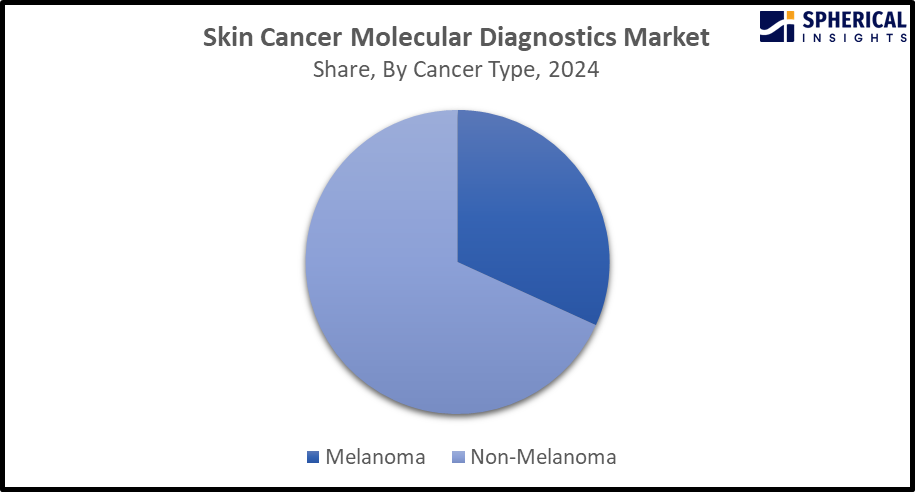
- The non-melanoma segment dominated the market with the largest share of about 75% in 2024 and is projected to grow at a substantial CAGR during the forecast period.
Based on the cancer type, the skin cancer molecular diagnostics market is divided into melanoma and non-melanoma. Among these, the non-melanoma segment dominated the market with the largest share of about 75% in 2024 and is projected to grow at a substantial CAGR during the forecast period. This is because non-melanoma skin cancer (NMSC) causes more deaths each year, as an aggressive form of skin cancer. Molecular diagnosis of NMSC (including basal cell and squamous cell carcinoma), emphasizing identification of UV-induced genetic mutations and protein markers for improved and early detection.
Get more details on this report -
- The hospitals and diagnostic laboratories segment accounted for the largest share of approximately 65% in 2024 and is anticipated to grow at a significant CAGR during the forecast period.
Based on the end-user, the skin cancer molecular diagnostics market is divided into hospitals & diagnostic laboratories, research institutions & academic labs, and pharmaceutical & biotech companies. Among these, the hospitals and diagnostic laboratories segment accounted for the largest share of approximately 65% in 2024 and is anticipated to grow at a significant CAGR during the forecast period. This is due to the use of advanced techniques in hospitals, which are beyond traditional pathology. This includes Immunohistochemistry (IHC), next generation sequencing (NGS), and gene expression profiling GEP for identifying specific molecular changes.
Regional Segment Analysis of the Skin Cancer Molecular Diagnostics Market
- North America (U.S., Canada, Mexico)
- Europe (Germany, France, U.K., Italy, Spain, Rest of Europe)
- Asia-Pacific (China, Japan, India, Rest of APAC)
- South America (Brazil and the Rest of South America)
- The Middle East and Africa (UAE, South Africa, Rest of MEA)
North America is anticipated to hold the largest share of the skin cancer molecular diagnostics market over the predicted timeframe.

Get more details on this report -
North America is anticipated to hold the largest share of over 45% in the skin cancer molecular diagnostics market over the predicted timeframe. The market ecosystem in North America is strong, with both cutting-edge startups and major industrial heavyweights well-represented, like VivoSight, Veriskin, Inc. The market demand has been driven by the region's increased awareness of precision oncology approaches and advanced healthcare infrastructure. The U.S. is estimated to account for about 87% of the regional skin cancer molecular diagnostics market due to several reasons, including skin cancer incidence, advanced diagnostic infrastructure, string reimbursement system, presence of biotech & diagnostic players, and greater awareness & screening programs.
Asia Pacific is expected to grow at a rapid CAGR of 11.7% in the skin cancer molecular diagnostics market during the forecast period. The Asia Pacific area has a thriving market for skin cancer molecular diagnostics due to its expanding healthcare accessibility, awareness campaigns, and government-backed precision medicine initiatives. The region's increasing use of solutions like biomaterials and artificial intelligence (AI), as well as international skin consortiums forming to bridge academia and industry in new collaborations, is expected to propel the regional market growth. China is the fastest growing country in APAC skin cancer molecular diagnostics market, due to the increased cases of MSM related deaths. For instance, it was estimated that in 2021, China reported approximately 13,437 new cases of MSM, with a total patient population of 81,219 and 5,373 MSM-related deaths.
Competitive Analysis:
The report offers the appropriate analysis of the key organizations/companies involved within the skin cancer molecular diagnostics market, along with a comparative evaluation primarily based on their type of offering, business overviews, geographic presence, enterprise strategies, segment market share, and SWOT analysis. The report also provides an elaborative analysis focusing on the current news and developments of the companies, which includes type development, innovations, joint ventures, partnerships, mergers & acquisitions, strategic alliances, and others. This allows for the evaluation of the overall competition within the market.
List of Key Companies
- Annoroad
- Roche Diagnostics
- Abbott Laboratories
- Thermo Fisher Scientific
- Qiagen
- Others
Key Target Audience
- Market Players
- Investors
- End-users
- Government Authorities
- Consulting And Research Firm
- Venture capitalists
- Value-Added Resellers (VARs)
Recent Development
- In October 2025, DermaSensor, a Miami-based medical device technology company that aims to revolutionize skin cancer detection in primary care offices, announced it has raised $16 million in Series B funding.
- In January 2024, the FDA cleared a new skin cancer detection device, DermaSensor, powered by Boston University-developed technology. The device provides quantitative identification of all skin cancer types at the point of care and within seconds.
Market Segment
This study forecasts revenue at global, regional, and country levels from 2020 to 2035. Spherical Insights has segmented the skin cancer molecular diagnostics market based on the below-mentioned segments:
Global Skin Cancer Molecular Diagnostics Market, By Cancer Type
- Melanoma
- Non-Melanoma
Global Skin Cancer Molecular Diagnostics Market, By End-User
- Hospitals & Diagnostic Laboratories
- Research Institutions & Academic Labs
- Pharmaceutical & Biotech Companies
Global Skin Cancer Molecular Diagnostics Market, By Regional Analysis
- North America
- US
- Canada
- Mexico
- Europe
- Germany
- UK
- France
- Italy
- Spain
- Russia
- Rest of Europe
- Asia Pacific
- China
- Japan
- India
- South Korea
- Australia
- Rest of Asia Pacific
- South America
- Brazil
- Argentina
- Rest of South America
- Middle East & Africa
- UAE
- Saudi Arabia
- Qatar
- South Africa
- Rest of the Middle East & Africa
Frequently Asked Questions (FAQ)
-
1. What is the market size of the skin cancer molecular diagnostics market?The global skin cancer molecular diagnostics market size is expected to grow from USD 5.59 Billion in 2024 to USD 25.50 Billion by 2035, at a CAGR of 14.79% during the forecast period 2025-2035.
-
2. Which region holds the largest share of the skin cancer molecular diagnostics market?North America is anticipated to hold the largest share of the skin cancer molecular diagnostics market over the predicted timeframe.
-
3. What is the forecasted CAGR of the Global Skin cancer molecular diagnostics Market from 2024 to 2035?The market is expected to grow at a CAGR of around 14.79% during the period 2024–2035.
-
4. Who are the top companies operating in the Global Skin cancer molecular diagnostics Market?Key players include Annoroad, Roche Diagnostics, Abbott Laboratories, Thermo Fisher Scientific, and Qiagen.
-
5. Can you provide company profiles for the leading skin cancer molecular diagnostics manufacturers?Yes. For example, Annoroad is a company focused on molecular-diagnostics-based IVD medical devices and multi-mics life sciences research services. Roche Diagnostics develops and produces medical tests and digital tools providing information to help healthcare professionals find the right treatment for patients and deliver the best patient care, developing diagnostic products.
-
6. What are the main drivers of growth in the skin cancer molecular diagnostics market?An increasing skin cancer prevalence, advancement in molecular diagnostics, and focus on personalized medicine concept are major market growth drivers of the skin cancer molecular diagnostics market.
-
7. What challenges are limiting the skin cancer molecular diagnostics market?Technical limitations, regulatory barriers, and limited availability of healthcare infrastructure remain key challenging factors in the skin cancer molecular diagnostics market.
Need help to buy this report?