Global Second Hand Trading Platform Market Size, Share, and COVID-19 Impact Analysis, By Type (Consumer-to-Consumer and Business-to-Consumer), By Product Type (Electronics & Gadgets, Fashion & Apparel, Furniture & Home Appliances, Automobiles & Automotive Parts, Books, Media & Entertainment, Luxury Items, and Others), By Platform Type (Mobile Application, Web-Based Platforms, and Others), By End User (Individual Consumers, Small Businesses / SMEs, Resellers & Professional Traders, and Others), and By Region (North America, Europe, Asia-Pacific, Latin America, Middle East, and Africa), Analysis and Forecast 2025 - 2035
Industry: Information & Technology
Global Second Hand Trading Platform Market Size Insights Forecasts to 2035
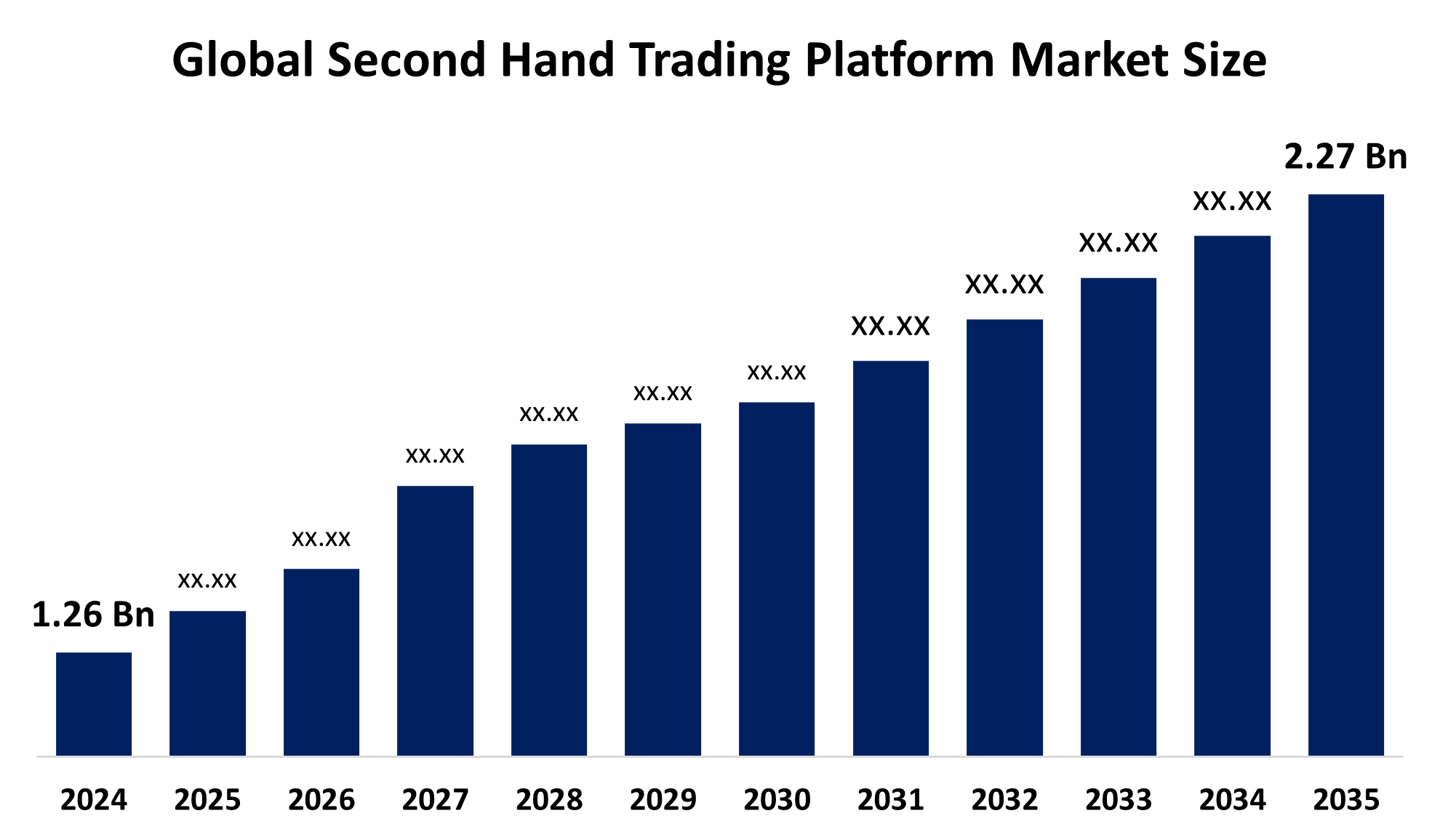
- The Global Second Hand Trading Platform Market Size Was Estimated at USD 1.26 Billion in 2024
- The Market Size is Expected to Grow at a CAGR of around 5.5% from 2025 to 2035
- The Worldwide Second Hand Trading Platform Market Size is Expected to Reach USD 2.27 Billion by 2035
- North America is expected to grow the fastest during the forecast period.
Get more details on this report -
According to a research report published by Spherical Insights and Consulting, The Global Second Hand Trading Platform Market Size was worth around USD 1.26 Billion in 2024 and is Predicted to Grow to around USD 2.27 billion by 2035 with a Compound Annual Growth Rate (CAGR) of 5.5% from 2025 to 2035. The second-hand trading platform market is growing because people now understand sustainability better, and they want to buy affordable products that have distinct features and digital platforms that authenticate their identity.
Market Overview
The Global Second Hand Trading Platform Market refers to digital marketplaces that enable individuals and businesses to buy and sell pre-owned products such as clothing, electronic furniture, books, and vehicles through mobile apps and websites. The platforms enable economical product usage while they support product reuse and circular economy operations, which result in longer product durations and decreased environmental waste. The main platforms, which include eBay, Poshmark, Depop and Vinted, have enabled consumers to access second-hand products through mobile applications and online websites. Market growth occurs because of two main factors, which include environmental awareness and increased smartphone usage and consumer needs for affordable products. The internet reaches more than 5.4 billion users worldwide in 2024, which enhances access to online resale platforms. The global resale market is expected to surpass $1 trillion by 2035 because of strong consumer market adoption.
The development of AI-based product suggestions, safe online payment solutions and international resale platforms creates new business possibilities. The younger generation drives market expansion because about 60-70% of Gen Z consumers bought second-hand products, according to research from recent years. The EU2030 Roadmap, which Classifieds Marketplaces Europe introduced in January 2024, requires the EU to develop stronger policies that will benefit second-hand commerce and circular economy development. Online resale platforms can help Europe achieve its green and digital transformation goals, according to Schibsted OLX Vinted and European Commission representatives.
Report Coverage
This research report categorizes the second hand trading platform market based on various segments and regions, forecasts revenue growth, and analyzes trends in each submarket. The report analyses the key growth drivers, opportunities, and challenges influencing the second hand trading platform market. Recent market developments and competitive strategies, such as expansion, type launch, development, partnership, merger, and acquisition, have been included to draw the competitive landscape in the market. The report strategically identifies and profiles the key market players and analyses their core competencies in each sub-segment of the second hand trading platform market.
Global Second Hand Trading Platform Market Report Coverage
| Report Coverage | Details |
|---|---|
| Base Year: | 2024 |
| Market Size in 2024: | USD 1.26 Billion |
| Forecast Period: | 2025-2035 |
| Forecast Period CAGR 2025-2035 : | 5.5% |
| 2035 Value Projection: | USD 2.27 Billion |
| Historical Data for: | 2020-2023 |
| No. of Pages: | 195 |
| Tables, Charts & Figures: | 102 |
| Segments covered: | By Product Type, By Type |
| Companies covered:: | eBay Inc., OLX Group, Mercari Inc., Vinted UAB, Zalando SE, Vestiaire Collective SA, ThredUp Inc., Beijing Shanyi Shanmei Technology, Poshmark Inc., Alibaba Group, Carousell Pte. Ltd., Shpock GmbH, ASOS plc, Depop Limited, and Other Key Players |
| Pitfalls & Challenges: | and COVID-19 Impact Analysis |
Get more details on this report -
Driving Factors
The Global Second Hand Trading Platform Market is expanding because customers want affordable products and sustainable practices, and digital marketplaces continue to develop. People who want to save money during times of rising inflation now choose to buy used products, which cost between 30- 70% less than new products. Environmental concerns are also influencing purchasing decisions, with reports indicating that over 50% of consumers prefer second-hand goods to reduce waste and support the circular economy. The mobile resale platforms eBay, Poshmark and Depop enable users to buy and sell used products through their devices, which has become the most common way to transact. The ThredUp 2024 resale report shows that the worldwide resale industry will increase three times faster than conventional retail operations because of strong market growth. In June 2025, U.S. lawmakers including Sydney Kamlager-Dove and Nicole Malliotakis launched a bipartisan sustainability caucus promoting the re-commerce economy. The initiative supports resale platforms like eBay, Etsy, and Depop, aiming to reduce fashion waste, support small sellers, and encourage circular business models in the U.S. market.
Restraining Factors
The Global Second Hand Trading Platform Market encounters obstacles because people doubt product authenticity and face fraud risks, while there are no established procedures to evaluate product quality. The Federal Trade Commission reports that online shopping scams led to consumer losses exceeding $2.7 billion in 2023, which resulted in decreased trust toward resale platforms. The complex return policies, together with the logistics difficulties, create obstacles that prevent people from participating in international second-hand product transactions.
Market Segmentation
The second hand trading platform market share is classified into type, product type, platform type, and end user.
- The consumer-to-consumer segment dominated the market in 2024, approximately 60% and is projected to grow at a substantial CAGR during the forecast period.
Based on the type, the Second Hand Trading Platform Market is divided into consumer-to-consumer and business-to-consumer. Among these, the consumer-to-consumer segment dominated the market in 2024, approximately 60% and is projected to grow at a substantial CAGR during the forecast period. The consumer-to-consumer (C2C) segment dominates the market, driven by the rise of peer-to-peer marketplaces and social commerce integration. Key growth factors include changing consumer preference for sustainable and affordable used goods, increasing smartphone penetration and digital payment adoption (with digital payments representing 57.4% of transaction volume in some markets), and platforms leveraging AI-powered tools like Smart List AI to enhance seller productivity.
- The fashion & apparel segment accounted for the largest share in 2024, approximately 42% and is anticipated to grow at a significant CAGR during the forecast period.
Based on the product type, the Second Hand Trading Platform Market is divided into electronics & gadgets, fashion & apparel, furniture & home appliances, automobiles & automotive parts, books, media & entertainment, luxury items, and others. Among these, the fashion & apparel segment accounted for the largest share in 2024, approximately 42% and is anticipated to grow at a significant CAGR during the forecast period. The fashion and apparel segment dominates the market growth is driven by Gen Z and Millennials, with nearly 80% participating in recommerce. Economic pressures are key, as 59% of consumers would choose secondhand if tariffs raise apparel prices. The thrill of the hunt also motivates 61% to shop resale regardless of budget. AI-powered platforms enhance user experience, with the online resale sector growing 23% in 2024.
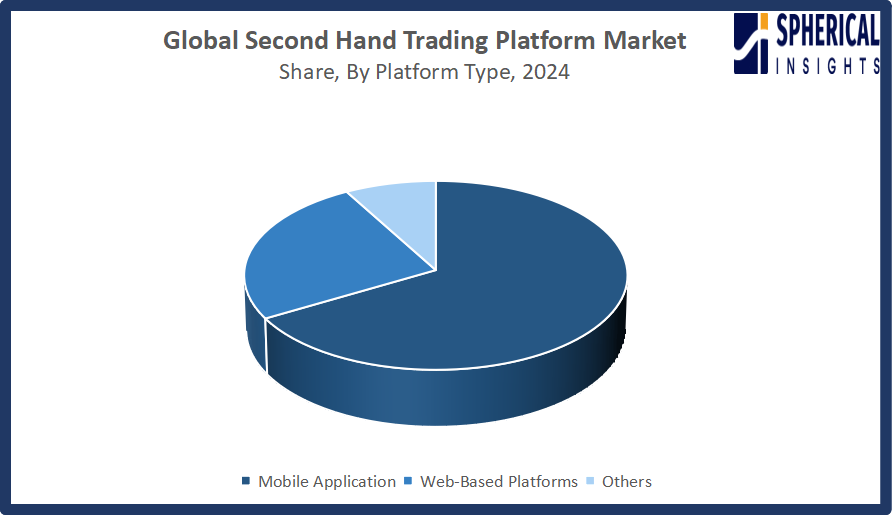
- The mobile application segment dominated the market in 2024, approximately 67% and is projected to grow at a substantial CAGR during the forecast period.
Based on the platform type, the Second Hand Trading Platform Market is divided into mobile application, web-based platforms, and others. Among these, the mobile application segment dominated the market in 2024, approximately 67% and is projected to grow at a substantial CAGR during the forecast period. The segment dominates the market due to its superior performance and user adoption. Mobile apps convert at 3.5% compared to just 2% for mobile websites, a 75% uplift, while reducing cart abandonment dramatically to 20% versus 97% on mobile web. 85% of consumers prefer apps for shopping, driven by frictionless checkout, stored user data, faster loading, and push notification capabilities that drive re-engagement. Digital wallet integration, used by 5.6 billion people globally, processing 54% of online transactions, makes one-tap purchasing seamless. The convenience of shopping anytime, anywhere has normalized resale behavior, with 77% of EU internet users making online purchases in 2024.
Get more details on this report -
- The individual consumers segment accounted for the highest market revenue in 2024, approximately 62% and is anticipated to grow at a significant CAGR during the forecast period.
Based on the end user, the Second Hand Trading Platform Market is divided into individual consumers, small businesses / SMEs, resellers & professional traders, and others. Among these, the individual consumers segment accounted for the highest market revenue in 2024, approximately 62% and is anticipated to grow at a significant CAGR during the forecast period. The segment led the market as the primary participants in the C2C e-commerce model, nearly 80% of Gen Z and Millennials actively participate in recommerce, with 35% of the UK population now buying or selling resale goods. Economic pressures drive participation, as 59% of consumers would choose secondhand if tariffs raise prices. AI-powered listing tools such as Poshmark's Smart List AI reduce friction for individual sellers, enabling higher listing volumes. In the US, 64% of secondhand clothing transactions are C2C.
Regional Segment Analysis of the Second Hand Trading Platform Market
- North America (U.S., Canada, Mexico)
- Europe (Germany, France, U.K., Italy, Spain, Rest of Europe)
- Asia-Pacific (China, Japan, India, Rest of APAC)
- South America (Brazil and the Rest of South America)
- The Middle East and Africa (UAE, South Africa, Rest of MEA)
Asia Pacific is anticipated to hold the largest share of the second hand trading platform market over the predicted timeframe.

Get more details on this report -
Asia Pacific is anticipated to hold the largest share of the second hand trading platform market over the predicted timeframe. The region is expected to hold the 38% share of the market due to rapid digital adoption, large populations, and growing price-conscious consumers. Countries such as China, India, and Japan are key contributors. In China, platforms like Alibaba Group’s resale app Xianyu reportedly exceed 500 million users. India’s expanding e-commerce ecosystem and rising smartphone penetration, with over 750 million users, support resale platforms such as OLX. Meanwhile, Japan’s strong recommerce culture and apps like Mercari drive high transaction volumes, supporting regional market leadership. In December 2025, Shanghai launched the Used Car International Trading Comprehensive Service Platform in the China (Shanghai) Pilot Free Trade Zone. Managed by Shanghai Waigaoqiao Free Trade Zone Group, it supports over 20,000 used car exports and aims to develop 3–5 leading exporters by 2027.
North America is expected to grow at a rapid CAGR in the second hand trading platform market during the forecast period. North America is expected to have a 28% share in the second-hand trading platform market due to strong e-commerce adoption, sustainability awareness, and rising demand for affordable products. The United States and Canada are key contributors, supported by established resale platforms such as eBay, Poshmark, and ThredUp. According to industry reports, over 50 million U.S. consumers purchased second-hand apparel in 2024, while the resale market is projected to grow over 15% annually. Increasing participation from Gen Z and millennials and growing environmental awareness continue to accelerate the regional market. In January 2024, HM Revenue & Customs required resale platforms like Vinted and Depop to report seller income above £1,000. The rule aligns with global transparency initiatives by the Organisation for Economic Co-operation and Development and the Internal Revenue Service in the United States.
Europe is experiencing strong growth in the second-hand trading platform market due to sustainability policies, circular economy initiatives, and high digital adoption. Countries such as Germany, France, and the United Kingdom lead the market. Platforms like Vinted and eBay are widely used. Europe’s resale fashion market is projected to exceed $30 billion by 2027, while EU circular economy policies further encourage reuse and online resale activities. In March 2025, the European Parliament flagged compliance issues in the second-hand sector after investigations across 25 EU countries found 52% of online traders breaching consumer laws. The European Commission pledged stricter enforcement and stronger tools for national regulators.
Competitive Analysis:
The report offers the appropriate analysis of the key organizations/companies involved within the Second Hand Trading Platform Market, along with a comparative evaluation primarily based on their type of offering, business overviews, geographic presence, enterprise strategies, segment market share, and SWOT analysis. The report also provides an elaborative analysis focusing on the current news and developments of the companies, which includes type development, innovations, joint ventures, partnerships, mergers & acquisitions, strategic alliances, and others. This allows for the evaluation of the overall competition within the market.
List of Key Companies
- eBay Inc.
- OLX Group
- Mercari Inc.
- Vinted UAB
- Zalando SE
- Vestiaire Collective SA
- ThredUp Inc.
- Beijing Shanyi Shanmei Technology
- Poshmark Inc.
- Alibaba Group
- Carousell Pte. Ltd.
- Shpock GmbH
- ASOS plc
- Depop Limited
- Others
Key Target Audience
- Market Players
- Investors
- End-users
- Government Authorities
- Consulting and Research Firm
- Venture capitalists
- Value-Added Resellers (VARs)
Recent Development
- In February 2026, eBay agreed to acquire second-hand fashion marketplace Depop from Etsy for $1.2 billion to strengthen its appeal among Gen Z shoppers. Depop has about 7 million active buyers, nearly 90% under 34, and over 3 million sellers, highlighting rising demand for resale fashion.
- In February 2026, Zalando expanded its second-hand platform to include children’s fashion across 14 European markets, including Germany, France, and the Netherlands. The C2B2C model allows families to sell unused clothes for store credits while boosting demand for affordable, sustainable fashion
- In November 2025, Xianyu, Alibaba Group’s secondhand goods platform, unveiled AI-powered smart search and market insights tools at the World Internet Conference. These features enhance transaction efficiency by matching buyers with suitable items and providing pricing and supply-demand trends using Alibaba’s Qwen large models.
- In October 2025, Boston Consulting Group and Vestiaire Collective reported that the global secondhand fashion and luxury market could reach $360 billion by 2030, growing three times faster than the first-hand market, with resale already comprising up to 40% of handbags in users’ wardrobes.
- In July 2025, CarTrade Tech Ltd announced that its subsidiary OLX India launched the Elite Buyer Program to enhance used-goods transactions. The AI-driven initiative offers subscribers a visible trust badge, helping over 180 million consumers connect faster with sellers and complete second-hand deals more efficiently.
- In April 2025, Vinted Group launched Vinted Ventures, an investment arm supporting startups in the re-commerce ecosystem. The initiative aims to accelerate second-hand consumption by funding innovative businesses across the resale value chain and helping founders reshape sustainable consumer behavior in global markets.
- In February 2025, Zalando expanded its resale platform by introducing second-hand kidswear across 14 European markets, including Germany, France, and Spain. The initiative strengthens Zalando’s circular fashion strategy, allowing parents to sell outgrown clothing while promoting textile reuse and sustainable consumption.
Market Segment
This study forecasts revenue at global, regional, and country levels from 2020 to 2035. Spherical Insights has segmented the Second Hand Trading Platform Market based on the below-mentioned segments:
Global Second Hand Trading Platform Market, By Type
- Consumer-to-Consumer
- Business-to-Consumer
Global Second Hand Trading Platform Market, By Product Type
- Electronics & Gadgets
- Fashion & Apparel
- Furniture & Home Appliances
- Automobiles & Automotive Parts
- Books
- Media & Entertainment
- Luxury Items
- Others
Global Second Hand Trading Platform Market, By Platform Type
- Mobile Application
- Web-Based Platforms
- Others
Global Second Hand Trading Platform Market, By End User
- Individual Consumers
- Small Businesses / SMEs
- Resellers & Professional Traders
- Others
Global Second Hand Trading Platform Market, By Regional Analysis
- North America
- US
- Canada
- Mexico
- Europe
- Germany
- UK
- France
- Italy
- Spain
- Russia
- Rest of Europe
- Asia Pacific
- China
- Japan
- India
- South Korea
- Australia
- Rest of Asia Pacific
- South America
- Brazil
- Argentina
- Rest of South America
- Middle East & Africa
- UAE
- Saudi Arabia
- Qatar
- South Africa
- Rest of the Middle East & Africa
Frequently Asked Questions (FAQ)
-
1.How is the growing adoption of second-hand trading platforms impacting global e-commerce revenues?The rising adoption of second‑hand trading platforms boosts global e‑commerce revenues by capturing resale demand. The global resale market is projected to reach $360 billion by 2030, growing 3× faster than traditional retail, expanding total online transaction volume and shopper engagement.
-
2.How are innovations in AI, mobile apps, and payment solutions transforming second-hand trading platforms?Innovations in AI, mobile apps, and payment technologies are transforming second‑hand trading with smarter search and personalized recommendations, boosting engagement. AI adoption in e‑commerce grew by 35% in 2024, increasing conversion rates and transaction efficiency on resale platforms.
-
3.What role do sustainability and circular economy initiatives play in expanding market demand?Sustainability and circular economy initiatives drive second-hand platform growth, with over 60% of consumers preferring eco-friendly purchases, increasing demand for resale items and supporting a global second-hand market projected to reach $360 billion by 2030.
-
4.How is Gen Z and millennial consumer behavior influencing platform adoption and transaction volumes?Gen Z and millennials dominate second-hand trading, with 70% of Depop users under 34 and 55% of New Yorkers holding unworn clothing, boosting platform adoption and increasing global transaction volumes significantly.
-
5.How are technological innovations, including AI-driven recommendations and secure payment systems, enhancing platform adoption?Technological innovations like AI‑driven recommendations and secure payment systems enhance platform adoption by improving user experience and trust. AI in e‑commerce boosts conversion rates by up to 30%, while secure digital payments increase online purchase likelihood by 25%, driving higher engagement and transactions.
Need help to buy this report?